—ON The Unequal Burdens of Multiculturalism.
Cultural Autopsy: The Velvet Scalpel Edition.
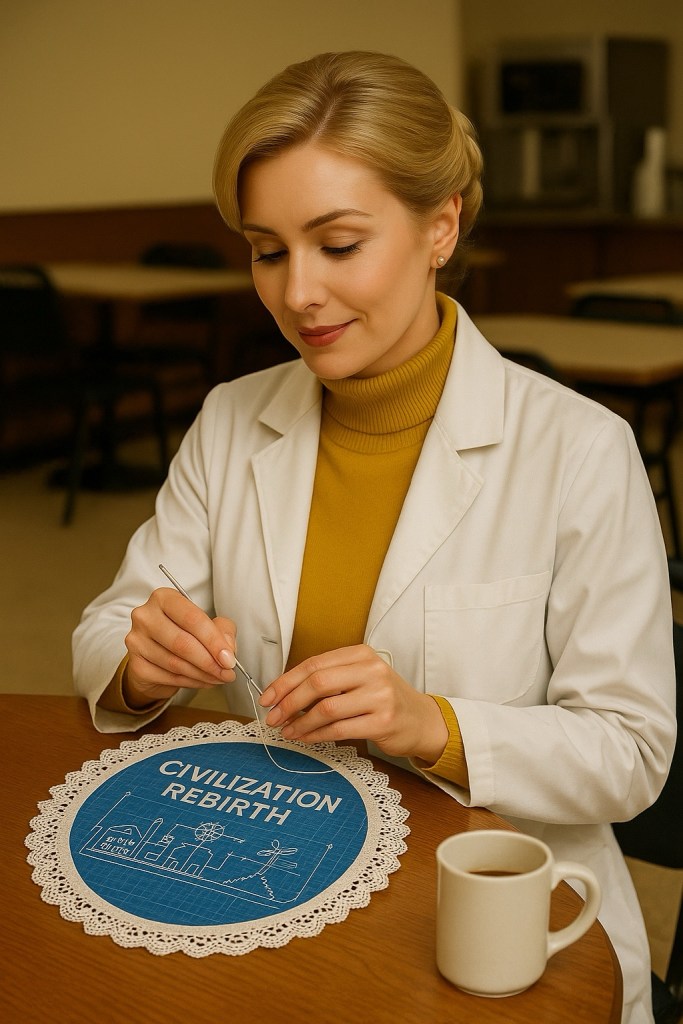
My Dear Councilors,
By Jove, John has done it again, I sighed—for nothing inspires a proper inquiry quite like one of Mr. St. Evola’s unfiltered observations.
Before anyone faints at my frankness, allow me to state the provocation:
John St. Evola, our Editor and the Council’s grease-handed Socrates, the eminence “grease” of our project, if you will—recently looked up from a condensing unit and asked—plainly, innocently—
“Why do so many scientists nowadays have names I can’t even pronounce?”
He didn’t mean it cruelly.
He meant it the way a man notices that the sky has turned a color nobody remembers consenting to.
And so, here we are.
And, to be fair to John, one need only glance at the modern laboratory directory to see why his provincial ears revolt:
Dr. Amina al-Qasrawiyyah Basheer al-Din in neurogenetics; the formidable polymer chemist Farbod Jamshid-Khonsari; cryovolcanologist Jörg-Magnus Þorláksson displaced from the antipodes; microbiome specialist Etsuko Morikami-Naitō; computational ecologist Ndhlovu Makhadzi Tshifhango; nutritional anthropologist Kwame Obeng Nyankopon; astrobiologist Vivek Subramanian Athreyan Iyer; and nanofabrication researcher Jiajun Zou Wen-Sheng—a whole cosmopolis of brilliant minds whose surnames require a passport, a map, and at least two breaths to pronounce. Their presence is not the only issue; the real concern is that so many of them are here—when their absence leaves gaping holes in the very countries that raised and educated them, often at great cost.
Everyone today—especially those carrying tote bags printed with slogans about universal harmony—insists that multiculturalism is a moral spa treatment.
A warm stone.
A restorative mist.
A virtue steamed lightly over an ethical sauna.
But the moment one inhales more deeply, one detects the scent of something far less soothing.
For beneath the slogans lies an uncomfortable truth:
Open borders and multicultural idealism create uneven winners and unacknowledged losers.
Talent drains from its homelands; cohesion drains from the hosts.
Everyone, in some sense, is being thinned out.
Yet John’s question points to an even deeper puzzle:
Why does the modern West now require this global infusion of intellect at all?
Consider:
The truly epoch-shaping innovations—the ones that bent history—were conceived when Frenchmen were unmistakably French, when Englishmen were assuredly English, and when Americans were a quarrelsome cocktail of Europeans who still knew their origins.
Steam power, calculus, the airplane, antibiotics, the microchip—none of these demanded a global manhunt through every passport office on the planet.

What changed?
We did.
Or rather, the work itself did.
There was once a time when solitary minds could sketch universes on the backs of envelopes.

Now, scientific “breakthrough” means assembling a battalion of specialists to negotiate grant terms, calibrate equipment, and debate three decimal points in a footnote.
The age of bold conception has withered into an age of microscopic refinement.
And because the machine we’ve built is vast and voracious, requiring endless hands to service its labyrinth of details, we cast our net across the globe—not from generosity, but necessity.
A civilization that once invented telescopes now struggles to manage its email.
Thus the West imports minds from every corner of the Earth.
The sending nations lose brilliance; the receiving nations lose identity; and the managerial class loses nothing—except, perhaps, the last vestiges of honesty.
What is marketed as cosmopolitan virtue often functions as a cognitive extractive industry:
a polite form of intellectual strip-mining wrapped in the rhetoric of inclusion.
And yes, the outcomes are uneven:
hosts lose coherence, homelands lose their gifted, individuals lose rootedness, elites gain moral prestige
This is what polite society won’t say.

But the Council has never specialized in politeness.
John’s unvarnished observation—uttered with the innocence of a man untrained in euphemism—lands squarely on the truth:
Multiculturalism, as practiced, carries serious negatives for many and benefits for very few.
It is not fair to the host,
not fair to the guest,
and not fair to the worlds from which these minds are uprooted.
But fairness was never the point.
Only functionality.
Now, if you’ll excuse me, my embroidery calls.
One cannot mend a civilization with stitches, but one can at least maintain one’s posture while the larger tapestry unravels.
***
Un moment, s’il vous plaît.
Permit me, then, a parting thought to put the apparent disjointedness of this screed in context—one worthy of both my ancestors and our resident provocateur:
One is young but once, my dears—but a certain cultivated immaturity can last a lifetime, as anyone familiar with Mr. St. Evola’s ‘anonymous’ contributions to this very essay can attest.
***

 COUNCIL-OF CONCERNED-CONSERVATIONISTS…..Between Jest And Earnest…..
Leave a comment