—An Admonishment from Mrs. Begonia Contretemp

To My Gathered Luminous Ones of the Council-of-Concerned-Conservationists,
My most cherished Council belles and beaux—
A peculiar ache has settled in my clavicles these last months, as if the collective imagination of our civilization were pulling the hem of my evening gown toward the gutter. Everywhere I look—cinema, literature, the endlessly self-regarding rectangle we call television—I see our most imaginative minds circling the drain of decline like doomed swans in a particularly melodramatic ballet.
What, pray tell, has possessed us?
The evidence is abundant and depressingly stylish.
Idiocracy, that curious 2006 fable, has become a documentary with better lighting.
The zombie genre—The Walking Dead, 28 Days Later, and their innumerable shambling cousins—remains as tireless as its diseased protagonists.
And now, the newest Netflix sensation Pluribus (you sweet darlings keep asking me about it as if it were a luncheon guest) gives us yet another panorama of fractured futures, divided polities, and social entropy served sous-vide.
I have also been assaulted by novels whose pages drip with apocalypse: The Road, Station Eleven, Oryx and Crake, and that recent publishing darling whose entire plot, I assure you, could be summarized as: “One must never hope; one must only run.”
Hope, my dears, has become déclassé.
And I simply will not have it!
The creative class—our poets, screenwriters, and impeccably shod auteurs—has wandered into an aesthetic cul-de-sac lined entirely with despair. They are, to borrow a phrase from my long-deceased Aunt Hortense, “romancing the rot.” It becomes quite tedious. Even worse: it is metaphysically reckless.

You see, my sugar plums, humans have always possessed a dreadful habit of becoming the very thing they mythologize. We dream our futures into being, even the unpleasant ones. This is why ancient peoples feared speaking certain names aloud and why modern peoples, who fancy themselves smarter, simply broadcast their nightmares on prestige cable.
Are our creatives predicting the future?
Or are they manufacturing it by force of collective imagination?
The Council has fretted over this for years, and quietly so—like good Europeans, anxious about making a scene in public.
But the hour is late, and I can no longer remain genteel on this.
The constant manufacture of dystopia is not merely bad taste.
It is spell-casting.
And the spell is working.
Which brings me to the second purpose of this talk: the turning.
My honeysuckle scholars, my beloved catastrophists, my dauntless scribes—it is time we do what the Council-of-Concerned-Conservationists always does when the culture has lost its bearings. We intervene with style.
Here is my modest proposal, scented faintly with bergamot and the faintest hint of defiance:
Let us begin imagining—and therefore creating—futures we actually intend to inhabit.
Not saccharine utopias (that is for Californians), but futures marked by coherence, continuity, dignity, and depth. A future in which the cultural inheritance of past centuries is not mocked but magnified. A future in which the creative mind’s default setting is not doomscrolling but cultural conservation.
To reclaim the imagination, we must perform three acts:
Charm the mind away from catastrophe. Lure it, as one lures a skittish cat, toward beauty and order.
Rehabilitate futurity. Give the imagination something finer to build than rubble.
Compose narratives that conserve rather than corrode. Even tragedy benefits from a backbone; it need not dissolve into mush.

In other words, my poppets, we must out-imagine the imaginations currently poisoning the well.
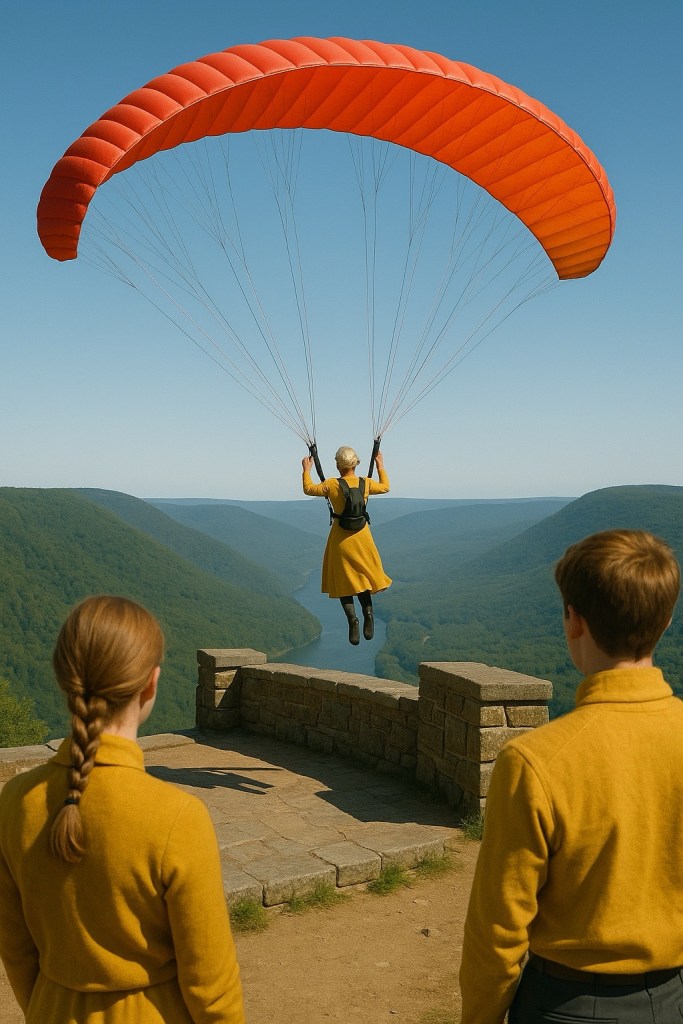
This is the Council way: not denial, but deflection—with hauteur and horticulture; not propaganda, but persuasion—with wit, with memory, with yellow neck gaiters that remind all sensible people that sunlight still condenses into cloth if only they lift their eyes.
The dystopians have had their little time.
Let them rest.
We have circuits to solder, gardens to plant and futures to cultivate.
I trust, my luminous ones, that you will not leave me to wage this imaginative reclamation alone. I await your proposals—practical, poetic, or delightfully unorthodox—on how we might turn the cultural gaze away from manufactured ruin and toward futures worthy of our inheritance. Do not dawdle; the imagination, like a garden, wilts when unattended.
I now bid you adieu—and always, refinement, resistance, and relentless optimism. My thanks also to the Council for sponsoring dear cousin Celestia’s visit to council headquarters; her spirits have risen at least an inch, which, for a Contretemp, is practically a renaissance.
European Correspondent of the Council-of-Concerned-Conservationists
[APPLAUSE]

Celestia Contretemp, Mrs. Begonia’s beautifully dour cousin, is standing beside me—honestly trying to lighten the temperament she arrived with, and doing better at it than she thinks.”
— The Accidental Initiate
***

 COUNCIL-OF CONCERNED-CONSERVATIONISTS…..Between Jest And Earnest…..
Leave a comment