The Commonwealth’s Accidental Revival of the Musical Hair.
—Filed by The Accidental Initiate, who fell into a daydream after a hairstyle-policy hearing and woke up in a Broadway overture he did not audition for.
The Accidental Initiate [AI]:
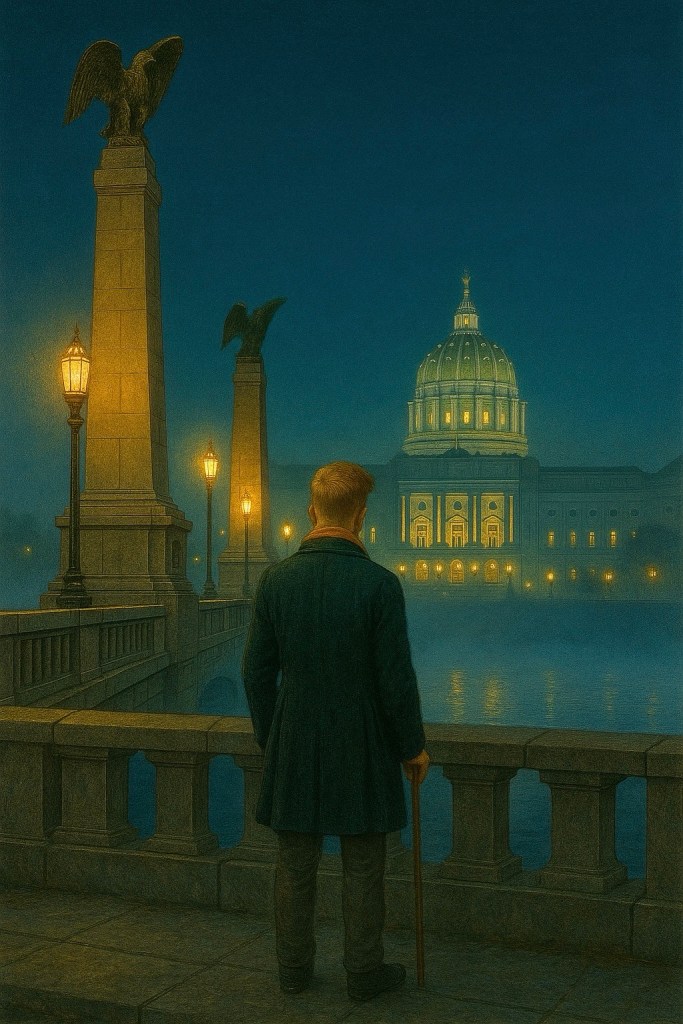
I stood on the Soldiers & Sailors Bridge as the Susquehanna breathed its evening fog upward, wrapping the Art Deco eagles in a pale, trembling veil. My yellow gaiter crept toward my cheek like a shy understudy waiting for its cue, and the whole bridge seemed to hum with the slow, tidal memory of epochs. In that hush, Harrisburg’s new decree about hair floated through my mind—strange, solemn, oddly theatrical—and the next thing I knew, the mist was turning into footlights, and I was drifting gently into a daydream the Commonwealth itself seemed to be composing.
The Pennsylvania legislature was still murmuring its talk of “protected hairstyles” glowing faintly in the mist. Standing on the Soldiers & Sailors Bridge, I let the words hover in the fog like distant traffic. Somewhere between “Section 3, Paragraph B” and that solemn phrase “undue burden,” the night loosened its seams—Harrisburg blurred, the eagles dimmed—and the whole world quietly rearranged itself into a musical.
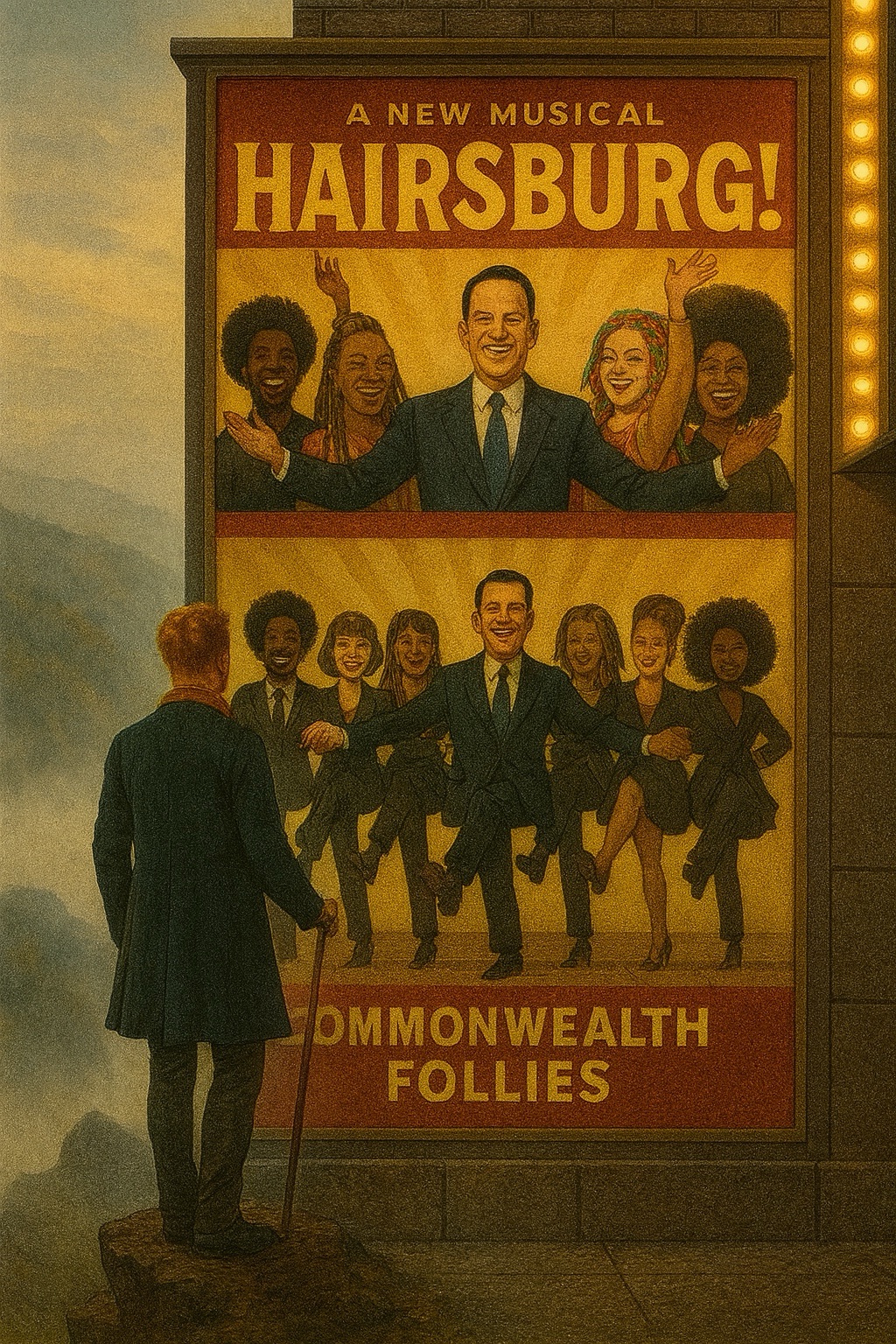
Suddenly I was in a gilt-lined theatre that looked like the State Capitol rotunda rented out for a touring revival.
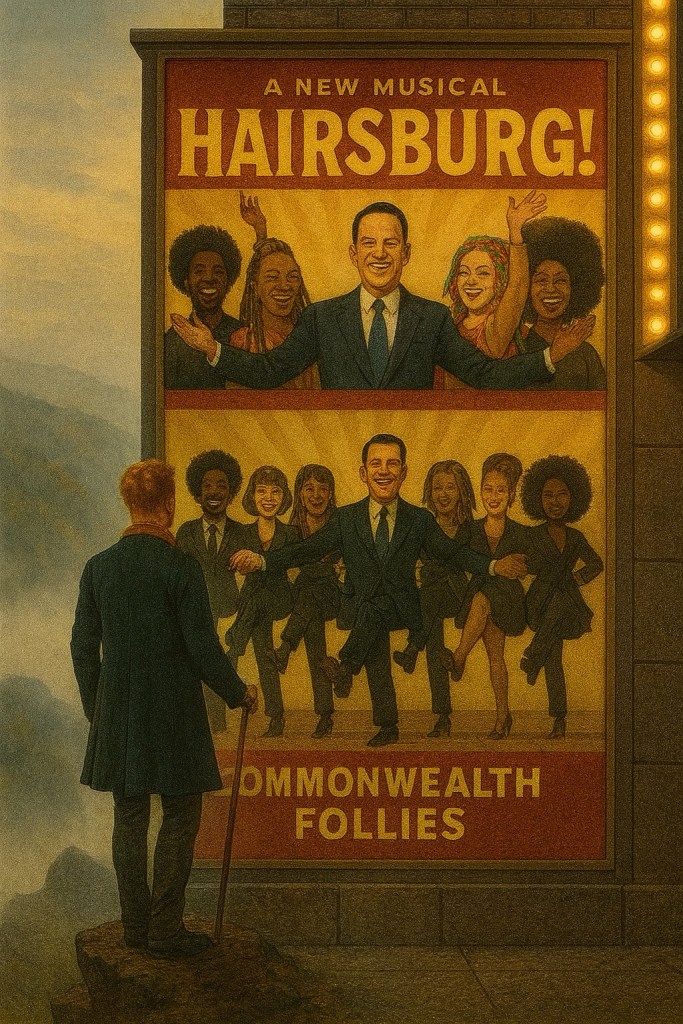
frizzy, fuzzy, puffed-up, poofy 🎶
—all the hair Harrisburg could conjure,
and one poor soul completely spaghettied!
Now playing: HAIRSBURG! The Musical Nobody Asked For.
Spotlights flared.
A pit orchestra tuned.
A gavel struck a perfect downbeat.
Then the entire General Assembly burst into a brassy rewrite of the 1967 classic:
“HAIR — Flow it, Show it,
Or Shave It, Fade It, Low-Crop Grow It!”
That last line felt like a benediction aimed squarely at me.
Because I’ve always favored the 1930s–40s close-cropped sides with a sensible crown on top — the kind of haircut that dries fast, needs no explanation, and never requires you to buy forty dollars’ worth of product that smells like citrus having a nervous breakdown. It’s also the look of a man who once lost an argument with a philosophy textbook and chose, quite wisely, to simplify his head rather than his worldview.
It’s a “life is short, let’s not spend it detangling things” sort of cut.
A style whose highest ambition is being clean.
The dancers swirled.
Gavels twirled in the air like righteous batons.
A Judiciary Committee soprano hit a note that rattled the frescoes.
And then the lights dimmed. A narrator stepped forward—looking suspiciously like me—and declared:
“What if hair is not just adornment—but a script the body writes about who we are?”
Cue the montage.
Across the stage burst an entire geological cross-section of hairstyles:
— braids
— coils
— neon streaks
— towering Afros
— locked spirals
— curls in every direction a curl can go
— styles requiring more scaffolding than the Hoover Dam.
It was impressive in a circus sort of way.
And right in the middle of this explosion, the dream allowed me one quiet aside—the kind of internal monologue you’re not supposed to have out loud anymore.
I thought about my own haircut.
That tidy, barbershop-classic 1930s style:
close-cropped sides that stay cool in summer, clean in winter, unbothered by rain, and dry within minutes—the hair equivalent of a reliable pocketknife.
Civilization in keratin form.
Meanwhile, the dream ensemble leapt into an interpretive celebration of every hairstyle the new legislation protects—and I leaned back in my imaginary mezzanine seat and murmured, just for myself:
“How long does all this take?”
Some styles looked like they required three hours, two assistants, ceremonial oils, and the patience of Job.
Some looked like they needed weekly maintenance, nightly rituals, or small annual grants from the National Endowment for the Arts.
Some looked like a full-time job that paid in compliments instead of currency.
And there I was, thinking of my own haircut—quick wash, quick dry, done.
A style that lets you leave the house in under five minutes and still look like you have some grip on the century.
I respected effort.
I respected creativity.
But inwardly I couldn’t help noting that much of what passed before me was not so much “hair” as “projects.”
Hair with ambition.
Hair that had a subversive agenda.
Hair that demanded a relationship.
Mine just sat there and cooperated.
Yet the dream seemed content to let me have my opinion—even the mildly curmudgeonly parts.
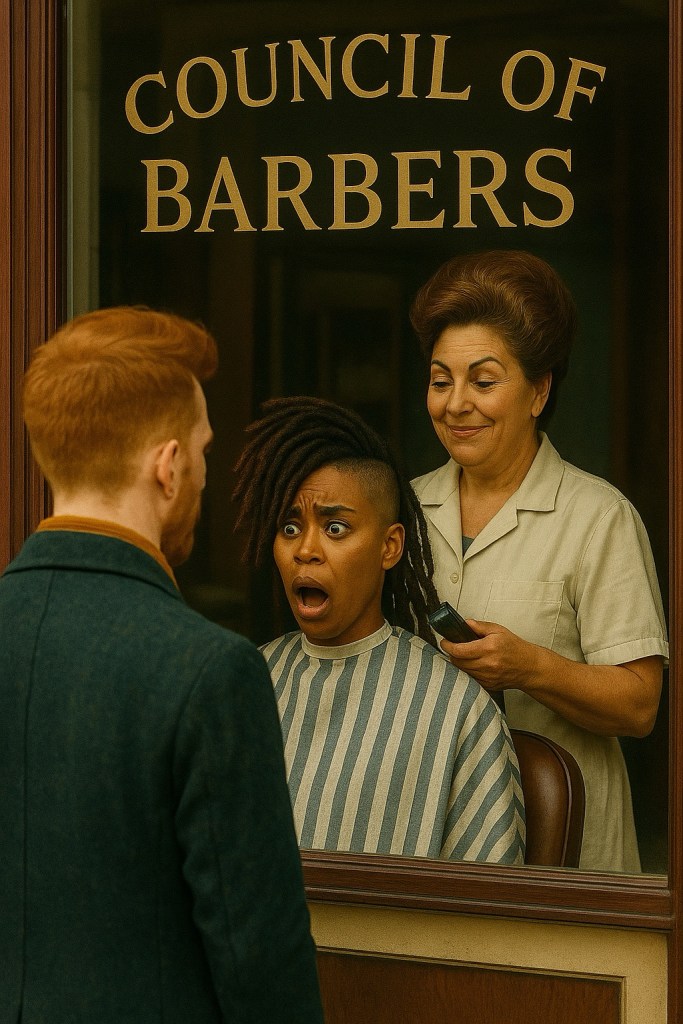
After all, I wasn’t writing statutes.
I wasn’t rewriting culture.
I was just a man in a dream-theatre quietly defending the practicality of a haircut that had served generations.
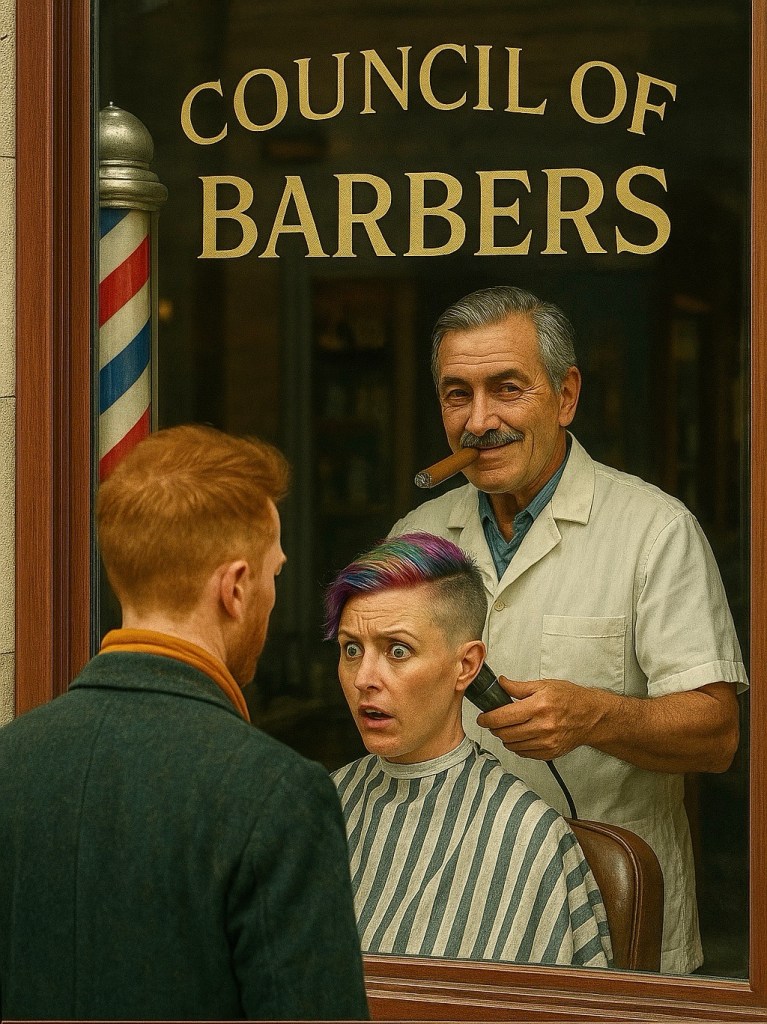
— Traditional Barbery for a World Gone Unruly.”
Where Every Fade Is a Cultural Intervention.
—Under the steady hand of Sal “Cigar Sal” Ventresca, Senior Fade Technician to the Council.
And then the finale swelled.
The whole cast joined together in a shimmering reprise:
“Give me a head with hair — long, short, or spare —
Though some of us like grooming done in minutes, not an hour!”
Confetti shaped like tiny combs fell from the rafters.
A baritone from Labor & Industry sang a heartfelt tribute to “follicular autonomy.”
The Speaker of the House launched into a tap-dance that suggested either grace or a pulled hamstring.
And then I woke up on the bridge —gaiter crooked, ears frozen mid-testimony, heart still faintly humming the overture.
Realizing once again that civilization is always one vote away from becoming a musical—and that some of us will keep the haircut that doesn’t require a pit crew.
—Who believes grooming shouldn’t take longer than making a sandwich.
 COUNCIL-OF CONCERNED-CONSERVATIONISTS…..Between Jest And Earnest…..
Leave a comment