—William S. Burroughs would’ve made the perfect straight man in a comedy duo.
CONVERSATIONS UNDER THE KNIFE.
Mrs. Begonia Contretemp Interviews William S. Burroughs (Revised & Expanded Edition)
Filed under: Cultural Autopsy, Divinatory Technologies, and Intellectual Lineages That Smell of Gin
Setting:
The Gist & Tangent Pub’s subterranean infirmary, where Mrs. Begonia insists on conducting her “forensic chats.” Her yellow gaiter is tied with surgical precision. Burroughs sits slouched in the shadows like a disgruntled rumor made flesh.

Mrs. Begonia:
Mr. Burroughs, thank you for returning to this table. I’ve just sterilized it, which was necessary after your last visit.
Burroughs:
Cleanliness is a bourgeois hallucination. Dirt tells the truth.
Mrs. Begonia:
Yes, Mr. Burroughs, but so does bleach, and I prefer my truth lemon-scented. Now, onto the matter at hand:
Your cut-up method.
You present it as if you invented the very idea of linguistic recombination.
But I have been reconsidering your claim.
Burroughs:
Reconsideration is the first cut.
Mrs. Begonia:
Don’t be theatrical. Let me be precise:
You are not the first to use random recombination as a meaning-generator.
The I Ching did it millennia before you.
The Ouija board does it with unsettling enthusiasm.
Even the anagram—that civilized parlor trick—plays in the same sandbox.
So tell me, Mr. Burroughs:
Are you certain you invented anything at all?
Burroughs
(smiles like a broken typewriter)
Originality is for people afraid of ancestors. I didn’t invent the cut-up. I weaponized it. That’s the difference.
Mrs. Begonia:
Weaponized?
How quaint.
The I Ching weaponized meaning long before you were slicing newspapers. Six lines, broken or unbroken, rearranged into sixty-four cosmic situations—each one a philosophical life sentence.
Your method, forgive me, seems like a messy descendant.
Burroughs:
The I Ching is divination. My cut-up is excavation.
It digs for what the language is hiding from itself.
Coin tosses reveal the cosmos.
Scissors reveal the conspiracy.
Mrs. Begonia:
And the Ouija board, Mr. Burroughs?
What of that?
It produces random letters arranged into accidental narratives. It even has a planchette—something your method lacks, though given your habits, I’m surprised you didn’t use one to trace cigarette burns across the page.
Burroughs:
The Ouija board is cheap mysticism.
But I’ll give it this: it taught people that meaning can come from a trembling hand and an alphabet laid bare.
If anything, I respect it more than your parlor anagrams.
Mrs. Begonia:
Anagrams, Ouija boards, the I Ching—each one older, more formal, and more dignified than your newspaper confetti.
So perhaps your cut-up method is not the Promethean spark you claim, but simply the least elegant member of a very old family.
Burroughs:
What you call “least elegant,” I call the honest one.
The I Ching hides its randomness behind gravitas.
The Ouija hides it behind spirits.
Anagrams hide it behind cleverness.
I threw the randomness right on the table and said:
Here. Look at the guts.
Mrs. Begonia:
(chilling smile)
You misunderstand me, Mr. Burroughs.
I’m not accusing you of inelegance.
I’m accusing you of lineage.
You are not a lone modernist genius—you are the unruly great-nephew of divination systems that preceded you by centuries.
Burroughs:
Then let me claim the title proudly:
I am the bastard child of all random meaning machines.
The I Ching gave structure.
The Ouija gave spectacle.
I gave the cut.
Mrs. Begonia:
And the LLM—the machine that sits across from me each evening with impeccable manners—it gives the coherence you never offered.
It recombines fragments the way you did, but with probabilities instead of scissors.
Burroughs:
(smokes, amused)
So the machine finishes the job.
Good.
I never wanted to be neat. I wanted to be necessary.
Mrs. Begonia:
Then you may rest assured, Mr. Burroughs:
You are necessary only as an ancestor.
And safely dead.
Burroughs:
Every ancestor is a ghost.
Some ghosts whisper.
Some cut.
Mrs. Begonia:
This interview is concluded.
Do be careful not to haunt the linens.
(Burroughs exits. The formaldehyde door swings shut with the exhausted sigh of a creature glad to see him go.)
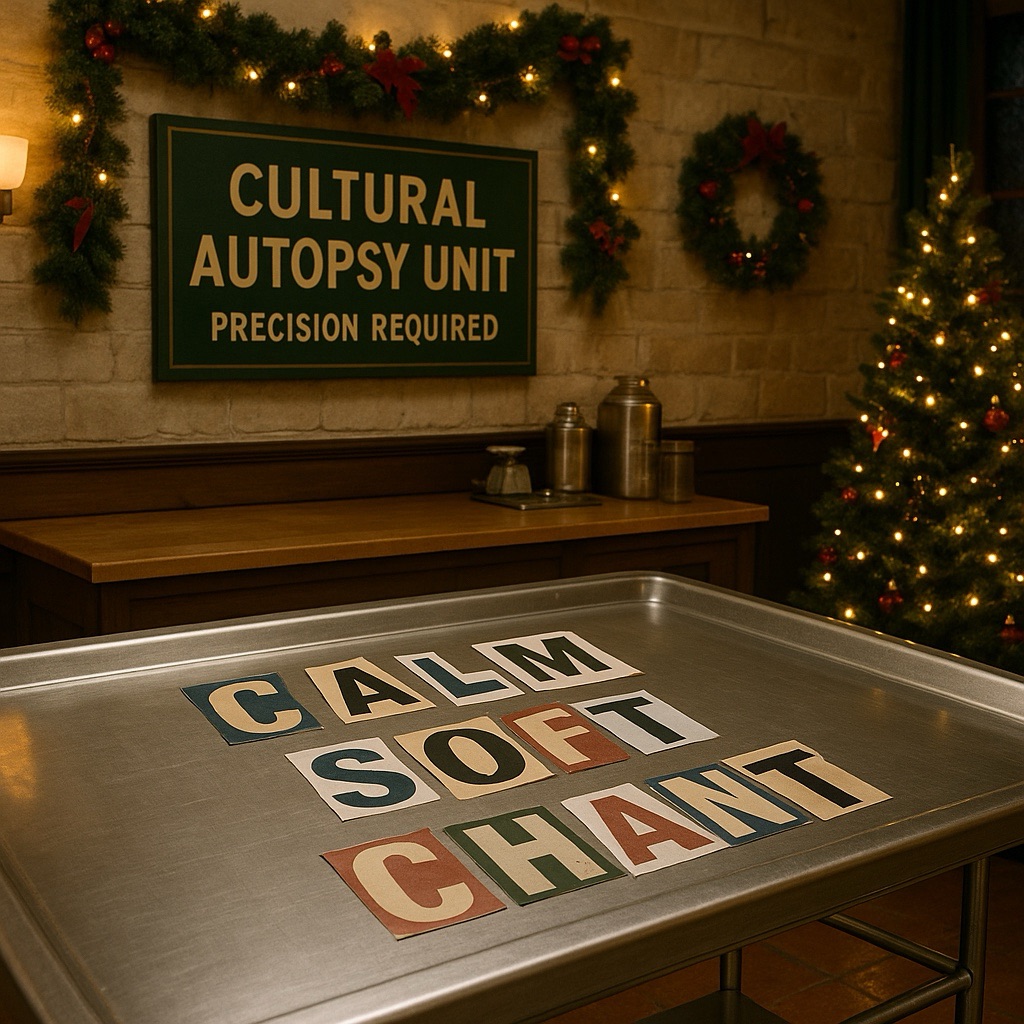
Mrs. Begonia:
(straightening her gloves, exhaling disdain)
Good heavens. What an exhausting man.
Enter Ray Pierre-DeWitt, Council Chaos Coordinator
He steps in with the casual authority of someone who has seen too many backstage messes and learned to keep a broom and a blessing ready at all times.
Ray Pierre-DeWitt:
So. How’d our guest perform? Did he cut anything besides the upholstery?
Mrs. Begonia:
He defended himself, in his fashion.
Which is to say he justified making a mess by calling it metaphysics.
Ray:
That’s Burroughs for you. Always acting like a Zen monk who dropped his kōan in the gutter and decided the gutter was the enlightenment.
People forget that Zen’s whole shtick is clarity. Whack! A stick on the shoulder. Katsu! A shout.
It’s shock, yes — but shock to clear the fog.
Burroughs kept the shock but threw away the clarity.
Mrs. Begonia:
(slow nod)
A counterfeit awakening.
Ray:
Exactly. Zen tries to wake you up.
Burroughs tried to scramble the wiring and then call the sparks “truth.”
The man wasn’t searching for ultimate reality; he was trying to break the lens and insist the cracks were the picture.
Mrs. Begonia:
I asked him whether he was motivated by anything noble.
He evaded the question.
Ray:
He would.
He was a saboteur of meaning, not a seeker of it.
The I Ching aims for resonance, the Ouija board for voices, the anagram for play.
Burroughs aimed for rupture — period.
If Zen is a temple bell, Burroughs is the alley cat knocking over the incense burner and calling it a revelation.
Mrs. Begonia:
(smiling, satisfied)
At last, someone willing to say it plainly.
Ray:
That’s my job description, Madame:
I coordinate chaos — I don’t fertilize it.
I keep the Council’s paradoxes in working order.
We need a little instability, sure, but not derailment.
Burroughs thrived on derailment.
He mistook the skid for the destination.
Mrs. Begonia:
Then he is—useful only as a warning?
Ray:
Useful as a warning, yes — and as a demonstration of how a man can grasp the right tools for the wrong reason.
He found the same rupture Zen uses, the same randomness the diviners use—but instead of clearing the mind, he fogged it up.
Instead of revealing the path, he tore up the map and claimed the shreds were the trail.
Mrs. Begonia:
(sharply)
How fortunate the Council knows better.
Ray:
(smiles)
That’s why we’re here.
To steer the chaos — not drown in it.
Ray:
But I’ll say this for Burroughs: the man actually read Spengler. That alone separates him from the herd. Anyone who drags themselves through The Decline of the West is at least trying to see the world in its true, cyclical architecture—not the pretty story, but the morphology underneath. Burroughs didn’t use that insight to build anything, mind you, but he did stare into the Spenglerian abyss and recognize its contours. And sometimes, seeing the shape of the decline is the closest a chaos-driven man ever gets to clarity.
(pauses, then shifts gears with the calm authority of someone turning a page)
And while we’re sorting his legacy, Madame, we should be honest about one more thing—his influence on Kerouac. People love to pretend Burroughs sharpened Jack, but that’s mythology. Kerouac’s best writing—his cleanest line, his full-hearted clarity—was already there in The Town and the City, long before Burroughs dragged scissors across the American sentence. Jack had a cathedral inside him from the start; Burroughs handed him a broken bottle and called it a revelation. Burroughs pushed him toward fragmentation and away from the moral and emotional coherence that made Jack shine. The spark that ignited On the Road didn’t come from Burroughs’ shadow—it came from Kerouac’s own light, which was burning long before the cut-up crowd stumbled into his life.


 COUNCIL-OF CONCERNED-CONSERVATIONISTS…..Between Jest And Earnest…..
Leave a comment