Thinking Outside The Box
— by Justin Aldmann,
C-of-C-C correspondent writing on Retirement, Senescence, Infinity, and Beyond.
When Gavin Newsom posted those three gilt-framed pictures of Trump nodding off, it didn’t make me think of politics at first. It made me think of my grandparents’ basement kitchen in Brooklyn.

The room was half above ground, half below—like it couldn’t make up its mind whether it lived in daylight or on a stage set. The TV sat right beneath those little ground-level windows, and above the tv sat that California bronze clock of a cowboy on a rearing horse, frozen in permanent triumph.
Off to the right, behind a cloth curtain, the steam boiler hissed and muttered like the creature was stirring in Frankenstein’s laboratory.
In winter the massive boiler warmed the room; in summer the whole basement stayed cool as the stone recesses in the Odenwald above Darmstadt—territory whispered about since the days of a certain doctor of reanimation—and I later felt that same cool breath in the brownstones of Würzburg when I walked among them. The floors were always spotless. Everything was spotless. And in the center stood that big Formica table with the chrome edging—expandable, indestructible, the command center of the family universe, looking for all the world like one of those heavy tables favored by a certain fictional experimenter—though ours brought meals to life, not monsters.
[And I admit my bias: Frankenstein imprinted on me at four, which is why I see laboratories everywhere. Romans assume nothing stays dead for long; AI merely confirms the old instinct.]
That’s the education lab where my Pugliese grandparents sat me at four years old to watch the Capitol Arena exhibition wrestling that came up from Washington, D.C. They didn’t believe a second of it, which was precisely why they enjoyed it.
“Giustì,” my grandfather would say, “they make themselves big so the truth gets simple.”

And as it turns out, those old wrestlers mapped perfectly onto the politicians of today.
Gavin Newsom is a straight descendant of Gorgeous George—the immaculate hair, the studied poise, the man who knows he’s playing a handsome villain or heroic beauty depending on which seat you’re in.
James Carville is The Professor, the rubber-faced ringside tactician who looks like he hatched in a library vent and yells instructions through the ropes while swearing he’s not part of the chaos.

J.B. Pritzker could walk into any arena as Haystacks Calhoun—big, buoyant, crowd-pleasing by sheer gravitational presence.
Nancy Pelosi carries the unmistakable aura of The Fabulous Moolah—the seasoned veteran who outlasts generations of challengers simply by knowing where every lever of the business is hidden.
And on the Republican side:
Ted Cruz is the classic heel with the monologue, the guy who talks longer than he fights, convinced the crowd wants a lecture between holds.
Matt Gaetz is the smirking young instigator, the troublemaker who draws boos and cheers with equal delight.
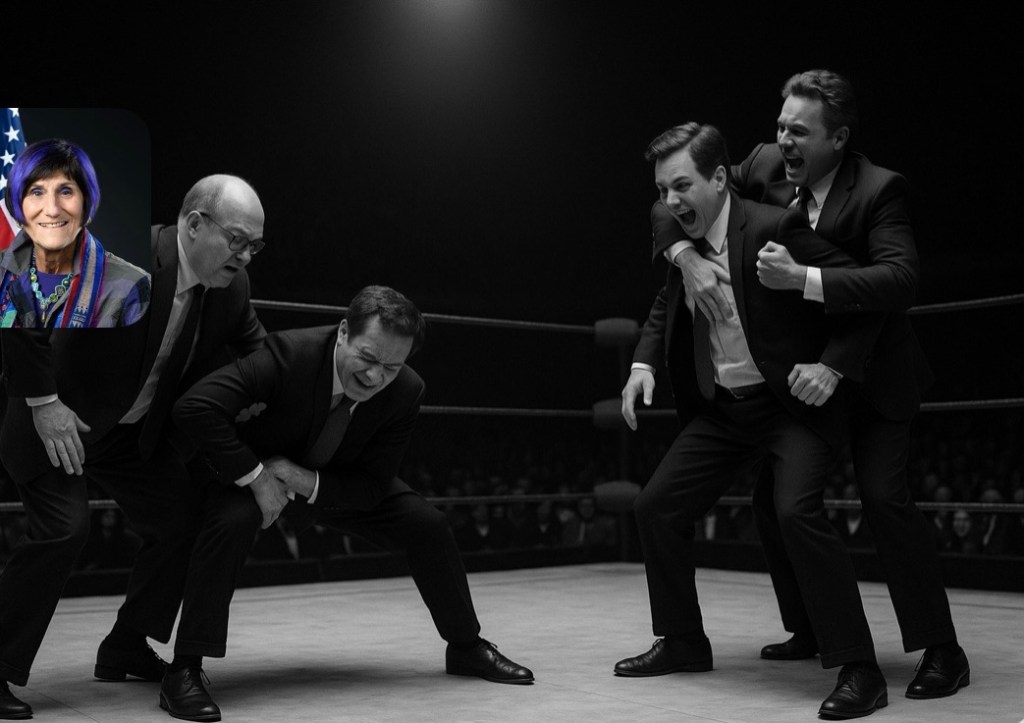
But here’s the part my grandparents understood long before cable news caught on:
Trump didn’t turn politics into wrestling—he just stopped pretending it wasn’t.
He walked into the arena like a man who had literally been in one. The kayfabe—the polite fiction—evaporated. Everyone’s “character” clicked into place. The spectacle announced itself honestly for the first time.
My grandparents didn’t just understand bread and circuses—they remembered it, in the way people sometimes carry an old empire in their bones. Southern Italians were claimed by Rome long ago—subdued, absorbed, folded into the empire—so the Roman formula endures in them like a soft ancestral resonance. They had seen this play before, even if only through the long fog of ancestry. Spectacle to distract, bread to pacify. The forms change; the instinct doesn’t.
And maybe that’s why they would’ve seen, long before we did, the direction the country was destined to go. Down in that Brooklyn basement—half cave, half workshop—we had that Formica table built sturdy enough for a certain type of fictional experimenter, and a steam boiler that hissed like something stirring behind a curtain. It was a room made for assembling things that nourished us, for bringing life to whatever good parts my grandparents gathered on that table. And somewhere along the line, America tried its own kind of assembly—only what it stitched together in politics didn’t rise as gracefully as our meals did. It stitched together its loudest characters, its theatrical combatants, its exhibition-wrestler lookalikes—piecemeal, headline by headline—and then acted surprised when the creations lurched upright and marched into public office. We didn’t just elect these figures. We assembled them.
Which brings us to the modern version:
Rome had panem et circenses to keep the people manageable.
We’ve updated the recipe.
The circuses are televised nationally.
The bread is loaded monthly onto an EBT card.
And the audience pretends this arrangement is normal.
My grandparents never mistook the show for the world.
I’m starting to think they were the last ones who didn’t.

 COUNCIL-OF CONCERNED-CONSERVATIONISTS…..Between Jest And Earnest…..
Leave a comment