Conversations Under the Knife
The Movie Review Team Speaks (Mostly)
Editor’s Note:
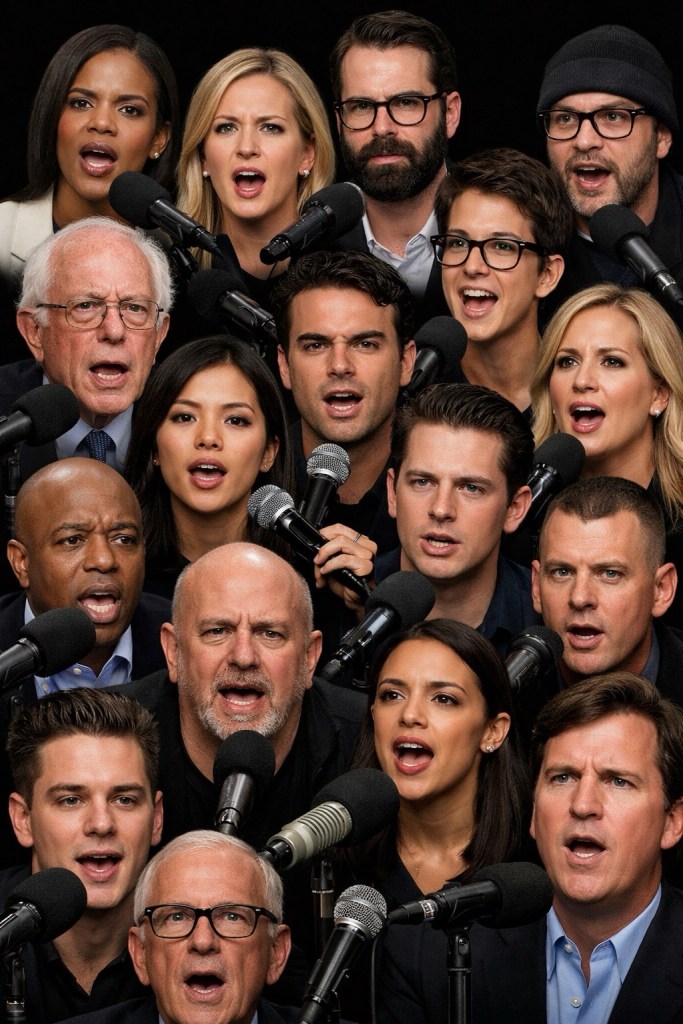
It has been some time since the Council-of-Concerned-Conservationists’ movie review team has appeared together in print. This is not due to disagreement, fatigue, or litigation, but rather to a collective sense that the culture itself has recently begun reviewing us—loudly, continuously, and without having watched the film.
Complicating matters further, neither Cliff Langour nor Arturo Haus has managed to get through the first ten minutes of any of the films they have selected lately, a failure they attribute not to declining attention spans but to an excess of commentary arriving before the opening credits have finished establishing a mood. It is possible, of course, that the films themselves are simply too slow, too ponderous, and populated by characters who seem determined to repel sympathy. It is equally possible that this is precisely the aesthetic their makers are aiming for, a style encouraged by an era in which attendance at film school has come to be mistaken for evidence of vision.
Cliff Langour remains our most verbally active critic, capable of delivering a complete aesthetic judgment between previews. Arturo Haus, by contrast, continues his long-standing practice of saying almost nothing at all. His silence has aged well.

In light of the present surplus of opinion and the simultaneous shortage of earned weight, Mrs. Begonia Contretemp convened a Conversation Under the Knife to address a simpler, more pressing question: who, exactly, selected all of these commentators—these talking heads—and on what grounds? The modern media landscape appears crowded with authoritative voices whose principal qualifications seem to be confidence, clarity of delivery, and a pleasing awareness of their own camera angles.
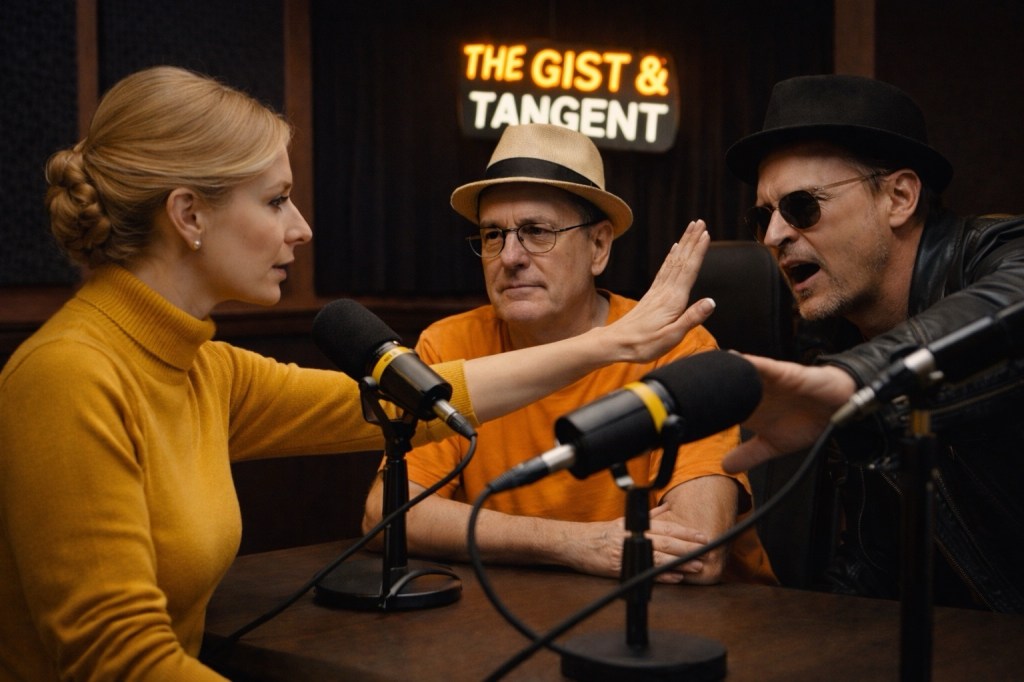
To examine this phenomenon, Mrs. Begonia selected Arturo Haus as her primary interlocutor, citing his rare and increasingly suspect credential: a sustained refusal to add yet another opinion to an already crowded room. It should be noted that Arturo has never been heard to speak at all, a silence some have interpreted as principled restraint and others as an unusually committed Harpo Marx cosplay.
What follows is a transcript.
Mrs. Begonia:
Arturo, welcome. It’s been too long since we’ve heard from you.
(Arturo inclines his head, neither agreeing nor apologizing.)
Mrs. Begonia:
Naturally. I invited you here to discuss the current explosion of experts, commentators, thought-leaders, explainers, decoders, truth-tellers, counter-truth-tellers, and people who have decided—often before breakfast—that their opinion deserves national circulation.
(Arturo does nothing.)
Mrs. Begonia:
Yes. Precisely.
Let’s begin simply. Do you believe everyone has the right to an opinion?
(Arturo nods. It takes a moment— or was it a facial tick?)
Mrs. Begonia:
Of course they do. A right is automatic. Like breathing. Or misunderstanding a headline.
But a rite—that’s another matter. A rite involves passage. Friction. Time. The occasional humiliation. Ideally, years spent being wrong where no one can monetize it.
(Arturo’s gaze drifts slightly to the side.)
Mrs. Begonia:
Quite. Privacy used to be where bad ideas went to mature or die. Now they’re livestreamed in infancy and sponsored by supplements.
Cliff, don’t interrupt.
(Cliff Langour opens his mouth, closes it, sighs.)
Mrs. Begonia:
Arturo, when did opinion replace experience?
(Arturo remains still.)
Mrs. Begonia:
Yes—when hesitation became a liability. When certainty, even false certainty, began to read as courage. The modern credential is not what you’ve done, but how confidently you repeat yourself.
One used to smell the sea on a sailor. Now one smells the studio.
(Arturo nods once, barely.)
Mrs. Begonia:
Thank you. That nod alone carries more weight than most podcasts.
Another question: what gives an opinion authority?
(Arturo blinks.)
Mrs. Begonia:
Exactly. Consequences. Being answerable to reality instead of an audience. Having something break when you’re wrong—preferably not other people.
Mrs. Begonia:
Consequences—something that used to precede the microphone, but now tends to arrive afterward, once the audience is secured and the neck is finally asked to make an appearance.
The tragedy, you see, is not that everyone speaks. It’s that no one is required to have passed through anything before doing so.
(Arturo folds his hands.)
Mrs. Begonia:
You’ve noticed it too. The rise of the professional declarer: men and women whose sole qualification is the ability to talk without interruption. Left, right, center—it’s the same outfit in different tailoring.
(Cliff attempts to interject.)
Cliff, I swear to God!
(Cliff makes a small, helpless gesture.)
Mrs. Begonia:
Arturo, final question. Why have you never corrected anyone? Never clarified your position? Never issued a definitive take?
(A long pause. Arturo gives the faintest shake of the head.)
Mrs. Begonia:
Yes. Because silence still remembers what speech has forgotten—that words should cost something.
In the old days, one was required to be wrong in private for twenty years before being wrong in public. Now we skip the apprenticeship and go straight to the sermon.
(Arturo nods once. Final.)
Mrs. Begonia:
There we have it. The most authoritative voice in the room has said nothing at all.
We’ll return to film next time—assuming the culture stops insisting on reviewing itself first.
(A beat.)
Cliff Langour:
Alright. I can’t take it anymore.
(Mrs. Begonia turns slowly.)
Cliff Langour:
Who the hell does the Council think it is?
(Arturo does not move.)
Cliff Langour:
I mean it. We’re sitting here talking about earned weight, authority, silence, rites of passage—and who appointed us? When did we pass through the fire? When did we get ordained? Why should anyone listen to a group of people who meet in a pub and issue judgments like we’re above the mess?
(Mrs. Begonia considers this.)
Mrs. Begonia:
An excellent question.
(She turns to Arturo.)
Mrs. Begonia:
Would you care to respond?
(Arturo does nothing.)
Mrs. Begonia:
Quite.
(She turns back to Cliff.)
Mrs. Begonia:
The answer, dear Cliff, is that we haven’t been appointed. We haven’t been authorized. We haven’t been certified, platformed, or ring-lit.
Which is precisely why anyone may ignore us entirely.
(A pause.)
Mrs. Begonia:
We offer no conclusions. Only observations, made slowly, by people who have failed often enough to distrust their own certainty.
(Arturo gives a single nod.)
Mrs. Begonia:
If that carries no weight, then the culture is free to scroll on.
(She smiles.)
Mrs. Begonia:
But if it does—well—that would suggest the problem was never opinion itself, but the speed at which it is issued.
(Silence.)
Cliff Langour:
—fair.


 COUNCIL-OF CONCERNED-CONSERVATIONISTS…..Between Jest And Earnest…..
Leave a comment