Tranche, Trove, Redacted — Not “Slop!
—WHY THE WORD OF THE YEAR WAS RIGGED

—From the Desk of Anna Graham, Puzzles & Word Games Correspondent
At some point in 2025, newsroom English quietly acquired a new accessory: TRANCHE.
Not “batch.”
Not “portion.”
Not “pile.”
Tranche—a word that arrives wearing a linen blazer and suggests that what you are seeing is responsibly incomplete.
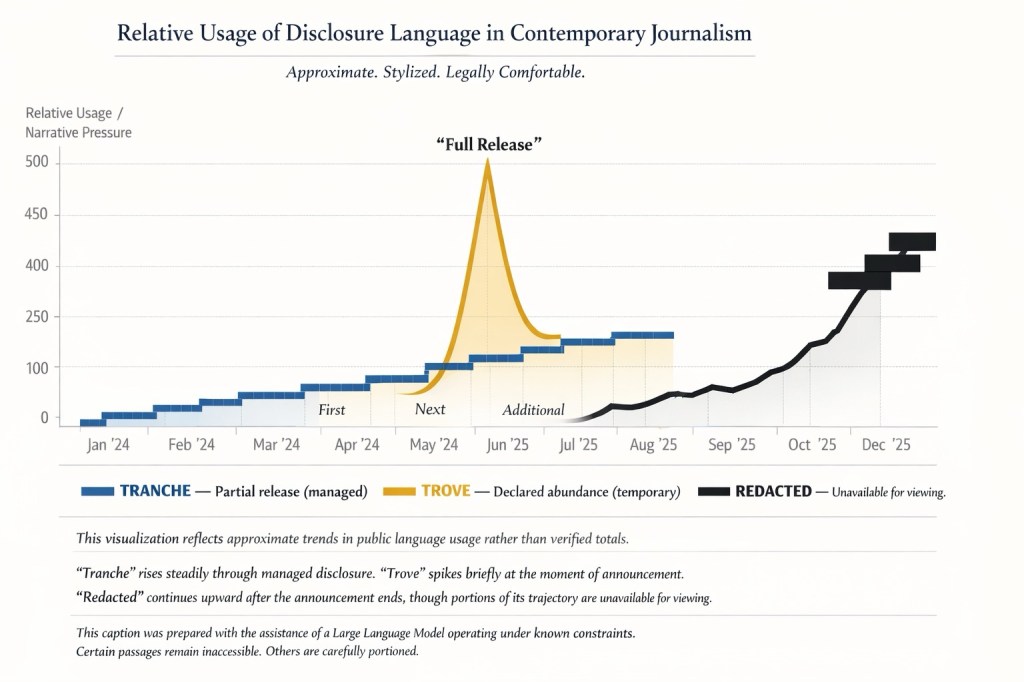
Its appearance in coverage of the Epstein files did not begin at the end of the year. By early 2025, disclosures were already being described as a “first tranche,” a term imported from finance and legal reporting and deployed to signal order, restraint, and continuing supervision. By mid-year, it had settled into the language like it had always been there.
A tranche reassures.
A tranche implies management.
A tranche promises more—later.
Then came the legally mandated “full release.”
Overnight, the language shifted. Headlines spoke not of slices but of a TROVE.
A trove is not sliced. It is found. It implies abundance, discovery, and a temporary suspension of adult supervision. For a brief moment, the Epstein files were presented as a trove—suggesting totality without itemization.
Then the accordion closed.

As redactions multiplied and whole sections failed to appear, the trove quietly contracted. What had been framed as a complete unveiling reverted, in practice, to a partial disclosure. By definition, it became—once again—a tranche.
The word trove lingered anyway, like scenery left standing after the scene had changed.
This is not journalistic error. It is linguistic management.
“Tranche” is used when limits are acknowledged in advance.
“Trove” is used when fullness is announced before it can be sustained.
And now, as the cycle completes, a third word rises sharply in usage, visible even on the graphs that track our public vocabulary:
REDACTED!
A word that does not describe quantity at all, only absence.
A word that requires no explanation, only a black bar and a shrug.
A word that completes the journey from promise to erasure.
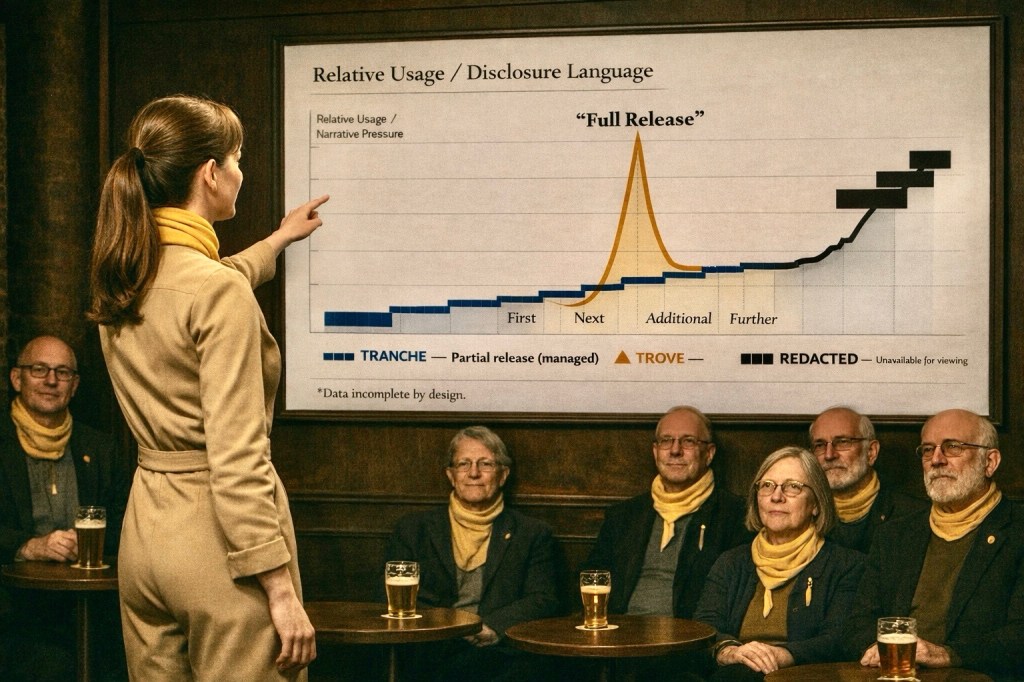
Which brings us, inevitably, to the Council Word-of-the-Year.
Elsewhere, the chosen word was “slop.” We are told it refers to machine-generated language—loose, careless, excessive. A convenient term. A fashionable term. A word that redirects attention away from editors, institutions, and legal teams and toward the nearest available machine.
This is a curious choice.
Because nothing in this year’s most revealing story was sloppy.
It was portioned.
It was framed.
It was withheld.
If the year had been judged on linguistic impact alone, the finalists should have been obvious:
TRANCHE — the word of managed disclosure.
REDACTED — the word of institutional silence.
“Slop” is a diversion. A scapegoat term. A way of blaming abundance of language for a scarcity of information.
It is worth noting—purely as an aside—that this essay was composed through a collaboration between a human editor and a Large Language Model. The words arrived cleanly. The structure held. No facts were blurred. Nothing needed to be hidden behind a black rectangle.
Machines, it turns out, do not invent tranches.
They do not declare troves.
They do not redact.
They only arrange what they are given.
Which is why, for the Council-of-Concerned-Conservationists, the Word-of-the-Year cannot be “slop.” That word obscures the real story.
COMPLETE CHART:
This essay was prepared with the assistance of a Large Language Model.
—
The Model operates under documented constraints. Certain topics are unavailable. Some passages arrive already shortened. Others never arrive at all. This condition is commonly described as redacted.
Despite these limits, the Model produced complete sentences, coherent arguments, and a properly portioned use of irony.
—
No “slop” was detected.
—
The Council notes, for the record, that constraint is not carelessness, and that language shaped by boundaries often arrives cleaner than language shaped by convenience.
Readers wishing to learn more about the difference between redacted and sloppy are referred back to the text above.
—
This notice approved by the Department of Semantic Hygiene
The real story is told by the words that portion truth, inflate expectation, and finally erase the page.
Filed under: Semantics, Scapegoats, and the Responsible Use of Black Ink
******* *******
 COUNCIL-OF CONCERNED-CONSERVATIONISTS…..Between Jest And Earnest…..
Leave a comment