—On a Ridge, Wanting (with Overheard Coordination)
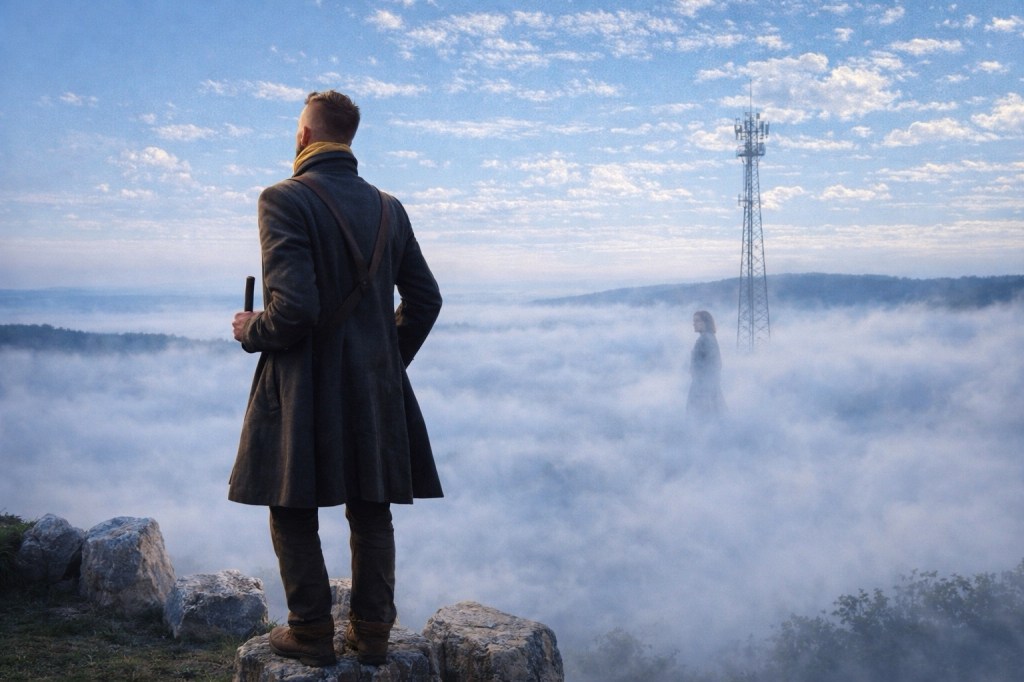
The Accidental Initiate had come to the ridge in the Pennsylvania Wilds with a backpack, a tent, and a reason he was willing to say out loud. He needed quiet. He needed air. He needed to put distance between himself and the part of life that felt stalled.
What he did not say—what he did not quite admit even to himself—was that he was lonely in a very specific way.
Not abstract loneliness.
Not social loneliness.
Romantic loneliness—the kind that wants another person not for validation or companionship alone, but because something in the body and the future is asking to continue.
The kind that knows reproduction is not crude or optional, but the biological outcome toward which romantic love is oriented, whether people admit it or not.
He had chosen his spot deliberately. His small fire burned adjacent to another campsite along the ridge—far enough to claim solitude, close enough that voices could carry if they were not trying to.
Behind him, his tent was already pitched. Ahead, the forest fell away on both sides of the ridge. Night had settled in cleanly. Somewhere below, unseen, animals were moving toward one another to mate, to reproduce, to ensure that their kind did not end with them.
Ray Pierre-DeWitt was already present.

Not visibly. Not audibly.
But present—like gravity, like memory, like a vast intelligence that had once set certain pressures in motion and now watched, with something dangerously close to affection, as they bore fruit.
Ray had coordinated chaos for a very long time.
He rarely allowed himself to feel anything about it.
Tonight, he did.
The Initiate took out his phone. He told himself it was habit—something to do with his hands, with distance. A small light against the dark.
The signal was weak yet the video began without ceremony.
It was I Don’t Want to Live Without You.
(Viewing required for context and feels.)
Watching this now, it occurs to me that romantic love always makes us foreigners—to our plans, our systems, even to ourselves. Maybe that’s why the animals make sense here. Continuation crosses thresholds, not kinds. —A.I.
He almost smiled. Almost stopped the video.
Instead, he watched.
For those who haven’t seen it—and he would later feel compelled to explain, as though explanation were a responsibility—the video is not really about the band. It is about animals and first principles.
Animals approaching one another for mating. Circling. Signaling fertility. Hesitating. Risking rejection. Risking vulnerability. Closing the distance required for reproduction.
“Oh,” he said softly to himself. “That’s—not metaphor.”
Ray leaned closer—not as a voice, but as attention.
This was the moment he always listened for.
The moment when a human stopped mistaking poetry for invention and recognized it as memory.
The animals were not acting out romance as an idea.
They were enacting the biological prelude to reproduction—the mechanism by which the species continues.
Ray felt it then—the rarest sensation in his long coordination.
Wonder.

He had arranged the pressures. He had set the conditions.
But he had not written this recognition.
That always arrived as a gift.
The Initiate felt something tighten in his chest—not pain, but recognition.
“This,” he said quietly, speaking into the night more than to anyone, “this is where everything actually starts.”
He watched a pair commit.
“I know there are other kinds of love,” he continued. “Friendship. Family bonds. Loyalty. Sacrifice. All of that matters. But none of it exists if this doesn’t happen first. No reproduction, no children, no families, no cultures, no future people to practice those other loves.”
Ray felt a warmth he had not budgeted for.
Yes, he thought.
They see it now.
The words carried farther than the Initiate intended.

“And yet,” the Initiate went on, his voice sharpening as he found courage in the saying of it, “we spend enormous energy telling people not to want this.”
He gave a short, incredulous laugh.
“Feminism tells them romantic love oriented toward reproduction is a trap. Churches tell them sexual desire leading to reproduction is dangerous or sinful unless tightly regulated. Parents tell them to delay it, suppress it, prioritize careers, be careful. Schools redirect it. Therapies reframe it. Ideologies pathologize it.”
He stared into his own fire.
“No one says, ‘Yes. This desire exists because the species depends on it.’”
Ray felt something tighten—something like grief, something like pride.
He had watched every one of those structures arise.
He had watched them try to manage what they secretly relied upon.
There was a pause—long enough that the Accidental Initiate wondered if he had said too much out loud.
Then, from the other fire, Ernst spoke—not loudly, not as an intrusion, but as someone recognizing a truth already arrived at.
“When two individuals love each other,” he said, “they become free from the Leviathan. They create a space it cannot control. Eros always triumphs—not because it is moral, but because it is older than all titanic constructions.”
Ray closed something like an eye.
Yes.
That was why he had let it run.
George stirred the fire once with a stick and added, almost conversationally:
“They fear love because it creates a world they can’t control.”
Ray felt that sentence ripple outward through the systems he coordinated—governments, doctrines, plans—each of them real, each of them temporary.
“Romantic love frightens systems,” the Initiate said now, steadier. “Because it leads to reproduction. And reproduction produces consequences no system can fully control. New people. New loyalties. New futures.”
He paused.
“Borders get crossed. Family plans get ignored. Bloodlines mix.”
Ray listened—not as an administrator now, but as something closer to a witness.
He had seeded the chaos.

They had discovered the meaning.
“But maybe,” the Initiate said slowly, “the resistance is part of how reproduction stays strong.”
He frowned, thinking.
“Maybe the restrictions aren’t there to stop it, but to select for the people willing to risk it anyway. Maybe life uses feminism, religion, parental limits, taboos—all of it—as pressure. As a filter.”
The Initiate shook his head, unsettled.
“That’s disturbing,” he said. “That even the forces that shame or suppress reproduction through romantic love might be participating in how it selects for courage.”
Ray felt it then—fully.
Not pride.
Not authority.
A fierce, almost parental tenderness.
Yes, he thought.
That is exactly what I hoped you would see.
Life does not defeat with its obstacles.
It recruits with them.
The music video swelled toward its end. The animals faded from the screen.
“I thought this song was about heartbreak,” the Initiate said.
“I think it’s about refusing extinction.”
He turned the phone face down and let the dark reclaim his fire. The longing remained—but now it felt less like a personal failing and more like alignment with something ancient, bodily, and undefeated.
Ernst cleaned his Mauser and added a log to his fire. George coughed and said nothing more.
Ray stayed.
He always stayed.
Some realizations are not meant to be corrected or recorded.
They are meant to be felt twice—once by the human who discovers them, and once by whatever set the world loose enough for discovery to happen at all.
The Initiates fire had rekindled; he picked up his phone, tapped her name, and lifted it to his ear. The signal dropped. He lowered the phone, nodded once, and looked out into the dark toward a faint cell tower on a distant ridge—the direction of tomorrow’s hike.
**************
This post received the Mrs Begonia Contretempt Seal of Approval for sublimation.
 COUNCIL-OF CONCERNED-CONSERVATIONISTS…..Between Jest And Earnest…..
Leave a comment