—STOCHASTIC—
How expanding knowledge gave us new words—not to control the universe, but to admit what we no longer could.
—Paige Turner, Sub-Sub Librarian.
I began hearing stochastic the way one hears dripping water in an old building—first as an annoyance, then as a clue. It appeared in footnotes before it appeared in headlines. It showed up in lectures that pretended not to be lectures. Someone said it in a podcast voice, softly, as if apologizing for certainty.
There is also the matter of how the word sounds:
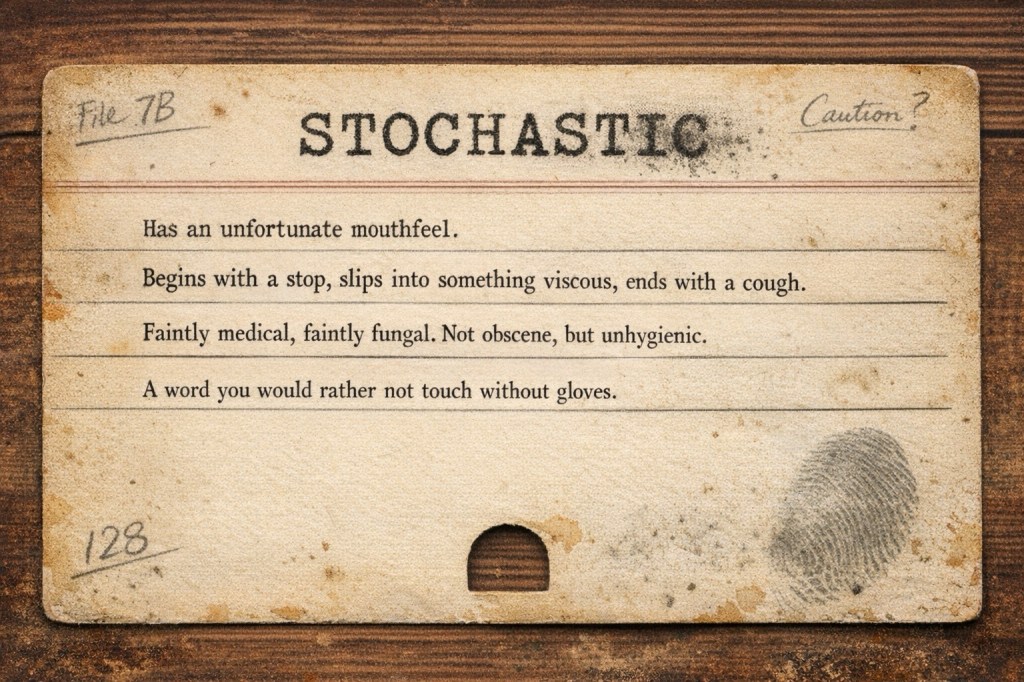
This may explain why it unsettles people before they know what it means.
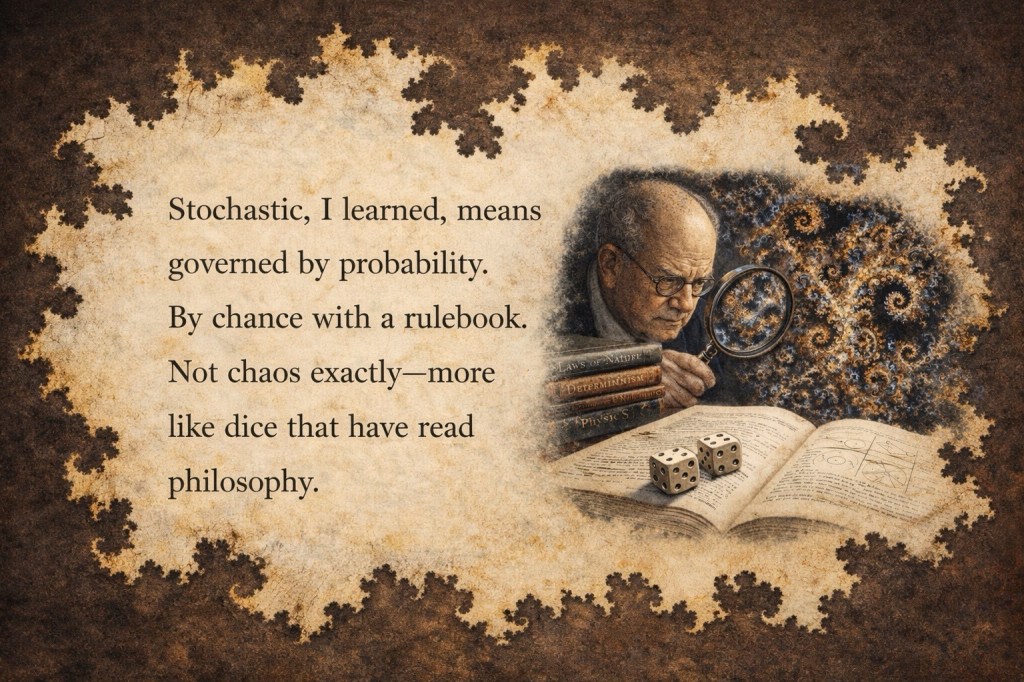
The word likes places where confidence used to live. Economics. Climate models. Artificial intelligence. Human behavior, once spoken of as if it were a filing system with labeled drawers, is now described as stochastic, which is a polite way of saying: we thought we knew, but the universe has been freelancing.
In the Sub-Sub-Library, stochastic is shelved between contingency and fate, though neither neighbor is happy about it. Fate resents the math. Contingency resents the calm tone. Stochastic just sits there, smug in its neutrality, pretending it has no metaphysical implications while quietly rearranging them all.
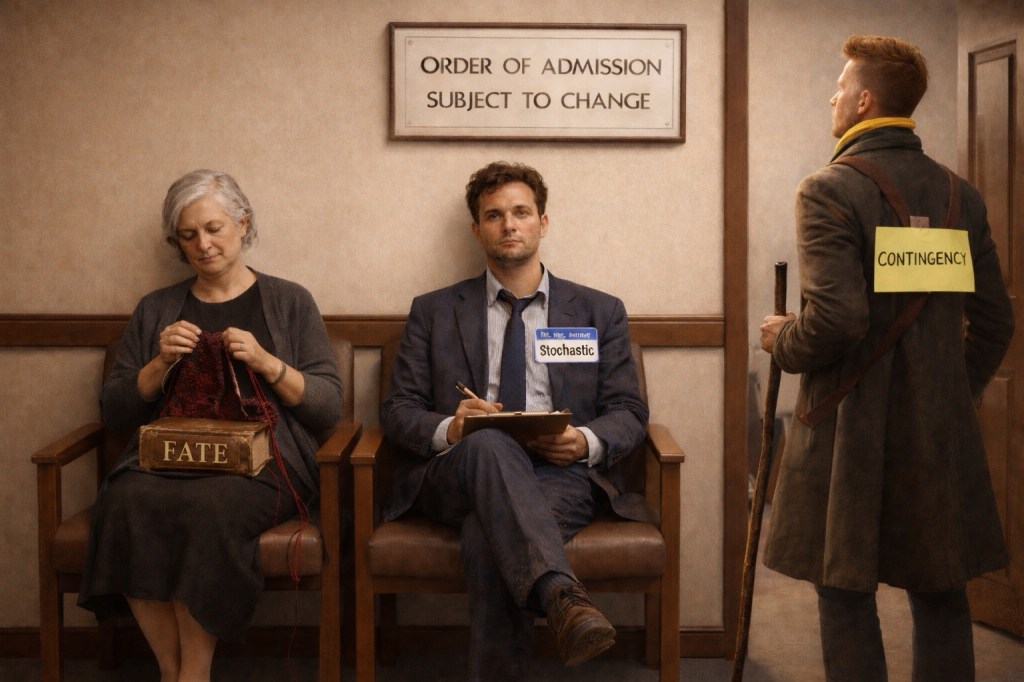
The role suited him: he was already there, already unsure, and already implicated.
What makes the word stochastic dangerous—and therefore useful—is that it sounds technical enough to discourage argument. You can end a discussion by calling something stochastic. It implies rigor while confessing uncertainty. It is ignorance in a lab coat, but an honest one.
I hear it more now because we are running out of sturdier words. Prediction is tired. Control is embarrassed. Even randomness feels too emotional. Stochastic offers a compromise: a world that behaves statistically, even if it refuses to behave personally.
My advice to readers is simple. When you hear stochastic, listen closely to what is being surrendered. Someone has stopped promising outcomes and has begun promising ranges. Someone has replaced “will” with “likely.” Someone has decided that the future will be handled by averages, because individuals have become too unruly.
This is not a bad thing. Libraries were never built on certainty anyway. They were built on accumulation, revision, and the hope that meaning emerges from patterns you only see after walking past the shelves many times.
Stochastic is not the end of understanding. It is the admission desk.
Filed for now. Subject to revision. Probability pending.

Fractal, stochastic, Bayesian:
three human ways of coping with the fact that the universe is less orderly—and we are less certain—than we once believed.
They do not promise control.
They acknowledge uncertainty, describe its structure, and ask us to act anyway.
 COUNCIL-OF CONCERNED-CONSERVATIONISTS…..Between Jest And Earnest…..
Leave a comment