—A provisional report from the Chaos Desk
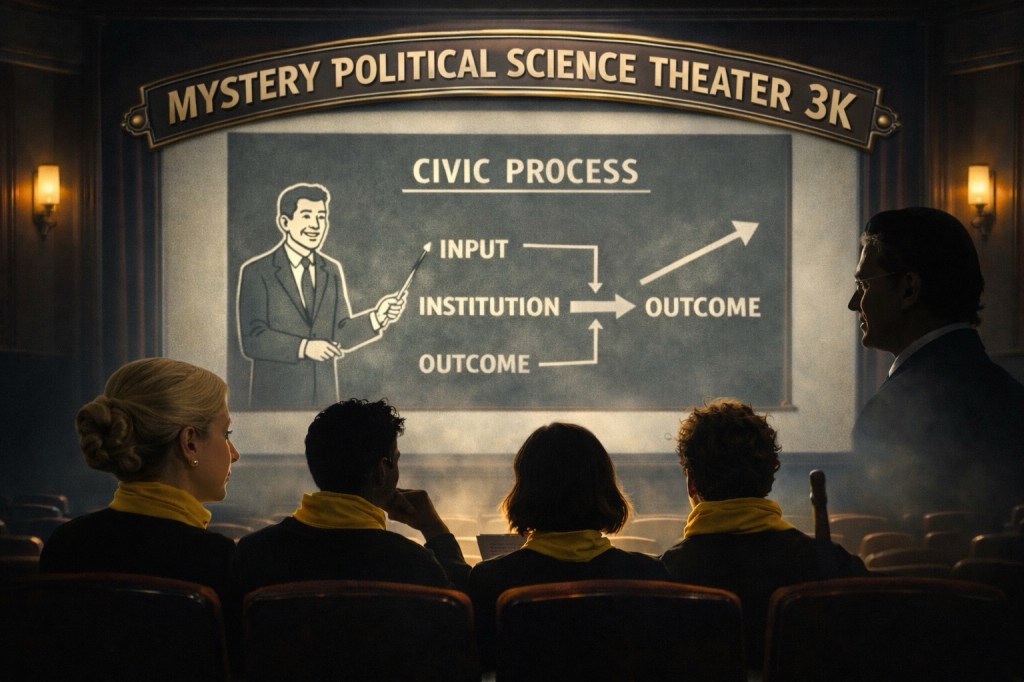
I have been doing something I’m not sure I’m supposed to admit.
I keep reading the comment section.
Not out of agreement. Not out of masochism. Mostly because, against all professional expectations, the comments keep noticing things before the official explanations do.
You know the feeling. A statement is issued. A policy is unveiled. A framework is declared inevitable. The language is smooth, rational, forward-leaning. The movie plays. And then—below it, or beside it, or out on the street—a second conversation starts muttering. Half jokes. Half complaints. Odd anecdotes. Unrefined intuitions. Someone points at the wiring. Someone else notices the boom mic. Someone says, “That’s not how it works where I live.”
This reminded me, unexpectedly, of Mystery Science Theater 3000.
The movie in that show was never stopped. It was allowed to take itself seriously. The silhouettes didn’t seize control of the plot. They didn’t rewrite the script. They just sat there, noticing—pointing out seams, cardboard sets, unintended comedy, moments where confidence outran reality. After a while, you couldn’t watch the movie straight anymore. Not because it had been defeated, but because it had been seen. Today, that second row has migrated to the comment section, where the muttering happens in public and the noticing leaves a record.
That feels uncomfortably familiar right now.
Let me be clear about what our turn toward the comment section is not.
This is not democracy-as-sentiment.
This is not populism.
This is not “the people decide.”
Crowds are often wrong. Crowds hallucinate. Crowds contradict themselves before breakfast.
But they also notice things—sometimes important things—before anyone with a microphone or a website does.
Serious rulers—kings, generals, priests, administrators, physicians—have always known this. You do not ask the crowd to govern. You listen to it because it registers stress, heat, and fracture before theory does. The mob is not always wise. But it is informative. Ignoring it is not aristocratic; it is brittle.
Political science today behaves like a tidy, supervised system: models, assumptions, linear causality, clean inputs. The commentariat behaves like an unsupervised one: messy, experiential, sometimes unhinged, constantly retraining on lived reality. Neither is sufficient alone. But between them, pattern sometimes precipitates.
What follows here—if it follows at all—is an experiment in noticing, possibly the beginning of a new column in the newsletter, and—if taken seriously—a kind of informal instruction.

Ground floor now open. Ascension not guaranteed.
In the future, I will occasionally present a small excerpt of the “movie”: a headline, a declaration, a policy claim. Beneath it, silhouettes from the swarm—comments, street remarks, overheard lines, recurring fragments, and inevitable Council commentary. These are not endorsements. They are not votes. They are arranged like weather reports, so pressure systems become visible.
I will resist conclusions. I will avoid solutions. When I speak at all, it will only be to point out recurrence: this phrase keeps appearing, this worry shows up everywhere, this joke is being told by people who agree on nothing else.
This may not become a column. It may dissolve on contact with daylight. Nothing here is binding. Nothing here is sacred—though I will admit a soft spot for anything that reveals order hiding inside noise.
And perhaps that is the deeper reason this form feels familiar.
Because when you think about it, this is what prayer and its less polite cousin—swearing—have always been. Commentary offered upward. Marginal notes shouted into the void. The human habit of talking back to something vastly larger, not because we expect to run it, but because remaining silent feels wrong.
If politics has become a kind of theater, then prayer has always been the comment section of humanity—full of gratitude, complaint, praise, rage, jokes, blasphemies, and the occasional line that lands closer to the truth than anyone planned.
Which means I should probably admit one more thing, in the interest of full disclosure.
What I am doing here—right now—writing this alongside my fellow correspondents, listening, arranging, muttering, noticing—is itself a small episode of Mystery Political Science Theater 3K. The screen glows. The silhouettes gather. Someone points. Someone laughs. Someone whispers something that refuses to go away.
The movie will continue either way. It always does.
I am only noting that more and more people are speaking at the same moments—upward, sideways, and under their breath—and it seems, how shall I put this, cosmically imprudent not to write that down.
— Ray Pierre-DeWitt
Chaos Coordinator
(standing somewhere between the screen and the exit)
***
NOTES:
An origin story for MYSTERY POLITICAL SCIENCE THEATER 3K by our correspondent, Vance:
This idea didn’t come from a theory seminar or a policy journal. It came from a Combat! Facebook fan page, where someone noticed a Walther in a character’s belt early in an episode and a Luger there by the final scene. It was a tiny, nerdy catch. It meant nothing. It struck a funny bone—and that was enough to give me the idea for this column. So I passed it along to Ray.
—Vance Gunczarus, C-of-C-C Waffenmeister und Waffenwirklichkeitsbeoba–chter (Weapon-reality observer)
John St. Evola adds:
My father once said that, as television went, Combat! was about as close as it got. He said this once while getting ready to go bowling on a Tuesday night, with the casual authority of someone who didn’t need to argue the point. He’d already been there and done that—that being combat—and now it was time to go bowling.
 COUNCIL-OF CONCERNED-CONSERVATIONISTS…..Between Jest And Earnest…..
Leave a comment