—A Proposal on Melting the Border
FOR IMMEDIATE RELEASE:
—Another C-of-C-C controlled experiment in civic reasoning—
As part of its ongoing mandate to test ideas before they test us, the Council-of-Concerned-Conservationists Newsletter occasionally adopts prevailing arguments in full and carries them to their logical conclusion. What follows is such an exercise. It is not an endorsement, but an exposure.
All views expressed are those of the contributor, their subconscious, or the policy logic currently circulating without adult supervision.
The banner rose: ABOLISH ICE.
The crowd cheered. Justice, it seemed, had been achieved—by removing the people responsible for enforcing it.
The border itself was not abolished. That would have required consent.
Instead, enforcement was dissolved, allowing the law to remain safely symbolic—present in statute, absent in practice. Illegal crossing would no longer be legal or illegal, but unobserved. A softer category, easier to defend.
The Council notes that this move does not stand alone. The abolition of immigration enforcement arrives as one plank in a broader program already underway—one in which enforcement retreats, crimes are reclassified as conditions, and law is preserved only as a symbolic gesture. What is presented as compassion in one domain quietly completes the logic of legalization in another.

This maneuver is not unprecedented.
In Nathaniel Hawthorne’s Earth’s Holocaust (1844), mankind burns every symbol of evil—laws, weapons, creeds—only to discover that one thing was left untouched: the human heart. The fire consumes the symbols. The problem survives.

What follows is a clinical assessment of the proposal, prepared under the now-common assumption that enforcement itself—not human behavior—is the primary source of social harm.

Where minor irritations are elevated to governing frameworks
TOWARD THE ABOLITION OF ENFORCEMENT
—By Dr. Faye C. Schüß
Medical and Mental Hygiene Expert
We are told the time has come.
Having already removed moral stigma from abortion, marijuana, and large swaths of property crime, our leaders now propose eliminating the final irritant: the enforcement of immigration law itself.
This is not legalization. That would require accountability.
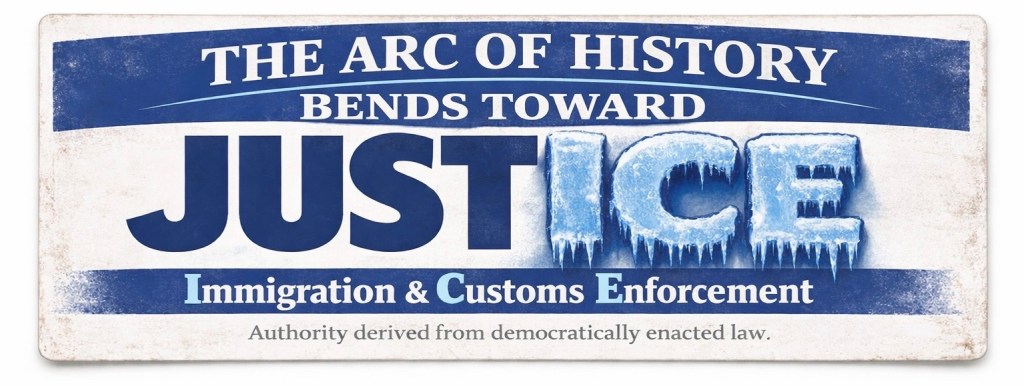
This is administrative mercy—the preservation of law without the discomfort of application.
Borders will remain, much like speed limits: intact on paper, optional in practice, enforced only when rhetorically useful.
The promised benefits are immediate.
No arrests. No footage. No explanations.
Outrage collapses when there is nothing left to push against.
Fiscal conservatives should applaud the efficiency. Enforcement is expensive. Non-enforcement costs only coherence, which no longer appears on the ledger.
Once enforcement is reclassified as inefficiency, the principle travels easily—from law, to physics, to the marketplace.

Food safety requirements suspended pending scalability.
COUNCIL FLOOR RESPONSES
Peter R. Mossback, Athwart Historian:
“A law without enforcement is not compassion. It is abdication wearing a halo.”
Miss Noor Singha Grudj, Newsletter Gadfly (enthusiastically):
“Finally! A justice system that asks nothing of anyone.
Keep the rules, lose the consequences, and call it progress.
I also look forward to abolishing air resistance next—it promotes unequal outcomes.”

Rey Pierre-DeWitt, Chaos Coordinator:
“When the referee leaves the field, don’t call it a new game. Call it noise.”
MEDICAL FINDINGS
Dr. Schüß cites emerging research suggesting that most public outrage can be neutralized by abolishing the institution tasked with confronting it. The field is provisionally titled Preventive Derealization™ and is expected to replace mediation in major municipalities.
EDITORIAL NOTE:
This dispatch is offered as a stress test of civic logic. When enforcement disappears but human nature remains unchanged, the result is not harmony—only quieter disorder, postponed conflict, and louder slogans.
Signed,
Office of Editorial Equanimity, Council-of-Concerned-Conservationists

(Lamentation to follow.)

 COUNCIL-OF CONCERNED-CONSERVATIONISTS…..Between Jest And Earnest…..
Leave a comment