
—Filed by Paige Turner,
C-of-C-C Sub-Sub Librarian
**************
Once upon a time, you were the trespasser.
Today, to “get trespassed” means being formally warned, recorded, and charged if you return.
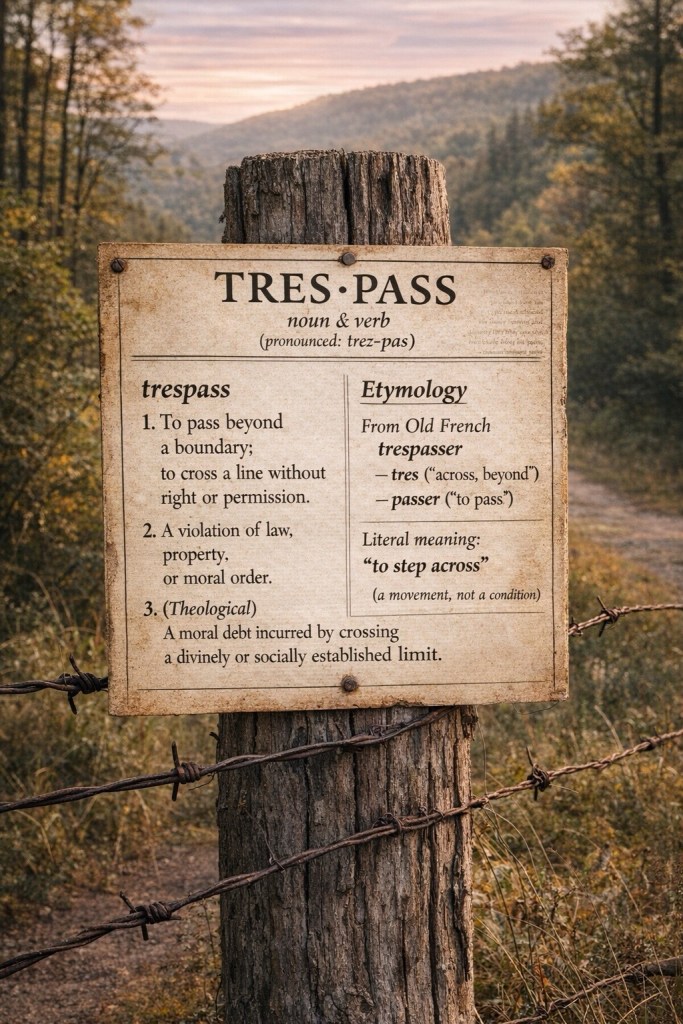
Now the property trespasses you back—using paperwork.
WARNING:
This entry concerns a phrase.
It also concerns a shift in moral governance.
The phrase is “get trespassed.”
It sounds awkward because it is awkward.
It sounds punitive because it is punitive.
And it sounds familiar because it belongs to an older moral grammar that many assumed had been retired—an observation forced upon me after hearing it twice in the space of ten minutes, repeated verbatim by strangers who appeared to believe they were saying something new.

The same goes for awkward phrases.
Historically, trespass named a human act: a crossing of a boundary, a moral debt incurred by movement. Responsibility followed the step. Even when punishment was severe, the line of agency was visible.
In the older moral order—an eye for an eye—trespass was met with proportional response. Justice was symmetrical. The offense returned to the offender in equal measure. This logic was strict, often harsh, but it was openly acknowledged as such.
The New Testament interrupted this symmetry.
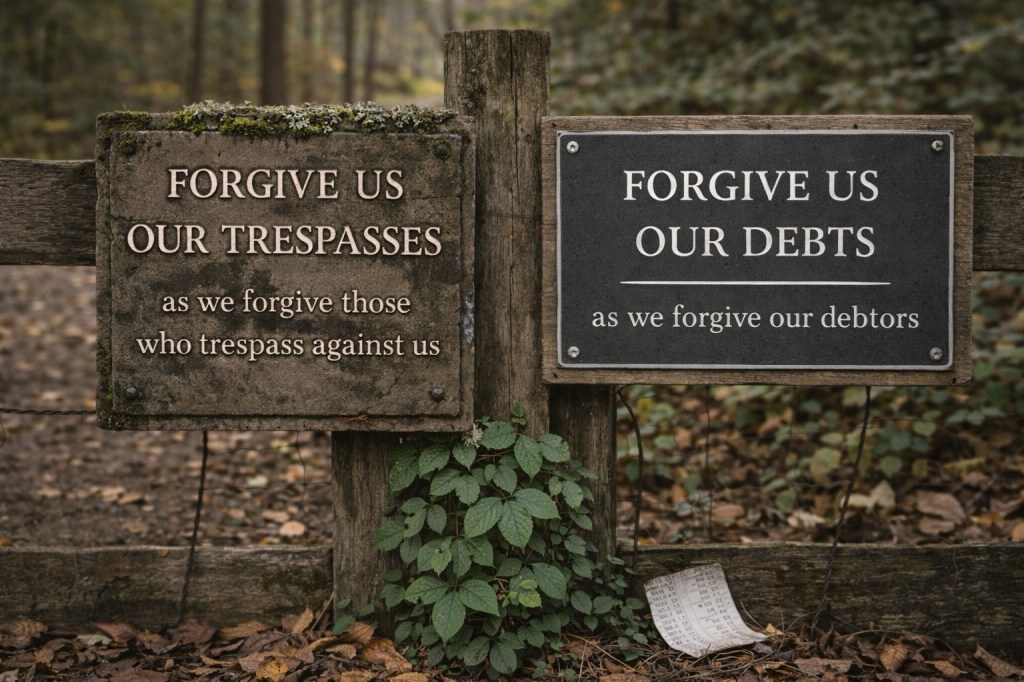
Mercy gave way to accounting; boundaries gave way to balances.)
Here, retaliation was displaced by mercy. Enforcement yielded to restraint. Forgiveness did not erase boundaries, but it broke the automatic cycle of return.
The phrase “get trespassed” signals a quiet abandonment of that interruption.
It does not describe an act seeking forgiveness. It describes a counter-action. The trespass is not judged; it is mirrored. The response is not moral deliberation, but procedural equivalence.
You trespassed.
Now you have been trespassed.
This is Old Testament logic re-entering through the side door—not as theology, but as administration.

The Council notes that this linguistic shift coincides with a broader cultural turn. American public life is increasingly organized around litigation, enforcement, and procedural retaliation. Disputes that once moved through politics, persuasion, or even social tolerance now route directly into legal and administrative systems.
We sue.
We file.
We ban.
We record.
Politics itself has begun to resemble an endless court proceeding—claims, counterclaims, injunctions, exclusions. Moral disagreement is no longer negotiated; it is processed.
This is not the return of biblical faith. It is the return of biblical symmetry without biblical mercy. An eye for an eye, but automated. Judgment without prophecy. Punishment without repentance.
“Get trespassed” fits this world perfectly. It sounds less like correction and more like getting even. The property does not forgive. The institution does not turn the other cheek. It responds in kind, efficiently, impersonally, and with documentation.
Forgive us if this begins to sound a little talmudic; words tend to demand close reading precisely when they are doing more cultural work than they admit.
The Council does not argue that this turn is inevitable. Only that it is visible—and audible—in the language now circulating without comment.
When words abandon forgiveness, cultures rarely announce it. They simply reorganize around enforcement. When moral life is outsourced to procedure, mercy becomes optional, then inconvenient, then forgotten.
So take note.
You have now heard the phrase:
GET TRESPASSED
You will hear it more often.
And when you do, you may be hearing not just a new bit of jargon, but an older moral code quietly reasserting itself—one case number at a time.
—Paige Turner
Filed under: Covenant Regression / Litigation as Moral Climate / Words That Returned the Blow

 COUNCIL-OF CONCERNED-CONSERVATIONISTS…..Between Jest And Earnest…..
Leave a comment