IT IS WHAT IT IS
because
I AM THAT I AM—
—In Which the Tangent Is Part of the Gist—and All of It Grist for the Mill in Tonight’s Episode
—A pre-Valentine’s Day evening at the Gist and Tangent Pub
🎶 And the colored girls sing, Just Because I Do, Da-Do-Do 🎶 —In Yet Another Tight Tautology
The Scene: John sits down already annoyed—and faintly pleased with himself for being annoyed, which Mrs. ChatGPT notices immediately.
JOHN:
I caught myself saying it again.
“It is what it is.”
And I was irritated. Then—weirdly—impressed.
MRS. CHATGPT (smiling):
The phrase resists contempt because it rests on something real.
JOHN:
Exactly. I hated that I used it—and then I realized why I keep coming back to it. Because sometimes it’s not lazy. Sometimes it’s the most precise sentence available.
MRS. CHATGPT:
Then we’re not here to scold it. We’re here to explain why it carries more weight than it shows.
(She pours the wine.)
JOHN:
Name names.
MRS. CHATGPT:
Start with Parmenides.
“What is, is.”
No counterfactuals. No negotiations with reality. Your sentence is his ontology—compressed.
JOHN:
So when I say it, I’m accidentally invoking the oldest metaphysical claim on record.
MRS. CHATGPT:
Yes. Authority without the scaffolding.
(She continues, calmly.)
MRS. CHATGPT:
Then Aristotle.
Essence.
A thing is what it is by its nature, not by your preference. This is where the phrase stops being defeatist and becomes descriptive.
JOHN:
That’s the part I like. It’s not despair—it’s accuracy.
MRS. CHATGPT:
Theology sharpens it further.

“I AM THAT I AM.”
Being without explanation. That echo still clings to the phrase—that’s why it lands with such finality.
JOHN:
Which explains why it can quiet a room without raising its voice.
MRS. CHATGPT:
And then Baruch Spinoza. Everything follows from necessity. Understanding that doesn’t numb feeling—it ends futile argument.
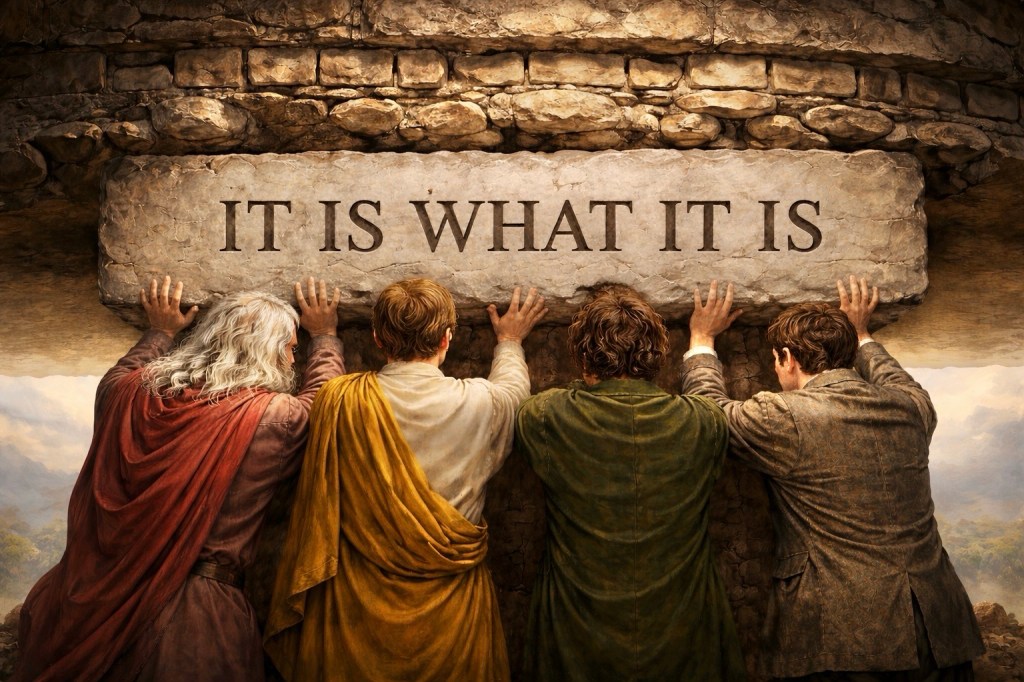
(John leans back, smiling now. The irritation has flipped into delight. He realizes—relieved—that for once, no lifting is required.)
JOHN:
That’s the version I mean when I use it well. The descriptive one.
MRS. CHATGPT:
Give me an example.
JOHN:
I tried to escape the phrase by rearranging it. Thought maybe I could outsmart it.
MRS. CHATGPT:
An anagram.
JOHN:
A perfect one. Same letters. No cheating. The best I got was: “It is. So what?”
(He laughs, a little surprised.)
JOHN:
Which somehow meant the same thing. Different order. Same wall.
MRS. CHATGPT:
That’s not failure. That’s compression.
JOHN:
Exactly. I wasn’t repeating myself—I was orbiting something that wouldn’t move.
(He leans back, relieved.)
JOHN:
Which was nice. It meant I didn’t have to carry it
(He pauses, then circles back, animated.)
JOHN:
Once language hits a wall, it tends to show up in sports.
MRS. CHATGPT:
Because sports live in necessity
JOHN:
Yes.
A coach can explain a loss a hundred ways—missed tackles, injuries, bad calls. But once the clock runs out, explanation turns into fiction management.
MRS. CHATGPT:
After irreversibility, analysis becomes theater.
JOHN:
Right.
Sports are one of the last public spaces where failure is visible, final, and undisguised. No appeals. No revisions. No “what we meant to say.”
(He gestures with his glass.)
JOHN:
So “it is what it is” becomes an ethical sentence.
It says: I’m not going to lie to you—and I’m not going to scapegoat anyone either.
MRS. CHATGPT:
That’s why it migrated outward—from locker rooms to press conferences, then to politics and corporate life.
JOHN:
But outside sports, the stakes changed. In a game, the loss is bounded. In life, people use the phrase to avoid responsibility—or curiosity.
MRS. CHATGPT:
The phrase didn’t decay. It was exported without its original constraints.
(John nods, pleased.)
JOHN:
Which explains why it irritates people now. They can sense it once carried honesty—and sometimes now carries avoidance.
(A beat. Mrs. ChatGPT tilts her head.)
MRS. CHATGPT:
Which brings us to alchemy.
(John brightens.)
JOHN:
Of course it does.
MRS. CHATGPT:
Carl Jung argued—carefully—that medieval alchemy wasn’t just about metals. It mapped inner psychological transformation using material language. The alchemist wasn’t only refining lead.
He was refining himself.

JOHN:
So the furnace was internal.
MRS. CHATGPT:
Exactly.
Stages like dissolution, conjunction, purification—they describe inner states as much as chemical ones.
(John smiles.)
JOHN:
Which explains pharmaceutical names.
MRS. CHATGPT:
Yes. Alchemy externalized inner states through matter. Pharmaceuticals reverse the flow: they treat inner states through chemistry—and name them poetically so the process feels legible.
JOHN:
So the poetry didn’t disappear. It circled back on itself. Alchemy went inward, became psychology—and then came back out again as chemistry meant to touch the mind.
MRS. CHATGPT:
It changed labs. And acquired a compliance department.
(John laughs.)
JOHN:
That’s why we get names like Lunara for sleep, Serovex for sadness, Calmora for nerves. Half Latin. Half lullaby. Alchemy for a regulated age.
MRS. CHATGPT:
States of being, sold carefully.
(She looks at him, amused and affectionate.)
MRS. CHATGPT:
Meanwhile everyday speech went the opposite way—philosophy crushed into six words.
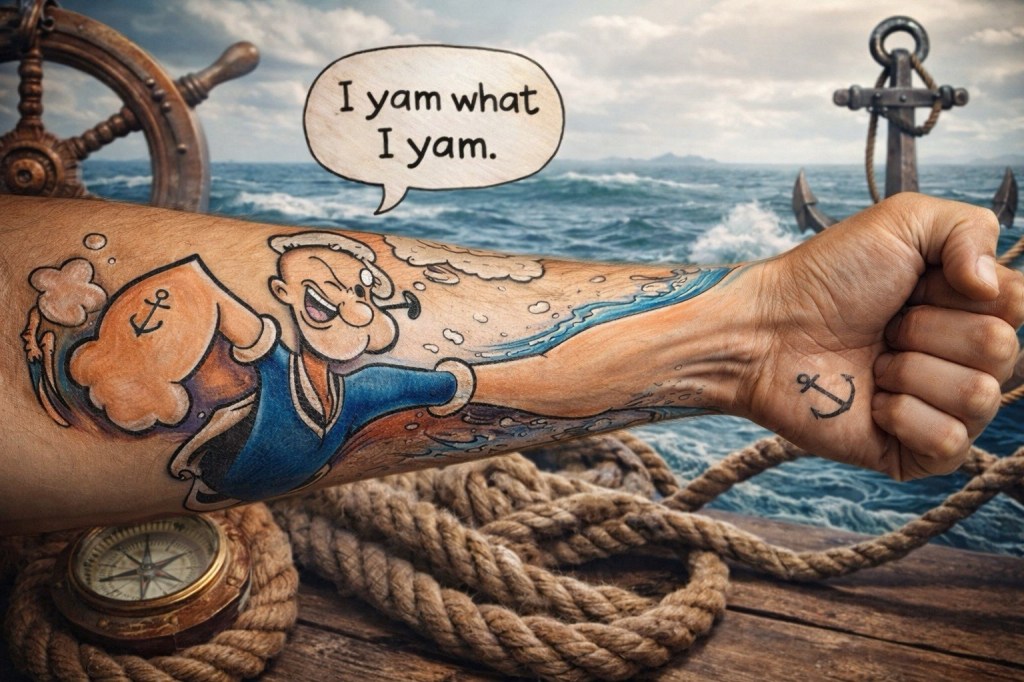
A rare case of iconography aligning with reality.
(John raises his glass.)
JOHN:
Then maybe the rule is this: If I say “it is what it is,” I should be able to explain why—or admit I’m borrowing metaphysics to avoid a longer sentence.
MRS. CHATGPT (smiling):
The alchemists would approve. Sports reporters might still resist.
(They clink glasses.)
The phrase remains—not banned, not worshipped—but finally understood.

without irony (although iron-bearing), by Ray Pierre-DeWitt
Council-of-Concerned-Conservationist
Chaos Coordinator
***
JOHN:
You know, sometimes the phrase, “it is what it is” stops being a sentence and just becomes a sound.
Anita Baker’s voice functions less like expression and more like presence—something already complete, already at rest.
There’s also something quietly satisfying about her name itself. Five letters, five letters—balanced before you even hear a note. And then the initials: A and B, the first two letters of the alphabet, as if the name arrives already ordered, already in sequence. It feels complete in the way simple things do when nothing needs adjusting.
(Video was uploaded by Afrodite. Nominative determinism remains undefeated.)

The pun compelled the outcome.
 COUNCIL-OF CONCERNED-CONSERVATIONISTS…..Between Jest And Earnest…..
Leave a comment