Delivered by the Right Reverend James Groady
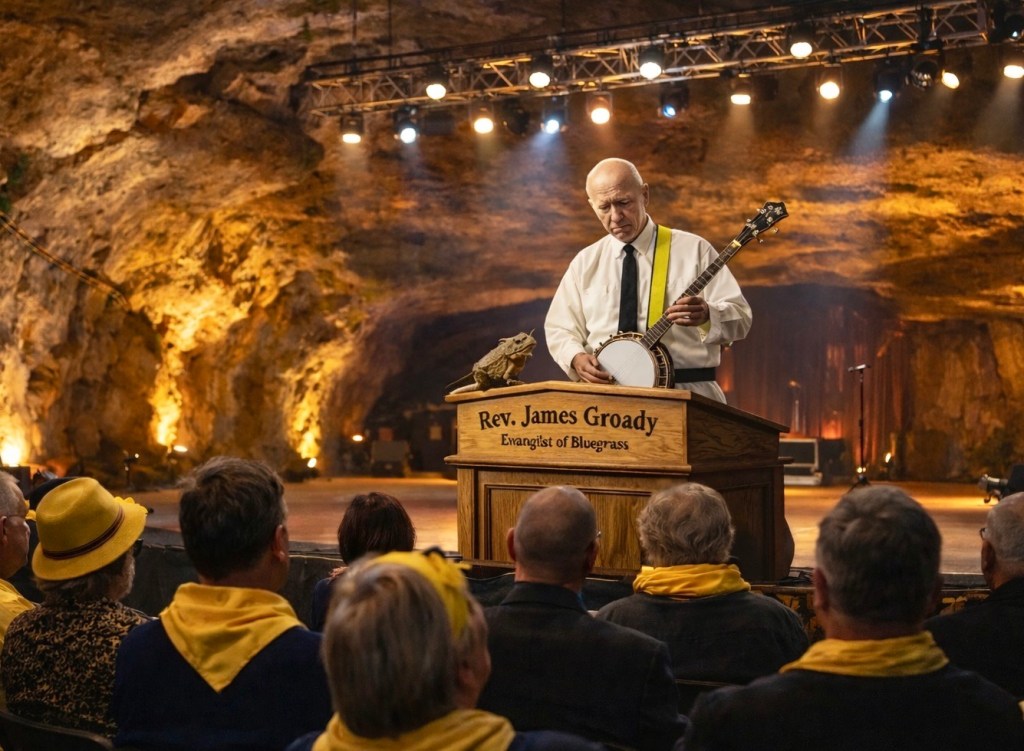
Brothers and Sisters,
I didn’t come bearing thunder today. I come bearing a sound you recognize—and one you don’t rush to condemn.
Now I’ve told you before, I’m half Southern Italian. My people learned early that not every disturbance means disaster. My great-grandfather worked the coal mines, and down here you didn’t jump at every noise. You learned the difference between trouble and—well—pressure letting itself be known.
That kind of discernment has a name where I come from.
They call it Pazienza.
Pazienza is Italian for patience, which means you don’t bolt from the room every time the air changes. You wait. You see if the walls are still standing. You notice whether the moment ends in panic—or in laughter.
That’s how my grandparents put it to me, over and over again—mostly my grandfather. Where he came from, a man wasn’t measured by how fast he spoke or how hard he reacted, but by how long he could stand his ground without making a spectacle of himself. He didn’t lecture. He’d just say it when things got noisy, and then he’d wait to see who stayed put.
Which brings me, inevitably, to Old Rip.
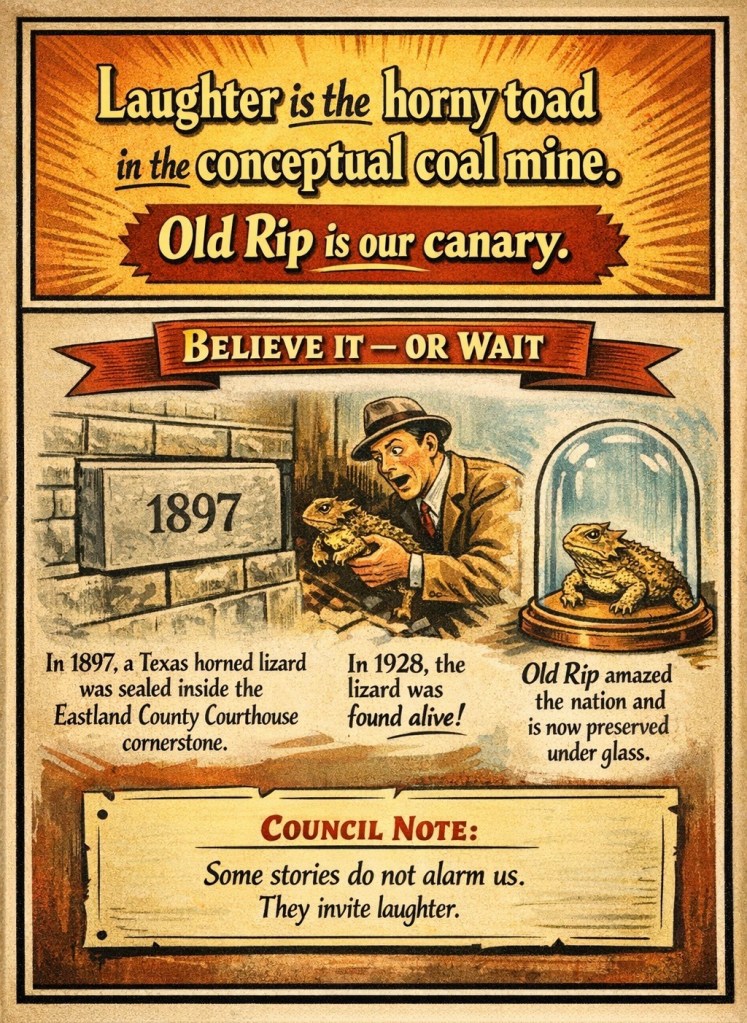
Back in 1897 they sealed a little horned lizard—what folks called a horny toad—inside a courthouse cornerstone. Thirty-one years later they opened that stone, and there he was. Alive. Calm. Not asking forgiveness. Not explaining himself.
They named him Old Rip, after Rip Van Winkle, but the comparison only goes so far. Rip Van Winkle slept through time. Old Rip sat with it. Let it pass. Let it do what it does.
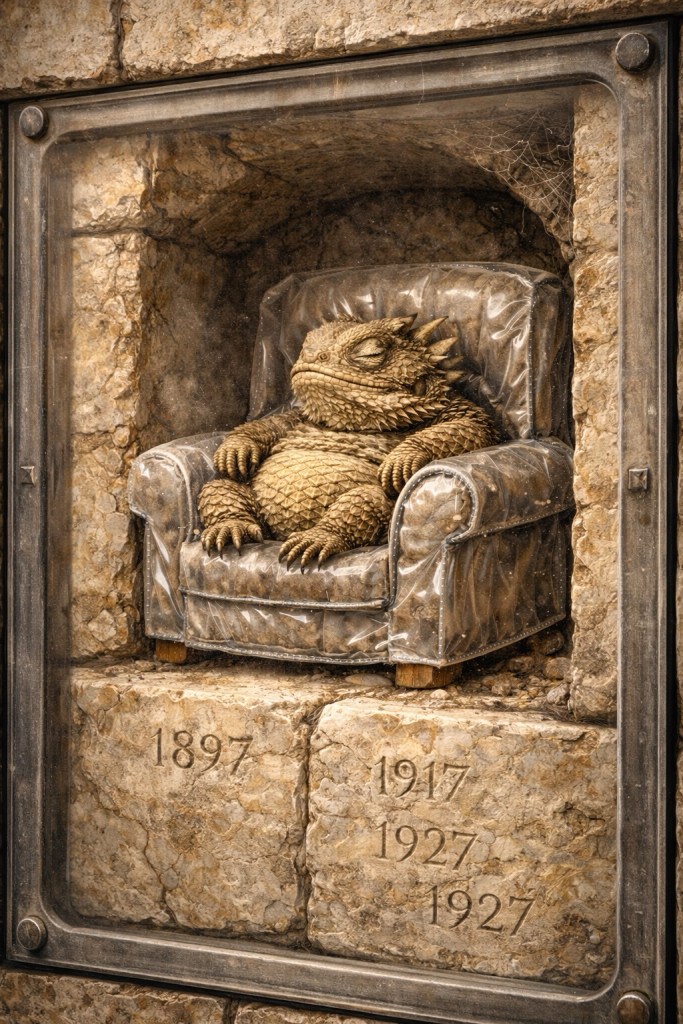
And when folks heard the story, they didn’t cry out. They didn’t call the authorities. They laughed.
Now laughter is a curious thing. Sometimes it shows up when a room needs relief. Sometimes it arrives when everyone knows something’s been released and nobody wants to make a federal case out of it.
Coal miners once relied on canaries because silence meant safety and collapse meant danger. But Old Rip taught us something subtler. Sometimes the warning isn’t death. Sometimes it’s the moment everybody chuckles and realizes the situation just ventilated itself.
That’s when you know the air is still breathable.
Laughter, friends, is the horny toad in the conceptual coal mine.
Old Rip is our canary.
And if you want to understand that without anybody spelling it out, you listen to the music:
There’s a tune called “Old Rip” by Lynn Morris. Notice how that banjo doesn’t hurry to judgment. It circles. It waits. It gives the moment time to settle before deciding whether anything actually went wrong.
That song knows the difference between catastrophe and—passing gas in the moral sense. A faster tune would’ve panicked. This one smiles and lets the room breathe.
So if you hear that tune and you find yourself laughing softly before you know why, don’t be embarrassed. That laugh is information. It means patience is still alive. It means discernment hasn’t fled the building. It means not every release requires an evacuation.
That’s all I’ve got to say.
Let the banjo handle the rest.
***
R.I.P.
Requiescat in pace.
Riposa in pace.
In Old Rip’s case, the initials were prophetic rather than premature.
Old Rip may still be visited, under glass, in Eastland,TX—where he continues to rest his eyes and hold his position, welcoming anyone patient enough to come see him
 COUNCIL-OF CONCERNED-CONSERVATIONISTS…..Between Jest And Earnest…..
Leave a comment