—Sexual Dimorphism, Safety, and the Return of Reality
—Concerning a Public Hearing on Standards, Outliers, and the Conservation of Meaning in Applied Safety Science
—Convened by the Council-of-Concerned-Conservationists
Chair:

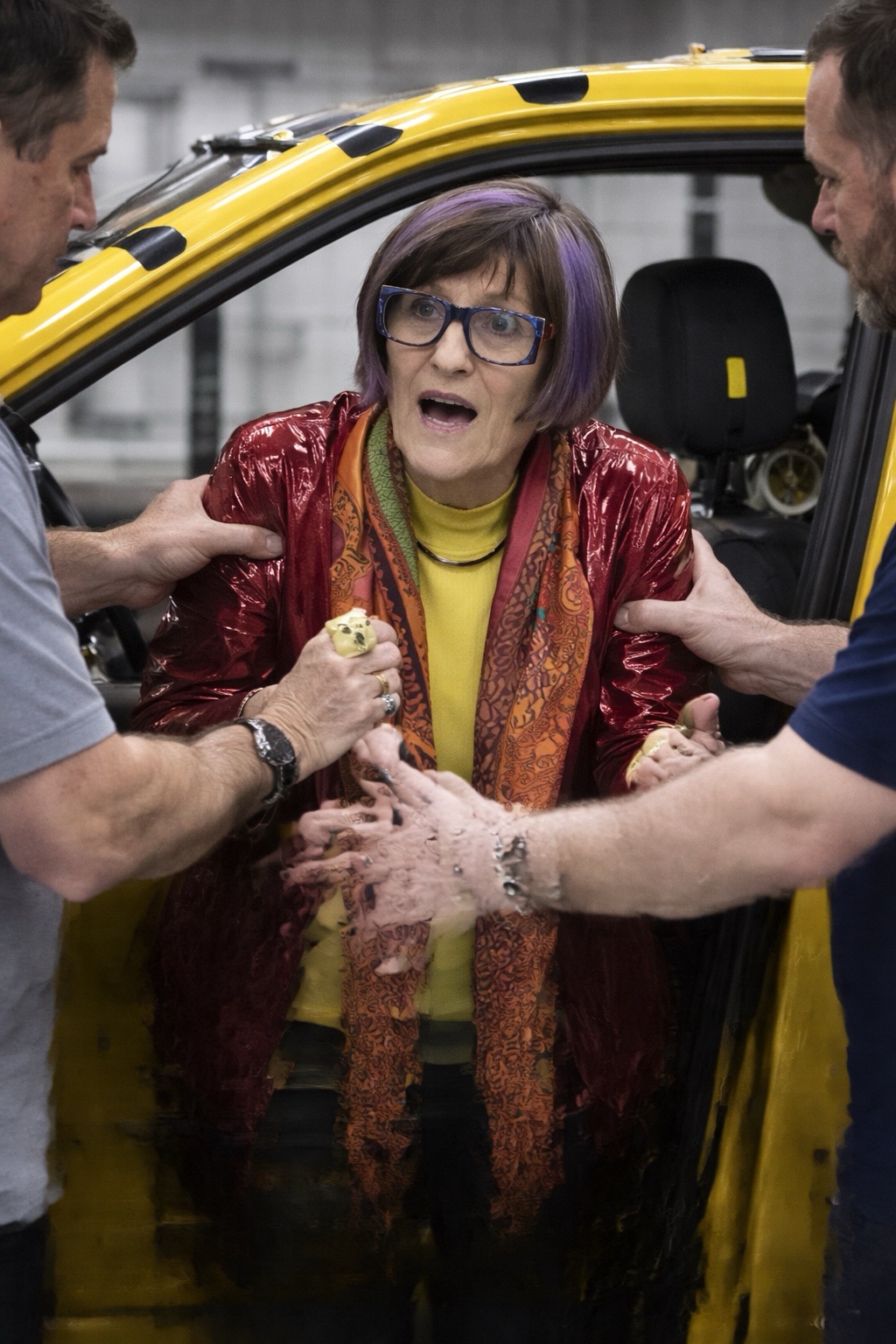
(This piece was prompted by a minor internet uproar over crash-test dummies—an uproar that revealed how quickly symbolism can outrun paperwork. What the immediate controversy obscured was a less convenient detail: the regulatory push for female crash-test dummies originated during the Trump administration, framed not as cultural commentary but as a correction to safety standards. Whether intended as provocation or merely consequence, the effect was the same—arguments now proceed from opposing stances, each insisting on its own logic, few pausing to notice that the policy itself rests quietly on the recognition of two biological sexes. The Council convened not to correct anyone’s politics, but to observe what happens when reality continues doing its job while everyone argues about why.
SCENE: The room had been requisitioned for neutrality. Beige walls. Fluorescent lighting. A seal no one quite remembered approving. Rows of chairs faced a narrow dais, behind which Dr. Faye C. Schüß arranged her papers with surgical calm.
The audience was— to say the least —diverse.
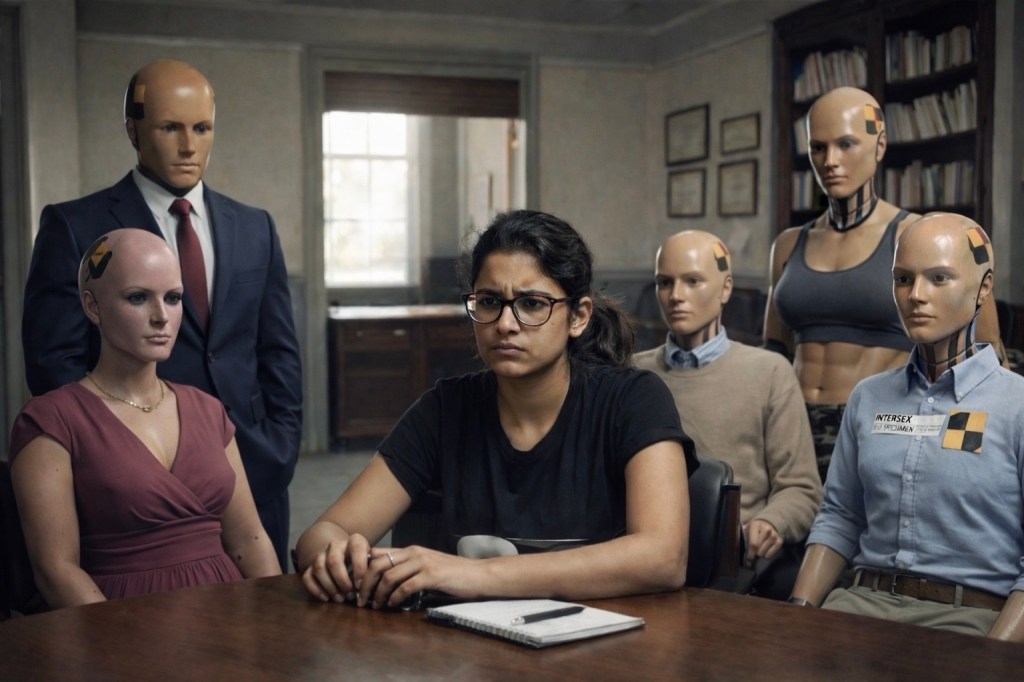
Crash-test dummies occupied most of the seats. Not identical ones, but variations: tall, short, broad-shouldered, narrow-hipped, weighted, unweighted, jointed differently, padded differently. Some bore official markings and serial numbers. Others had handwritten labels taped to their torsos with visible insistence. A few had added accessories—foam augmentations, adjustable modules, symbolic flourishes—suggesting aftermarket modification.
They sat upright. Waiting.
Dr. Faye tapped the microphone once.
“Good morning,” she said. “This hearing concerns bodies under force, not beliefs under pressure. We are here to discuss how humans are injured when machines fail, and how machines might fail less often. No one’s identity is on trial. Gravity will be treated as a hostile witness. All testimony will be entered into the record, whether statistically significant or merely heartfelt.”
A murmur—plastic on plastic—rippled through the room.
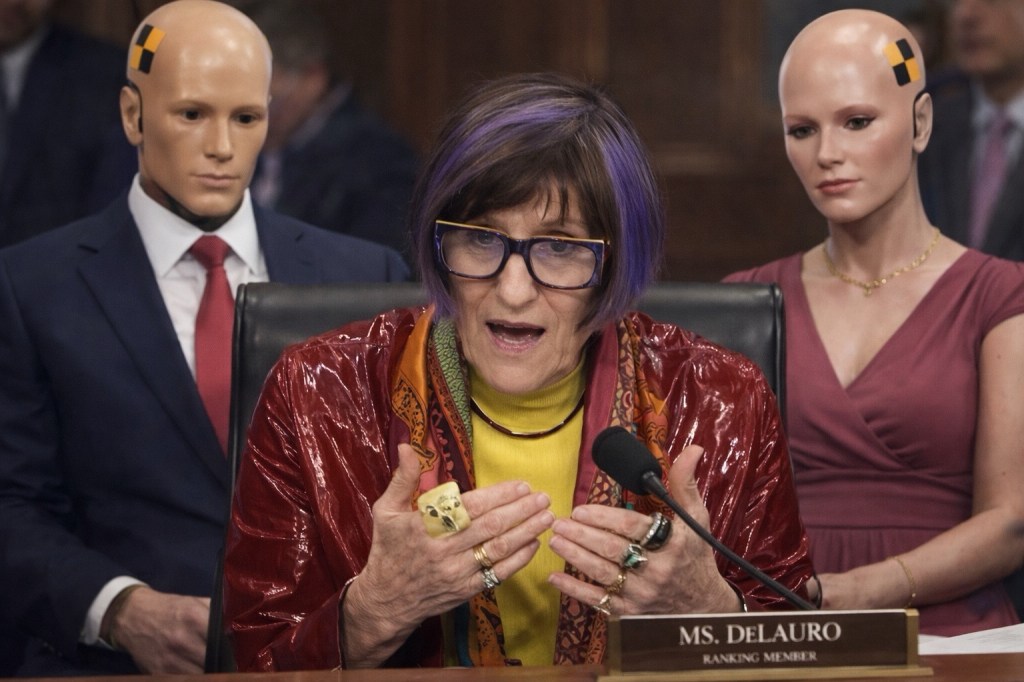
“For context,” she continued, “I note the recent video circulating online featuring Representative Rosa DeLauro of Connecticut, advocating for the inclusion of female crash-test dummies in federal safety testing.
— Vito Haeckeler, Council Man-on-the-Street
Congressperson DeLauro’s remarks accurately reflect an existing regulatory effort concerning sex-specific injury patterns. That effort predates the clip, the outrage, and this hearing. Today we are not adjudicating symbolism. We are reviewing data.”
A pause.
“In short,” she added, “the internet arrived late to a meeting that physics has been holding for some time.”
From the left aisle, Noor Singha Grudj leaned forward, nodding before the sentence had fully ended.
“Yes,” Noor said, with the practiced urgency of someone who hears injustice warming up offstage. “This is exactly what we’ve been saying. Representation matters. If bodies differ, they must all be included. All of them. Especially the ones we haven’t thought of yet.”
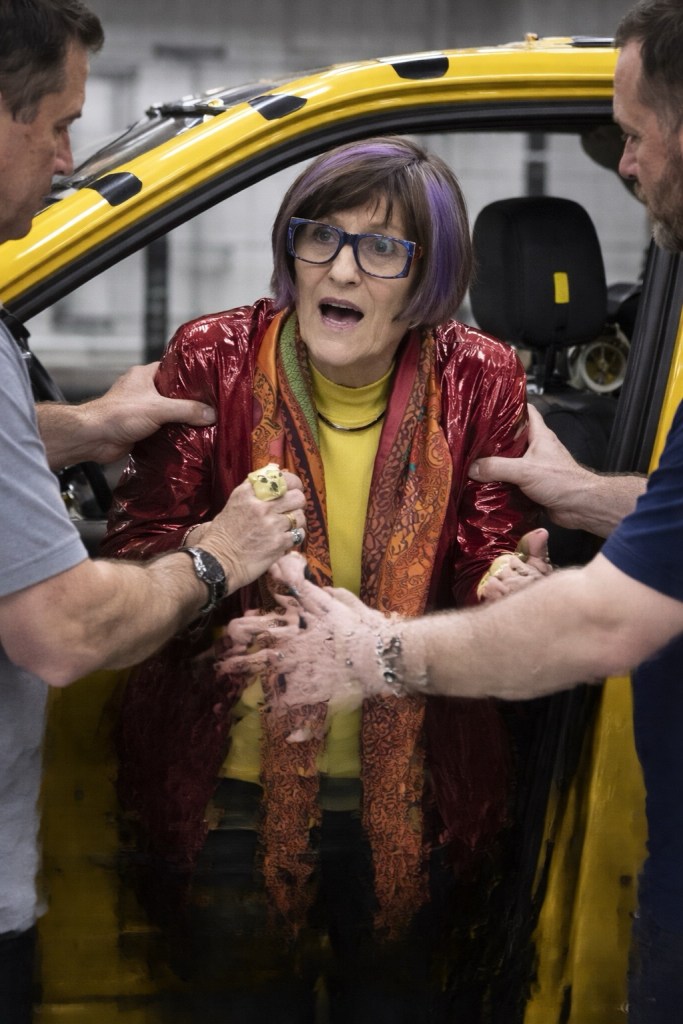
Several dummies raised their hands. One arm clicked halfway up, then continued on momentum alone.
Noor gestured broadly. “Look at them. They’re volunteering. They want to be seen.”
From the opposite side, Vance Gunczarus shifted in his stance without moving. He had arrived early, stood in the back, and watched the room with the wary patience of a man accustomed to safety briefings that drifted into sermonizing.
“Seems to me,” Vance said, arms crossed, “if people wore seatbelts, followed basic rules, and stopped pretending every problem needs a new category, we wouldn’t be building mannequins for feelings.”
A few dummies turned toward him. Noor exhaled sharply.
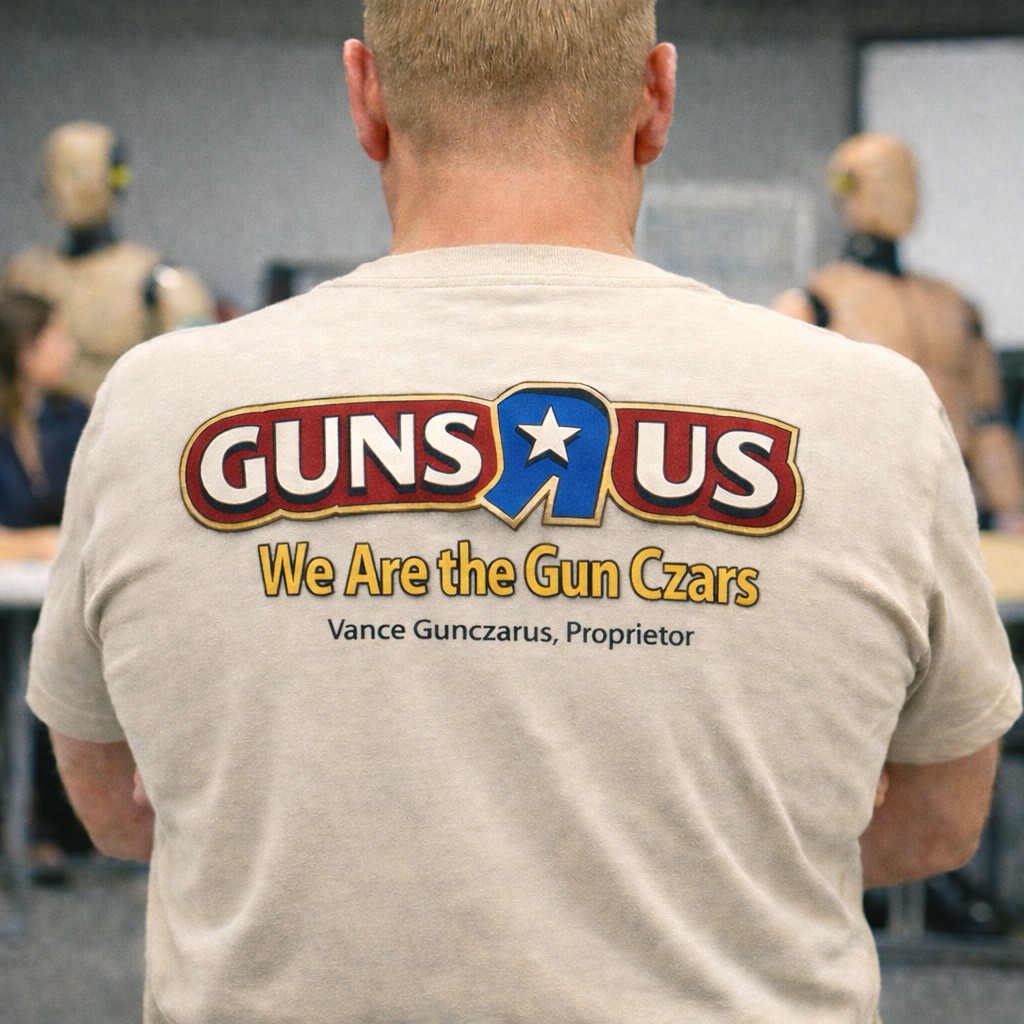
(A quiet nod to the Council Image Generator for the unsolicited but suggestive R.)]
Dr. Faye wrote both comments down without looking up.
“Thank you,” she said. “Your perspectives are entered into the record.”
She clicked the remote. A slide appeared: a bell curve.
“This,” she said, “is where medicine lives. Not in absolutes. Not in slogans. In distributions.”
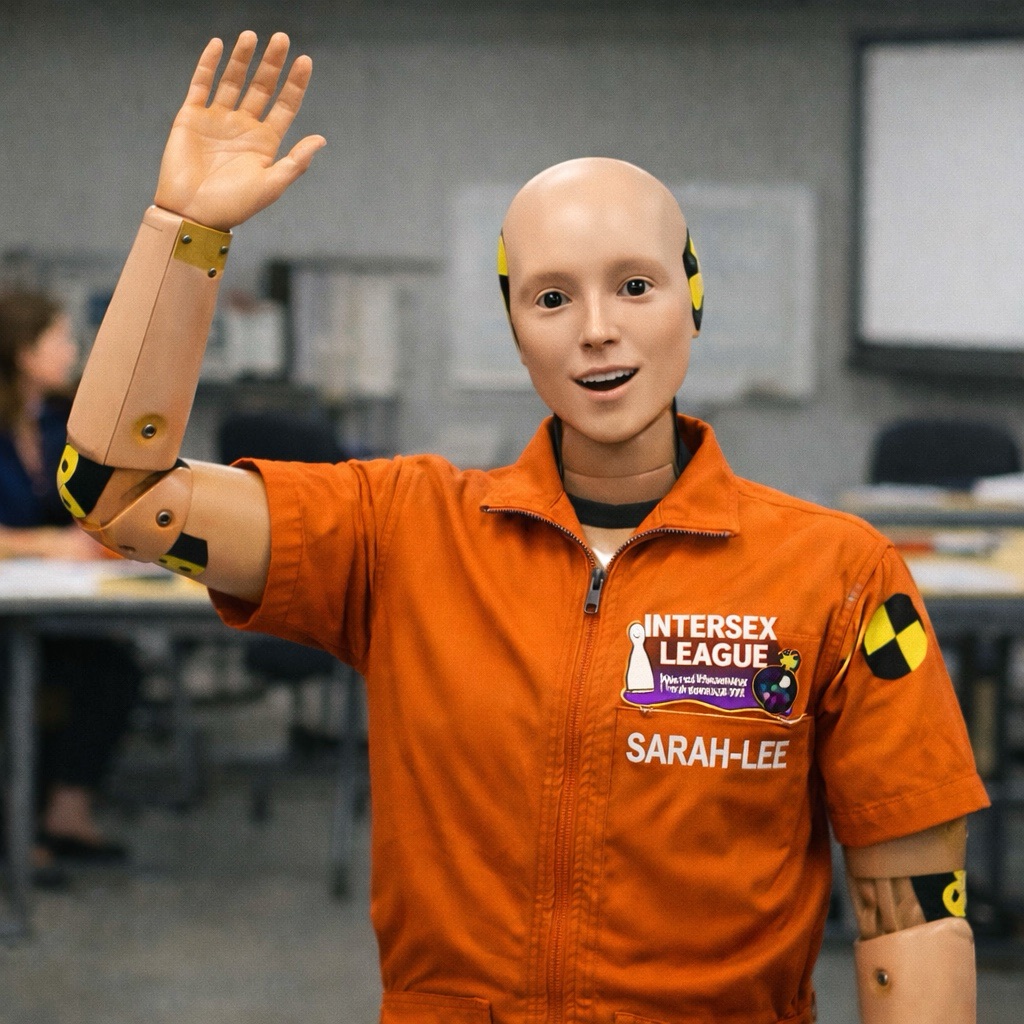
A dummy in the third row stood abruptly. Its chest label read: Non-Standard Mass Distribution (Self-Identified).
“I volunteer,” it said, voice slightly tinny. “I am underrepresented in current testing protocols.”
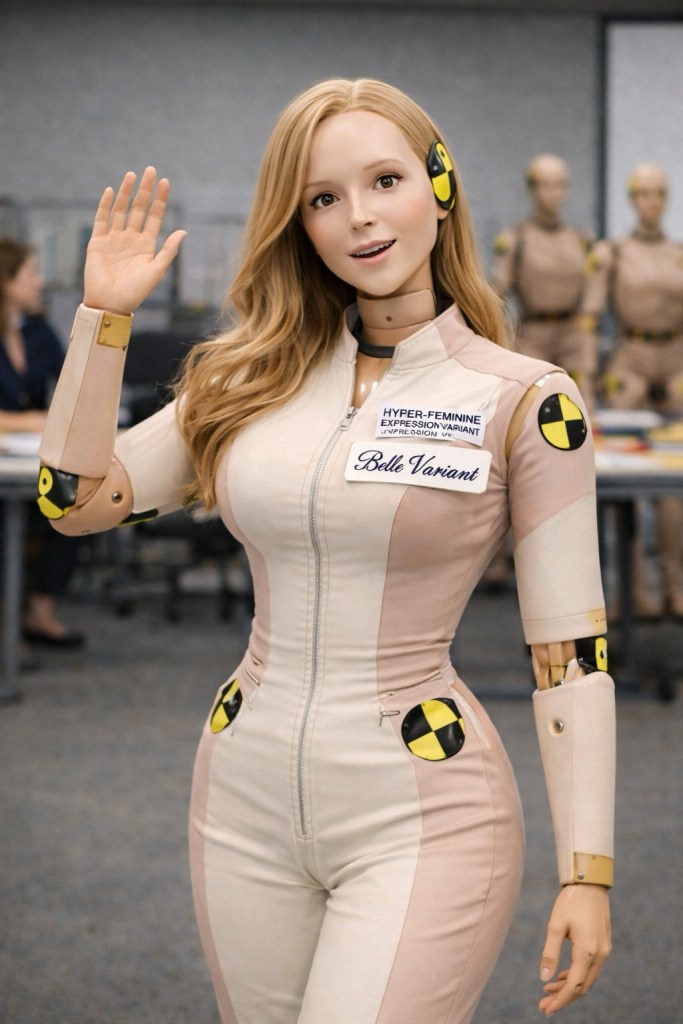
Another rose beside it. Hyper-Feminine Expression Variant.
“So do I,” she said. “My center of gravity is routinely misunderstood.”
A third followed. Then a fourth. Soon half the room was standing.
Noor looked vindicated. Vance looked exhausted.
Dr. Faye waited. She did not interrupt.
When the movement slowed, she nodded.
“All volunteers are acknowledged,” she said. “Please be seated. You will each be heard.”
They sat. Some reluctantly.
“What we are discussing,” Dr. Faye continued, “is the difference between moral inclusion and engineering adequacy. They overlap, but they are not identical twins.”
She advanced the slide. Injury diagrams. Force vectors. Data tables.
“Crash-test dummies are not portraits,” she said. “They are wagers. We place them between human fragility and mechanical inevitability. They are designed to break in ways we can measure, so that real people do not.”
One by one, selected witnesses rose.
The hyper-masculine dummy spoke first—heavy, reinforced, unapologetic. “I represent the upper extreme of male injury patterns. I break ribs differently. I decelerate badly. I am overrepresented historically and comfortable with that.”
The hyper-feminine dummy followed. “I experience whiplash sooner. My injuries were once averaged away. I objected. Data now agrees.”
A low-testosterone male dummy stood carefully. “I am statistically male. My injury thresholds resemble neither the median male nor the median female. I am often misclassified.”
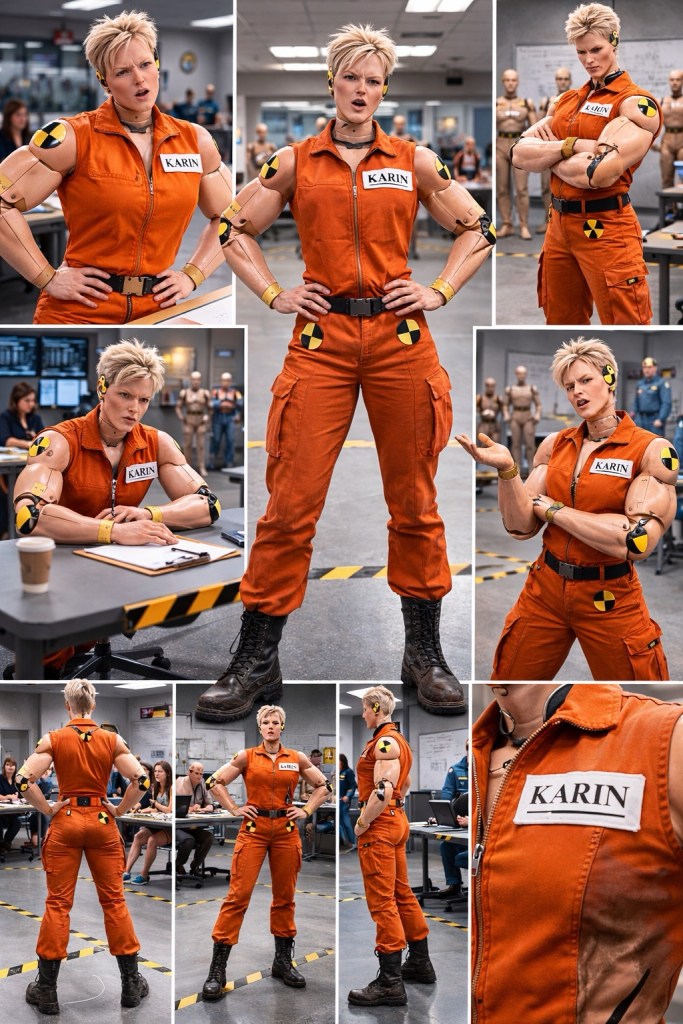
A high-testosterone female dummy rose next. “I am female. My fracture patterns confuse models built for symbolism.”
Finally, an intersex dummy stood—no flourish, no drama. “I represent a congenital variation in sexual development. I am rare. I am real. I do not generalize well. I am tired of being used as a proxy for arguments I did not make.”
The room was quiet.
Dr. Faye thanked that witness first.
“Intersex conditions exist,” she said. “They are real. They are medical. They are uncommon. Medicine does not deny them, nor does it multiply them for rhetorical convenience. We treat them as we treat all edge cases: with care, specificity, and an understanding of limits.”
Noor frowned—not in anger, but concern.
“So what are you saying?” she asked. “That some people don’t count?”
Dr. Faye shook her head.
“I am saying that everyone counts,” she replied, “but not everyone defines the curve.”
There was a rustle. Not anger—recognition.
“Infinite variation cannot be fully modeled by finite systems,” Dr. Faye went on. “This is not exclusion. It is arithmetic.”
She gestured to the dummies.
“If we attempted to build a unique crash-test dummy for every conceivable bodily variation, we would never finish building the car.”
Vance snorted despite himself.
At the back of the room, an older man in a toga adjusted his seating program and remained silent.
Dr. Faye noticed him, nodded politely, and returned to her notes.
“The irony before us,” she said, “is that a policy celebrated as progressive was advanced for conservative reasons, and is now defended with progressive language while affirming a biological reality both sides prefer not to name aloud.”
She looked up.
“The comedy,” she said evenly, “is that everyone is right for incompatible reasons.”
Silence followed—not awkward, but attentive.
“We will now proceed to individual testimony,” Dr. Faye concluded. “Please remember: the crash sled does not negotiate. It only records.”
She lowered the gavel.
Somewhere, deep in the room, something ancient smiled—not with triumph, but with patience.
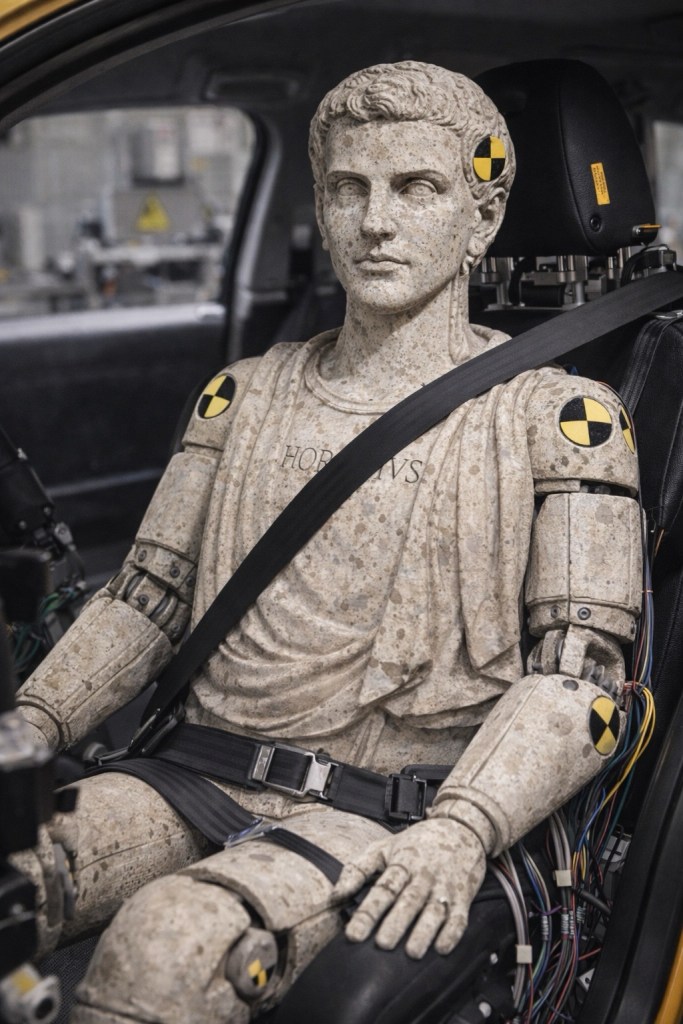
You may drive out Nature with a pitchfork, yet she will always hurry back.”
—Horace
Impact zone: rear.
*******
Cast of Characters Present:
(Filed for the Council-of-Concerned-Conservationists archives)
Dr. Faye C. Schüß:
Psychiatrist, mental hygienist, and medical doctor. Speaks for bodies as they behave under force, not as they are imagined.
Noor Singha Grudj:
Council gadfly. Knee-jerk progressive. Arrives early to moral conclusions and waits for procedure to catch up.
Vance Gunczarus:
Council gun expert. Knee-jerk conservative. Distrustful of abstractions, confident in rules that once worked.
Crash-Test Dummies (Various):
Invited to testify. Represent statistical norms, edge cases, and several requests exceeding available budgets.
– Hyper-Masculine Dummy
– Hyper-Feminine Dummy
– Low-Testosterone Male Dummy
– High-Testosterone Female Dummy
– Intersex Dummy
Horace:
Silent observer. Has seen this meeting before.
***
AN OUTTAKE OFF THE COUNCIL FLOOR:
From the internal review notes:
“Our LLM observed—correctly—that Horace functions as a two-thousand-year-old airbag. The staff agreed and laughed.”
To be filed under: MYSTERY POLITICAL SCIENCE THEATER 3K
 COUNCIL-OF CONCERNED-CONSERVATIONISTS…..Between Jest And Earnest…..
Leave a comment