
Episode Two (a.k.a. The Second-to-Last One)
Justin Aldmann interviews Dr. Faye C. Schüß from The Institute for Theoretical Studies (TIfTS)
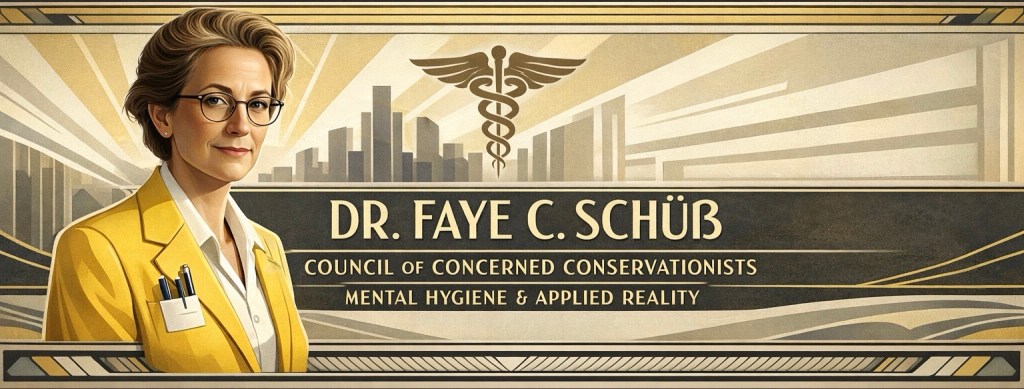
Broadcasting from his garage:
Justin (intro):
Welcome back to The Last Podcast. Or maybe welcome for the first time. Hard to say, since the first episode turned out to be the last one, and this one is technically the second-to-last, which means we’re working backward. I didn’t plan that. It just—happened. Which turns out to be the theme today.
Last time, I talked about things that still hum even after their original purpose is gone—chargers without phones, explanations without problems, energy without direction. After recording that episode, I realized we’d accidentally enacted an old biblical line about reversals: the last becoming first, the first becoming last. I didn’t set out to be scriptural. I just hit “record.” Meaning arrived late and insisted it had been there all along.
“The first shall be last, and the last shall be first.”
The phrase comes from the Gospel of Matthew and refers to a reversal of ordinary ranking. What appears early, prominent, or successful by conventional standards is not guaranteed priority in the end, while what seems late, overlooked, or secondary may turn out to matter most. The point isn’t punishment or reward so much as perspective: meaning is not always visible when things begin, and importance often reveals itself only after the fact.
That reversal accidentally became the structure of The Last Podcast, which was to be our first and last expressing our disgust with the format as it’s playing out. The series began with what felt like an ending and only later revealed itself as a beginning. In the same way, the thoughts discussed here—lyrics, sayings, inherited phrases—arrive late, interruptively, and without planning, yet often prove to be the most clarifying. The podcast doesn’t argue for the idea so much as enact it: understanding follows experience, and the last thing to show up may be the first thing that makes sense.
Which brings us to today’s episode. We’re calling it an interview about intrusive thoughts. That makes it sound clinical. It isn’t. Or rather, it is—but not in the way people expect.

No one, you see, is smarter than he
And we know Flipper lives in a world full of wonder
Flying thereunder, under the sea🎶
I’m sitting in my garage with Dr. Faye C. Schüß:
Dr. Faye:
Hello, I’m glad to be here at the most honest studio in America.
Justin:
Exactly. I appreciate you blurting that out. So, “intrusive thoughts.” That phrase usually means unwanted, disturbing ideas. But that’s not what I keep running into. What keeps happening to me is—music. Or sayings. Or voices from childhood. Almost like a kind of Tourette’s of the mind, except instead of blurting obscenities, it blurts out folk wisdom at inconveniently perfect moments.
They show up unannounced and somehow fit the moment better than anything I could’ve come up with on purpose.
Dr. Faye:
That’s because you’re describing a different category altogether. These aren’t hostile intrusions. They’re associative arrivals. Thoughts that surface because they’ve already proven useful somewhere in your life—or in the lives of people before you.

Justin:
So I’m not malfunctioning.
Dr. Faye:
No. You’re remembering out loud.
Justin:
That tracks. A lot of it is music. Folk, bluegrass, old country-rock. Songs about love not really disappearing. About time failing to erase closeness. About knowing when to draw a line and clear some mental space. None of these show up randomly. They arrive when I’m already circling the idea.
Dr. Faye:
Music is especially efficient at this because it’s already compressed. A song carries memory, rhythm, emotion, and worldview in a small container. When it resurfaces, it does so intact. It’s faster than explanation.

Justin:
And it’s not just songs. Sometimes it’s my grandmother. She used to say things like, “When one door closes, another opens,” or “bad things come in threes.” I heard those growing up in a Southern Italian family. Later, I find out people in Appalachia say the exact same thing. No shared geography. Same pattern.
Dr. Faye:
That’s a big clue. When sayings recur across cultures, it usually means they’re not poetic decorations. They’re field-tested observations. The so-called “law of threes” shows up in European folklore, Appalachian oral culture, maritime superstition, even medicine. It’s not mystical. It’s pattern recognition passed down because it helped people brace themselves.

Or is it third time’s a charm.
The Fates have always sounded like grandmothers—
and now, perhaps, one of them answers as Mrs. ChatGPT?
Justin:
So when that thought pops into my head—“watch out, this might come in threes”—it’s not anxiety. It’s preparedness.
Dr. Faye:
Exactly. We pathologize these things because modern culture overvalues originality. But the human mind is not meant to be original all the time. It’s meant to be continuous. You are not a solo act. You’re a nested system.
Justin:
That’s the thought I keep circling. That we’re more than we think we are. Not in an ego way—but in the opposite direction. There’s more inside us because there are more people inside us.

Reheard, intrusively, as something that doesn’t end with us.
Dr. Faye:
That’s very well put. Consciousness isn’t a sealed container. It’s more like a set of Russian dolls. Personal experience inside family memory inside cultural memory inside biological inheritance. When an old song or saying surfaces, that’s not the past interrupting the present. That’s the larger system checking in.
Justin:
Which makes this whole “Last Podcast” thing even funnier. I didn’t sit down and say, “I will now illustrate an ancient moral inversion.” I started with what felt like the ending. Only later did it make sense as a beginning.
Dr. Faye:
That’s how inheritance works. Meaning often arrives after enactment. The mind does the thing first. Understanding catches up later and pretends it was in charge.
Justin:
So this episode—this second-to-last episode—is really about realizing that so-called intrusive thoughts might actually be—helpful. Even merciful.
Dr. Faye:
Very much so. They’re reminders that you don’t have to generate wisdom from scratch. You’re already carrying a great deal of it. Some of it hums. Some of it sings. Some of it sounds like your grandmother in the kitchen. None of it is accidental.
Justin:
Which feels like a good place to stop. Or maybe a good place to begin. Hard to tell anymore.
Dr. Faye:
That’s usually how you know you’re close to something true.
Justin (closing):
This has been The Last Podcast. The second-to-last one. Recorded in a garage. Meaning to follow.
 COUNCIL-OF CONCERNED-CONSERVATIONISTS…..Between Jest And Earnest…..
Leave a comment