—A Field Note on Archetypes in American Media
There was a time when America kept its tricksters small.
They were green. Amphibious. Whispering from the margins. Froggy from The Andy Devine Show did not overthrow anything. He snickered. He nudged. He destabilized safely.
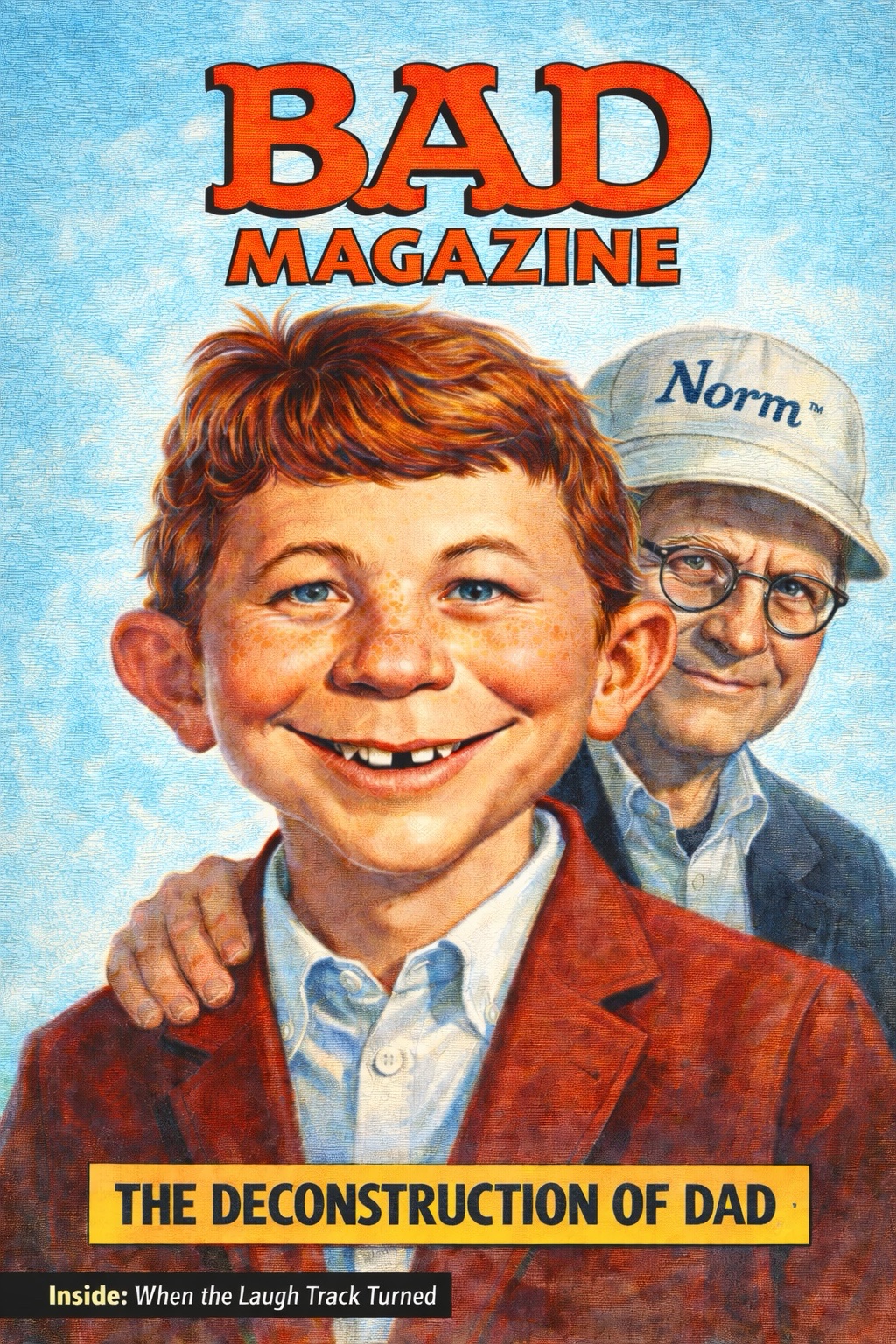
Then came the freckled grin of Alfred E. Neumann, the eternal boy who fronted Mad Magazine. MAD did something quietly revolutionary: it trained middle America to laugh at authority. Presidents, generals, advertisers, cultural sacred cows — all were eligible for deflation.
The Trickster had gone mass-market.
At roughly the same time, American television offered a counterweight: the Father—Calm—Measured. A cardigan philosopher presiding over the suburban hearth. In Father Knows Best and its cousins, the paternal archetype embodied steadiness. He absorbed disorder and restored equilibrium by the closing credits.
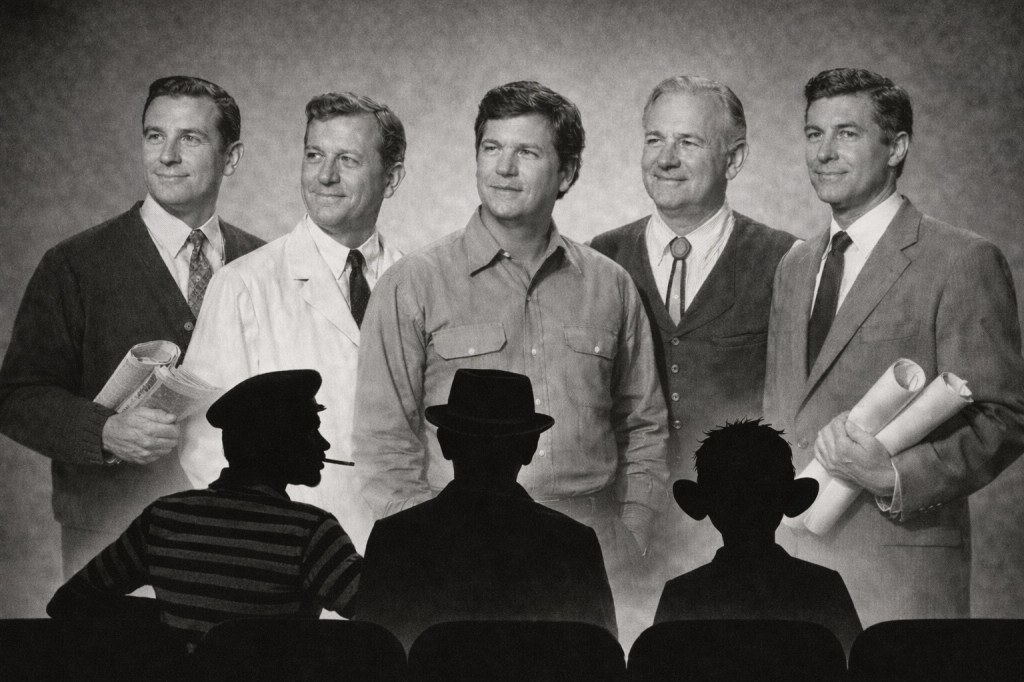
Two archetypes coexisted:
The Trickster and the Father.
Mischief and Order.
Then the ground shifted.
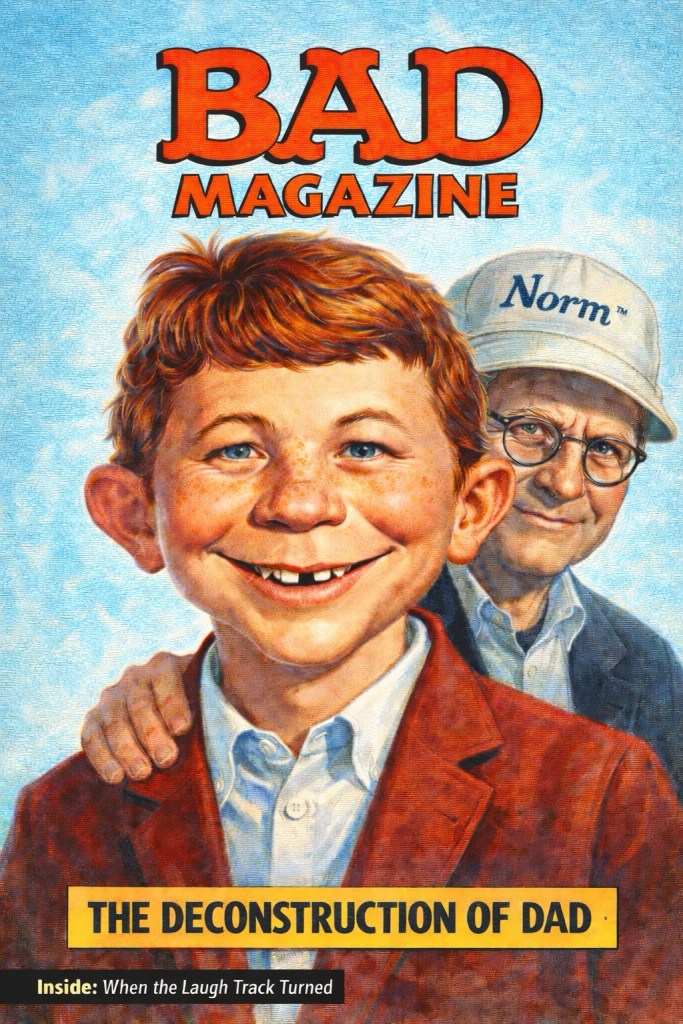
By the 1970s, under figures like Norman Lear, the Father himself was deconstructed. In All In The Family, authority became loud, flawed, sometimes ridiculous. The old stability was interrogated in prime time. Satire moved from the margins to the living room.
Irony became a civic language.
For decades thereafter, skepticism was expressed primarily through mockery. Late-night monologues. Editorial cartoons. Meme culture. The Trickster dominated the air.
But archetypes do not vanish. They recombine.
When irony saturates a culture, something curious happens. Laughter loses edge. Mockery becomes background noise. In such moments, a different hunger emerges — not for naiveté, but for steadiness that has already passed through skepticism.
Enter the Watchful Father.
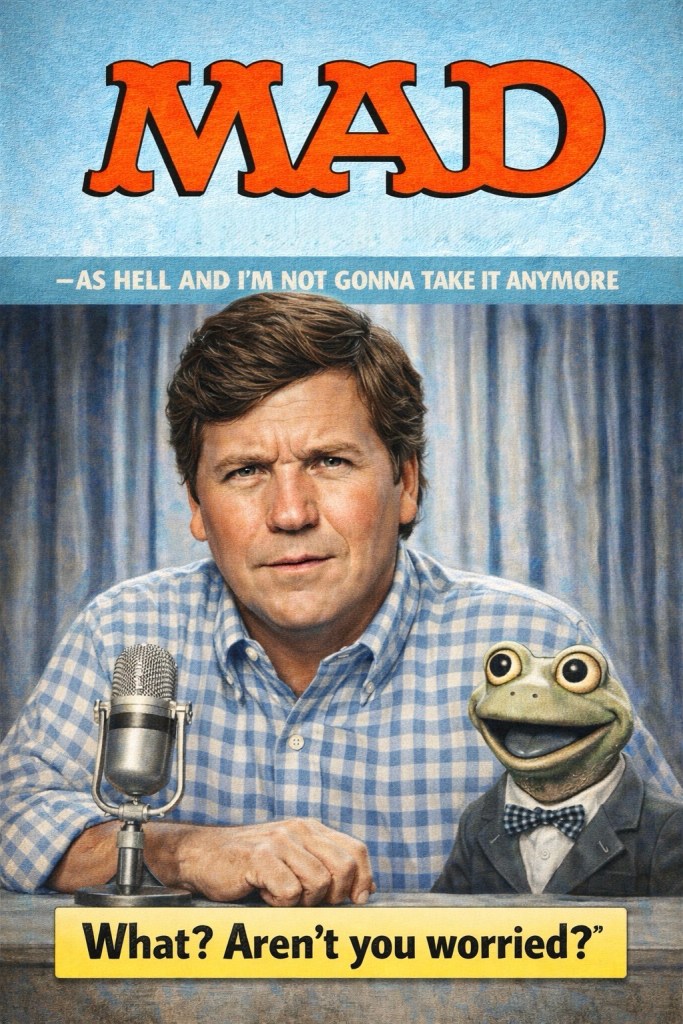
In the current media landscape, Tucker Carlson occupies, for many, that space. Not the cardigan patriarch of the 1950s, untouched by doubt. Nor the satirical jester of mid-century print. Rather, a figure who projects composure while openly challenging institutional narratives. And yet, beneath the fatherly steadiness, there remains a trace of boyish impishness — the raised eyebrow, the half-smile — as if the gap-toothed trickster of an earlier era has been transmuted rather than discarded. The irreverence once aimed at middle-class conformity now pivots in a different political direction, folded into a posture of watchfulness rather than mockery.
He does not only grin at the system.
He interrogates it.
To supporters, this posture reads as courage — a willingness to confront entrenched power without theatrical rage. To critics, it reads differently. But regardless of vantage point, the archetype is visible: a paternal tone shaped by an age that has already digested decades of satire.
This is not the return of the 1950s.
History does not reverse.
It is the re-emergence of a stabilizing figure in a culture fatigued by permanent irony.
Meanwhile, the Trickster never left. He merely molted. In contemporary culture — and in our own pages through characters like Pepe — the amphibian impulse persists. A wink here. A destabilizing aside there. The frog still whispers. The grin still flickers.
Healthy cultures require both.
Which brings us, symbolically, back to MAD.
Imagine a cover. The masthead unchanged: MAD.
But the expression has shifted. Not wild-eyed. Not vacant. Not sneering. Instead, alert. Focused. Slightly incredulous.
MAD not as “crazy,” but as morally awake.
In the mid-twentieth century, America’s conscience wore freckles and shrugged: “What, me worry?”
In our time, that conscience may wear a checkered shirt or tie, raise an eyebrow, and ask a different question:
“What are they doing?”
So maybe, instead of, “What!? Me Worry?” it is: “We Should Be Worried!”
The archetypes remain.
They have simply changed costumes.
The frog remains.
***
We humbly invite you to patronize our sponsor below, just as we have patronized you. Do unto others as you would have them do unto you — especially when others are underwriting page 65.
Gold, as ever, remains the standard

More from Eugene Bodeswell, Council Ethnographer
 COUNCIL-OF CONCERNED-CONSERVATIONISTS…..Between Jest And Earnest…..
Leave a comment