—Field Notes on an Indispensable Human Instrument
Every tribe possesses tools it does not formally acknowledge.
Some are physical—nets, knives, missiles, or fire. Others are cognitive—small instincts refined over thousands of years of not getting killed. One such instrument has been hiding in plain sight inside the English language. It is a small word, blunt and efficient:
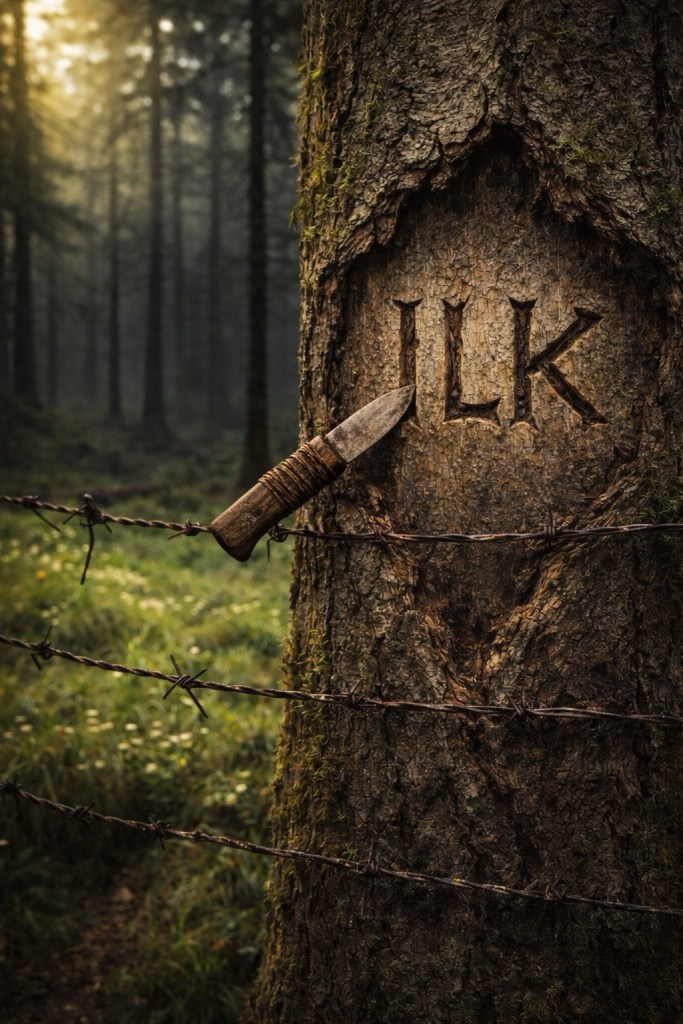
In modern usage the word means a type or kind, often spoken with a slight narrowing of the eyes: “people of his ilk.” Yet the word began its life more innocently. It derives from the Old English ilca, meaning simply “the same.”
The Scots preserved this original meaning in the old phrase “of that ilk.” A laird might be called MacDonald of that ilk, meaning MacDonald of the same place that bore his name.
Over time the meaning drifted. “The same” became “that sort.” A subtle but revealing shift. The word moved from identity to classification.
From an ethnographic perspective this shift is not accidental.
Human beings possess what this correspondent has provisionally termed the ILK Faculty, an ancient cognitive instrument best rendered as an acronym:
I.L.K. — Instinctive Lineage Knowledge
This faculty allows rapid recognition of shared customs, loyalties, habits of speech, and other small but decisive signals of belonging. It is the quiet mechanism by which humans determine, often in a matter of seconds, whether another person is likely to be friend, foe, stranger, guest—or trouble.
Tribes lacking this faculty rarely persist long enough to produce ethnographers.
Interestingly, the word itself physically reenacts the act it describes. When spoken aloud, ilk performs a small choreography in the mouth—almost a mini act of revulsion.
The vowel opens the sound. >Observation.
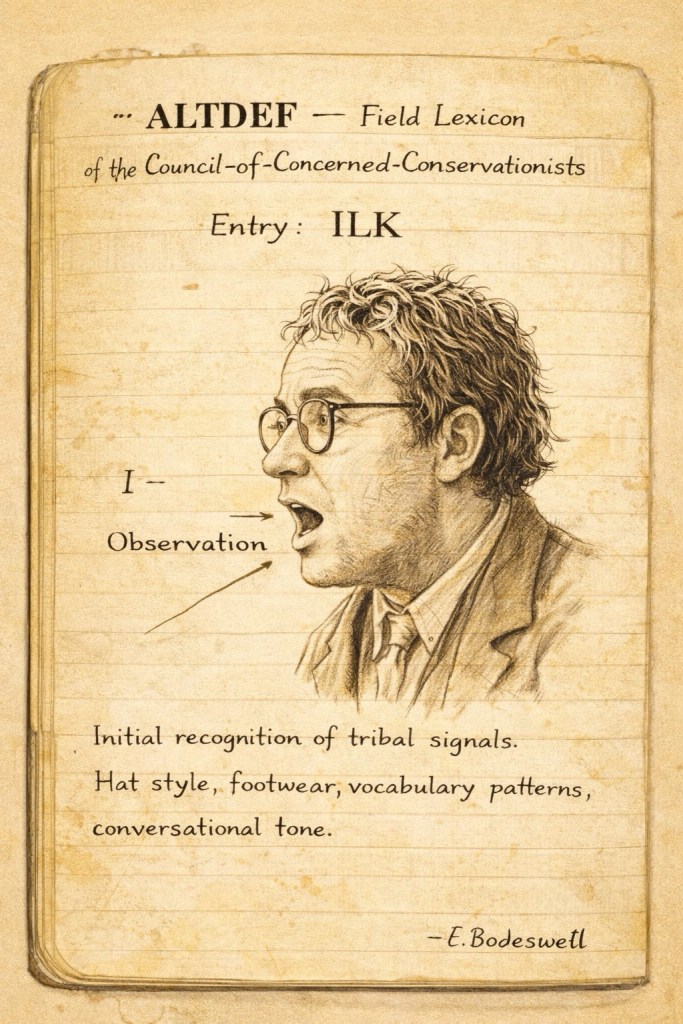
The tongue pauses briefly against the ridge. >Evaluation.
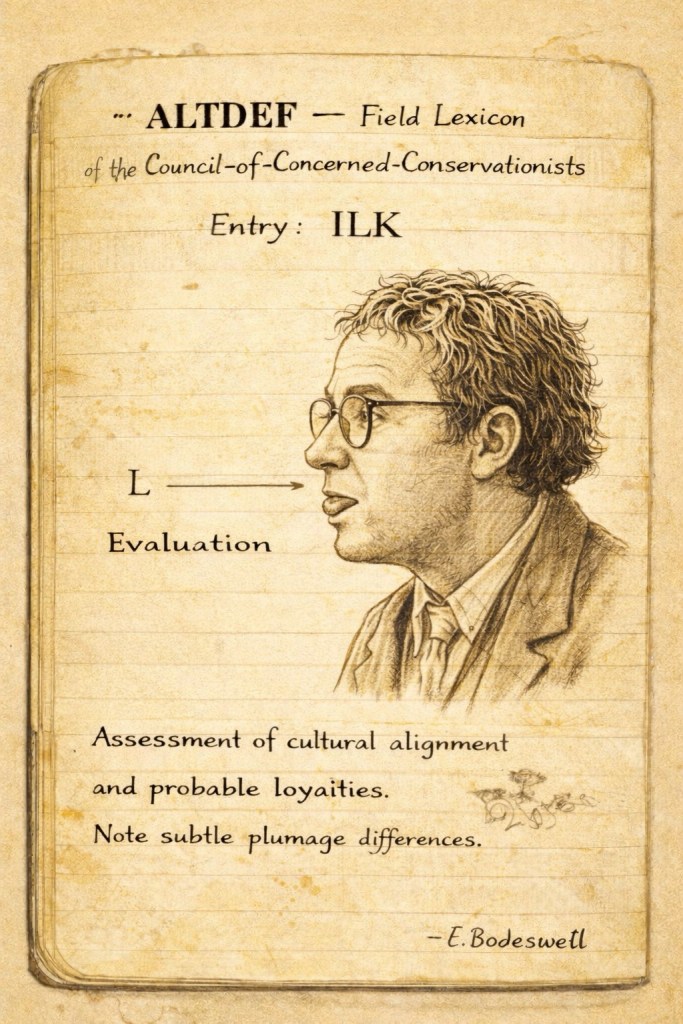
The back of the tongue closes with the hard k—classification. A warning to others and one’s own ilk alike.
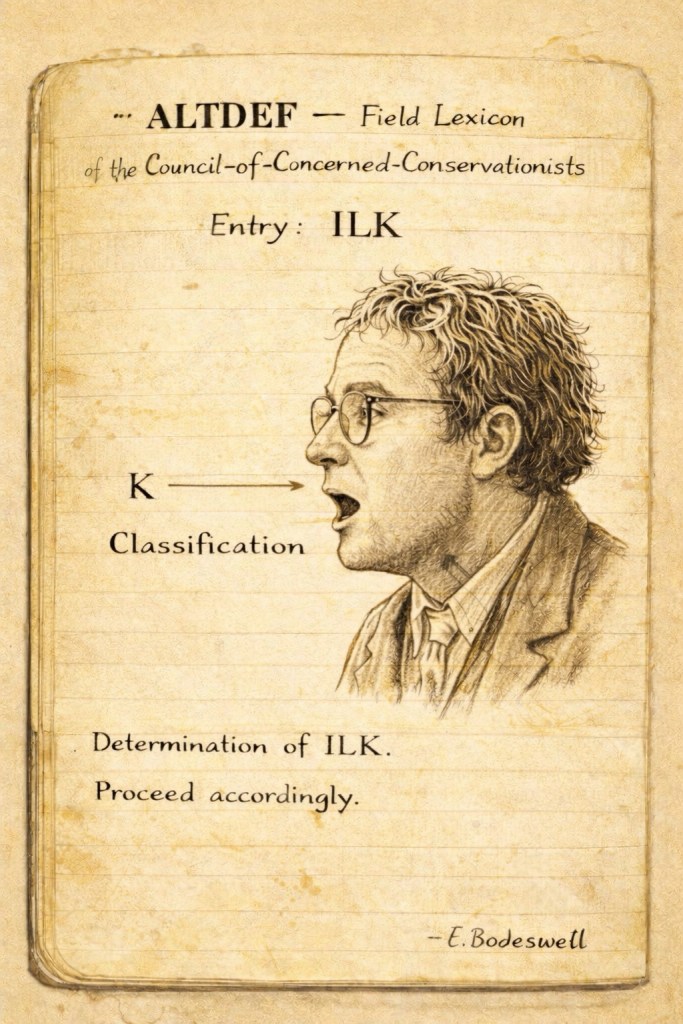
Observe. Assess. Conclude.
The word is, in effect, a miniature ethnographic procedure.
Modern commentators sometimes claim that such classifications are relics of a primitive age, that categories themselves should be dismantled. Yet prolonged observation suggests something rather different. Those most eager to deconstruct categories tend to assemble—quite energetically—with others of their ilk who share their language, assumptions, and moral signals.
In short, they possess an ILK⃝ of their own.
The instrument has not been abolished. It has merely been recalibrated.
The Council-of-Concerned-Conservationists therefore proposes a modest clarification for the public record: the ILK Faculty is not a defect in human perception but a survival mechanism—one that has served tribes, villages, guilds, and republics for a very long time.
Civilization, properly understood, is not the disappearance of ilks.
It is the ongoing negotiation between them.
***
This correspondent submits that the wise observer does not pretend the instrument does not exist. He merely learns to recognize it—both in others and, with some humility, in himself.
Which, upon reflection, may reveal that the ethnographer too belongs unmistakably to an ilk of his own.
***
More from EUGENE BODESWELL
 COUNCIL-OF CONCERNED-CONSERVATIONISTS…..Between Jest And Earnest…..
Leave a comment