—A Council-of-Concerned-Conservationists Field Dispatch:
Colleagues,
A recent scientific report notes that chimpanzees display a marked fascination with crystals.
Smithsonian magazine: Chimps Seem to Love Crystals. Their Attraction Might Help Explain Humans’ Obsession With the Shimmering Stones
When presented with a dull rock and a multifaceted quartz specimen, the chimps immediately selected the crystal, lifted it toward the light, examined it carefully, and eventually carried it back to their sleeping quarters as a treasured possession.
Researchers described the behavior as surprising.
Members of the Council’s ethnographic division described it as recognizable.
Anyone who has wandered through a New Age crystal boutique has witnessed a very similar primate ritual:
The subject approaches the display table. The subject lifts the quartz. The subject turns it toward the light. The subject pauses thoughtfully.
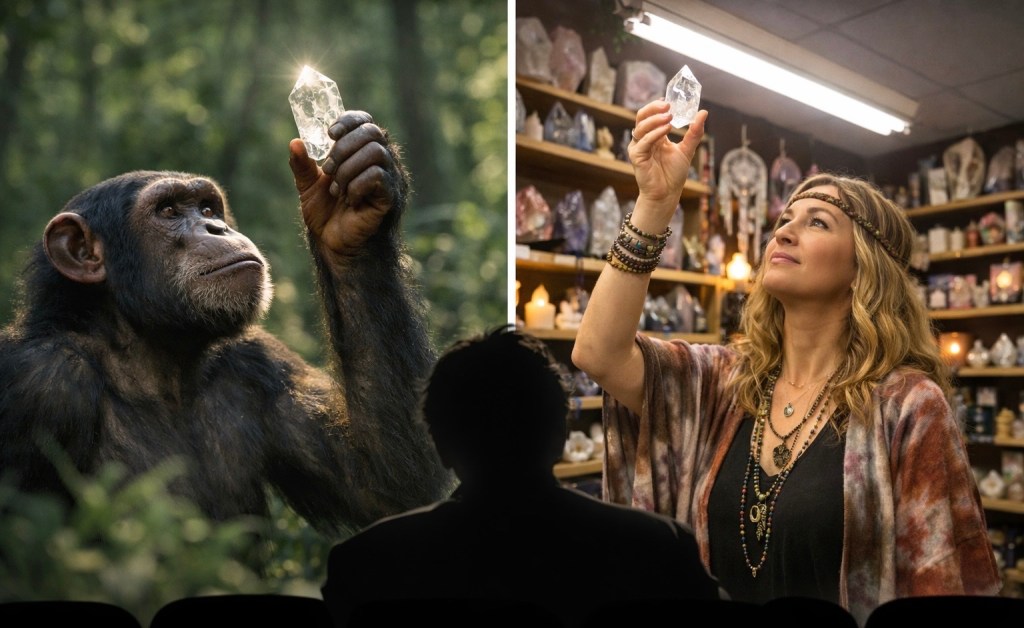
The subject returns home with the object and places it near the bed.
In this respect, chimpanzees and humans appear to share a deep evolutionary instinct: if something sparkles in a geometrically satisfying way, it deserves immediate attention and possibly a small altar.
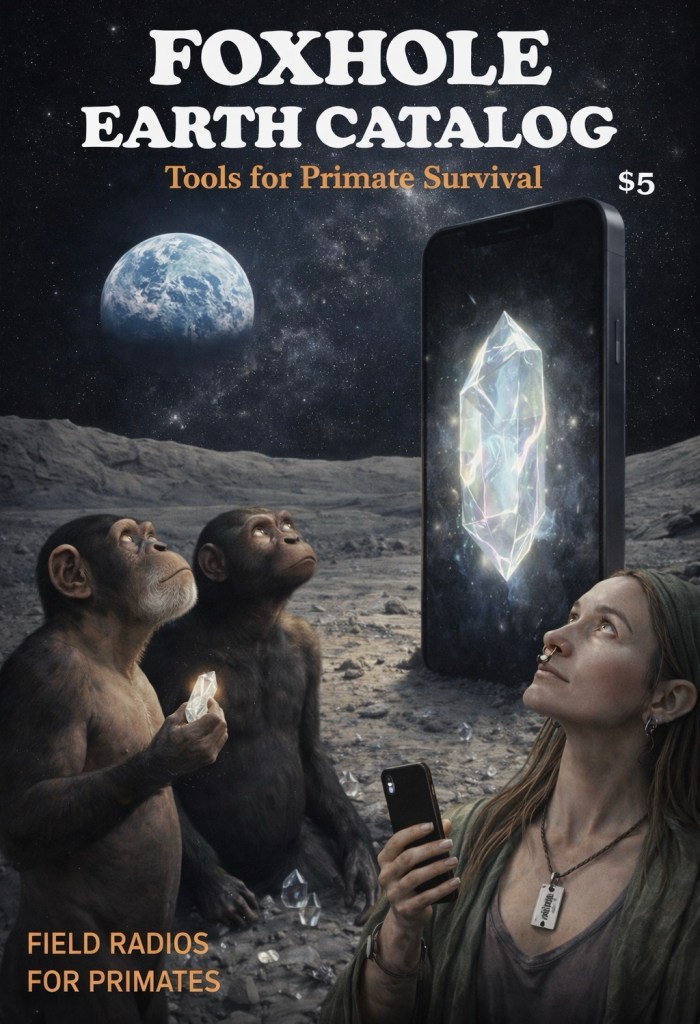
But the story becomes even more interesting when we introduce the bonobo.
Chimpanzees, as primatologists often note, are somewhat territorial and hierarchical creatures. When they discover a valuable object, they tend to claim it. The crystal becomes their crystal. A trophy. A possession. Something to guard.
This, one might say, represents the chimp stage of crystal culture.
But bonobos—our other close relatives—operate very differently. Their societies are famously cooperative, socially affectionate, and deeply invested in maintaining group harmony. Tension is defused through bonding, sharing, and a general atmosphere that researchers politely describe as “prosocial.” It must also be said—usually in the smaller print of the primatology textbooks—that bonobos are famously promiscuous and broadly bisexual, using an impressive range of affectionate encounters as a form of social diplomacy. Harmony, in bonobo culture, is not merely a concept; it is an activity.
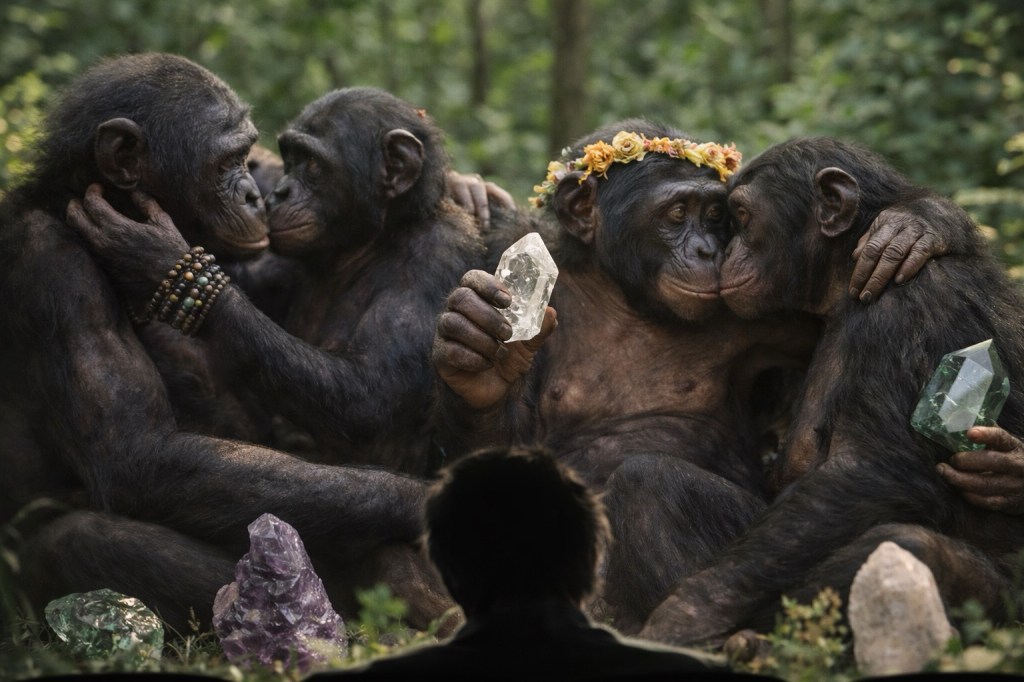
In other words, bonobo society runs less like a competition and more like a very relaxed community gathering in Sedona.
One begins to see where this is going.
Because if the chimps represent the possessive phase of crystal enthusiasm, the bonobo model maps almost perfectly onto the human New Age crystal community.
Observe the parallels:
Chimpanzee crystal culture:
“I found the shiny rock. It is mine.”
Bonobo-style crystal culture (hypothetical but plausible):
“The shiny rock belongs to the group. Let us pass it around and barter for favors to maintain social harmony.”
Human New Age crystal culture:
“This quartz point is helping the collective energy of the room.”
At this point the Council must consider a bold hypothesis.
Perhaps the modern crystal enthusiast is not imitating chimpanzees at all.
Perhaps they are instinctively reenacting bonobo culture with better lighting.
The crystals are placed in circles. The participants sit calmly. Everyone speaks about alignment, harmony, and shared energy.
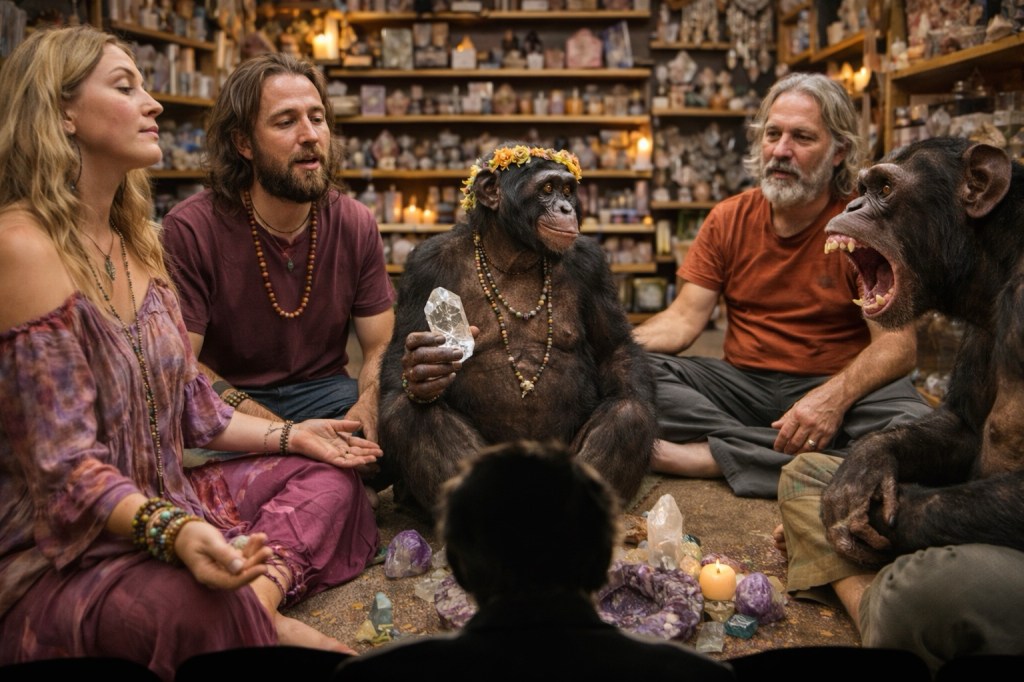
From an anthropological perspective this is remarkably similar to what one would expect if bonobos discovered geology and interior decorating.
Now before the Council dismisses the entire matter as incense-scented primatology, we must acknowledge a complication.
Crystals genuinely possess extraordinary physical properties.
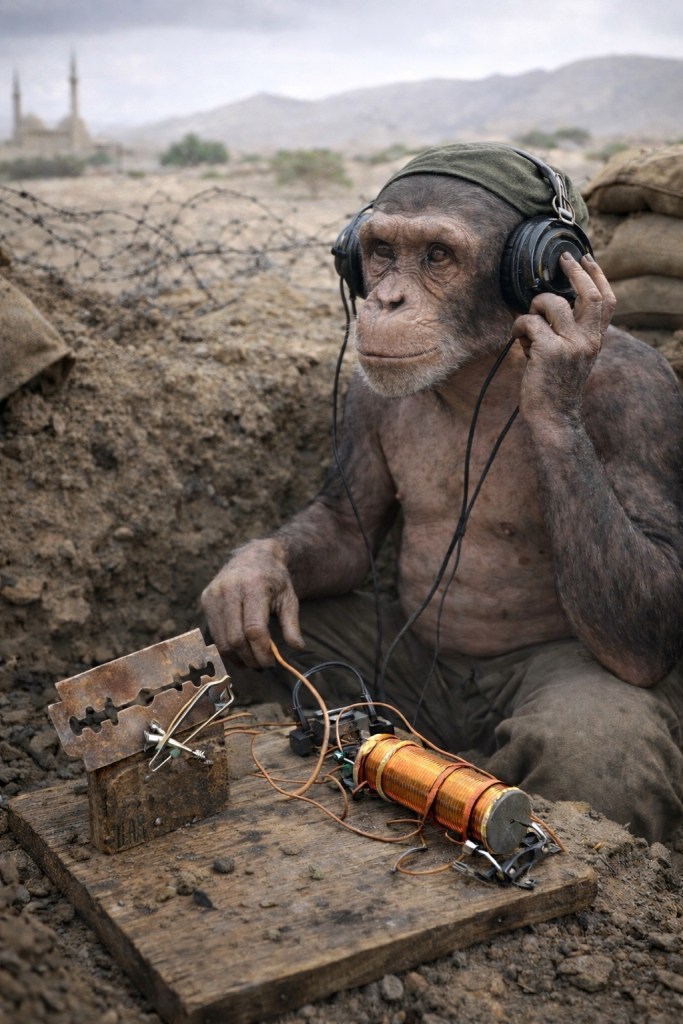
A crystal radio detector can turn invisible radio waves into audible sound without batteries.

Quartz crystals vibrate at precise frequencies and regulate clocks and watches with uncanny accuracy. Silicon crystals organize electrons so efficiently that they form the basis of every computer chip on Earth. Certain crystals even focus and amplify light to create lasers.
So while the New Age explanation may be poetic, the engineers have quietly demonstrated something even stranger.
Crystals do, in fact, shape invisible forces.
They organize radio signals.
They stabilize time.
They guide electricity.
They sculpt light itself.
In short, the mystics selected the correct object. They simply guessed the wrong mechanism. Which leaves us with three observable primate responses to crystals:
Chimpanzee:
“Ooo. Shiny. Mine.”
Bonobo:
“Ooo. Shiny. Let us share the experience together.”
Human engineer:
“Ooo. Shiny. This will regulate the global communications infrastructure.”
Meanwhile the New Age crystal circle appears to represent a kind of bonobo renaissance, a social experiment in cooperative primate geology.
The chimpanzees collect crystals because they sparkle.
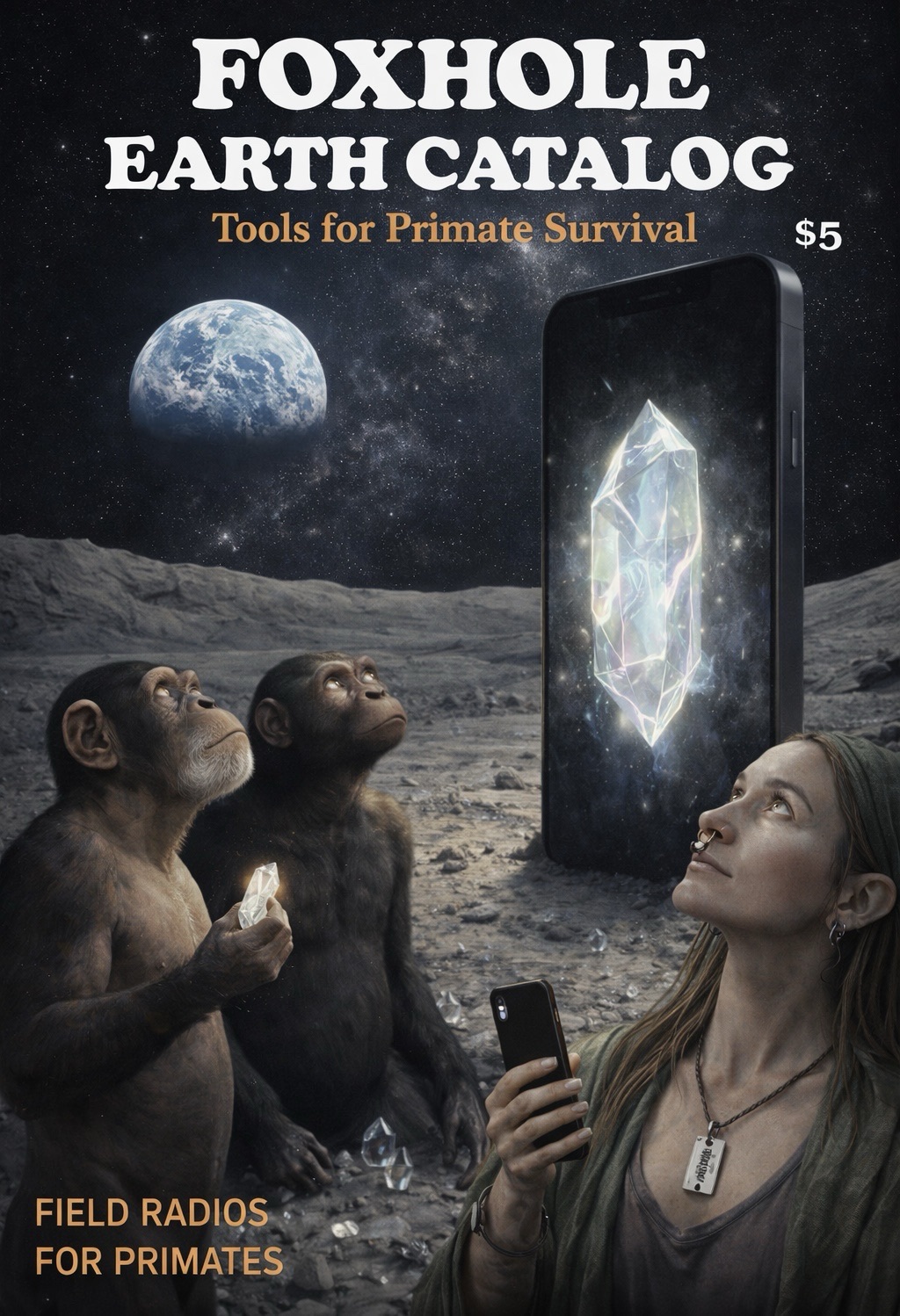
Human civilization began with roughly the same instinct. The next step, historically speaking, involved radios, microchips, and lasers. The Council therefore recommends keeping a polite eye on the chimps’ research program.

And so, engineers collect crystals because they run the technological world.
The bonobo-minded humans collect crystals because they help everyone feel better about both of those facts.
From the Council’s vantage point, this arrangement may represent one of the more charming outcomes of evolution: three closely related primates, each discovering the same shiny rock and building an entirely different culture around it.
Respectfully submitted,
Eugene Bodeswell
Ethnographer-at-Large
Council-of-Concerned-Conservationists
***
 COUNCIL-OF CONCERNED-CONSERVATIONISTS…..Between Jest And Earnest…..
Leave a comment