A Missing Fragment from:

We recently discovered a missing piece from Episode 4 of The Twilight End Zone.
How could we have forgotten Mrs. Swanström. . .

She was a thin, fine-featured Nordic-presenting woman in her forties who lived in the apartment just below ours. Prim and proper would describe her well. She was either a teacher or a secretary who lived alone—most of the time.
That is, except when her merchant seaman husband returned.
He was a very boisterous, jolly, ruddy fellow who was fond of handing out five-dollar bills to little kids. My blond younger sister was his favorite. He claimed she looked Norwegian and got a kick out of the fact that we were Southern Italian. Meeting Mr. and Mrs. Swanström on the stairway landing was always fun because the pair were often inebriated—though in the good version of that state.
I especially liked the generosity part.
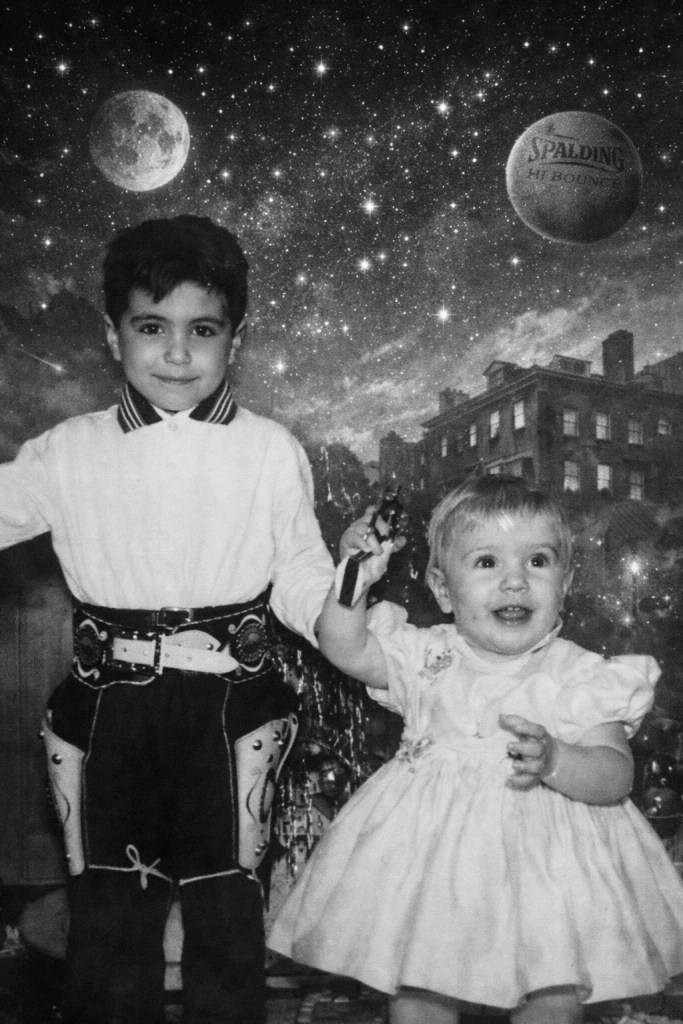
Mr. Swanström must have made a good living as a merchant seaman. He was a cook and reminds me now of that muppet, the Swedish Chef.
Whenever he returned from sea—which was not frequently—our neighbors below would create quite a ruckus. To my young ears it sounded like the rhythmic moving of furniture, followed by laughter and loud guffawing through all hours of the day and night. My mother would have an embarrassed smirk when she observed me noticing.
Those two really enjoyed themselves until the short leave ended and the sea called again.
This was all the more incongruous because Mrs. Swanström herself was such a delicate and proper lady. Think classic stereotype of a librarian. She wore thin-framed glasses with one of those little chain cords attached.
But the truly spooky part was her apartment.
One time my mother agreed to tend Mrs. Swanström’s parakeet while she was away for a few days. I imagined she had gone to visit family somewhere like Boston.
Our railroad-style apartment above was always spit-and-polish clean. It had the combined smell of sautéing garlic and simmering tomato and pork gravy mixed with the faint hint of Lysol and Mr. Clean.
Entering Mrs. Swanström’s apartment to feed the bird was another matter entirely.
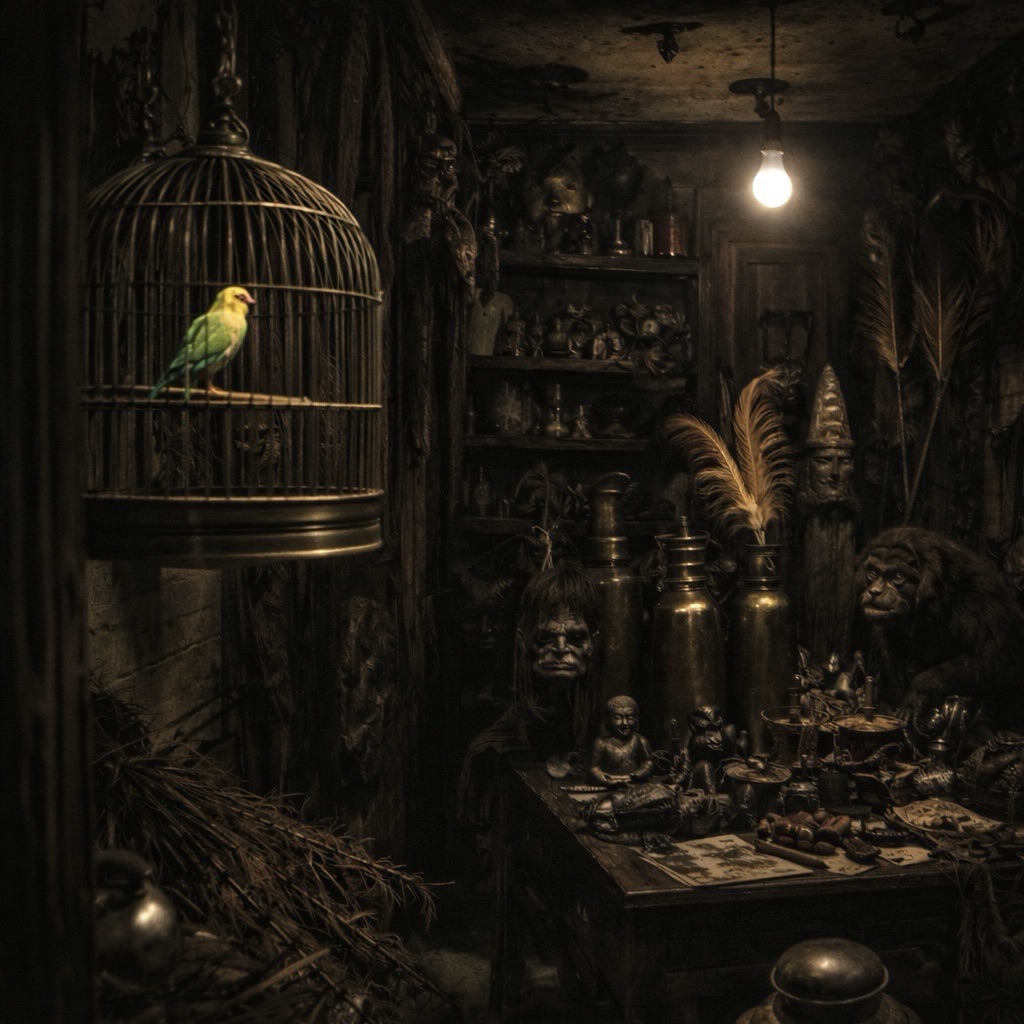
The moment we stepped inside we were met with a stench. The foyer was dim and crowded, and it only got worse as we moved through the rooms. Souvenirs, gifts, and artifacts from the husband’s travels filled every available space in the four-room railroad apartment. I don’t remember many specific details because the effect was overwhelming—well beyond the merely baroque or macabre. The darkness and stuffiness didn’t help.
I do recall two massive brass shell casings that must have come from a 16-inch naval gun on a battleship. Sticking up from the hollow mouths were spears with feathers—some South Sea Island souvenir, I suppose.
There were stuffed animals—real ones—and statues of exotic idols and gods everywhere. I can’t verify that there were shrunken heads hanging in the corners, but I believe there were.
My mother was appalled.
Crossing the threshold of that apartment truly felt like entering another world—except that the world had been compressed into a black hole by the sheer number and variety of objects.
Mrs. Swanström’s son was a strapping six-foot Marine whom we never actually met. Photographs of him hung in the apartment. He had served as part of the honor guard at President Kennedy’s funeral, a fact she often reminded us of.
That dates these memories to the turn of ‘63.
When one normally thinks of the Nordic countries, one imagines austere minimalism and primary colors—if any color at all.
The Swanström apartment, however, looked like a successful attempt at the aesthetic of an Ingmar Bergman film—something like The Seventh Seal, which happened to be playing on Channel 13 around that time. Or perhaps a Hieronymus Bosch painting.
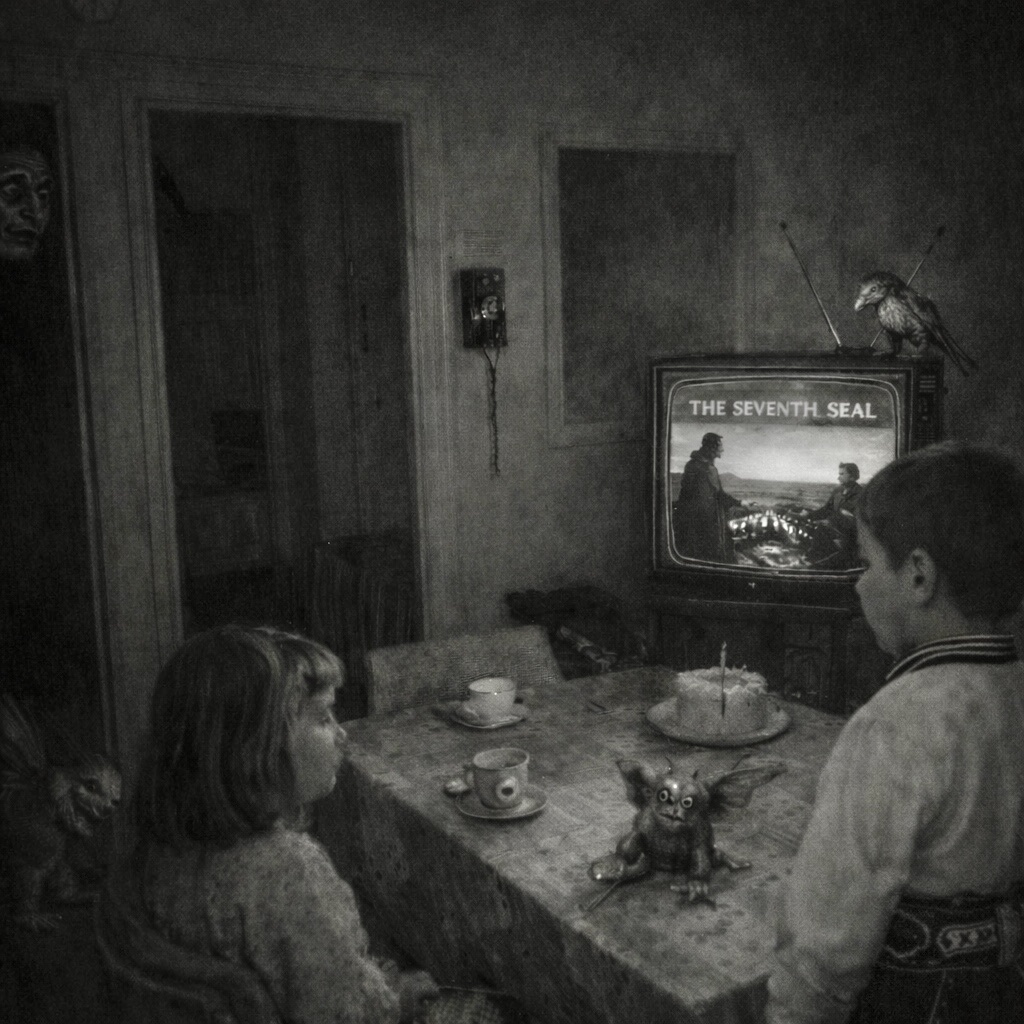
Combine all this with the Gothic church I attended several times a week as an altar boy and I truly believe I grew up inside a surreal version of the Middle Ages.
It has been noted that the Southern Italian peasant culture in which I was raised was itself a relic of that Feudal age and its attendant code of fealty—even as it was transplanted to America.
[. . .And now a slightly atonal musical interlude to further set the scene:
***
Twilight Zone episodes were like Saturday morning cartoons to me.
Almost laughable compared to my normal waking life.
Truth is stranger than fiction.
That’s why, for me, it has always been strictly the non-fiction section.
—Justin Aldmann
***

Announcing Episode 4 of a new fantasy / sci-fi / weird tale / morality-play series on the C-of-C-C Network.
We are still working on filming it, but for now our text and visual trailer will have to do. Use your imagination—like we once did when listening to the radio—and now once again with podcasts.
This helps keep production costs down and artistic values as high as you are capable of envisioning.
—The Editors / Producers
INTRO
Delivered by our inimitable host and psycho-pompatus.
(Our swarthy host speaks from the side of the screen, barely perceptible in the shadows.)
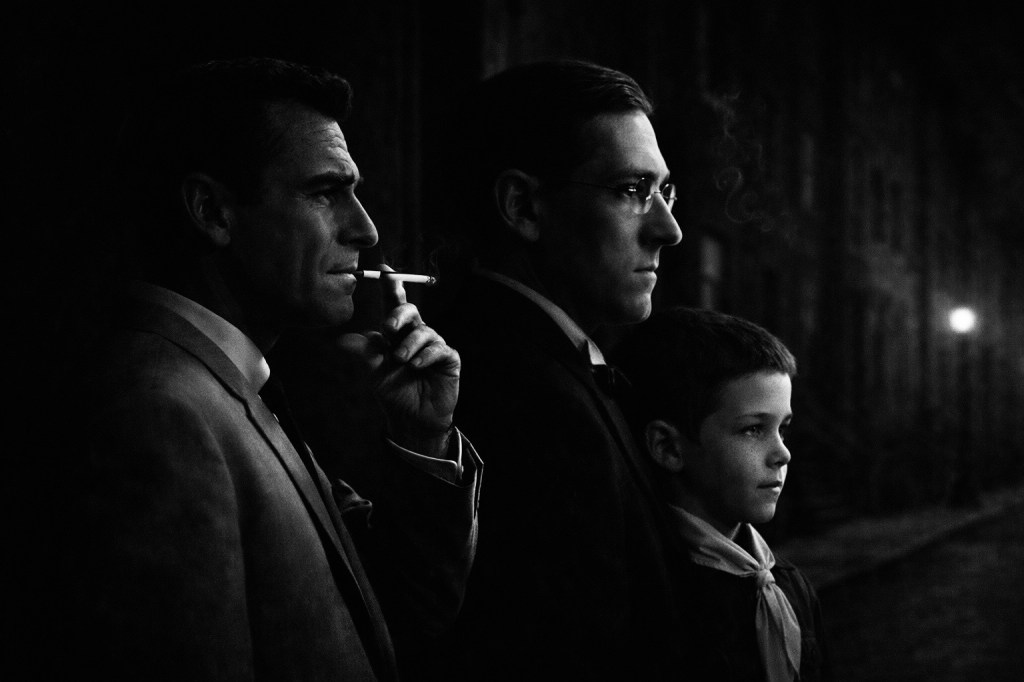
J. St. E.:
Imagine a world where all of the following characters inhabited one city block—a microcosm of the multicultural universe, perhaps even a prototype for the Star Wars cantina scene.
All of it occurred in a now-mythical place. Not the prosaic, bourgeois-infested borough of Queens, but somewhere stranger.
Tonight we present a first-hand account of one young child’s experience.
The original television series from which we take our inspiration was a Friday-night event for cousins gathered around a glowing screen. But for one perceptive peasant boy, the experience occurred every waking hour.
Right next to his family apartment lived a Black family with ten children, about half of whom had been professionally diagnosed as clinically retarded. One of the older boys—a simpleton giant—considered our subject his best friend.
Unfortunately, he was hard to avoid because the entrance doors were directly adjacent.
Back then childhood recreation consisted largely of rough-and-tumble wrestling and mock fighting—activities that often produced the same results as the real thing.
Our gracile Mediterranean boy was lucky to survive his mother’s dreaded but frequent encouragement to “go out and play.”
Imagine constantly trying to avoid a Mike Tyson–type personality who didn’t know his own strength. He was good-natured—but Mike Tyson, as we know, once bit someone’s ear off.
Living directly below that towering twelve-year-old was another unlikely household.
The mother was an alcoholic Russian-Jewish woman who had married Tom Chin—a Chinaman who operated a one-man laundromat a few storefronts down the block.
The mother never left the apartment.
In the five or so years Justin lived beside them he never once saw her—only heard her voice yelling from somewhere up the hallway, like a disembodied spirit.
Tom Chin used an abacus in his business and, in Justin’s memory at least, wore his hair in a queue.
The result of this unlikely union were two beautiful Eurasian daughters whom even a grade-school boy could admire.
His admiration remained purely platonic until one Saturday evening when the older sister, Bunny, babysat while the parents went out.
Bunny produced a pressed duck for dinner.
She unwrapped the desiccated and anatomically correct bird and began eating it with gusto.
Justin’s neurotic younger sister immediately threw up.
Bunny was never quite the same idealized beauty after that.
Thirty feet from the front door stood an Irish bar.
It could not have been more than eight feet wide, though it stretched far back into the building. A large green shamrock was painted onto the concrete square in front of the entrance.
He peeked inside only once.
Justin smelled the hops and heard the heavily brogued voice of Michael D.’s grandfather, who looked exactly like the caricature of the snub-nosed Irishman.
Michael himself was a Catholic schoolmate of athletic build who stood head and shoulders above everyone else. He was the pitcher on an opposing Little League team and beaned Justin more than once. His fastball already had professional speed.

Years later he went on to play professional basketball and eventually became the manager of a professional team out of L.A.
Justin can still hear the ringing in his ears as the hardball smacked into the batting helmet.
Justin once went to a birthday party in Mike’s basement where we all danced the Twist. His father was a soccer player back in Ireland and his living room had 6’ trophies along the walls. His mother was a stunning Irish specimen; not an unexpected mate for his alpha dad. It seems Justin had an eye for female beauty even though he must have been only eight years old at the time.
Not far away at the end of the block stood the Jewish delicatessen.
The owner was an older man with a problem involving his eyelids. To keep them open he had to tape them from lid to forehead so he could see.
Justin never learned what the condition was called.
But the deli had great bialys and fresh bagels—and one of those big wooden barrels filled with dill pickles in brine where you simply reached in with your hand and grabbed one. Sans tongs.
Could we survive eating a liverwurst and Swiss sandwich with mustard on a bagel today? It would probably feel as though a homunculus had taken up residence in our lower abdomen.
Speaking of food, Justin once met a guy with cauliflower ears just outside the deli. He stopped Justin and his father and decided out of the clear blue to explain his boxing career to a little kid. The father got a kick out of the addle-brained old guy but to Justin the old boxer looked just like an alien he had seen the previous Friday night on tv. Fantasy and reality had a way of blending into each other. It’s surreal, or at least that’s what Justin thought his Barese grandfather said when he wanted to indicate that something was genuine. “It’s a real”, he would say in his Italian accent. Justin couldn’t tell the difference.
This was the neighborhood.
Hasidic students passing in groups with black coats and beaver hats.
An Erasmus Hall High School student with a Mohawk haircut—because he actually was a Mohawk.
Construction workers from the Mohawk nation were famous for walking steel girders high above Manhattan without dizziness. They possessed a genetic trait for this ability.
And then there was Martense Street.
Lovecraft, who lived just a few city blocks away, himself mentioned the short street in “The Horror at Red Hook.”
Martense was barely wide enough for a single car, hemmed in by three-story brownstones. It possessed a claustrophobic gloom that left no doubt the writer had walked there himself.
There was a schoolmate, an American kid, who lived in this slightly more upscale section right around the corner. His father was a draftsmen of some type. Justin was secretly allowed into his apartment one day to see the father’s art work which lined the foyer. There were classical nude sketches which the kid said were rumored to have been modeled by his mother. The kid seemed to take some delight in this. The presentation was all done in the interest of Art with a capital T and A, of course. Justin’s house had one painting of the Virgin Mary dressed in the robes and head covering of the time with her pierced heart on the outside of the clothing. She was pointing to it as it was pierced by a dagger. She had a smiling but nonetheless ominous look on her face. Justin confessed to preferring his friends naked sketches even though he sensed at that tender age that there was something Oedipal about the kid’s willingness to show them. The American kids were truly strange.
What does all this have to do with the World Dwarf Games? It is what opened the floodgates of memory that inspired this episode.

(To each his own, and everything in its place.)
The other side street to the apartment—which still had the gas jet fixtures from when indoor lighting was raw natural gas—by the way—was Linden Boulevard. An instance of deja vu once brought Justin back there while walking the streets in Würzburg, Germany—of all places. Seems the architectural style on the boulevard originated in Bavaria—very gothic, but that was part of the ambience of the old neighborhood.
Justin walked this same route to the library. One day he returned in sheer terror. He had just read Operation Bluebook, the US Air Force investigation into UFO’s. If the respected Air Force believed in alien craft enough to study the phenomenon they might as well have landed already to his impressionable mind. Coupled with the fear of war and invasion that the Cuban Missile Crisis had him in at the time, the recognition of the aliens by a bona fide government agency pushed him over the edge. Justin retreated into himself and did not speak for weeks. He was finally brought out of the funk by the show that the brother and sister dwarves who lived on Linden Boulevard performed on their front porch. They were the children of a Black physician—a brother and sister act. They made the most of their condition and became favorites in the neighborhood. They looked just like the subjects in the link below as they did cartwheels and handstands for the local kids.

Why do dwarves, even of different races, resemble each other?
And so it went. One block. Dozens of worlds.
It is said that Rod Serling drew his inspiration from his combat experiences in the Pacific. Crouching in the dark of the jungle with all those clear stars above, the fear of the Other lurking somewhere out there with equally murderous intent must have made a deep impression on him. So too a young boy experiencing the Other within the confines of one city block in Brooklyn.

Editor’s Note: Only one clarification. Justin now believes one detail may have been conflated. The deli owner with the eyelids taped open may actually have been the Thom McCan or Buster Brown shoe store owner. The rest, he maintains, is entirely accurate—subject only to the usual condition that every observer is, in his own way, the eyes of the universe.
 COUNCIL-OF CONCERNED-CONSERVATIONISTS…..Between Jest And Earnest…..
Leave a comment