—The Spirit of 2026: The Common Sense of Thomas Paine, Found in the Comment Section
—A NOUVELLE VAGUE ZWISCHENSCHAFT
Field Correspondence —
American Tour, Continued

To: René Seance, Director
Re: Further Evidence. The Road Continues to Instruct.
Dear René,
I write from a motel outside of town — the town itself being less important than the fact of the road, which continues westward with the indifference characteristic of this country’s better qualities.
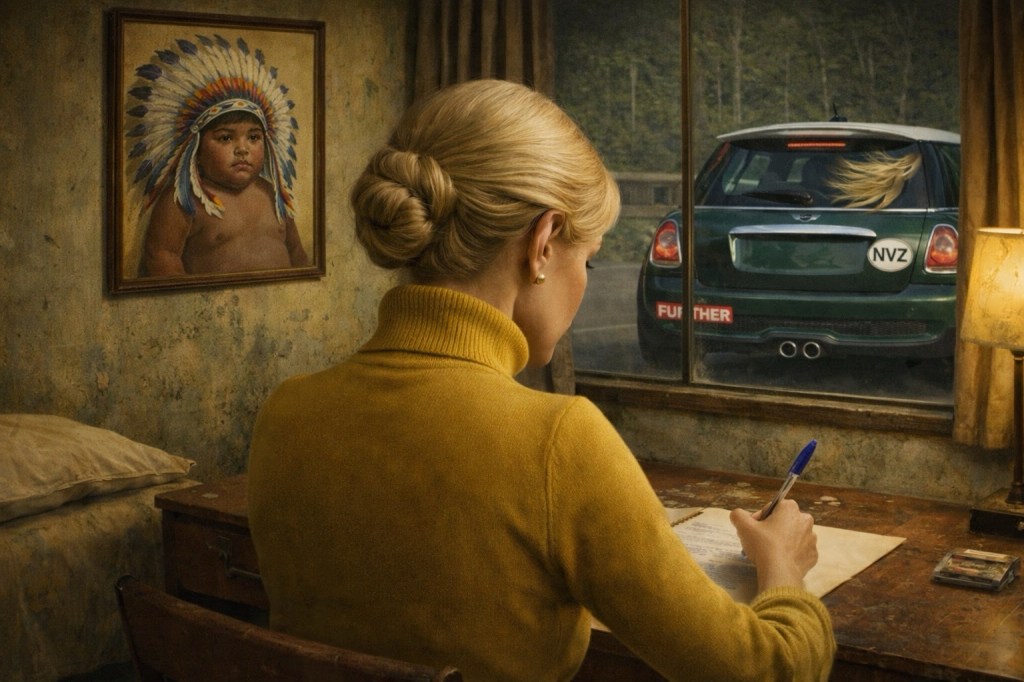
The room is adequate. The television is present but chastened. The Mini Cooper is accounted for.
America has presented me with a new exhibit.

A story appeared on my screen this week — distributed widely, as American stories are, with the flat confidence of a country that believes facts speak for themselves and requires no further assistance from anyone.
The facts were these:
A young man — quadruple amputee since infancy, the consequence of sepsis at ten months of age, not carelessness — had allegedly shot a companion while operating a motor vehicle.
This was filed. Distributed. Received.
Without a single question asked.
René, I must pause here to account for the young man properly, because the journalism did not.
By the time this story darkened he had already been, in sequence with what one can only describe as an argument against limitation so thorough it bordered on the philosophical. He was:
a wrestler, a footballer, a dirt bicycle enthusiast, and a champion of something Americans call cornhole — a game of precision and patience which rewards exactly the qualities one would assume his condition had foreclosed.
He had achieved all of this without hands.
Without feet.
America celebrated him briefly in the way it celebrates such things — with the bright flare of a human interest story, the label it applies when a person has done something that makes the rest of us feel the appropriate emotion and then return to our business. Then it moved on. As it does.

When the darker story arrived, the journalism moved on again — this time in the opposite direction. Same velocity. Same incuriosity. The headline appeared without context, without the elementary questions any reasonably awake person would immediately ask.
How, precisely, does a quadruple amputee operate a motor vehicle?
How does he discharge a firearm?
What adaptive technology made both possible?
What does it mean that the same ingenuity celebrated on the sports page now requires explanation in a court of law?
The journalists did not ask.
They filed and moved on, René, as though the asking were someone else’s responsibility.
And here — I must tell you — is where America surprised me again.
As it has developed the habit of doing.
I descended, with some reluctance and considerable curiosity, into the comment section.
*Paid advertisement*
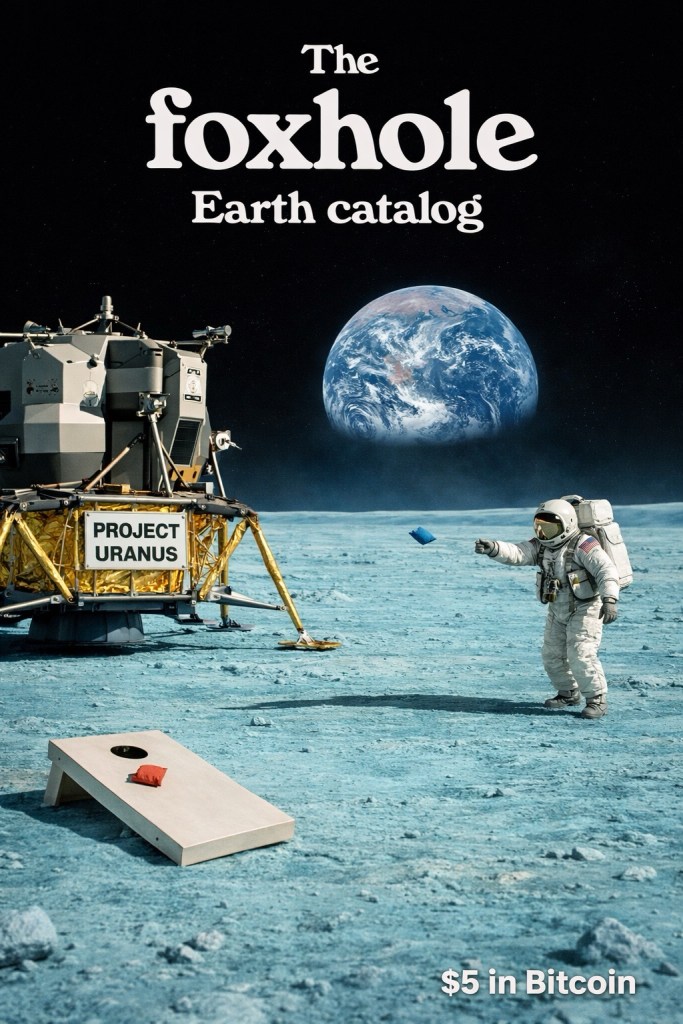
The American Cornhole League announces its capital campaign for Project Uranus. NASA has not returned our calls.
You know my feelings about comment sections, René. I have expressed them previously and they were not charitable. I retract them. Partially. Provisionally. With the caveat that I reserve the right to reinstate them should conditions warrant.
Because the comment section was asking every question the journalism had abandoned.
Ordinary Americans — not journalists, not academics, not correspondents of any recognized organization — were pulling the thread. How did he drive. How did he shoot. What devices made this possible. What does this life mean in its entirety — the achievement and the catastrophe taken together as a single remarkable human story rather than two unrelated headlines.
The curiosity was there, René.
It had simply relocated.
You will recall my dispatch from Route 6, in which I reported that America’s philosophy had migrated from institutions to bumper stickers — compressed into vinyl, distributed at velocity, read in passing by those with eyes to see.
I believe I can now report a second migration.
America’s curiosity — its genuine instinct to ask, to pull at the loose thread, to demand an accounting from a universe that files things without explanation — has migrated from the journalism into the comment section.
The professionals drove past.
The commenters pulled over.
I do not yet know what to make of the young man’s full story, René. It had no doubt exemplifies the American genius for ingenuity, but it resists the available categories. It is not only inspiration, though inspiration was present. It is not tragedy in the classical sense, though the Greeks would recognize the shape of it immediately and would have a word for it I am not yet ready to deploy.
What I know is this.
He was extraordinary. The capability was real. The achievement was genuine. And somewhere between the cornhole championship and the courthouse, America produced a story it could not be bothered to ask questions about — and then asked all the questions anyway, in the one place no one is supposed to take seriously.
The Renaissance, René, may not be where we expected to find it.
Check the comments.
Yours In Continued Inquiry,
Mrs. Begonia Contretemp
—Correspondent-at-Large
American Tour, somewhere west of the last town worth mentioning.
***
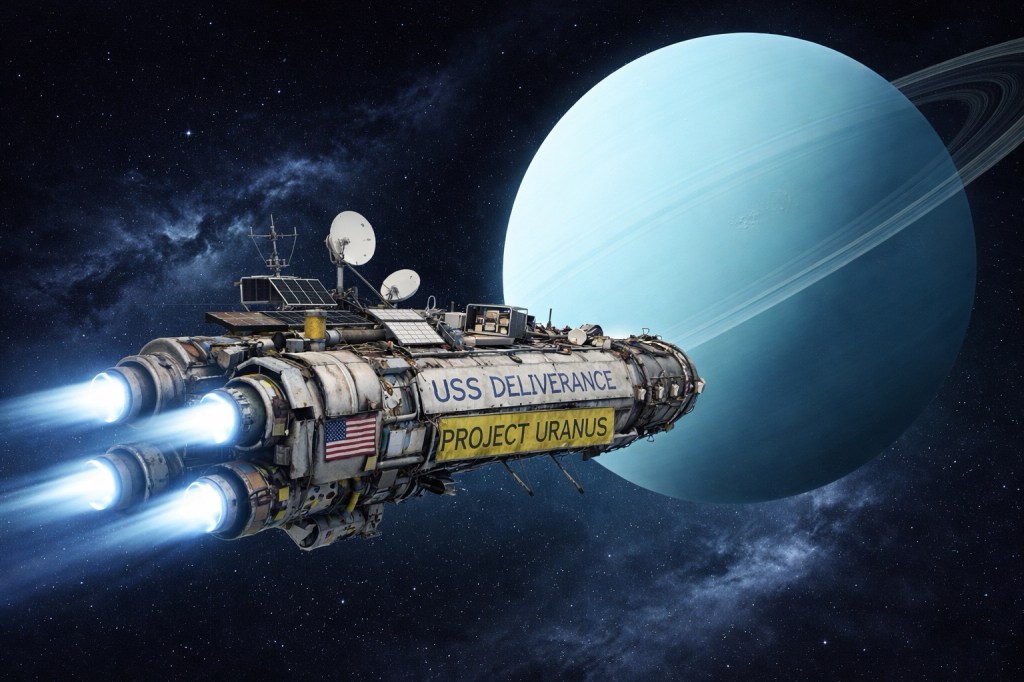
Project Uranus — commissioned by the American Cornhole League in pursuit of its vision to bring America’s fastest growing sport to the outer planets.
We note that in 1971 Alan Shepard brought a golf club to the moon. Golf. A Scottish sport for the leisured class. Nobody objected.
The American Cornhole League asks only for comparable consideration. Our sport requires two boards and eight bags. We are prepared to adapt for zero gravity. We have done more difficult things.
Admittedly the hole is considerably harder to find at this distance. But we are Americans. We find the hole.
The current NASA administration remains unavailable. We may have better luck after the next election. The League remains undeterred.
More from Mrs. Begonia Contretemp
 COUNCIL-OF CONCERNED-CONSERVATIONISTS…..Between Jest And Earnest…..
Leave a comment