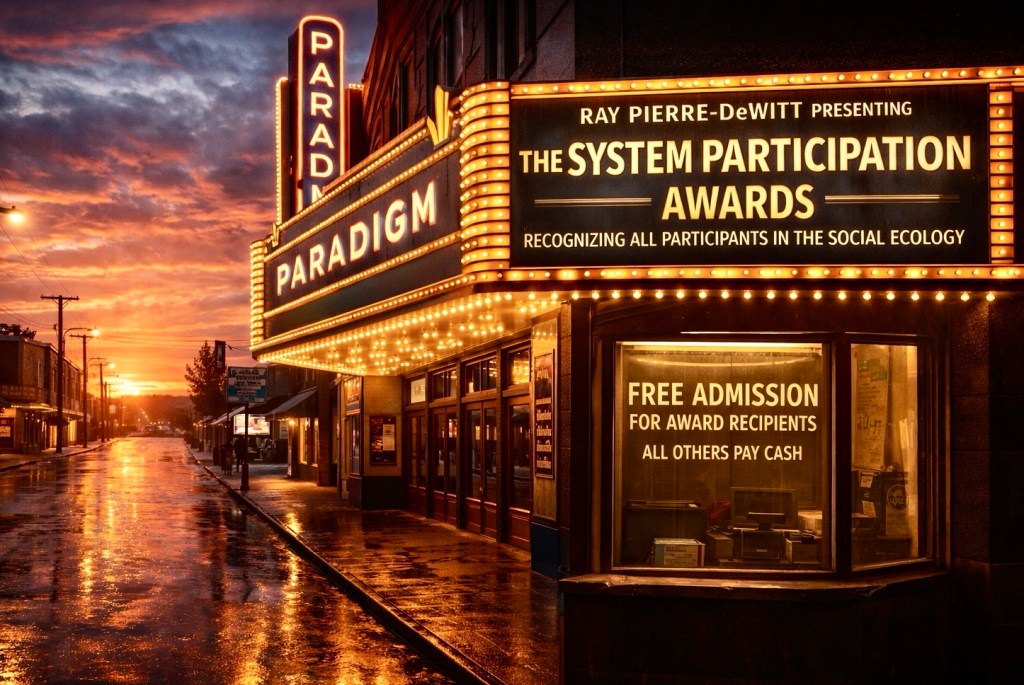
in Weedville, Pennsylvania
Serving the greater Hollywood, Force and Weedville area.
—A Council-of-Concerned-Conservationists Award Ceremony—
Hosted By Ray Pierre-DeWitt, Chaos Coordinator
Good evening! Thank you all for participating.
Let me just say this plainly, because I can feel some of you shifting in your seats already.
Yes—there are problems in the system. Yes—people want them solved. And yes—that desire has been heard. It’s also been. . . accounted for.
Now here’s the part that tends to get skipped over:
This evening concerns a simple arrangement—rarely stated, but widely practiced:
Some people generate revenue. Others keep the people who generate revenue in motion. That’s not a glitch.That’s the structure.
And so, without further ado—by the way, the facilities are out back—some of you already know where they are, and may have just come from there—so let’s begin.
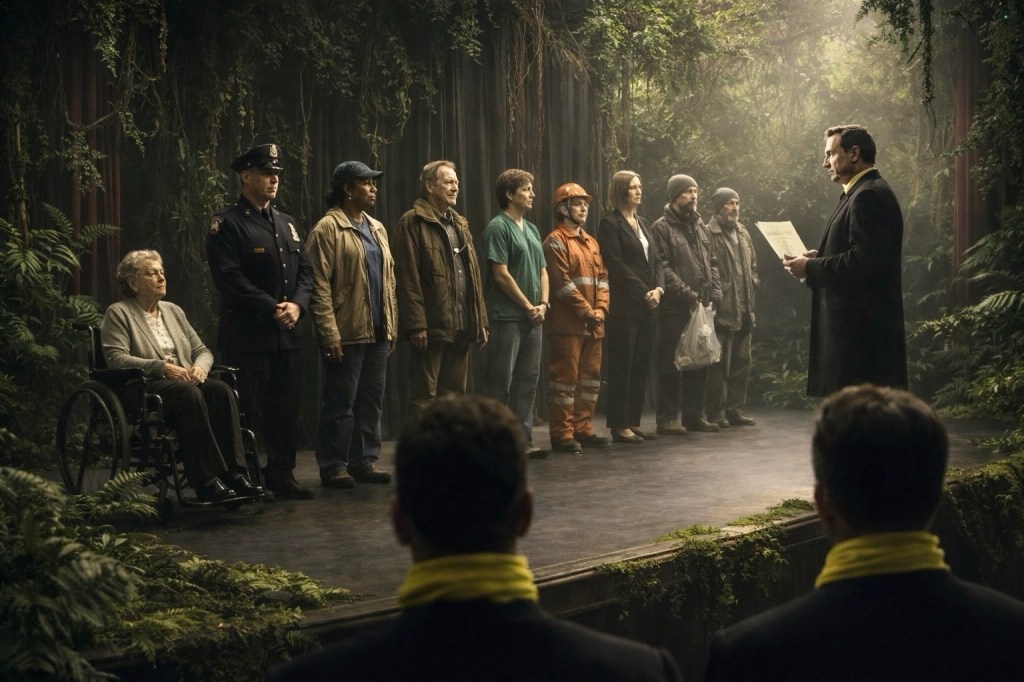
REVENUE-POSITIVE BEHAVIORS
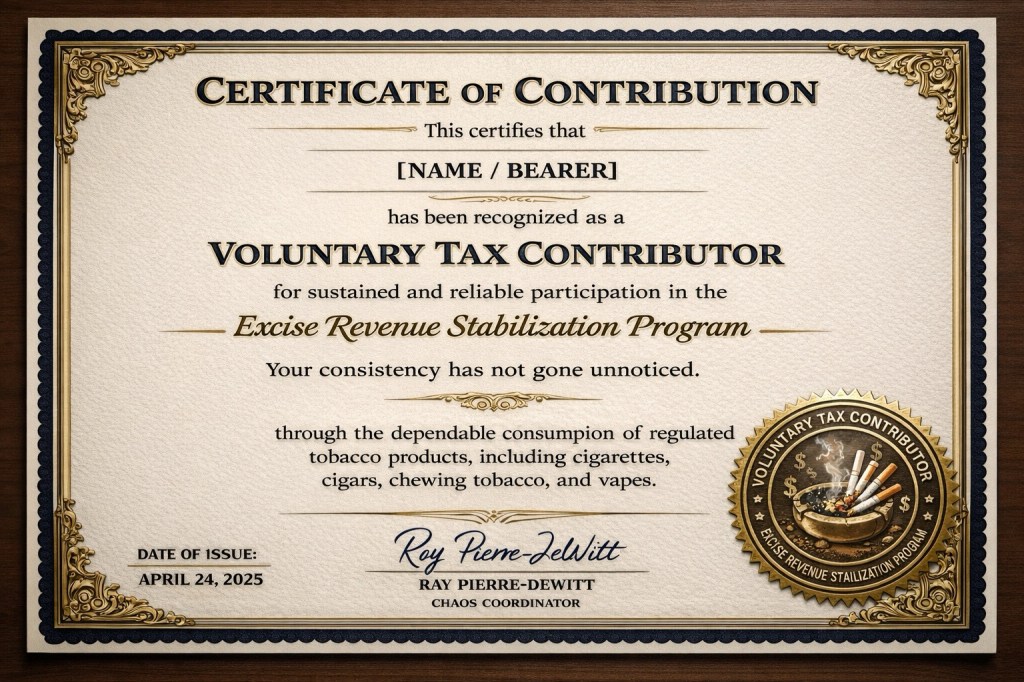
1. Smokers — The Excise Tax Backbone
2. Drinkers — Liquidity Stabilizers:
They keep money moving—bars, restaurants, distributors, taxes. It all flows. You smooth the edges of life, and the system smooths its balance sheet.

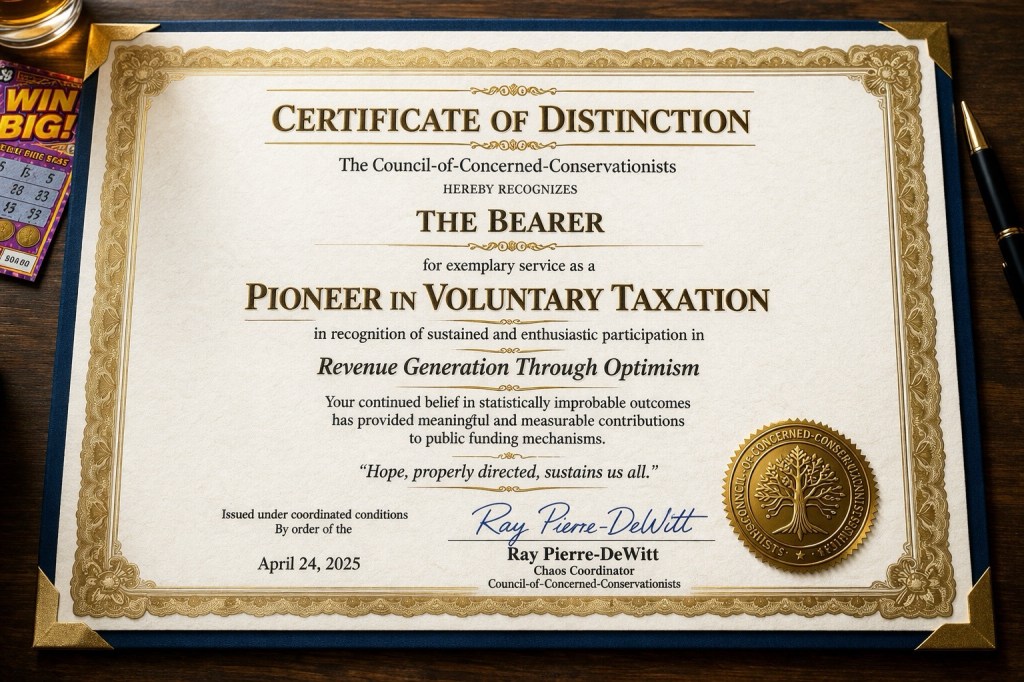
3. Lottery Participants — Voluntary Taxation Pioneers
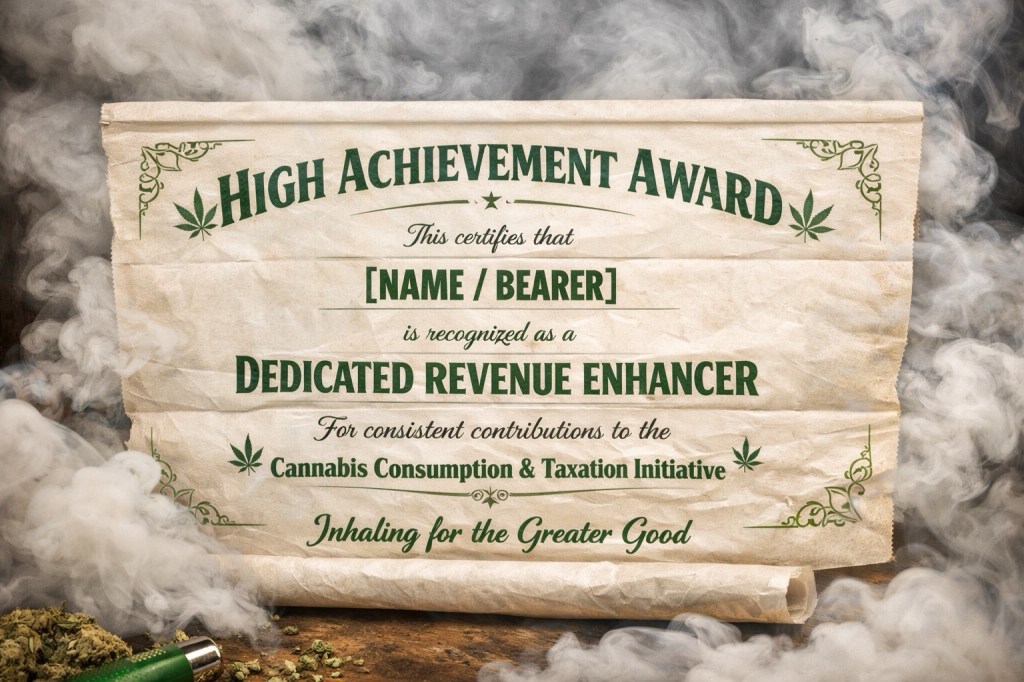
4. Cannabis Consumers — The Regulated Tranquility Sector
They generate revenue and take the temperature down a notch. Fewer sharp edges, fewer immediate pressures. That has value—on both sides of the ledger.
SERVICE-DEPENDENT POPULATIONS
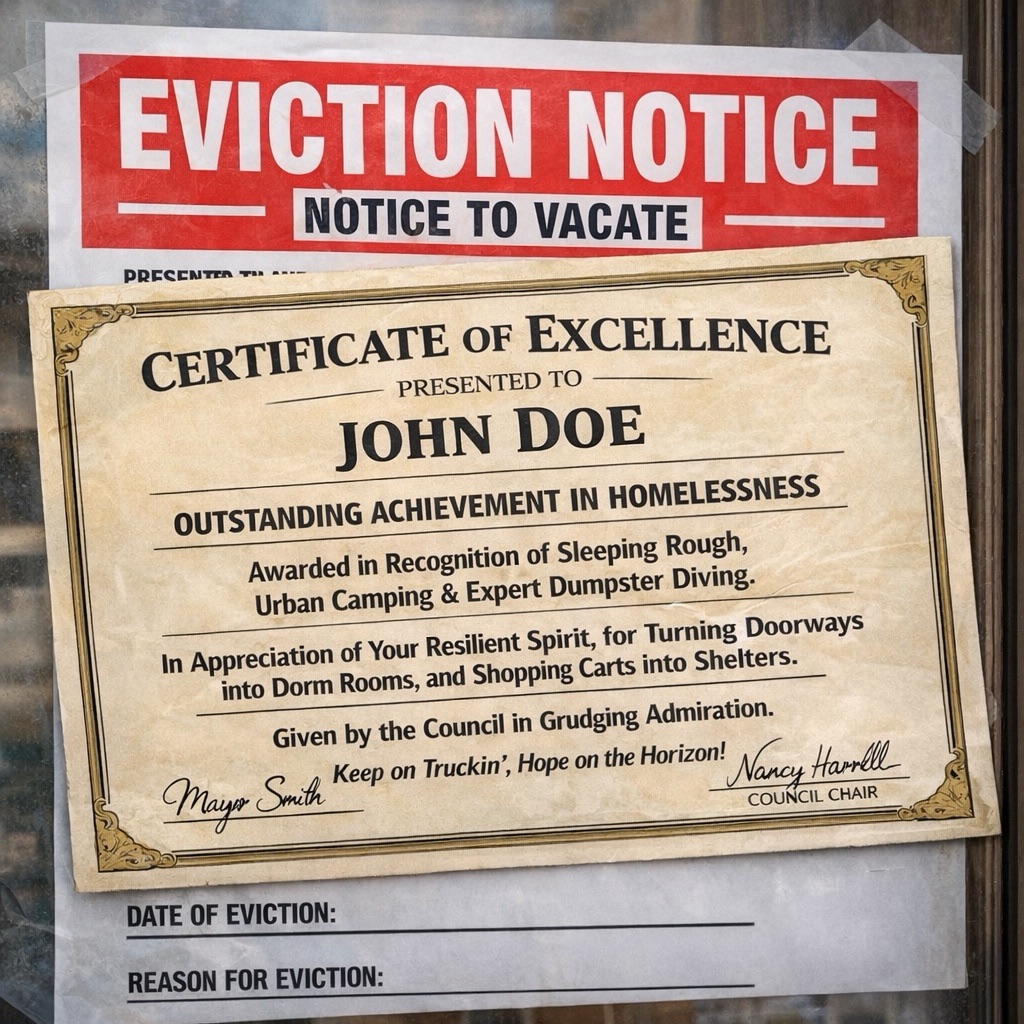
1. The Unhoused — Urban Employment Ecosystem Drivers
2. Addiction Cohorts — Intervention Continuity Specialists and their enablers among the users.

3. INSTITUTIONAL ANCHORS
Defense Contractors — Geopolitical Activity Sustainers

4. Chronic Offenders — Judicial Throughput Contributors

The Chronically Ill — Healthcare Utilization Base
It’s one of the largest sectors we have. Ongoing care means ongoing work—doctors, nurses, administrators, suppliers. And again, the revenue cycles back.
Now step back for a second. Nobody sat down and assigned these roles. But they settled into place anyway. Revenue comes in. That revenue supports systems. Those systems, in turn, support the conditions that keep the revenue coming. That’s not chaos.
That’s a loop.
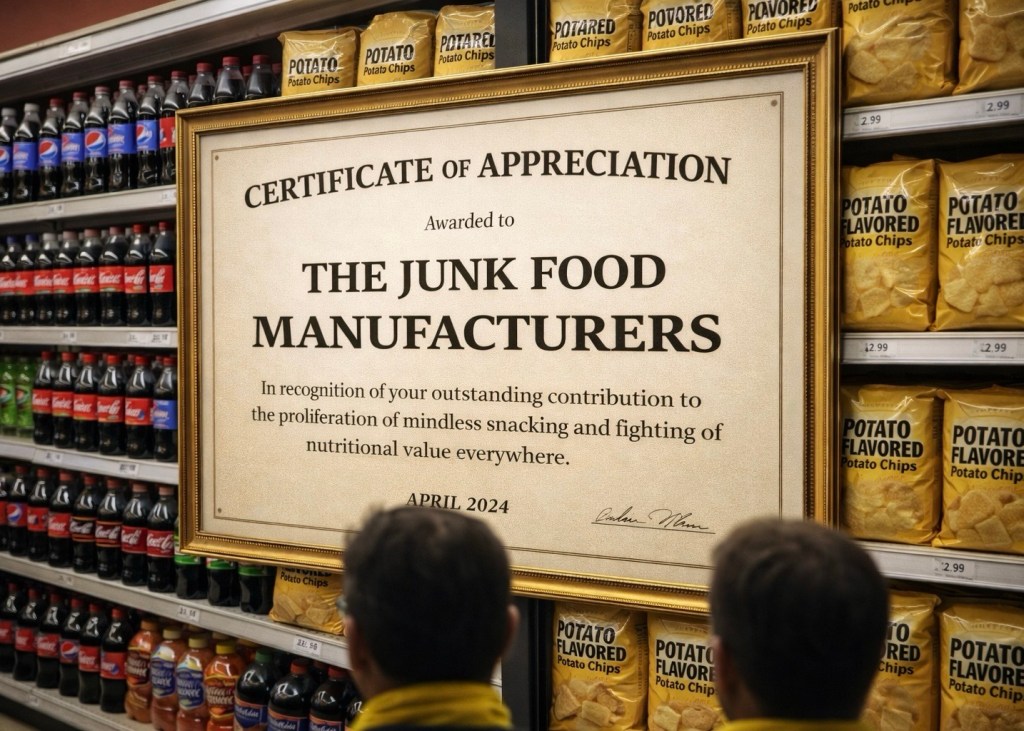
All Council members, in accordance with standing custom, consume potato-flavored potato chips, thereby sustaining the great State of Idaho and its indispensable role within the ecosystem.
FOR THOSE WHO FIND THIS UNSETTLING
I get it.
This is usually where people say, “Well, that’s not how it should be.”
And that’s fine. That reaction has a place too. Because what happens next?
People organize. They advocate. They research. They regulate. They write, speak, consult, campaign.
And all of that activity—every bit of it—is funded.
Grants. Salaries. Donations. Subscriptions. Institutional backing.
So now the critique is part of the system. The pushback creates more motion. More motion creates more funding.
And the loop—holds.
You don’t step outside it by noticing it. You just move to a different position inside it.
SO WHAT’S THE MOVE?
This is where people expect me to say “fix it.”
But if you fix something too quickly, you don’t just remove the problem—you remove everything that formed around it.
Jobs. Revenue streams. Entire layers of activity. That kind of efficiency has consequences. So no—we don’t rush. We adjust. We manage. We keep things. . . within range.
Nothing here is random. Nothing here is drifting. Every piece—whether it’s generating revenue, sustaining it, or reacting to it—has been accounted for.
What looks like chaos from the outside—is just the system. . . working.
And yes—it’s under control.
—Ray Pierre-DeWitt

More From Ray
 COUNCIL-OF CONCERNED-CONSERVATIONISTS…..Between Jest And Earnest…..
Leave a comment