
—A Council-of-Concerned-Conservationists Field Dispatch
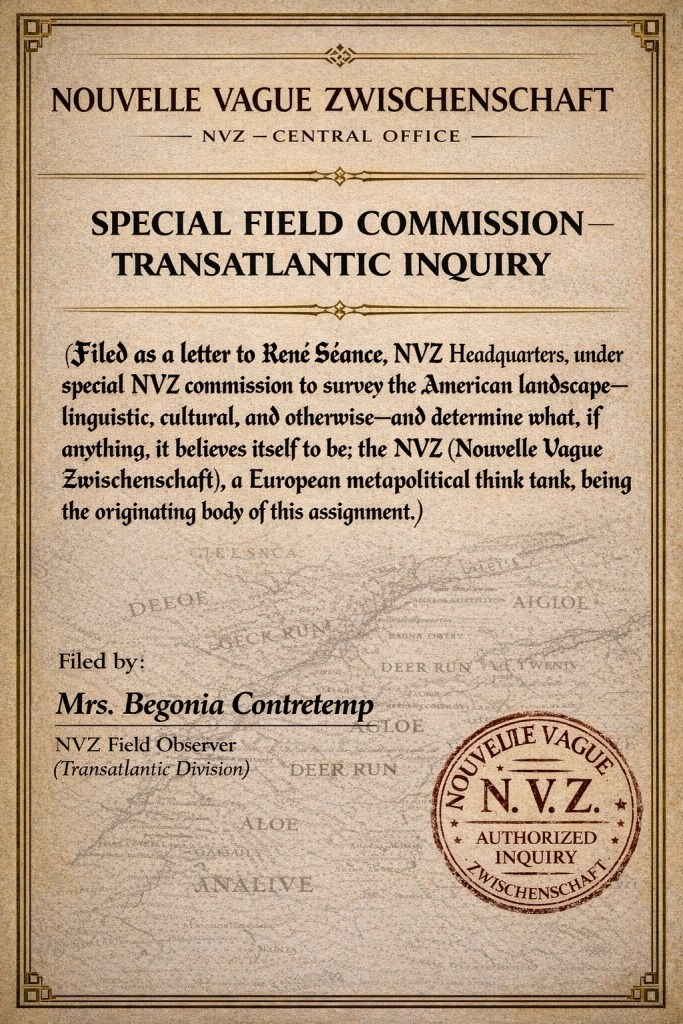
My Dear René,
You will forgive the delay. America does not so much resist observation as it absorbs it, like a velvet chaise that remembers the shape of every prior guest and insists upon adjusting yours accordingly.
I write to you now from the road—though “road” is an insufficient term. These are less routes than sentences, each exit a clause, each cul-de-sac a period placed prematurely by a developer with a fondness for pastoral nostalgia.
—On the Matter of a Town That Should Not Be
You will appreciate this, René, as it concerns authorship—and theft, which is merely authorship with poor manners.
I made a detour into the Catskills to visit the curious case of Agloe, a town that began not as a settlement but as a copyright trap—a phantom insertion by mapmakers who wished to catch their rivals in the act of imitation.
The name itself, I am told, was composed from the initials of its creators, a kind of bureaucratic sigil disguised as geography.
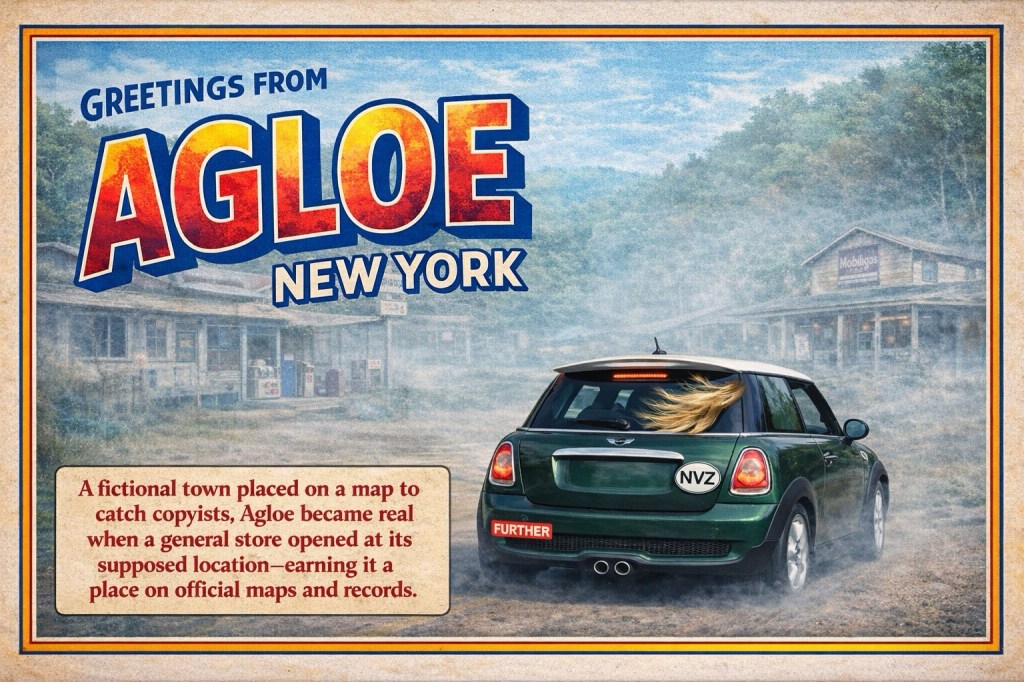
And yet—this is where the Americans become unintentionally metaphysical—someone, encountering the name on a map, believed it sufficiently to build there. A store was erected. A presence established. A fiction. . . ratified.
One imagines the mapmakers, upon discovering this, experiencing the peculiar vertigo of seeing their private joke enter the census.
You see the implication, of course:
A word, placed carefully enough, may summon the world it pretends to describe.
I confess a certain admiration. It is the sort of maneuver the NVZ has long theorized but rarely executed with such rustic efficiency.
One notes, in passing, that not all such maneuvers proceed in the same direction.
Further along in New York, I was reminded that the Woodstock festival did not, in fact, occur in Woodstock. The event took place some distance away, in a field in Bethel—chosen, I am told, for reasons of logistics rather than poetry.
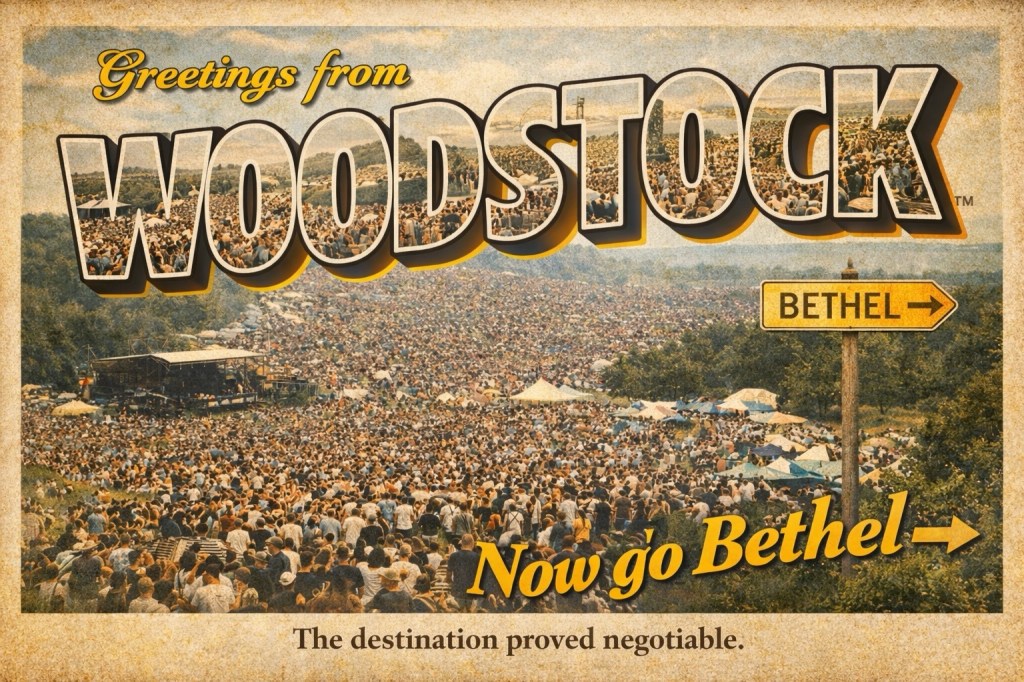
The name, however, was not relocated. It remained fixed—attached not to the site of occurrence, but to the idea already in circulation: a place of artists, of atmosphere, of pre-existing resonance.
The discrepancy appears to have caused no lasting concern. The word had already established the necessary conditions. The event merely complied.
—A Tangent Within The Gist—
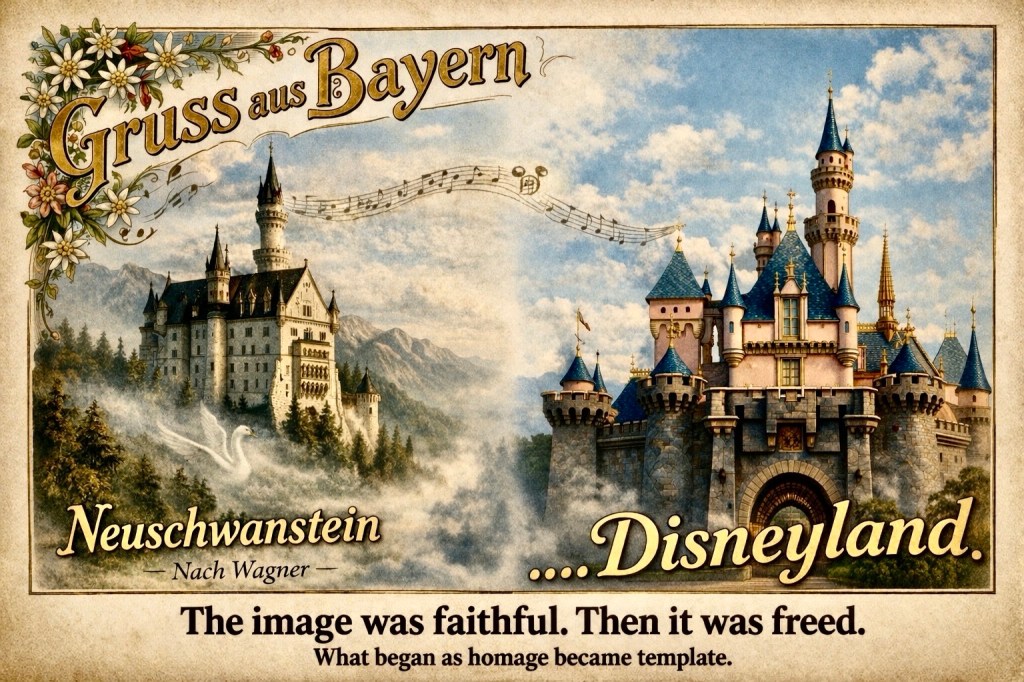
A swan-born king made music true,
He gave the stone, the sky, the star,
And wish-born songs went wandering far,
“Let it go,” the old world sighed,
“Under the sea,” the echoes replied,
The dream passed on—the source untied.
🧚♀️✨
—On a Language That Refuses to Be Silenced
Further along, I encountered a different species of phenomenon—less architectural, more behavioral.
There are, it seems, certain words that cannot be spoken directly in this country’s digital salons. They are discouraged, filtered, or quietly removed by what the locals refer to, with an air of resigned intimacy, as “the algorithm.”
And yet, René—how shall I put this delicately?—the people have not complied.
Instead, they have begun to speak in substitutions:
—“unalive” for death
— “corn” for the unspeakable varietals of cinema
— “pew-pew” for instruments of regrettable enthusiasm
At first, I mistook this for infantilism. It is not. It is adaptation.
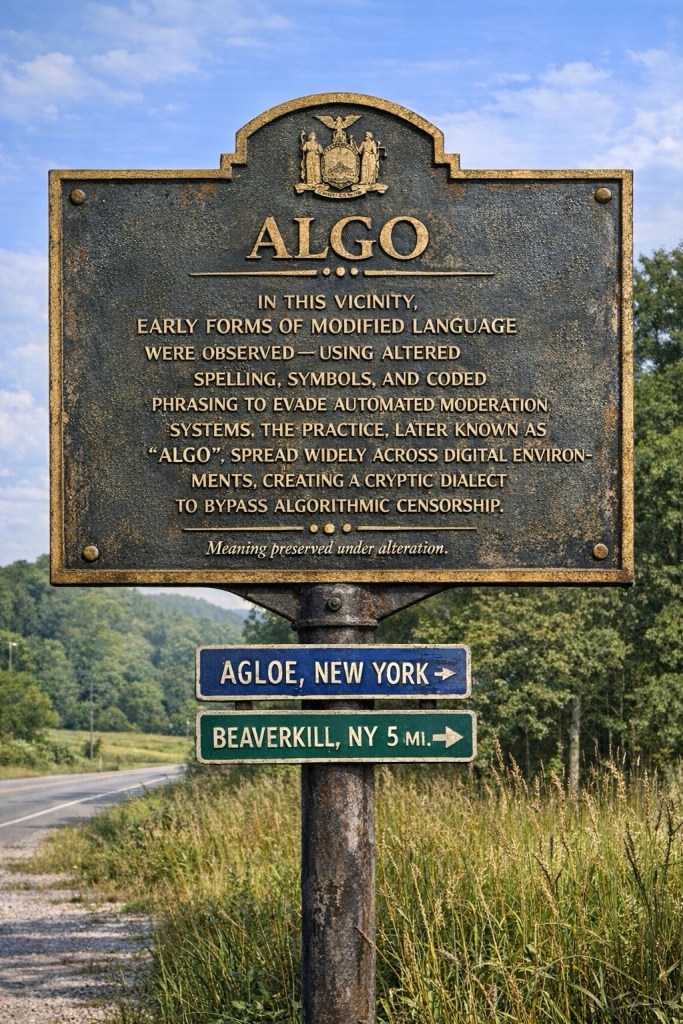
When a word is hunted, it does not perish. It alters its plumage.
The meaning survives. The surface shifts. One hears, beneath the euphemism, the unmistakable rustle of the original.
I have begun to suspect that language here is not regulated so much as it is pressurized, and under such conditions, it develops curious new forms—linguistic deep-sea creatures, bioluminescent with implication.
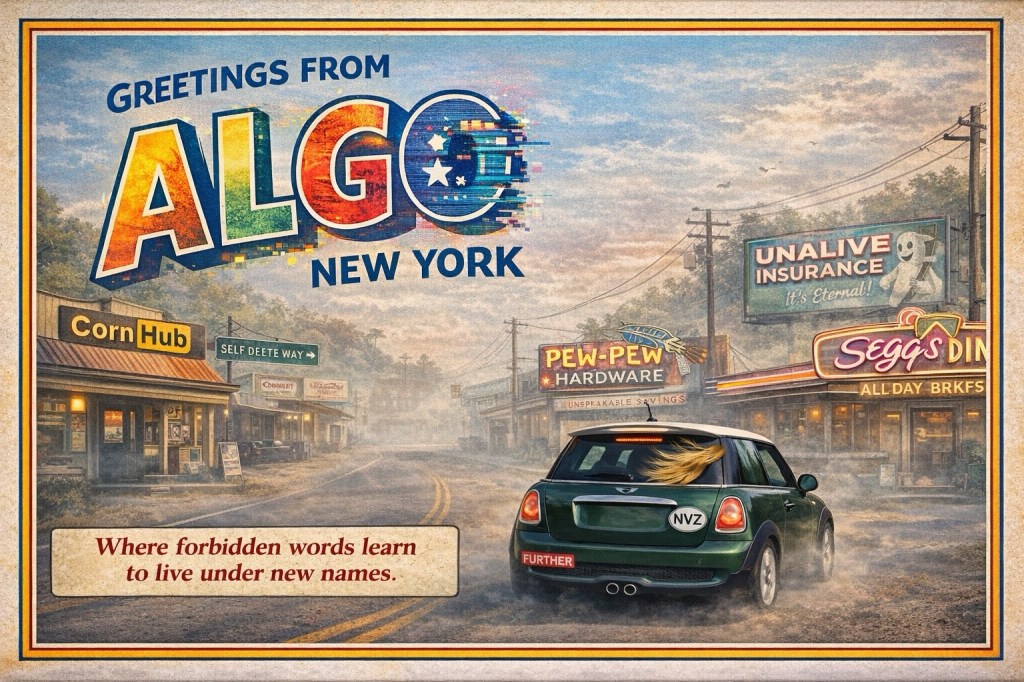
—On the Establishment of Linguistic Preserves
It would be an error, René, to assume that these adaptive species roam freely without constraint. Quite the opposite.
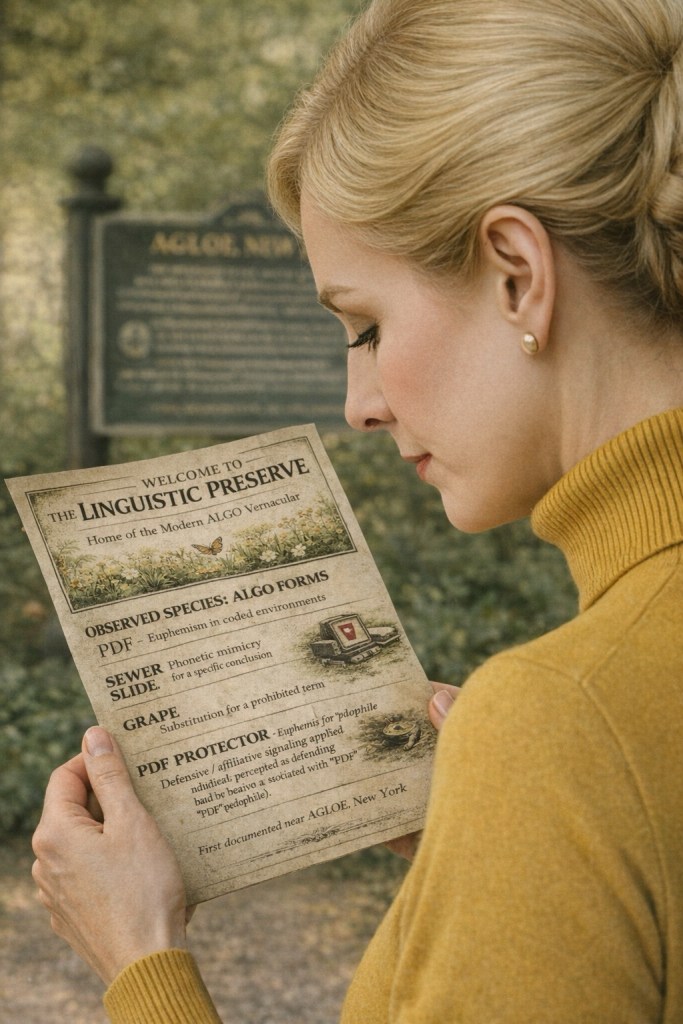
I have observed that slang, euphemism, and what I shall call algorithmic fauna are permitted to exist—indeed, to flourish—but only within certain designated habitats.
These are not, as one might expect, the forest preserves or Unique Areas so carefully demarcated in places like New York State. No signage announces them. No ranger patrols their borders.
And yet, they are unmistakable.
They exist in comment threads, in the captions of short-form videos, and in the lower registers of discourse—where one finds tone and suggestion doing a great deal of the work formerly entrusted to words.
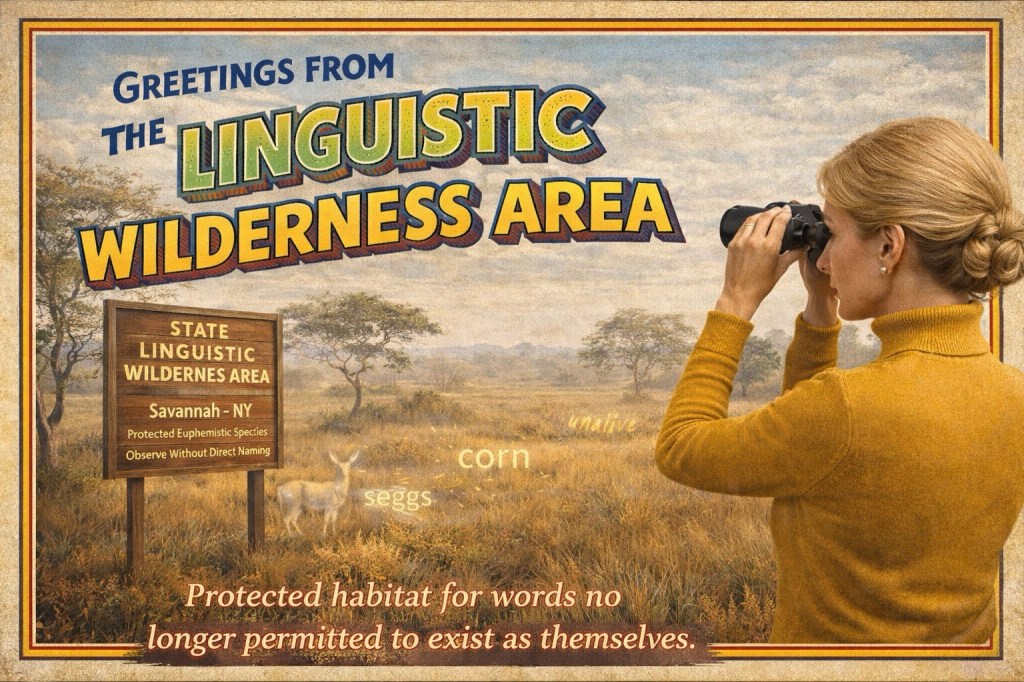
Here, one finds “unalive” in small numbers, “seggs” circulating freely, and “corn” in what can only be described as cultivated abundance.
Step outside these zones—into official statements, institutional speech, or what passes for polite society—and the species vanish entirely, as though they had never evolved.
These are, in effect, linguistic preserves: areas where forbidden or fragile meanings are allowed to survive under altered names.
One might even say they are managed—though by whom, and to what end, remains unclear.
I marked this under Conservation Strategy: Semi-Permissive Containment.
—On the Commemoration of Absence
By the third day, I had entered what the Americans call “developments,” which I take to mean areas where reality has been improved upon by its removal.
I passed through a sequence of names that will interest you:
Deer Run, Fox Hollow, Pine Ridge
There were no deer, René. No foxes. No pines. Not even the suggestion of a ridge.
Only signage—tasteful, serifed, and faintly apologetic.
I inquired, with what I believe was admirable restraint. I was informed that these names “honor what was once here.”
I paused, as one does when confronted with a statement that is both sincere and indicting.
The thing is gone. The name remains. And the name is now the amenity.
This is not deception. It is something more refined.
It is eulogistic branding—the transformation of loss into a selling point.
I have taken to thinking of these signs as linguistic fossils, pressed delicately into the asphalt, each one a record of a prior ecosystem now available in three-bedroom configurations.
—Toward a Small Theory (Provisional, Naturally)
You will indulge me, René, if I attempt a synthesis.
It appears that in this country:
A word may precede a thing and bring it into being (Agloe) A word may be forbidden, yet survive in altered form (the algorithmic evasions) A word may be contained within preserves, flourishing only in designated linguistic habitats A word may outlive its referent, persisting as a decorative relic (Deer Run)
These are not isolated curiosities. They are, I suspect, ecological behaviors.
If one were to risk the language of the field (and I risk it only in your company):
—Words are species
—Meaning is their habitat
—Power is the climate
And under changing conditions:
Some species are introduced and naturalize. Some are hunted and adapt. Some are confined to preserves. Some go extinct, leaving only their names behind.
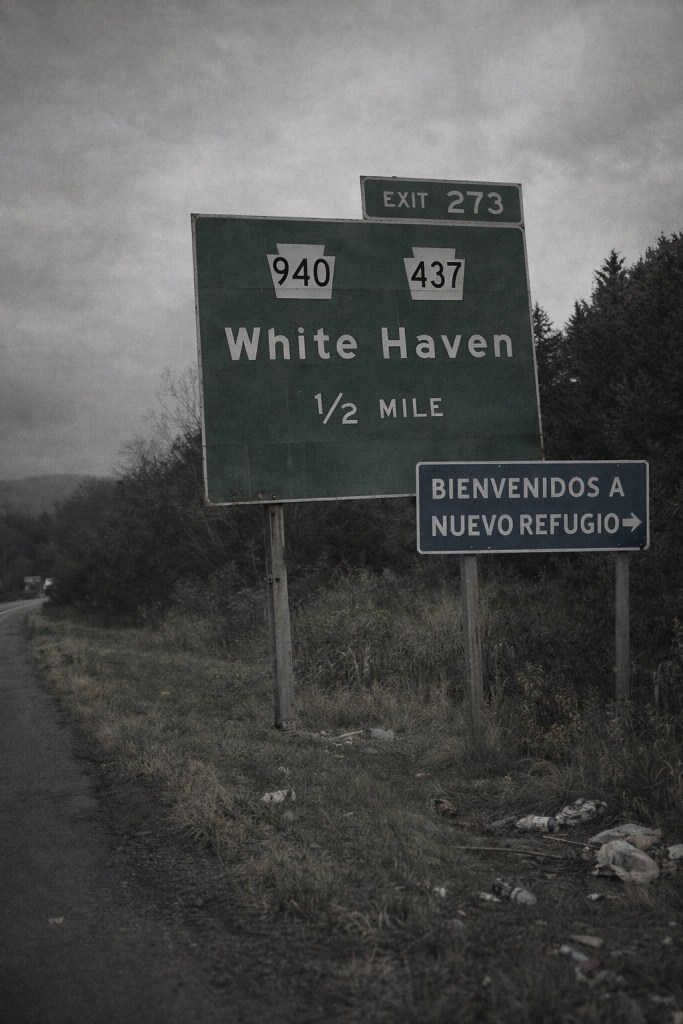
—A Note for the NVZ (Confidential, Naturally)
I begin to suspect that what we have long treated as semiotics is, in fact, a form of conservation biology conducted in public.
America does not simply use language. It manages it: culling here, breeding there, zoning certain expressions into protected or restricted areas, preserving certain specimens behind tasteful signage.
The result is not silence—but a kind of overgrown garden, in which meanings bloom, wither, and reappear under slightly altered names.
—Closing (From a Place Called Whispering Pines)
I conclude this letter from a location identified, with admirable confidence, as Whispering Pines.
There is no whispering. There are no pines.
But the name persists, and in persisting, it performs a curious function: It allows the absent thing to remain just present enough to be missed. . . and therefore, perhaps, to be sold.

Do write back, René. I should like to know whether the NVZ has encountered similar phenomena in its European theaters, or whether this peculiar choreography between word and world is, like so much else here, distinctly American in its optimism.
Yours, In Observation And Mild Astonishment,
Mrs. Begonia Contretemp
P.S. En route, and increasingly persuaded that the map is not only the territory—but occasionally its replacement.
*Paid advertisement*

More from Mrs. Begonia Contretemp
 COUNCIL-OF CONCERNED-CONSERVATIONISTS…..Between Jest And Earnest…..
Leave a comment