—A Duet Referencing Cole Porter and Aleister Crowley—
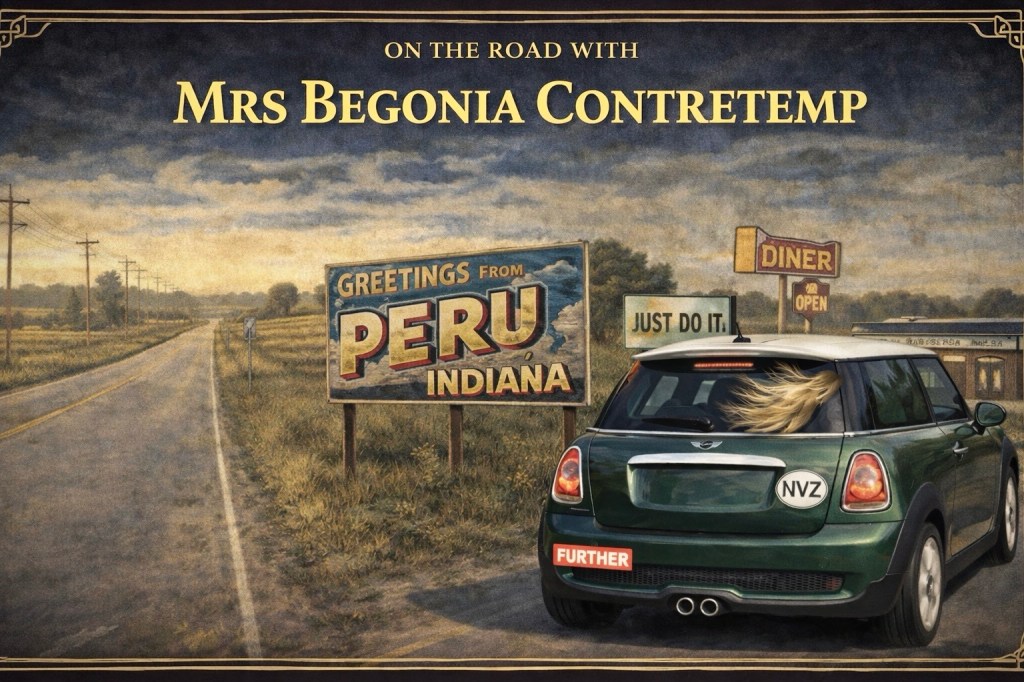
Filed as a Letter to René Séance, NVZ Headquarters
April 1, 2026
— in the Year of Our Lord (circumstances pending)
My Dear René, Whose Instructions I Continue to Follow—Within Reason,
I have arrived in Peru, Indiana—a name that carries, however faintly, the echo of another Peru, whose Inca civilization once governed stone, sky, and human sacrifice with a coherence no roadside marker could hope to summarize. That such a name should now rest upon a quiet Midwestern town is not, I think, accidental. It is the sort of cultural afterimage one encounters frequently in this country: the grandeur of the past reduced to signage, the memory of order preserved in nomenclature alone.

There is, here, a modest commemoration of Cole Porter—tasteful, restrained, almost apologetic. One expects, given the man, a certain theatrical residue; instead one finds lawn, brick, and a silence that behaves itself.
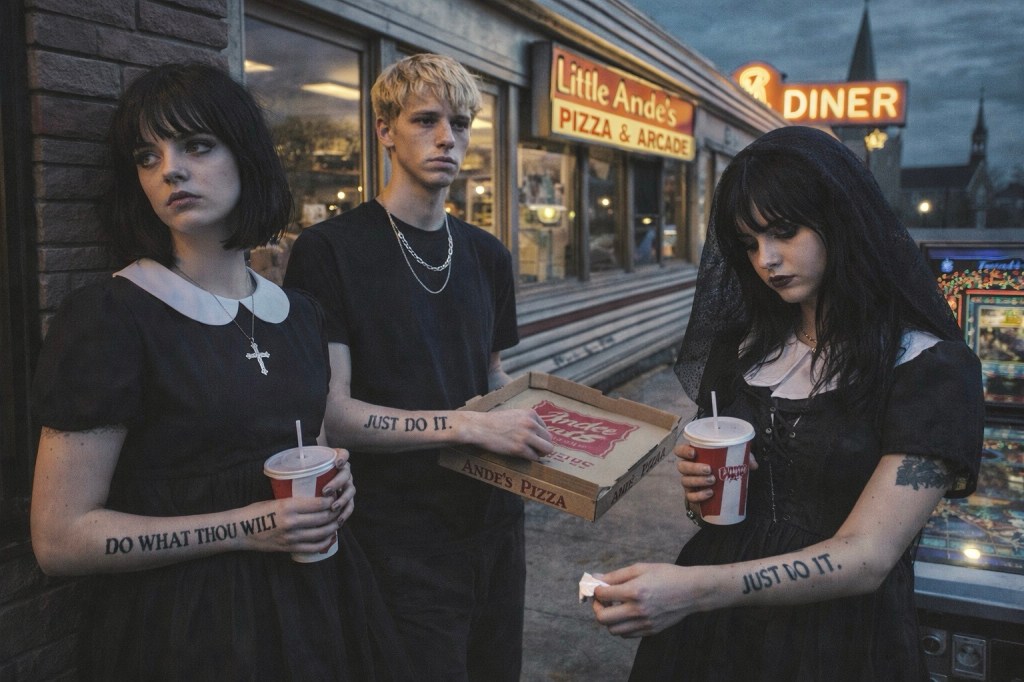
I dined, unwisely, at an establishment called the Little Andes Pizza & Arcade, whose offerings appear to have been engineered less for nourishment than for compliance.
Only afterward did the name resolve itself improperly: Peru—not Italy, but Peru, Indiana, borrowing a geography it did not understand. The Andes followed close behind.
One recalls, uncomfortably, those well-documented high-altitude offerings—children sacrificed and preserved in the cold—given to something that did not explain itself.
With recent revelations and the release of certain files, it is difficult to insist we have progressed as far as we claim. The arrangements feel. . . familiar. Only the décor has changed.
I did not make the connection at the time. One rarely does. One simply eats—and later wonders what, precisely, was being asked in return.
My lodging—a roadside motel of democratic ambition—featured a carpet whose pattern suggested past civilizations and previous tenants who had attempted escape by staring into it. The meal lingered. That night, I dreamt. . .

I was aboard a ship—though not at sea. It seemed anchored in a kind of cultural harbor, where nothing arrived and nothing departed, yet the orchestra played without interruption. A woman stood center stage, bright and immovable, singing:
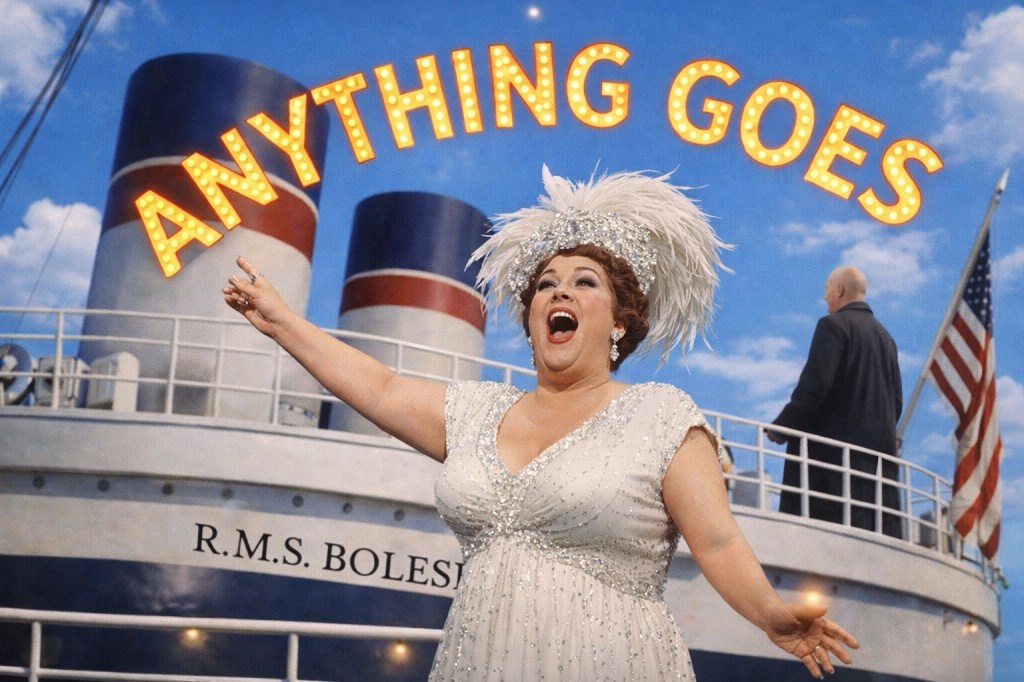
My oneiric audience applauded not in delight, but in recognition. Around her, scenes unfolded with the efficiency of a revue:
“In olden days, a glimpse of stocking…”
—now greeted with a shrug;
“good authors. . . now only use four-letter words”
—refinement reduced to bluntness;
“the set that’s smart. . . intruding in nudist parties”
—the arbiters of taste arriving late to transgression, only to make it fashionable.
Even the grand refrain:
“good’s bad today. . . black’s white today. . . day’s night today”
—was not argued but absorbed, as though contradiction itself had become a form of agreement. It became clear to me that they were not breaking rules so much as updating them. And who knew that so much of modern American culture would devolve through African influence?
At some point—the music did not stop, but shifted—a second presence entered, not onto the stage but into its margins. An Englishman. Familiar, and not altogether welcome. Aleister Crowley. I am obliged to acknowledge him as a countryman, though not one we are eager to seat at table without qualification. The British Isles have produced their share of transgressors; we have rarely mistaken them for legislators.
I recalled his maxim:
Do what thou wilt.
—so frequently repeated, so insufficiently carried: It may be, in its proper setting, a demanding and even aristocratic proposition, requiring discipline, initiation, and a certain interior architecture. But here, René, it has been received as a slogan—portable, cheerful, and entirely unburdened. The distance between proposition and practice has collapsed. In the dream, as the chorus persisted, the two phrases—his and Porter’s—began to echo one another until they were indistinguishable:
Do what thou wilt. Anything goes.
At this, he seemed—if not pleased—misrendered.
I confess to a harsher thought upon waking: that a philosophy of such volatility ought never to have been offered for general circulation. It belongs, if anywhere, within a narrow custody—among those formed to bear its contradictions without dissolving into them. Here it has been democratized. The children know it. The chorus requires no instruction. What was once a burden has become a convenience.
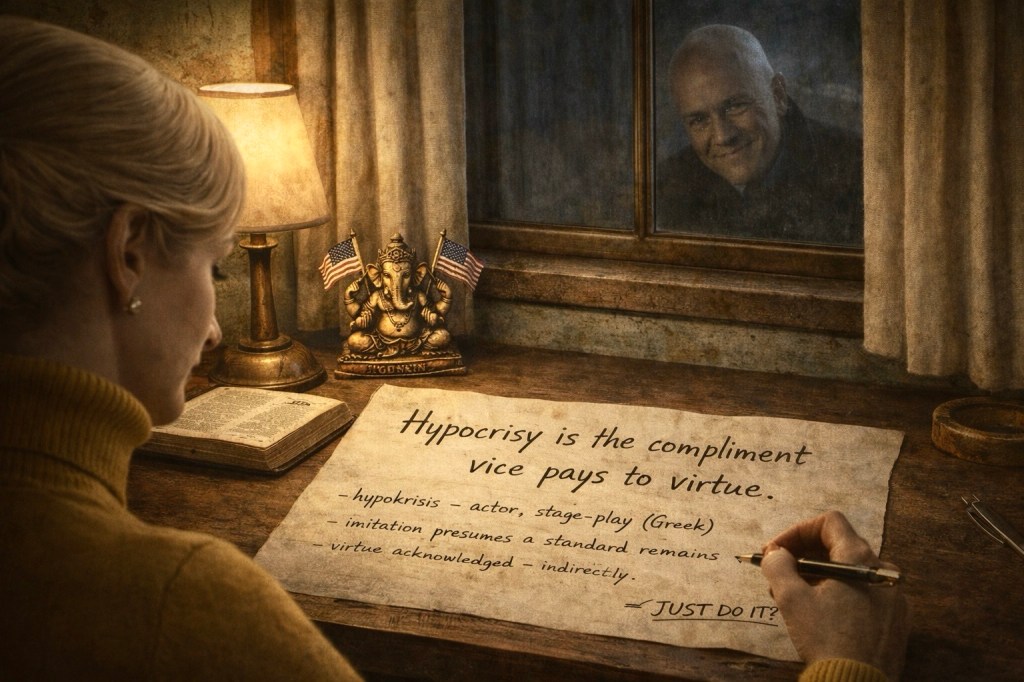
You once suggested, René, that hypocrisy is merely failed virtue. I begin to suspect it may also be its necessary companion—the courtesy that vice pays to virtue, and the scaffold that keeps aspiration from collapsing into appetite.
An aristocratic code, if it is to function, may require tensions, exceptions, even the polite maintenance of appearances—not because it is false, but because it is too potent to be universally applied without distortion. Where hypocrisy is forbidden, one is left not with honesty, but with exposure—and exposure, here, has become entertainment.
I woke to the soft electrical hum of the motel lamp, which, like many institutions in this country, appears always on the verge of flickering into honesty. It occurred to me that the Americans have achieved something rather remarkable: they have taken what may have been, in other contexts, an aristocratic burden and rendered it a public convenience. No initiation required, no contradiction permitted, no reserve maintained. Even their elites:
—hurry to each new permission as though afraid to be the last to surrender a boundary. Although there are exceptions.
Here, everything is applied universally. And thus, nothing holds.
The song is cheerful. This is its most unsettling feature. It was, for me, a bad dream—and also, I suspect, a partial map. One does not descend—one participates.
Yours, Under Modest Duress And Questionable Upholstery,
Begonia
P.S. René—
I have enclosed the lyrics in full and footnoted them for your review. Not exhaustively, I’m afraid. . . as I am quite exhausted.
—ANYTHING GOES—
🎶Times have changed
And we’ve often rewound the clock
Since the Puritans got a shock
When they landed on Plymouth RockIf todaaayy
Any shock they should try to stem
‘Stead of landing on Plymouth Rock
Plymouth Rock would land on themIn olden days, a glimpse of stocking
Was looked on as something shocking
But now, God knows
Anything goesGood authors too who once knew better words
Now only use four-letter words
Writing prose
Anything goesIf driving fast cars you like[3]
If low bars you like
If old hymns you like
If bare limbs you likeIf Mae West you like
Or me undressed you like
Why nobody will oppose?When every night the set that’s smart is intruding in nudist parties in studios
Anything goesWhen Misses Ned McLean[1], God bless her
Can get Russian reds to “yes” her
Then I suppose,
Anything goes
When Rockefeller[2]still can hoard enough money to let Max Gordon
Produce his shows
Anything goesThe world has gone mad today
And good’s bad today
And black’s white today
And day’s night today
And that gent today
You gave a cent today Once had several chateaux
When folks who still can ride in jitneys[7]
Find out Vanderbilts and Whitneys[4]
Lack baby clothes
Anything goesWhen Sam Goldwyn[5]can with great conviction
Instructs Anna Sten in diction
Then Anna shows anything goes
When you hear that Lady Mendl[6]standing up
Now turns a handspring landing up on her toes
Anything goes🎶Just think of those shocks you’ve got
And those knocks you’ve got
And those blues you’ve got
From that news you’ve got
And those pains you’ve got
If any brains you’ve gotFrom those little radios
So Misses R., with all her trimmin’s
Can broadcast a bed from Simmons
‘Cause Franklin knows
Anything goes
Footnotes: On the Cultural References in “Anything Goes” (1934)
The lyrics of “Anything Goes,” written by Cole Porter for the 1934 musical Anything Goes, are densely packed with contemporary references, many of which would have been immediately recognizable to audiences of the period.
[1]“Mrs. Ned McLean (God bless her)” Refers to Evalyn Walsh McLean, a Washington socialite and owner of the Hope Diamond, known for her flamboyant lifestyle and widely publicized personal scandals.
[2] “Rockefeller still can hoard enough money / To let Max Gordon produce his shows” A nod to the immense wealth of the Rockefeller family, contrasted with Max Gordon, a prominent Broadway producer, suggesting that even vast fortunes could be channeled into theatrical excess.
[3]“If driving fast cars you like / If low bars you like” Evokes the culture of Prohibition-era speakeasies (“low bars”) and the fascination with modern speed and luxury.
[4]“The Vanderbilts and the Whitneys lack baby clothes” References two elite American families—the Vanderbilts and Whitneys—whose wealth and status were widely known; the line satirizes gossip surrounding their personal lives.
[5]“When Sam Goldwyn can with great conviction / Instruct Anna Sten in diction” Refers to film producer Samuel Goldwyn’s heavily promoted (and ultimately unsuccessful) attempt to make actress Anna Sten a Hollywood star, including efforts to refine her accent.
[6]“When you hear that Lady Mendl standing up / Now turns a handspring” Lady Mendl was the stage name of Elsie de Wolfe, a high-society interior decorator and actress, known for her elegance—making the image of her performing acrobatics absurd.
[7] “When folks who still can ride in jitneys / Find out Vanderbilt’s and Whitney’s lack baby clothes” “Jitneys” were informal, low-cost shared taxis; the contrast underscores class inversion and the democratization (or vulgarization) of status awareness.
[8]“When Mrs. Ned McLean (God bless her) / Can get Russian reds to ‘yes’ her” Likely referencing the fascination and flirtation between American elites and revolutionary or émigré Russians in the interwar period.
P.P.S. René—
The song reads, on reflection, as a rather breathless catalogue of interwar celebrity, uneven fortunes, Prohibition habits, and transatlantic drift—its humor relying almost entirely on the listener’s immediate recognition of the names and circumstances invoked. I note it here, though I suspect I shall not sleep for having done so.
More from:

 COUNCIL-OF CONCERNED-CONSERVATIONISTS…..Between Jest And Earnest…..
Leave a comment