—In Which Mrs. Begonia, In A Fit Of Homesickness, Prescribes Herself A Film—And Finds Herself Returned, Briefly, To England

In The Year Of Our Lord
April 1, 2026
My Dear René,
(I trust this finds you where you intended to be, which is more than can be said for most of us.)
Now, there are places in America that attempt to resemble England, and then there are places that—through some accident of proportion and temperament—nearly succeed. I write to you now from one such location: Niagara-on-the-Lake, Ontario, Canada—which presents itself not as imitation, but as recollection.

It was here that I encountered my dear friend, Lee Sfocato, who is presently in Canada on assignment, photographing beavers.
He arrived with mud on his boots and a camera that appeared to have seen more than either of us would care to catalogue. I had secured a room at a motel whose chief virtues were discretion and a functioning television. Lee regarded both with equal suspicion.
“I have been in the marsh for three days,” he said. “The beaver she is a very misunderstood animal.”
“In what sense?” I asked.
“It is appreciated,” he replied, “for reasons not always. . . ecological.”
“How unfortunate,” I said.
“Some a times, yes.” he added, with what I took to be a professional neutrality.
I became, rather despite myself, aware that Lee’s expertise in the matter was both extensive and, in certain respects, not without distinction beyond the strictly zoological—something one could not help but register in the manner with which he handled his subject.
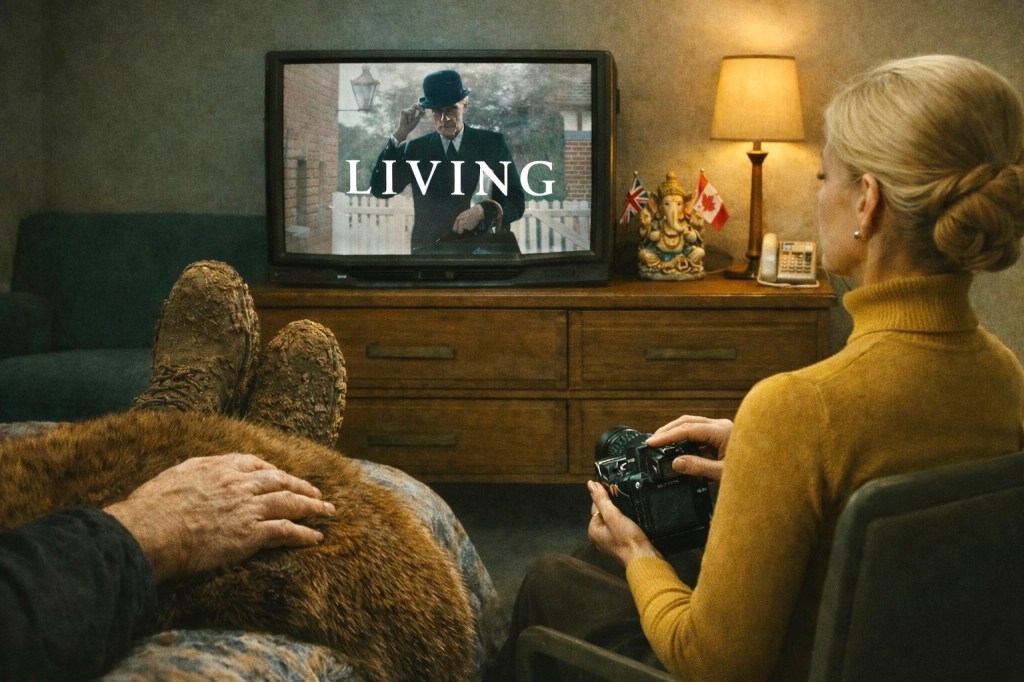
We watched the 2022 film, Living—prescribed, in my case, for the management of a mild but persistent homesickness, which had not been alleviated by proximity to an English-looking town.
Lee reclined. I did not.
From the outset, the film proceeded with a kind of deliberate quiet, as though unwilling to impose itself upon the viewer. Papers were shuffled. Voices were lowered. Time passed not in events, but in acknowledgments.
Lee watched for several minutes before speaking.
“He is dying, yes?” he said.
“Yes.”
“And still he fills out forms.”
“He is not still filling out forms,” I said. “He is finishing them.”
“In the Cilento,” Lee replied, “we begin with a’ the park.”
“In England,” I said, “one must earn the park.”
There followed a series of pauses—within the film, and between us—which Lee found increasingly notable.
“Why does no one say a’ what they mean?” he asked.
“They do,” I said. “They simply do not say it aloud.”
He considered this.
“In this she very efficient,” he said finally.
“It is not intended to be efficient,” I replied. “It is intended to be correct.”
I noticed, as I watched, that I was not following the plot so much as the faces. A hesitation at the mouth. A decision withheld. A sentence redirected before it had the chance to become something else.
It felt like home.
Lee, meanwhile, watched with a growing mixture of curiosity and disbelief.
“He feel everything,” he said.
“Yes.”
“And says a’ nothing.”
“Yes.”
Lee offered the screen a modest, pinched-finger inquiry—the sort that translates, roughly, as: explain yourself.
“This a’ she either very noble,” he said, “or very inefficient.”
At a certain point—one I will not describe in detail, as it would be ungentlemanly—there is a shift in Mr. Williams, the civil servant played by Bill Nighy. Not a declaration, but a release: something long held in check is, if only briefly, permitted.
Lee did not speak.
When he did, it was quieter than before.
“Ah,” he said. “Now a’ I understan’.”
Earlier that afternoon, in the manner of someone discussing weather or bread, Lee had mentioned Grey Owl—born Archibald Belaney, an Englishman who came to Canada, assumed an Indigenous identity, and became a defender of the beaver and its habitat. His portrayal persuaded many, including prominent admirers, and endured for years before his true origins came to light after his death.
It was presented as a matter of fact—Lee mentioning Grey Owl, and I emphasize, the Englishman Archibald Belaney, who became, with complete sincerity, the Indian he portrayed. An eccentricity, certainly—but of a distinctly English kind, in which the performance does not cancel the feeling, but makes room for it; not unlike that familiar figure who, though not what he appeared to be, felt it all the same.
Lee made a small, open-palmed gesture of resignation.
“Eh—how you say this. . . the two most famous Indians—one is Englishman, Grey Owl. The other—Iron Eyes Cody, the one crying for the garbage—he is Sicilian!”
He shook his head, not entirely disapproving.
“Ma. . . what can you do? They believe. And the man—he believe also.”
Watching the film, Living, I found myself returning to it.
There are, it seems, those who become themselves only at the end—and others who become someone else in order to do something meaningful. One hesitates to rank these approaches. Both appear to require a certain. . . delay.
When the film concluded, the room resumed its original proportions. The lamp hummed. The ice machine persisted in its uncertain duties.
Lee stood and stretched.
“In my country,” he said, “we would have said all of this much sooner.”
“I know,” I replied.
He looked at me, affectionately.
“But perhaps,” he added, “it would not have meant the same thing.”
I find, René, that distance does not always produce clarity. Occasionally, it produces recognition.
England, it seems, is not merely a place—but a method. A way of containing experience until such time as it may be properly expressed—or, failing that, quietly understood.
That this method should reveal itself most clearly in a motel room, in a country not my own, while in the company of a southern Italian photographing beavers, is not something I would have predicted.
And yet, there it was.
Yours, In Temporary But Instructive Displacement,
Mrs. Begonia Contretemp
(Filed under: NVZ Field Correspondence — On the Portable Conditions of Englishness)
From the Desk of René Séance
Nouvelle Vague Zwischenshaft — Office of Provisional Approvals:
Ma Très Chère Begonia,
I receive your letter with interest. . and, how you say, a certain tightening of the brow.
You are, unless my maps have been quietly revised without consultation, no longer in the United States—but in Canada. This alone introduces complications for the reimbursement schedule, which, as you know, is not a poem but a document.
And then—there is the matter of Lee Sfocato.
You mention him as one mentions the weather. A presence. Boots, it seems, and pelts. I do not object in principle—no, no—but I observe that the NVZ does not typically underwrite accommodations in which additional. . . atmospheres. . . are installed without prior notation.
You understand, chère Begonia, this is not jealousy. It is administration.
Still—one wonders. You are sent to observe the American condition, and instead you find yourself in a Canadian motel, in the company of an Italian gesture, watching an Englishman learn to live. It is. . . how you say. . . a triangulation of expense.
I will not say no to the reimbursement. But I will say. . . not yet.
Nous verrons bien.
Until then, I remain,
René Séance

(Department of Provisional Approvals and Conditional Generosities)**
 COUNCIL-OF CONCERNED-CONSERVATIONISTS…..Between Jest And Earnest…..
Leave a comment