—With a Brief Stop at A Wing and a Prayer
—The Promotion of a Hunch (Now Appearing as a Prior)

A new word has been moving through the conversational underbrush:
—PRIORS—
You’ll hear it everywhere now—podcasts, panels, polite disagreements over coffee:
“My prior was that this would work.”
“That doesn’t match my priors.”
“I’ve updated my priors.”
Which is, at heart, a very graceful way of saying: I thought one thing. . . and now I think another. No harm done. No dignity lost. Just a quiet recalibration, as if one were a well-tuned instrument rather than a person who guessed wrong on Tuesday.
I’ve come to suspect that “priors” serves two purposes, both of them rather clever.
First, it compresses meaning—it’s actually useful shorthand.
Second, it signals membership: “I’m part of the thinking class that uses this framework.”
And there it is—the double life of the word. On the one hand, efficient. On the other, a faint whiff of intellectual tailoring—like a perfectly fitted jacket worn to describe what used to be called a hunch.

There is also something I cannot un-hear: priors sounds suspiciously like prayers. And once noticed, the resemblance lingers. Because what are “priors,” as used in the wild? Not equations. Not probability distributions. They are intuitions. And intuitions—if we are being honest—often begin as wishes.
“My prior is that this will go well.”
“My prayer is that this will go well.”
The substitution holds better than one might expect.
Now, we should be fair.
This column is not a denunciation; it is an observation—with a smile.
We are not above these words. In fact, we may be a few conversations away from using them ourselves, perhaps while discussing Bayesian updates over something regrettably artisanal. Because new words are always a little exciting. They give you a new handle on things. They make thoughts feel organized. It’s only when everyone reaches for the same handle at once that it begins to squeak.
A word enters the culture, proves useful, spreads, and acquires a certain tone. Then—inevitably—it becomes just noticeable enough to be funny. That is where we find priors today: half tool, half tell.
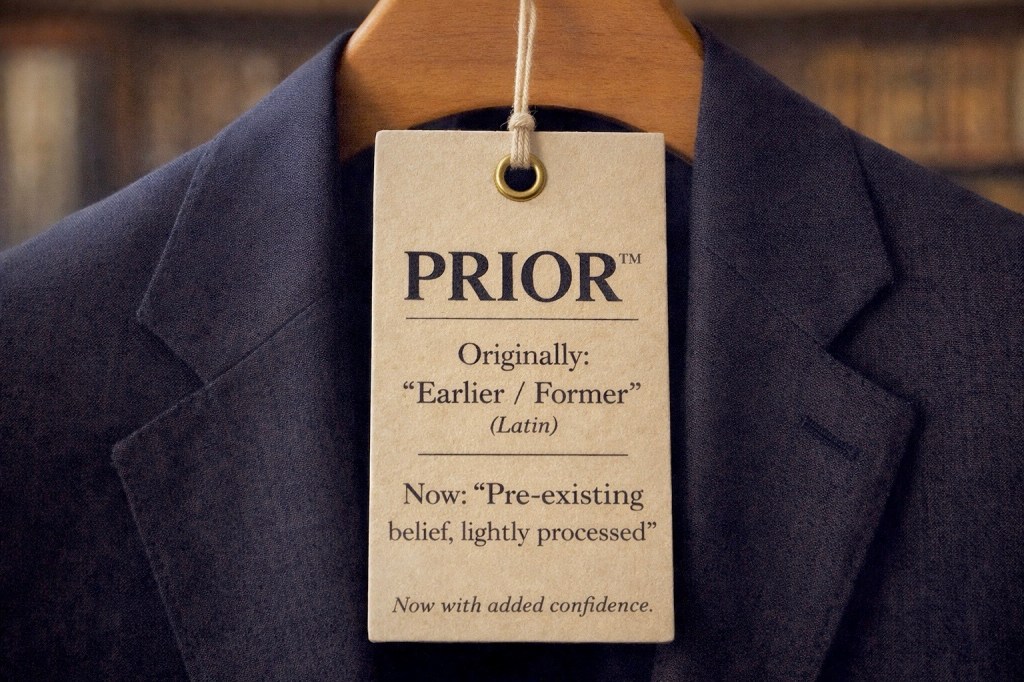
A quick etymological aside: prior comes from the Latin prior, meaning “earlier” or “former.” So despite its modern podcast career, it’s actually an old word in a new suit—recently reissued with improved explanatory confidence.
 COUNCIL-OF CONCERNED-CONSERVATIONISTS…..Between Jest And Earnest…..
Leave a comment