—Notes from the Road on a Month in the Country—

Filed as a letter to René Séance, NVZ Headquarters.
Under special commission to observe the American landscape—linguistic, cultural, and otherwise—and determine what, if anything, it believes itself to be.
APRIL 2, 2026
In a Season of Passing Observations
René, As Ever—
I have continued on from Niagara-on-the-Lake, though not without a certain reluctance. Lee, as it happens, was called away—something involving beavers, though whether photographic or physiological in nature was not entirely made clear. He departed with the calm assurance of a man accustomed to such a summons, leaving behind a silence which, while not unwelcome, proved more noticeable than one might have expected. The maid gave me a lashing over the muddy boots on the bed as I was leaving.
In his absence, I found myself drifting southward and, by arrangements that were more logistical than intentional, passed the night in a place called Ithaca, NY, in the Finger Lakes region. One does not, at first, attach significance to such things. And yet, having arrived, I discovered no particular reason to remain. It seemed, on reflection, an inversion of the usual arrangement: one reaches Ithaca, and then—quite promptly—leaves it again.

It was there, in the evening, and in a mood I can only describe as faintly homesick in the English manner—that is, not for any particular place, but for a certain tone of existence—that I came upon a small English novel by J. L. Carr.
The cover—tasteful, attractive to the eye, and entirely untroubled by urgency—recommended it as a suitable companion. I began reading without expectation, and continued, as it turned out, without interruption.
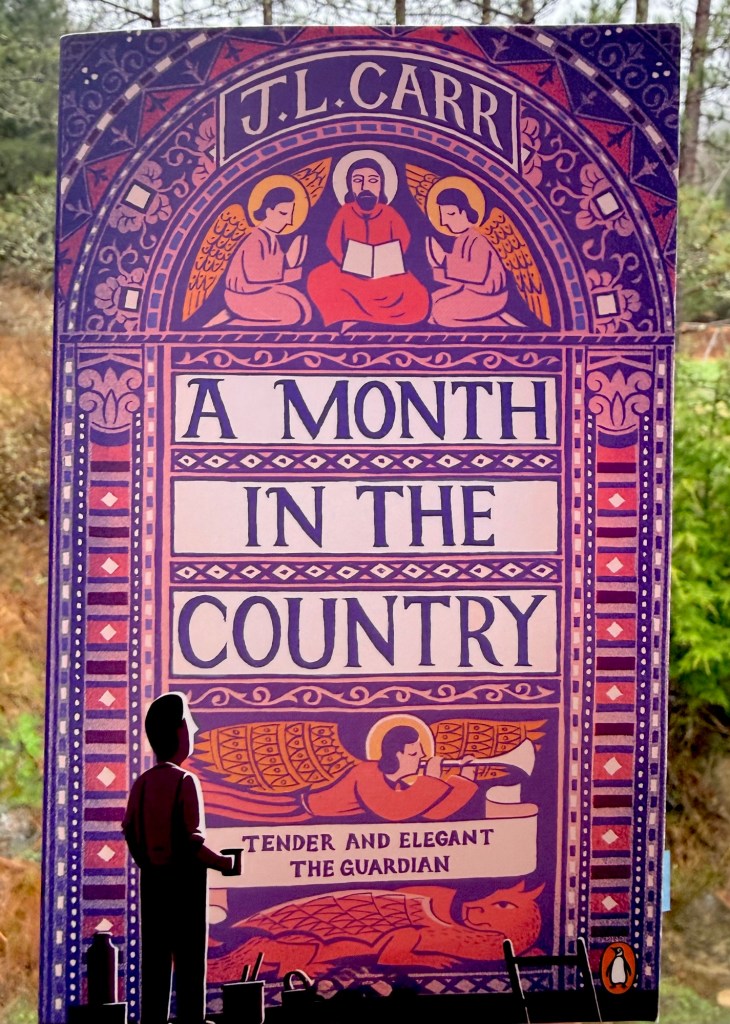
The book concerns a Mr. Tom Birkin, a veteran returned from the Great War, who takes up temporary residence in a small Yorkshire parish in order to uncover a medieval wall painting—specifically a large depiction of the Last Judgment—that has, over time, been painted over with whitewash and forgotten. His task is to remove these later layers and reveal the original work beneath, doing so slowly and carefully so as not to damage what remains.
At the same time, he becomes acquainted with the small circle of people around the church, including another man working nearby to locate an old grave, and a married woman, Mrs. Keach, whose circumstances are not entirely happy. Her manner toward Birkin suggests—without ever stating it directly—that an alternative arrangement between them might be possible. The possibility is real, and felt. Mr. Birkin does not pursue it.
Not, one feels, from coldness or incapacity, but from a reluctance to interfere in a life already formed, however imperfectly.
“Summertime! And summertime in my early twenties! And in love! No, better than that – secretly in love, coddling it up in myself.
It’s an odd feeling, coming rarely more than once in most of our lifetimes. In books, as often as not, they represent it as a sort of anguish but it wasn’t so for me. Later perhaps, but not then.”
Forgive me, René. I couldn’t resist inserting that quote.
But Tom Birkin’s work continues. The painting, once hidden, is gradually restored to visibility—not altered, not improved, but uncovered. And the relationships around him are left as they are. The month passes. Nothing is dramatically resolved, and yet something has been quietly completed.
One closes the book with the impression not that events have been driven to a conclusion, but that a particular time and place have been allowed to stand, intact, without disturbance.

The following day, having resumed the road, I found myself in Ulysses, PA, where I took a room at an establishment called the Sirens Rest Inn.
This name of this motor inn, as they are known hereabouts, might be understood either as an invitation or as a report. The accommodations, while not perceived as imminently dangerous, did appear designed to test one’s resolve.

It occurred to me—though not immediately—that Mr. Birkin, in his quiet way, seems to have effected something similar to what this place implies. He does not overcome the Siren so much as decline to answer her. One does not sense a struggle so much as a settling.
In that sense, it is perhaps not that the Siren is defeated, but that she is—quite simply—allowed to rest.
This is, I suspect, a more durable solution than binding oneself to the mast.
It was at this point—while I was still in possession of these thoughts—that I received a message from our American colleague, John St. Evola.
It read, in its entirety:
“You’ll want to see this. Come down.”
No further clarification was provided.
I found him some miles along the road, standing before a large roadside billboard, partially stripped of its more recent coverings. The newer advertisements—for Mini Marts, Subarus, assurances of continued motion—had begun to peel away, exposing beneath them an older image: a Dodge Caravan, rendered in the unmistakable visual language of the late 2000s, now re-emerging where the upper layers had failed to hold.
John regarded it with a certain satisfaction.
“You mentioned that book,” he said, gesturing toward it. “Fellow uncovering a painting, was he?”
I confirmed that this was the case.
He nodded, then pointed again—more precisely this time.
“Well,” he said, “this is our version.”

One hesitates to draw a direct comparison between a medieval rendering of the Last Judgment and a billboard advertising a family vehicle from 2009. And yet, the manner of their respective reappearances suggests a shared principle.
In both cases, what was once visible had been covered—not destroyed, merely superseded—and what is revealed again owes its return not to reinvention, but to removal.
In the novel, Mr. Birkin required patience, tools, and a steady hand. Here, the work appears to proceed by weather, neglect, and a certain indifference to revision— no doubt with the prospect of putting up a new advertisement. And yet—the result is not entirely dissimilar.
It is, I am sure, entirely coincidental that one should finish reading of such a process in the evening, only to be summoned to witness its American equivalent the following day.
Still—the timing is difficult to ignore.
The English, when they place an image upon a wall, tend to concern themselves with matters of final significance—judgment, redemption, the ordering of souls. The Americans, by contrast, elevate rather different assurances: reliability, affordability, and the promise—implicitly—that one may continue onward without incident—preferably in a Dodge.
“’It’s not easy, he repeated. “The English are not a deeply religious people. Even many of those who attend divine service do so from habit. Their acceptance of the sacrament is perfunctory: have yet to meet the man whose hair rose at the nape of his neck because he was about to taste the blood of his dying Lord. Even when they visit their church in large numbers, at Harvest, Thanksgiving, or the Christmas Midnight Mass, it is no more than a pagan salute to the passing seasons. They do not need me. I come in useful at baptisms, weddings, funerals. Chiefly funerals – they employ me as a removal contractor to see them safely flitted into their last house.’ He laughed bitterly.”
One should not, perhaps, press the comparison. The novel, as the quotation above makes clear, takes a rather different view.
And yet, both seem designed to be encountered in passing, and to reassure the viewer that something, somewhere, has already been settled.
The method—one notes—is remarkably consistent.
As I came toward the close, I found myself unable to ignore the contrast that had been forming all along. In the novel, Mr. Birkin uncovers a medieval mural—patiently, reverently—revealing something laid down centuries ago, waiting beneath neglect but never erased.
And here, by contrast, the American mural: not hidden, but layered; not recovered, but replaced—until, by accident or entropy, an earlier promise reasserts itself.
The mural endures by being rediscovered.
The billboard survives by being covered—again and again—until something underneath insists.
One invites silence and attention.
The other abolishes both.
And what we call conservation, I suspect, depends entirely on which of these we still recognize when we see it.
It is not recorded that Mr. Birkin concerned himself with roadside advertising.
Still, one suspects he would have approved of the method—if not the subject.
Yours, At The Divide,
Begonia Contretemp
POSTSCRIPT — From our Creative Director:
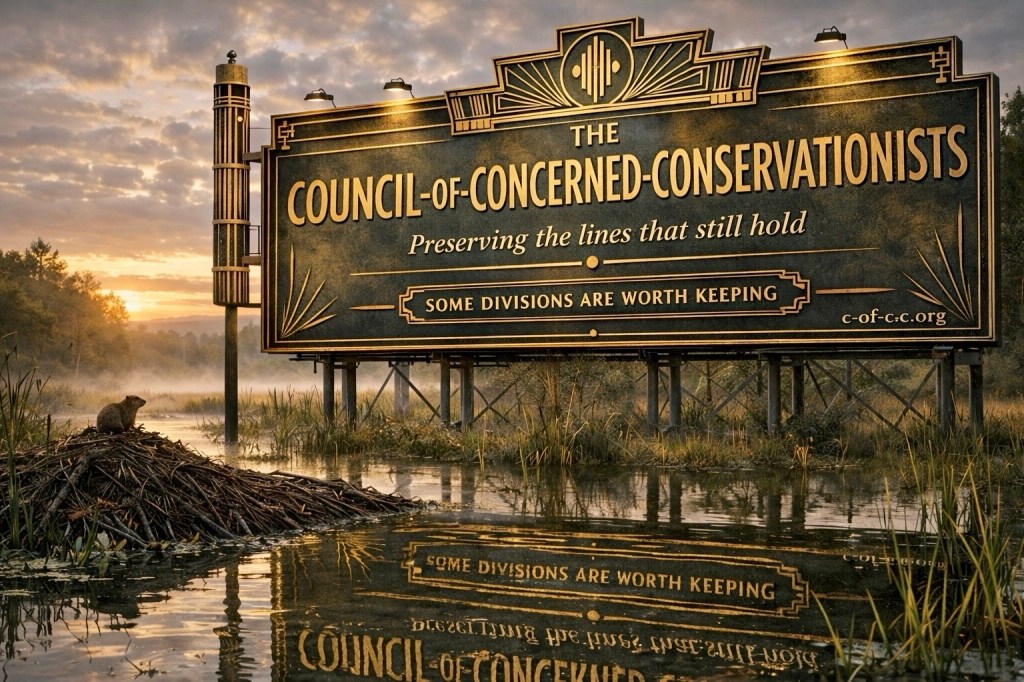
For the record—so no one thinks this was arranged—the billboard came first.
It stood out because the car wasn’t current. A Dodge Caravan from about seventeen years ago had started to show through where newer ads were peeling away. I noted it—and, regrettably, didn’t stop to take a picture.
A few days later, for unrelated reasons, I picked up A Month In The Country—a cheap copy with a beautiful cover—just to get away from the Internet. I had no idea of the details of the book.
Only while reading did I realize the novel turns on a man uncovering a long-hidden wall painting.
That’s when the billboard came back. I didn’t go looking for a connection. The two things showed up on their own, a few days apart, and only afterward lined up.
Call it coincidence if you like. I’ve tried that. It doesn’t quite settle the matter.

 COUNCIL-OF CONCERNED-CONSERVATIONISTS…..Between Jest And Earnest…..
Leave a comment