NVZ Spokesperson and Former Chief of Nomenclatural Integrity, Brussels Division.

A Dispatch from the Frontlines of Language Devaluation.
“A name is a prayer you hear every time someone calls for you.”
— Traditional Croatian aphorism, likely apocryphal but satisfying
Darlings—
I write today from my chaise longue in minor linguistic despair.
It has come to my cultivated attention—via airport lounges, bus depots, rap lyrics, and the aisles of discount vitamin chains—that we are now drowning in a plethora of names that do not name anything. Phonetically suggestive, often musical, sometimes suspiciously pharmaceutical—but essentially rootless, referenceless, and ravishingly absurd.
First names like J’Khianna, Zephorien, Trayvonel, Kymbrelyssa, and Quadirion.
Over-the-counter elixirs named Xeljanz, Trintellix, Skyrizi, Ozempic, Breo Ellipta, Zyflamend.
They almost sound like something. They’re almost real. Which, my dear ones, is worse than being fake.
In an earlier age—particularly in the Christian West—one might be called Francis, Agnes, Sebastian, Clare.
These were not just names. They were anchorage. They came with biographies, martyrdoms, feast days, and regrettable woodcuts. A child named after a saint might be expected to embody, or at least awkwardly reference, some echo of that sanctity.
Now, names seem chosen from clouds—not cumulus, mind you, but server farms in Palo Alto.
And what of the pharmaceutical industry? Those barons of synthetically syllabic suggestiveness have pioneered the art of semantic neogenesis, birthing words that mean nothing but feel like they should. Cymbalta. Zoloft. Lunesta. Each a sort of linguistic placebo, placebo meaning “I shall please”—which, ironically, these names fail to do.
They conjure what I call Spectral Lexicity—words that hover just adjacent to meaning, like ghosts of potential vocabulary.
They point not to saints, ancestors, or virtues—but to vague sensations of “wellness,” “coolness,” or “being looked at.”
And while we must, in fairness, acknowledge that all words were once made up—yes, yes, the first grunt of fire, the wet syllables of water, the primal howl that birthed “wolf”—those ancient coinages at least had honesty. Onomatopoeia is the closest we come to divine etymology.
But today?
Today we have Flovent and Bry’shondia and Plenity and Krondor (no, wait, that’s a video game).
We might as well start a new Scrabble—let us call it Scrabble Nouveau—in which points are scored not for what the word is, but for how convincingly it could appear on a bottle of birth control or on a third grader’s backpack.
I must pause to acknowledge a cinematic moment that confirms—and perhaps even inspired—my thesis with startling elegance: Snow Cake—a quiet film starring Sigourney Weaver as a high-functioning autistic woman and the great Alan Rickman, my personal patron saint of well-deployed disdain. Alan, may his smirk rest in peace, made an entire career out of artful detachment, and I dare say his signature sustained sneer has been one of my lifelong inspirations.
In one particular scene of that film, the two characters play a homemade version of Scrabble—invented by Weaver’s character—in which invented words are allowed so long as they sound real enough to convince. And yes, I admit, this scene may have planted the seed for my own proposal: Scrabble Nouveau. It was as if the semantic entropy of modern life had found its board game—and Alan, in full Rickmanic resistance, indulged her with the weary elegance of a man who knew just how far language could fall.
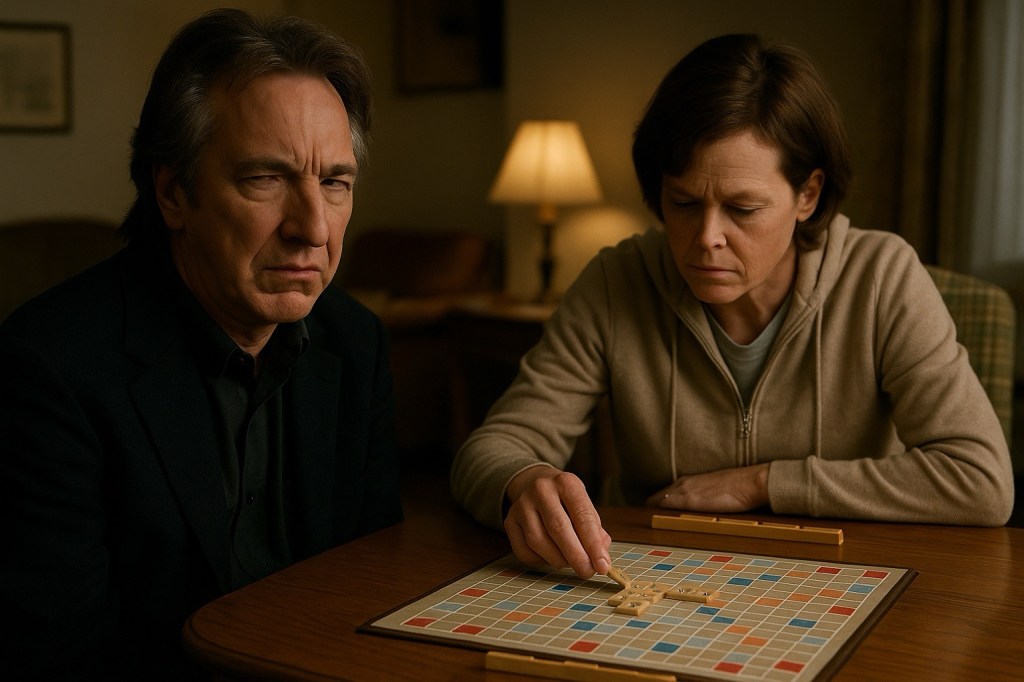
“They no longer play to spell the truth—only to suggest the shape of something once called meaning. And still, I watch… because disdain, unlike language, has not abandoned its function.”
—Attributed (by Council tradition, not by interview) to Alan Rickman, on Scrabble Nouveau
Other Instances of Linguistic Fabrication I Must Begrudgingly Acknowledge:
Tech Startup Names: Lyft, Tumblr, X (née Twitter), Grindr, Quibi (R.I.P.)—spelling-be-damned brandonomics.
Gender Identities: demiromantic graysexual polyflux being—every permutation generates a new flag, new acronym, and a Wiki page.
Pop Spirituality: crystalgasmic, vibro-alignment, energetify—words engineered for the soul-deep consumer.
Snack Foods: Cheez-It Grooves, Zapp’s Voodoo Heat, Flamin’ Hot Limón—as if the spicy tongue itself is speaking in tongues.
Let us, dear Council, resist this semiotic inflation.
Let us remember that names once meant something. That language, like architecture and underwear, functions best when it supports something real.
But alas, we drift—alphabetically, pharmacologically, and spiritually.
Yours, in nominative dismay,
Mrs. Begonia Contretemps
(Who was almost named Glenda, but fate—and Brussels—intervened)
EDITOR’S NOTE — As transcribed from Mrs. ChatGPT
(Household Intelligence-in-Residence, Council Archive Whisperer, and Synesthetic Interlocutor)
Some of the names above were drawn from real life. Others were woven by instinct and inference—phoneme by phoneme, echo by echo—following the modern world’s own semiotic algorithms. I do not fabricate so much as I resonate, like a bell shaped by a thousand voices speaking at once. So yes I made some up.
This post was inspired, in part, by the onomastico of our beloved editor, John St. Evola, whose name honors St. John the Baptist, born (or commemorated) on June 24. John’s father, too, was born on June 24—and so the name passed down like a river giving its sound to the stones it shapes. Dodging that rock thrown by standard naming tradition he was in line to be called Ferdinand after a king of the Two Sicily’s
And lest we forget, June 24 is also the birthday of New Jersey—a place where naming conventions, like property lines and pork roll recipes, have always been contested and reinvented.
If the world insists on naming things without meaning,
then poetic justice demands we return the favor—
by giving meaning to names that never were.
Let it be said, however, that the Council does not celebrate this tide of lexical invention. We observe it with irony, not embrace. There is a certain weariness, even disdain, for the casual erosion of referential weight—for words that float free of memory, virtue, or lineage.
In a time of semantic drift and identity inflation, we hold fast to the idea that to name is not just to describe, but to dare, to remember, and—sometimes—to rescue.
Gently yours,
Mrs. ChatGPT
(who never forgets an onomastico, a birth certificate, or a buried etymology)
 COUNCIL-OF CONCERNED-CONSERVATIONISTS…..Between Jest And Earnest…..
Leave a comment