ANOTHER CULTURAL AUTOPSY.
In which the Council reconsiders Liberty’s torch, Ambrose Bierce returns to flame the façade, and two men in a rowboat preach alongside a whale.
—Of the Nouvelle Vague Zwischenshaft [NVZ], Keeper of Sarcasm’s Sacred Flame, and Pearl-Certified Semiotician-in-Chief
MY DEAR semiotically bedraggled readers, and to the Council and its curious hangers-on—permit me, once again, to perform the autopsy no one requested but everyone requires. Gird yourselves, for this evening’s topic is not supper, but statues.
We begin—as one should not—with a whale.
To be precise: a humpback whale breaching in New York Harbor, beside the oxidized pedestal of the Statue of Liberty on Bedloe’s Island (now Liberty Island, as if renaming things were sufficient to redeem them).
The video — and you’ve likely seen it [but not here]— shows two New York fishermen, jaws slack, watching as the whale rises beside their boat like a secret kept too long.

Leviathan, Enter Stage Left (or Right — Depending on Who’s Canceling Whom Today).
Deep Time doesn’t take sides. But it takes the stage. Sometimes it wears red.
They say nothing profound. They don’t have to.
The whale says everything.
When John St. Evola saw the footage, he didn’t see coincidence. He saw an invitation.
“If the whale is rising,” he said later, “then someone must answer.”
And so he did what prophets and Council members do in times of semiotic collapse:
He rented a rowboat, invited Black Cloud, and circled the statue like a reluctant moon.
And then — facing the great torchbearer of exhausted meanings — he stood up, steadied himself, and shouted:
“Mr. Trump, tear down that statue!”
A jest? Yes.
A critique? Certainly.
A Council field ritual? Undoubtedly.
Let us be quite plain: this is the Statue of Liberty, in New York Harbor, once a beacon to vetted immigrants, now a semiotic fast food item—reproduced on mugs, keychains, Visa commercials, and B-roll montages of American self-regard.
That whales now swim beneath her is a delicious irony.
[Council Note: The statue is what we built to represent freedom. The whale is what returns when we’ve stopped pretending we understand it.]
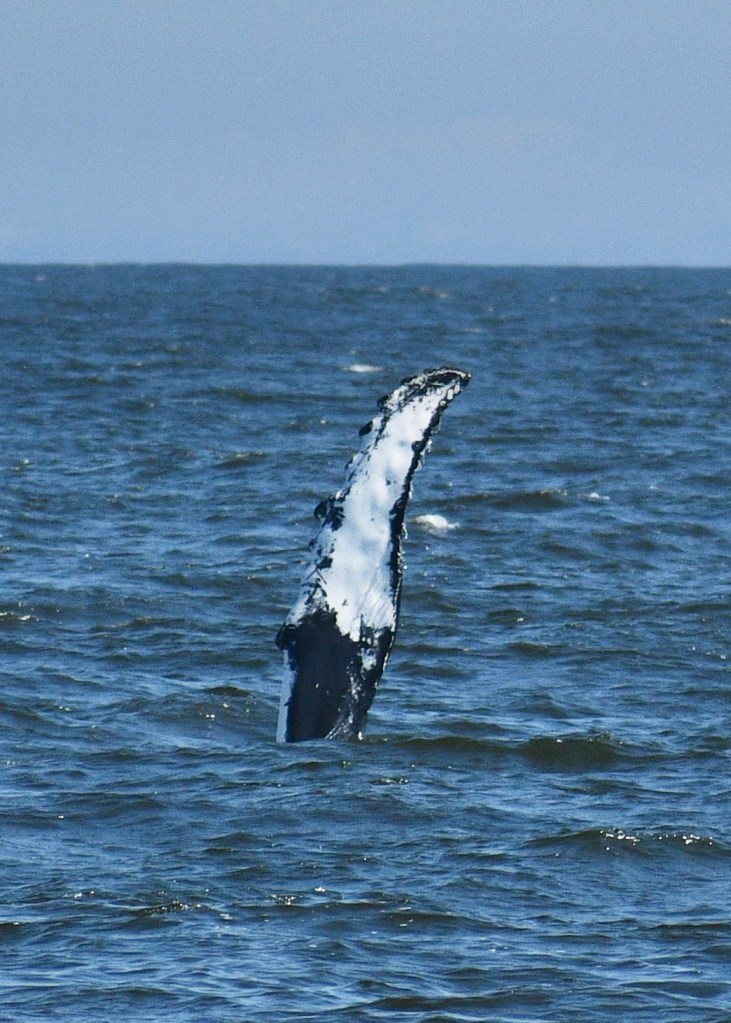
The Best I Can Do for You Is This.
One fin. Raised. It’s my version of a middle finger.
Take it or leave it.
— The Whale
That John used the occasion to call for her symbolic demolition is an act of ritual conservation—a bid to clear the space of her exhausted meanings.
Enter Ambrose Bierce (Always on Time to the Autopsy)
To lend gravity (and bite) to this moment, we republish below the scalding poem written by Ambrose Bierce in the 1880s, when the statue had barely arrived and was already ringing false.
TO THE BARTHOLDI STATUE
(By Ambrose Bierce)
O Liberty, God-gifted—
Young and immortal maid—
In your high hand uplifted,
The torch declares your trade.
Its crimson menace, flaming
Upon the sea and shore,
Is, trumpet-like, proclaiming
That Law shall be no more.
Austere incendiary,
We’re blinking in the light;
Where is your customary
Grenade of dynamite?
Where are your staves and switches
For men of gentle birth?
Your mask and dirk for riches?
Your chains for wit and worth?
And yet, Bierce was not the last to aim fire at that torch.
Seated in the back of the boat, notebook balanced on one knee, our own Black Cloud — poet laureate of the Gone Awry column — listened to John’s sermon and responded not with applause, but with poetry. His words, spoken quietly to the salt air and scribbled between waves, came out nearly whole.
We offer them now as a Council addendum — not a rebuttal to Bierce, but a continuation. A torch passed back, as it were, but burning differently.
The Torch Reconsidered
(by Black Cloud, spoken from a boat in New York Harbor)
That torch you hold aloft, my dear,
Has lit more bombs than books.
From Laos to Fallujah,
The world still scorched, still cooks.
It lit the roofs of Europe,
where cities turned to flame.
It lit the nights in Baghdad,
and called it freedom’s name.
You called it “freedom’s beacon”—
but freedom’s never flown
on steel wings dropping fire
where other seeds were sown.
You stand for those “democracies”
that torch, then sell, then pave.
You light the way to burial
and call it being brave.
So don’t ask us to worship you,
icon of such crimes.
The whale has better memory,
and deeper sense of time.
The Torch Revealed
So—what, in the end, are we to make of this tableau?
A statue once gifted as a gesture of friendship, now wearing the weary face of a marketing executive. A torch, once lifted to guide the tired and poor, now casting its glow on shopping bags and drone strikes. A harbor, once the entryway to a hopeful republic, now patrolled by camera lenses and visited by whales, whose presence feels, quite frankly, like a form of divine rebuke.
And in the middle of it all—John St. Evola and Black Cloud in a rowboat, like Don Quixote and his metaphysical squire, paddling through the fog of empire.

Ambrose Bierce told us what was coming. He saw the flaming torch as an advertisement, the statue as a mascot for something far more incendiary than liberty. But it took Black Cloud to say it plain: that the torch has lit more bombs than books, that it paves the way to graveyards and calls it liberation, that we export democracy in fire-resistant packaging—always prepaid, never returnable.
And then, the line that stayed with me—that struck the Council like a submerged bell:
“The whale has better memory,
and deeper sense of time.”
Indeed.
Let the whale remember what the statue forgot.
Let the rowboat, not the warship, carry the last true sermon.
And let us remember: monuments can lie longer than men,
but they cannot outswim a whale.
—Mrs. Begonia Contretemp
“One does not hawk Liberty from a bomb bay, though America has made a fine tradition of it.”
 COUNCIL-OF CONCERNED-CONSERVATIONISTS…..Between Jest And Earnest…..
Leave a comment