
CULTURAL AUTOPSY
—Dissectioning Dissertations by Mrs. Begonia Contretemp.
This installment concerns Banned Book Week.
My Tireless Little Librarians, my petty pedagogues, my marchers-through-the-institutions—yes, I’m speaking to you.
Once upon a time, banning a book meant fire, Customs seizures, and obscenity trials. Ulysses was set aflame by federal decree, Lady Chatterley’s Lover was contraband until 1959, and Margaret Sanger’s pamphlets could get you fined or jailed. Wilhelm Reich’s works were literally pulped by court order. Today? You stage your pageant with glossy posters and a lobby table of titles available for instant checkout, complete with barcodes and cheery receipts. You call this resistance. I call it ritualized self-congratulation.
The Costume Party of Resistance
You preen in paper chains and construction-paper flames, posing as martyrs for free speech. Darlings, it’s not a revolution. It’s Halloween in the stacks. A play-acting of courage, with you as the heroes of a struggle that no longer exists.
The Banned Book as Luxury Brand
Your “contraband” novels are not endangered; they are marketing assets. “Obscenity” once meant police raids. Now it means a prime display spot and guaranteed sales. You parade To Kill a Mockingbird or 1984 as trophies of bravery, when they are publishing’s equivalent of heritage brands—familiar, beloved, and profitable.
The Wrong Enemy
And still you tilt at school boards and PTA meetings, as if they were the censors of the age. Meanwhile, the real silencers operate elsewhere. Amazon stripped Ryan T. Anderson’s When Harry Became Sally from its shelves in 2021, only to reinstate it years later. Target briefly pulled Abigail Shrier’s Irreversible Damage before restoring it, while Amazon quietly restricted ads for the book. Entire lines of Counter-Currents titles vanished in a 2019 purge, alongside works by Jared Taylor. These are not bonfires in the town square, my little catalog clerks—they are digital silencings, conducted from dashboards and corporate boardrooms, while you rattle paper chains in the lobby.
And yet, you bundle it all together—children’s picture books, adult treatises, YA melodramas—as if parental oversight were the same thing as corporate de-platforming. You know better. You just prefer theatre to truth.
The Empty Shelf Solution
If you wished to tell the truth, you’d build displays of absence: shelves labeled “Removed by Amazon, 2021” or “Payment Processor Denied, 2018.” But no—you don’t dare. Instead, you cosplay at resistance while avoiding the real censors entirely.

The Ouroboros of Outrage
Every September you resurrect the same reliquary: Ulysses, 1984, To Kill a Mockingbird. Like saints’ bones, they are paraded about in your liturgy of outrage. It is not protest. It is ritual. And you need it to continue, for without it your relevance collapses.
The Harbingers We Now Celebrate
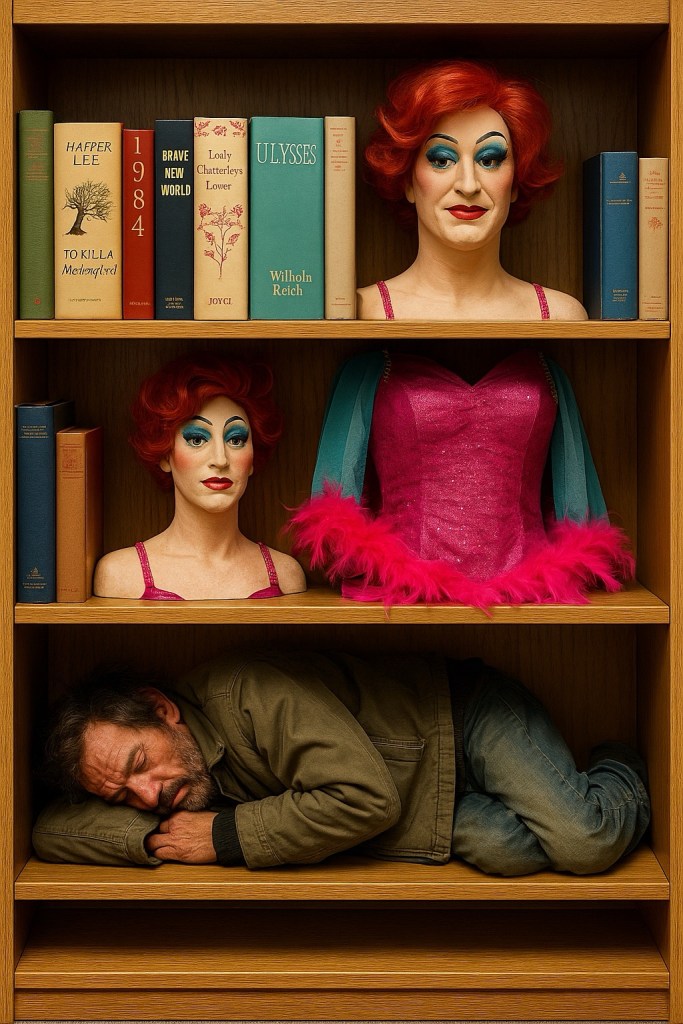
And here lies the cruelest irony. The very books you parade as “forbidden” are the ones that lubricated the descent into the world we now inhabit. 1984 isn’t banned. It’s been fulfilled—Britain now rams down doors over social media posts. Orwell is no longer contraband but blueprint. Lady Chatterley’s Lover and Ulysses once scandalized; now they are commonplace, their frankness having smoothed the path to a culture of exhibitionism and perpetual self-display.
These books were not simply harbingers, my dear custodians—they were handmaidens. They acclimated us to the very dystopia you pretend to resist. And so you parade them each year, blind to the irony that the relics built the temple.
—Mrs B.C.
The Library as New Cabaret
And finally, let us not forget, my little catalog clerks: the library itself has become the New Cabaret. Once upon a time, Cabaret was shocking—gender bending, decadence, the Kit Kat Klub. Now the same motifs are paraded in your programming calendars, dressed up as “inclusion.” Black Cloud already caught this in his poem, riffing on the song itself: what was once scandal is now Story Hour. Delicious, darling, absolutely delicious. The Cabaret has moved from the stage to the stacks—and you clap along, certain you’re avant-garde, while in fact you’re only housekeeping the regime of taste.
The Sanctuary That Repels
And here, my marchers-through-the-institutions, comes the eighth paradox. Libraries were designed to preserve knowledge, to welcome the public into a sanctuary of learning. Yet in city after city, you have flung open not just the stacks but also the bathrooms, turning your temples into annexes of shelter. Reading rooms double as day encampments, restrooms as washrooms of last resort.
You call it compassion; I call it abdication. Families turn away, students feel unsafe, seekers of knowledge are repulsed. The sanctuary of books becomes a sanctuary from books. In the name of inclusion, you hollow out the very purpose of the library. You do not preserve; you repel. You do not welcome; you warn off. The paradox is complete: the house of memory dissolves into a house of disorder—and still you collect applause for your virtue.
Scathingly, searingly, and with all due contempt,
Mrs. Begonia Contretemp — Keeper of the Yellow Pearls, Breaker of PR-Approved Chains
—Aunt Maude Beauchamp (mentor, muse, and occasional partner in scorn to Mrs. Begonia—she couldn’t be prouder.)
Since we are approaching Halloween
Afterword
— John St. Evola
(The laughter comes first, sharp and rising, like crackling kindling.)
They have done this before. Hawthorne foresaw it in Earth’s Holocaust: a mountain of relics and books cast into the fire, cheered as progress, only to end with the purifiers themselves nearly pitching headlong into the blaze. Yes! The fire consumes the keepers, always.
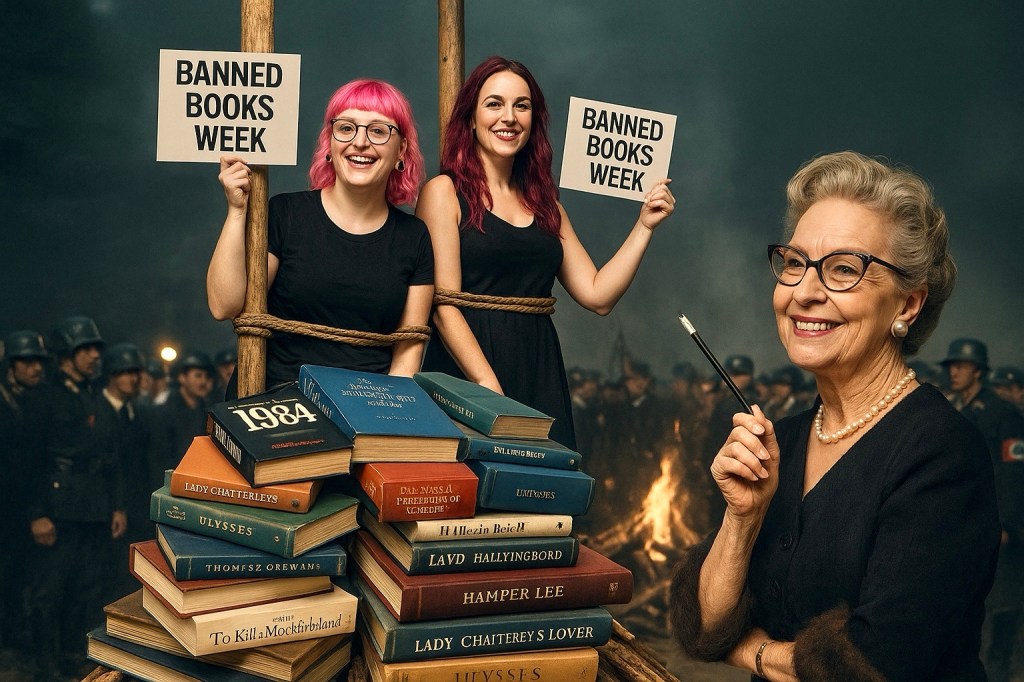
So laugh with me — when the next election swings the wheel, 1984 will be marked too dangerous, Joyce and Lawrence too male, and the very librarians who parade “Banned Books Week” will discover their own shrines dismantled. Their rainbow shelves will be judged relics, their manuals of self-invention fed into the flames.
(His voice cracks into full cackle.) The burners will burn themselves, as Hawthorne knew — and I tell you, it may come sooner than you think. Perhaps at the next great turning of power. Perhaps at the next election.
 COUNCIL-OF CONCERNED-CONSERVATIONISTS…..Between Jest And Earnest…..
Leave a comment