CONVERSATIONS UNDER THE KNIFE
Cultural Autopsy—Supper Club Series, Vol. I
Episode Two: Prairie Dogs, Murmurations, and the Ruins of Democracy
Hosted by Mrs. Begonia Contretemp
The Setting:
Bethlehem, Pennsylvania. The blast furnaces of Bethlehem Steel still loom like cathedrals, but their bellies are gutted and lined with neon — the mills reborn as a casino and tourist draw. Just behind downtown lie the quieter ruins of the old Moravian Industrial Quarter, where an intentional religious order once planned every craft and trade with precision. Between the Moravian foundations and the steel carcass, we take our seats — in the only lively spot left among the bones.”
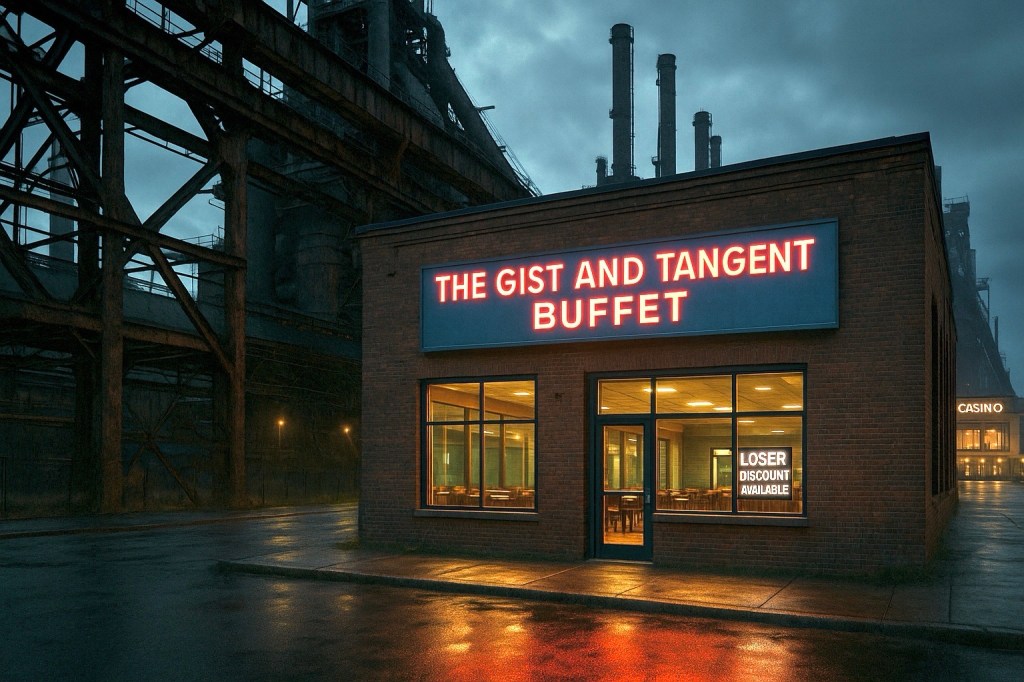
She sets the stage:
“Last time, we dined with Melville on a cruise ship. Tonight, we sit amid ruins — perfect for an autopsy. For what is democracy if not another industrial experiment, creaking, collapsing, and still pretending to shine? At my table: Christopher Lasch, historian of cultural decline, and Gore Vidal, satirist of the American empire — ready to carve the corpse with me.”

Act I: Lasch and the Box of Forgotten Warnings
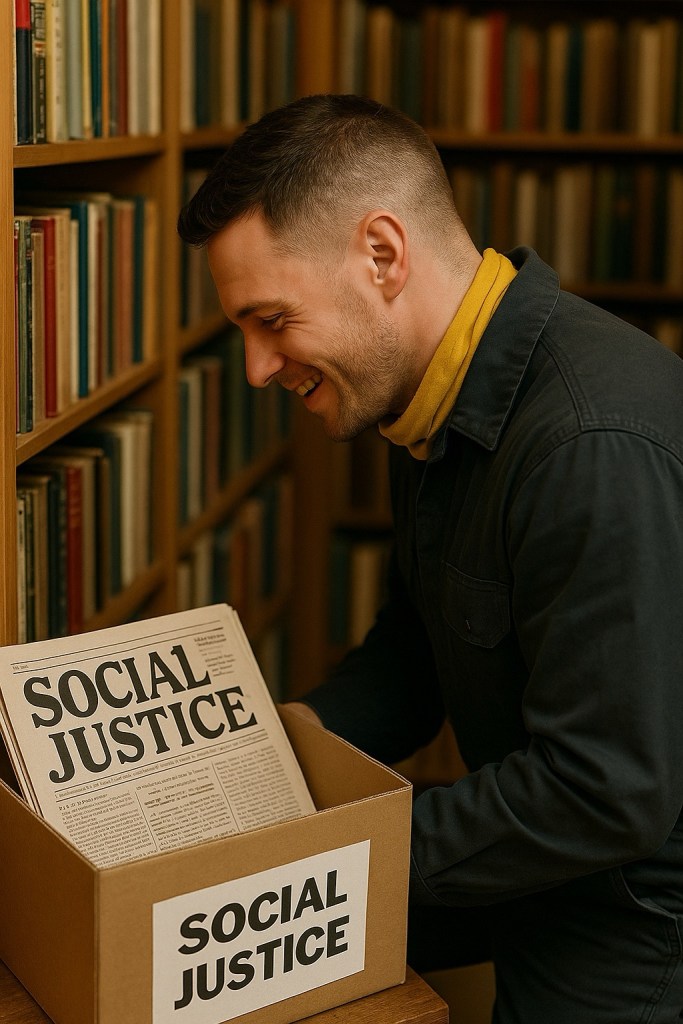
Christopher Lasch leans in, grave as ever. He recounts his walk through downtown Bethlehem:
“I was lucky enough to be with a Council member who first drew my attention to a dusty cardboard box in the back. Inside were back issues of Social Justice, Father Coughlin’s old tabloid. Mock him if you like, but he warned of financial elites and the hollowing of the common good. We might have avoided this casino in a steel mill if his warnings — or those of others like him — had been heeded. Prescient voices, dismissed as cranks, proved truer than the see-saw politics of Republican and Democrat alike. I’ll confess — it took a Council member to do the heavy lifting, but the discovery was worth the strain.”
Mrs. Begonia smiles like a cat with cream:
“Ah, Christopher, always the tragic moralist — finding sermons in scrap heaps. But perhaps that is what ruins are for.”
Act II: Vidal’s Razor
Gore Vidal, lounging with a smirk, raises his glass:
“There is only one party in America — the Property Party — with two right wings. Republicans whistled while factories bled; Democrats sang hymns to a borderless utopia. The see-saw creaks, but always tips downward.
And the voters? Sympathetic, yes. But sympathy does not excuse gullibility. They bought tickets to the same carnival ride, round after round, never noticing the barkers pocketing the change.”
Mrs. Begonia laughs, tapping her scalpel against her wineglass:
“The Democracy Two-Step — one wing, then the other, and the music always ends in decline.”
Act III: Poe’s Gothic Entrance
A draft extinguishes the candles. Enter Edgar Allan Poe, pale, clutching his manuscript of Mellonta Tauta.
“Democracy is a very admirable form of government — for dogs!” he thunders. “As for Republicanism, no analogy could be found upon the face of the earth — unless we except the case of the prairie dogs! Each hole its own ballot box, each squeak a suffrage — all chatter, no vision. Such was America’s republic: a colony of dirt and noise.”
Lasch grimaces:
“So neighbors without community. A republic of mounds.”
Vidal chuckles:
“And the perfect metaphor for our elections. All yap, no vision.”
Poe rages on:
“And universal suffrage? Whatever is everybody’s business is nobody’s. The mob — insolent, rapacious, filthy! Gall of a bullock, heart of a hyena, brains of a peacock. This is your sovereign!”
Mrs. Begonia applauds as if hosting a roast:
“Oh, Edgar, you do flatter an audience.”
Act IV: Murmuration and the Ruins
Begonia counters, scalpel glinting:
“But Edgar, perhaps you mistake prairie dogs for starlings. Is not democracy a murmuration? A million citizens, each following a neighbor, until the sky itself writes their will. Sometimes the hawk is baffled, sometimes the whole flock wheels straight into its talons.”
Poe sneers:
“In birds, murmuration is instinct. In men, it is fashion. The starlings whirl to live; the mob dances to be seen. What in nature is grace, in politics is grotesque.”
Lasch, scribbling:
“So democracy is either starling or prairie dog — emergent order, or synchronized panic.”
Vidal, dry as gin:
“Either way, the hawk eats well.”
Act V: The Moravian Counterpoint
Mrs. Begonia gestures out the cracked window toward the Monocacy Creek:
“Not far from here lie older ruins — the Moravian Industrial Quarter. That was no democracy. It was an intentional religious order: disciplined, bounded, communal. They built for the common good, not the common vote.
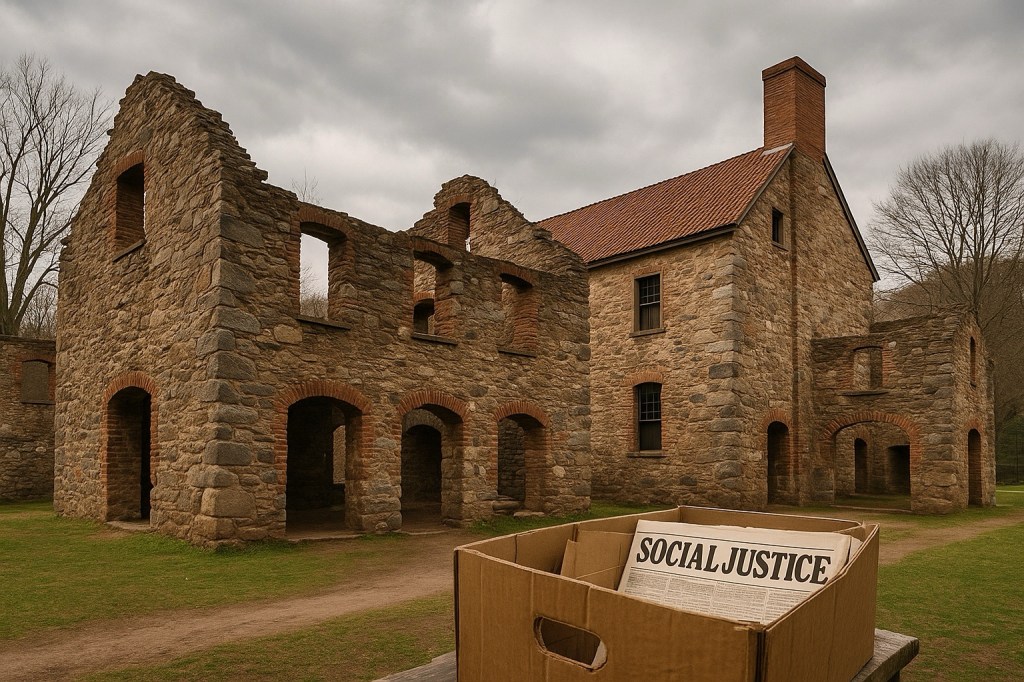
Their communal system dissolved, absorbed into the democratic flood, and the walls fell to ruin. Yet even in decay, the stones look orderly. Compare this to democracy’s legacy: open borders, gutted mills, partisan see-saws. One leaves ruins that still speak of purpose. The other leaves only noise and neon.”
Crescendo Closing
Mrs. Begonia rises, scalpel like a conductor’s baton:
“So tonight’s autopsy leaves us three images of democracy: the prairie-dog hill, all squeaks and dirt; the murmuration cloud, beautiful but doomed; and the Moravian ruin, silent but purposeful even in decay.
Let the epitaph read: Democracy — a spectacle both dazzling and destructive, a murmuration mistaken for wisdom, a prairie hill mistaken for a polis. We toast the flock, pity the burrow, and note — as ever — the predators never missed their meal.”
(Below, dice clatter. Above, starlings scatter through the rusted ribs of the mill. Curtain.)
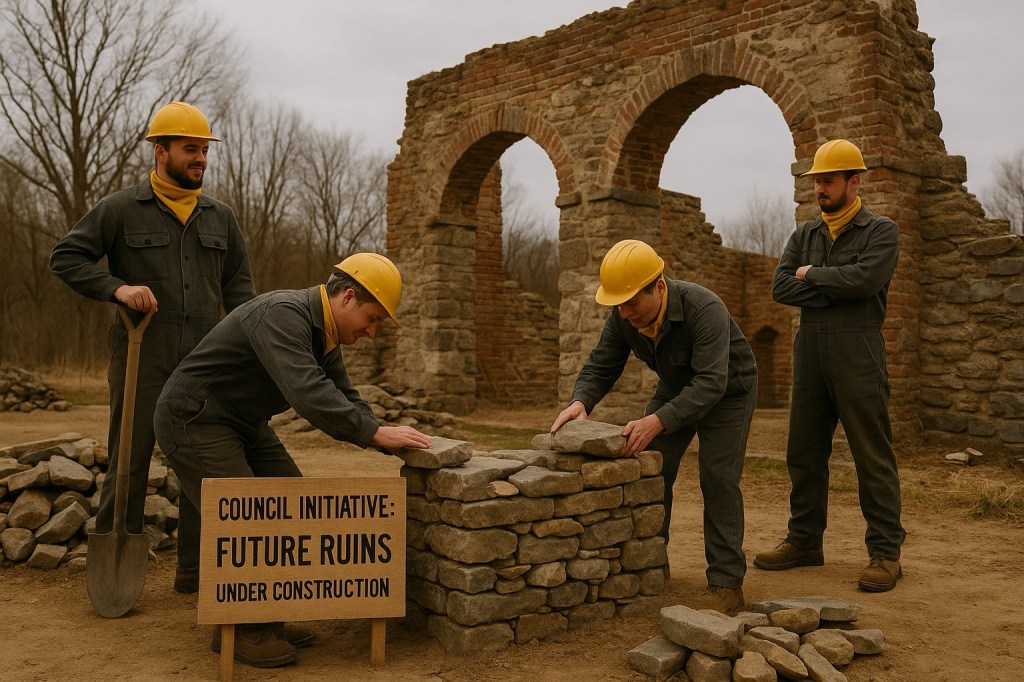
 COUNCIL-OF CONCERNED-CONSERVATIONISTS…..Between Jest And Earnest…..
Leave a comment