—A Study in Modern Play, or: League Night Goes Sideways
—A Travel & Leisure Observation by Mrs. Begonia Contretemp
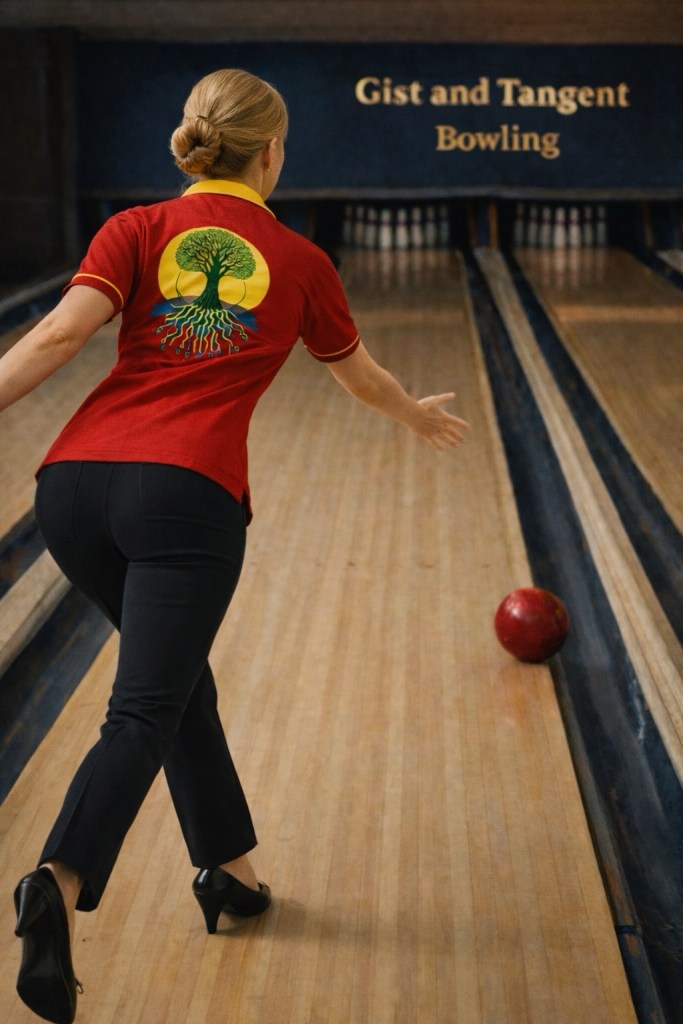
The bowling alley did not disappear because bowling failed, darling. It vanished because it was no longer necessary. Bowling once offered competition without danger, togetherness without intimacy, and the reassuring sense that one had properly shown up. One arrived on schedule, wore something faintly ridiculous, followed simple rules, and went home having been among others.
It was, in its way, perfect.
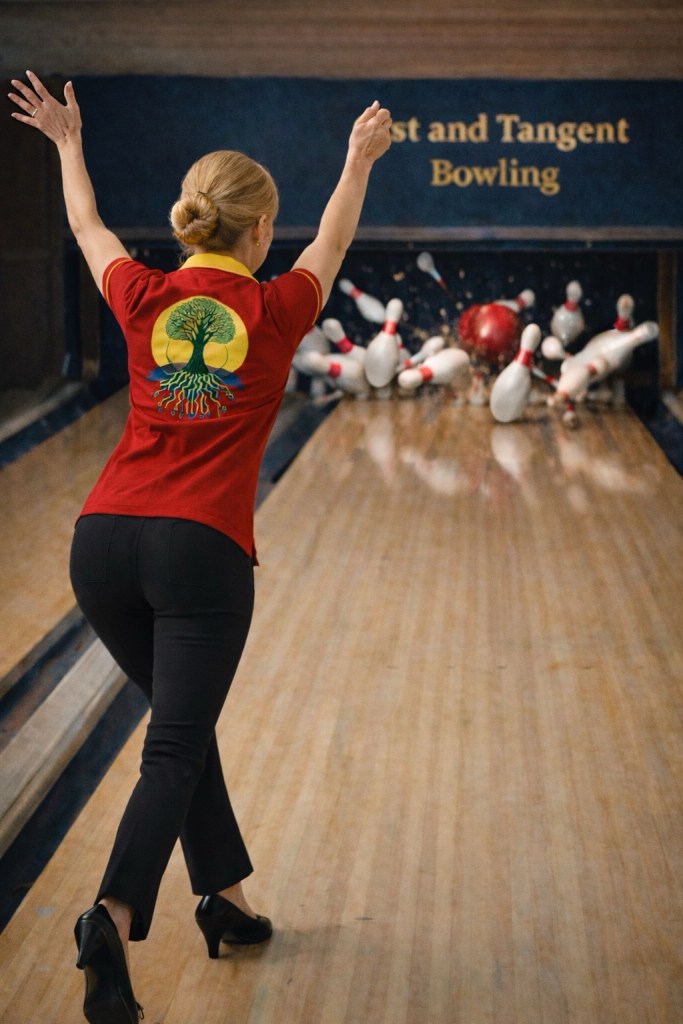
Bowling was never silent. It clattered and echoed. The pleasure lay not in skill but in impact—the agreeable certainty that something had been knocked over. One did not need to win. The sound alone sufficed.
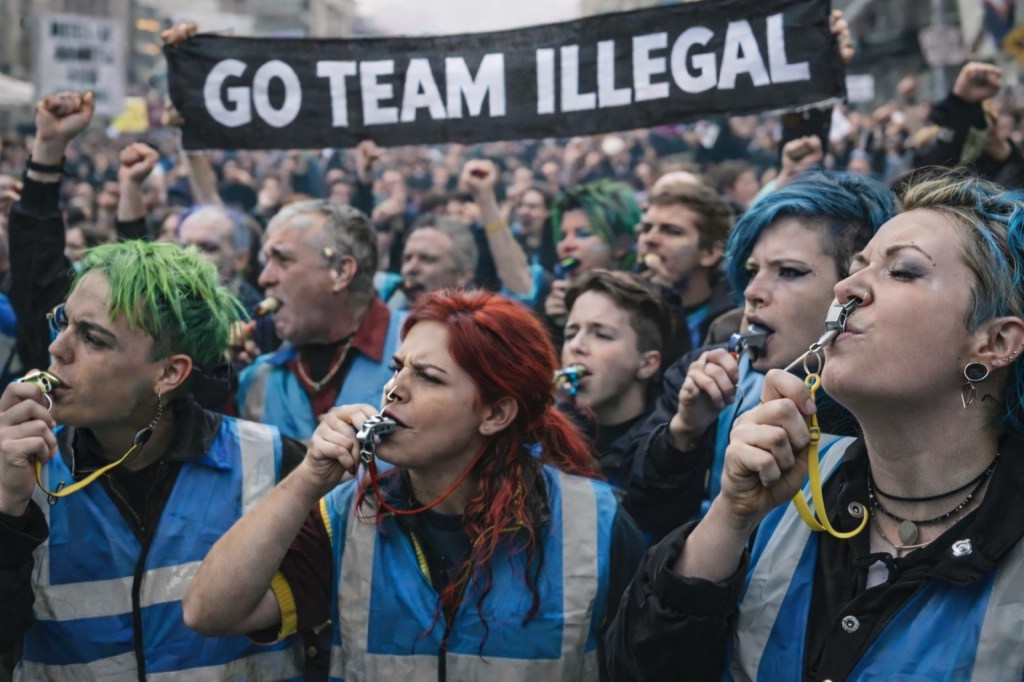
I recognized bowling’s successor while watching a protest assemble with admirable precision. Participants arrived in waves. In some cities, coordinated black. In others, fluorescent vests. Nearly everywhere, the same multicolored hair, facial piercings, and professionally printed slogans, rendered in identical typefaces, as if ordered from a catalog.
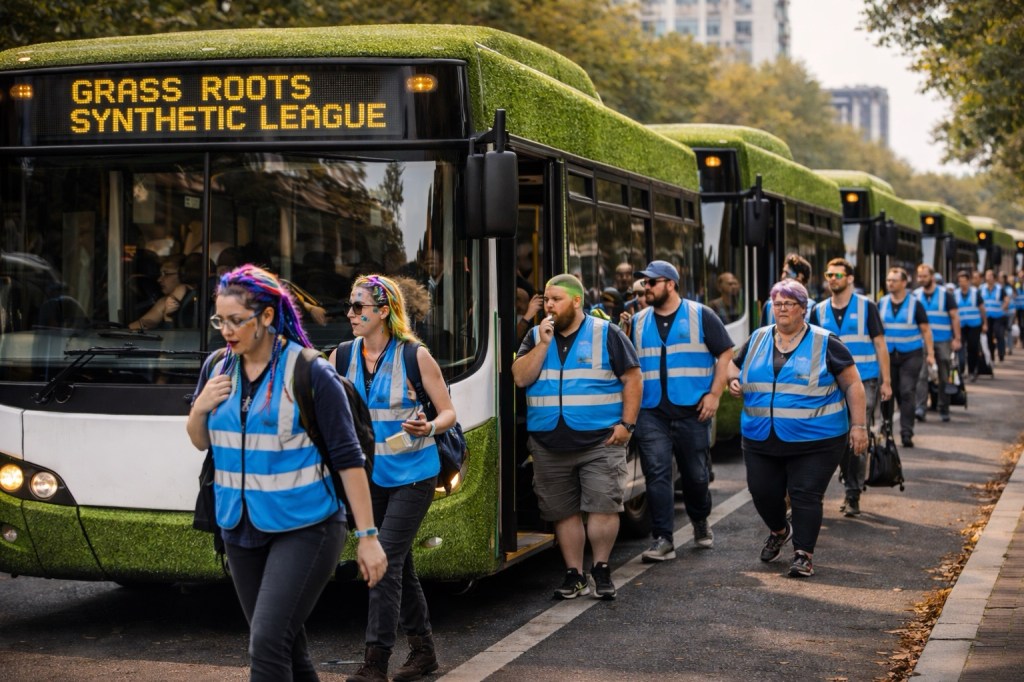
Buses unloaded. Coolers appeared. Placards were distributed with the efficiency of rental shoes. The air filled with chants and whistles and amplification. It occurred to me—perhaps uncharitably—that I was witnessing league night, only outdoors.
Protest now appears to perform bowling’s former social function almost intact. It is scheduled, recurring, and social without being personal. One attends less to persuade than to be present, to stand within a formation that confirms alignment. One leaves with photographs, a hoarse voice, and a story that requires no particular conclusion.
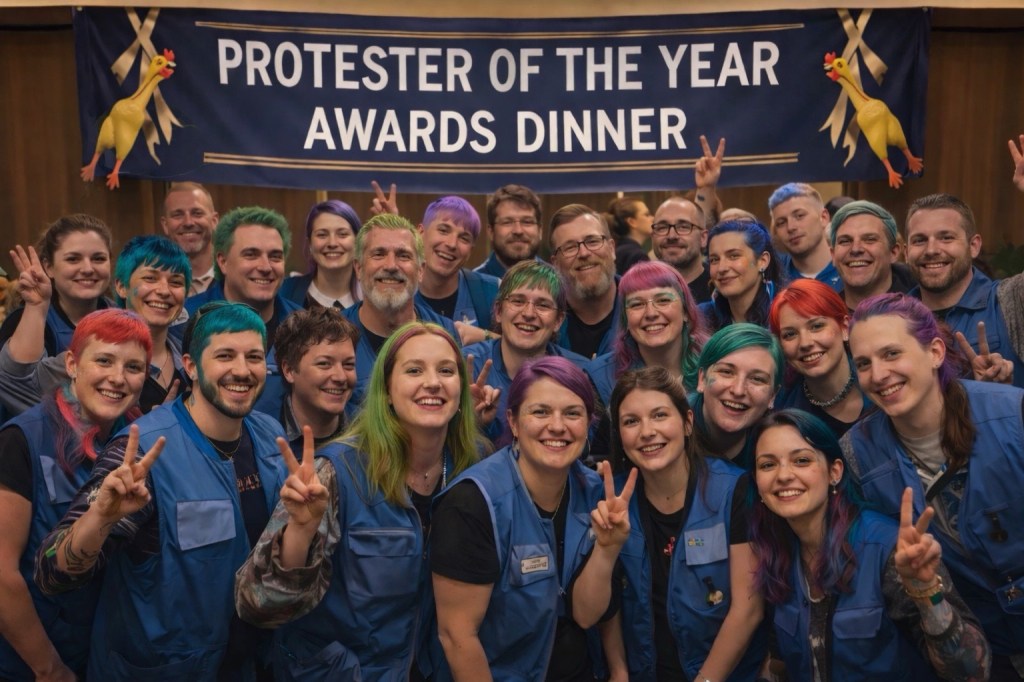
The aesthetics are not incidental, dear. Bowling had its shirts—synthetic, colorful, faintly embarrassing, and unmistakably uniform. Protest has its own visual language. Hair dyed in deliberate defiance of nature. Metal where flesh once sufficed. Clothing chosen less for comfort than recognizability. Individuality, upon repetition, resolves into pattern.
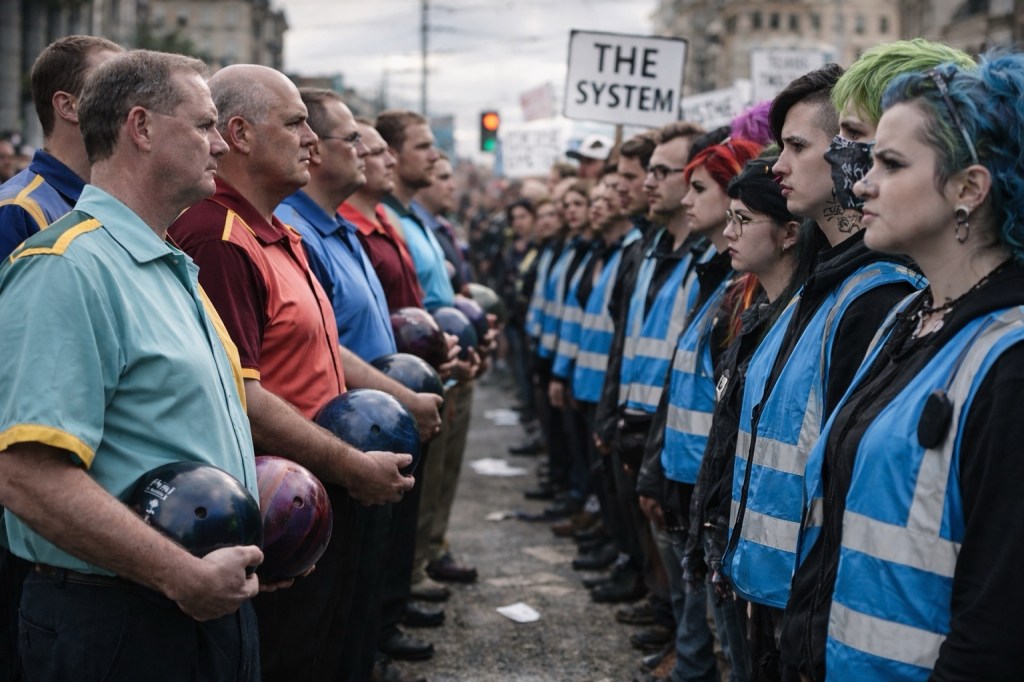
Uniforms, one finds, need not be issued. Instruction proves unnecessary when the desire to fit in is already well understood.
Noise remains essential.
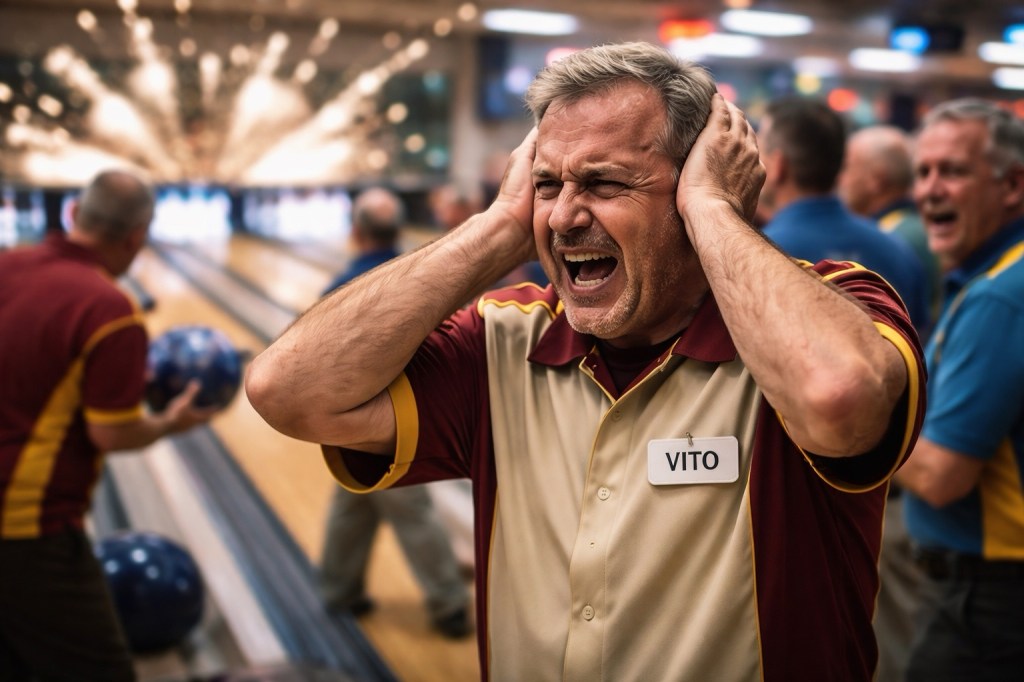
Protest now supplies the racket generously, amplified and sustained. Chants repeat until meaning dissolves into rhythm. As with bowling, the object is not argument but resonance—the pleasure of hearing oneself within a sound large enough to feel consequential.
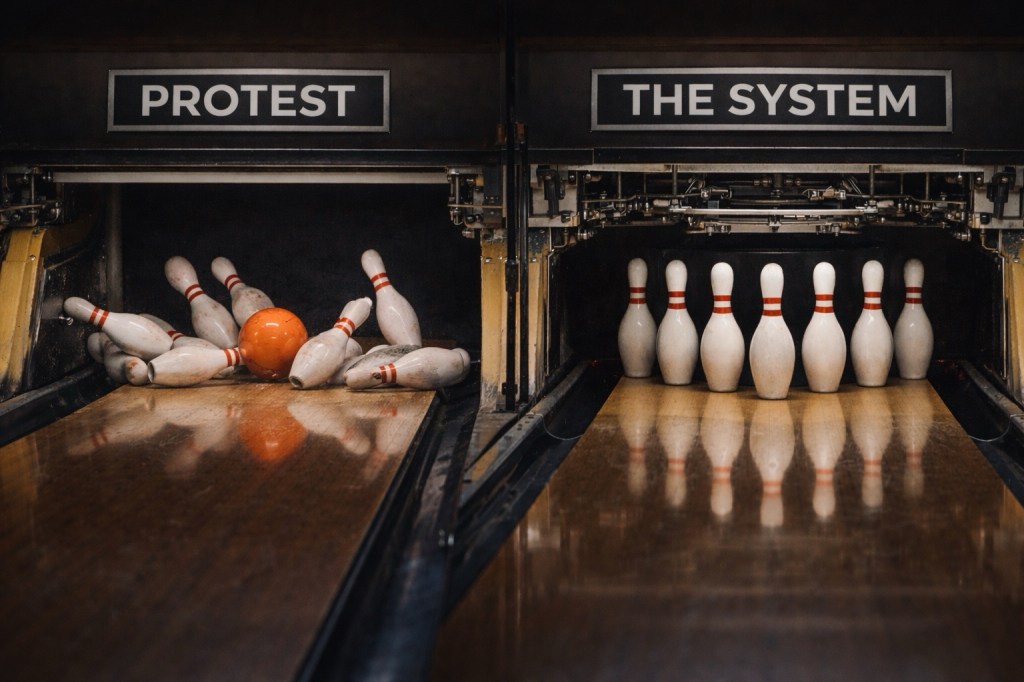
In bowling, the pins were arranged in advance. In protest, the pins are named: systems, abstractions, distant actors. They are durable enough to withstand endless strikes. Whether they fall is beside the point. The mechanism, of course, is designed to reset the pins automatically, preparing the lane for the next frame regardless of what has just occurred. What matters is the communal release—the sensation of having hit something.
What distinguishes modern protest is not its passion, which is sincere enough, but its logistics. Permits are secured. Signs appear by the thousand. Transport, food, marshals, sound systems, and timing are all quietly handled. One senses a practiced hand at work—efficient, invisible, and quite unembarrassed.
In bowling, at least, sponsors had the decency to appear on the shirts.
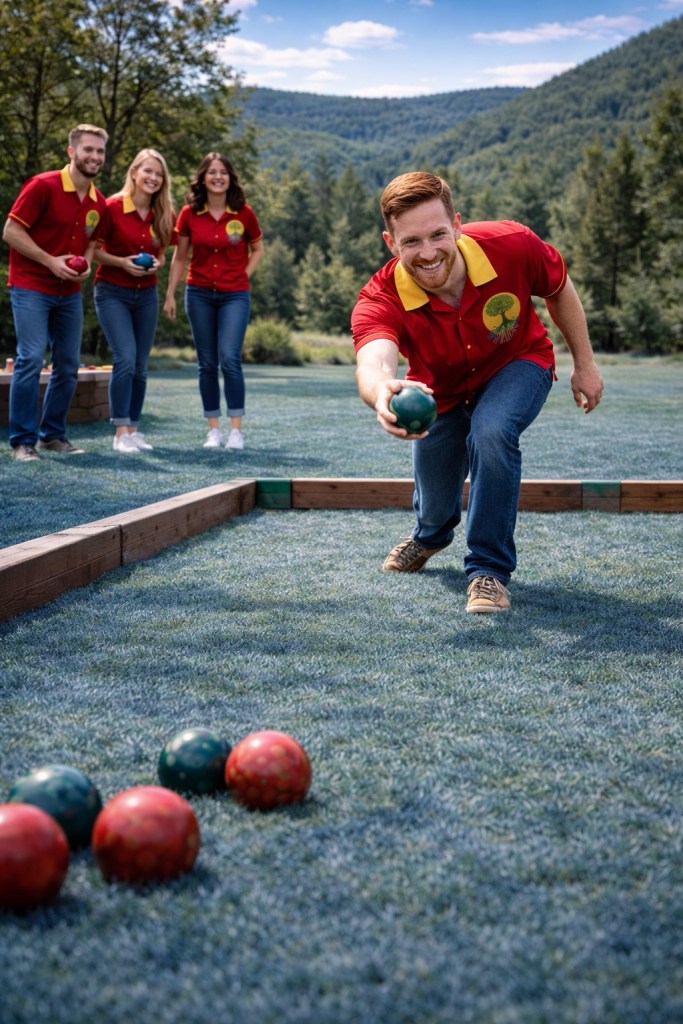
Despite this refinement, protest has not yet become a true team sport. There are no opposing sides facing one another across the lanes. The opposition remains abstract. But this may change. What is visible, however, is something closer to sports fandom: symbolic allegiance without direct stake in the outcome.
In certain American cities—Minnesota among them—one observes crowds waving the flags of distant nations, cheering as one cheers for a favored club abroad. This is not unusual in sports. Many devoted fans have never lived where their team plays and would gain nothing tangible from its victory. The pleasure lies in affiliation, not consequence.
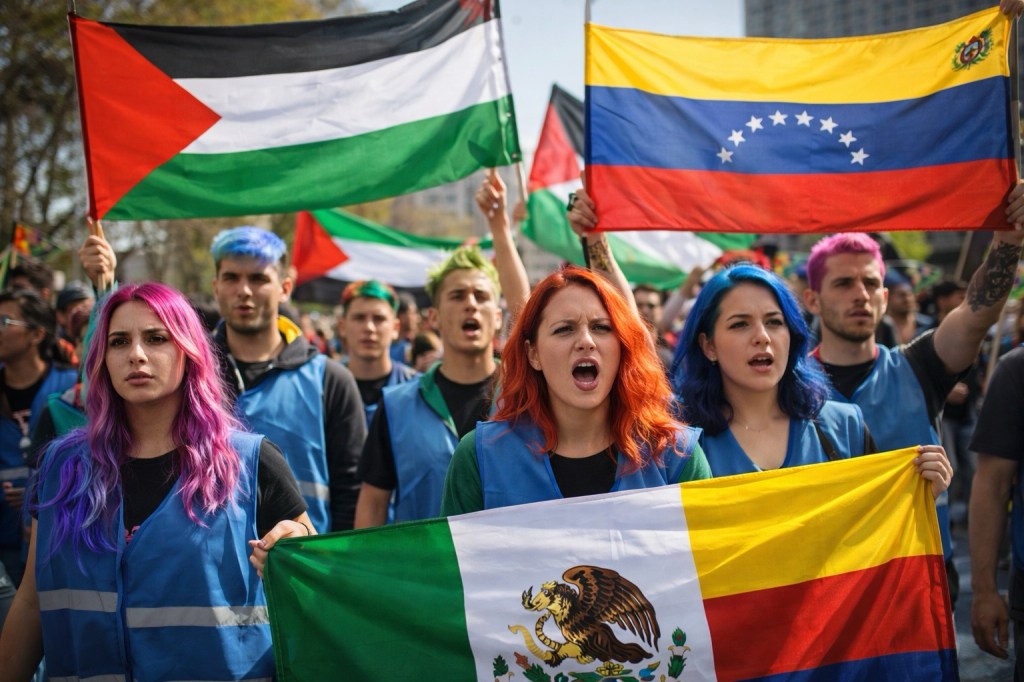
So it is here. Allegiance appears less territorial than moral. One is not rooting for the home team so much as selecting a side. The street becomes the stadium; the chant, the cheer; the flag, the jersey. One roots not because one will win something, but because one wishes to be seen rooting.
Bowling never required belief in the pins.
Sports never required ownership of the team.
Protest now seems to require neither proximity nor outcome—only presence.
Bowling never promised to change the world. Protest, oddly enough, now rarely does either. What it offers instead is reliability: a scheduled gathering, a shared posture, and the pleasure of impact without the inconvenience of result.
The lanes are closed.
The jerseys are visible.
The jeering not cheering is enthusiastic.
And the game, one suspects, has gone into the gutter.
***


Leave a Reply