—The Scenic Route
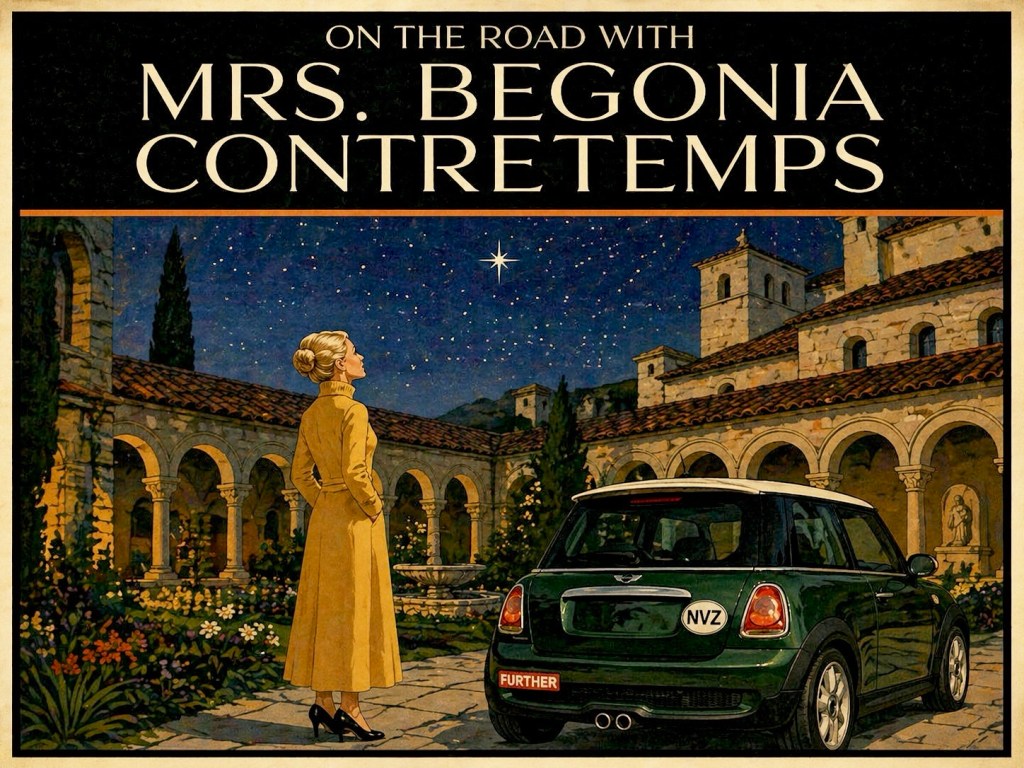
Letter to René Séance, NVZ Headquarters
Filed under instructions to ascertain what, precisely, America is—an inquiry I have been assured is ongoing.
Towanda, Pennsylvania
April, Anno Domini 2026
Mon cher René,
I left The Cloisters in upper Manhattan under very specific instruction from our editor, John St. Evola, who advised—quite calmly, though not without intention—that if I wished to understand America, I ought to begin not with its institutions, nor even its people, but with its signs.
“Drive north,” John said, “and read what the country has chosen to remember out loud. Black Cloud will meet you at the first proper stop. He’ll help you interpret what’s been. . . posted, shall we say. “
I asked what I was looking for.
“You’ll know,” he said, which is not, as you can imagine, the sort of clarity one hopes for in a set of directions.
My nominal destination remained the French Azilum historic site, which he described as “a good ending, if you get there.” I was not, he implied, to be overly concerned with the route.
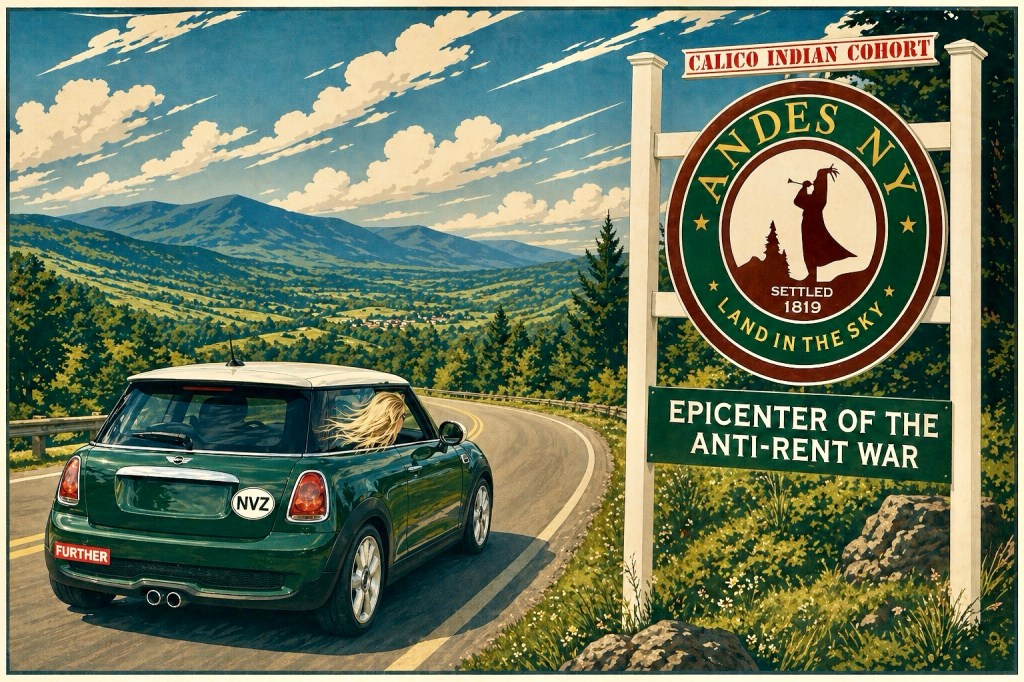
It did not take long for the route to concern itself with me.
A sign appeared: Historical Marker Ahead. Then another, as if to confirm that the first had not been metaphorical. By the third, which included a rather decisive arrow, I felt I had been noticed.
“Well then,” I said aloud, “one follows.”
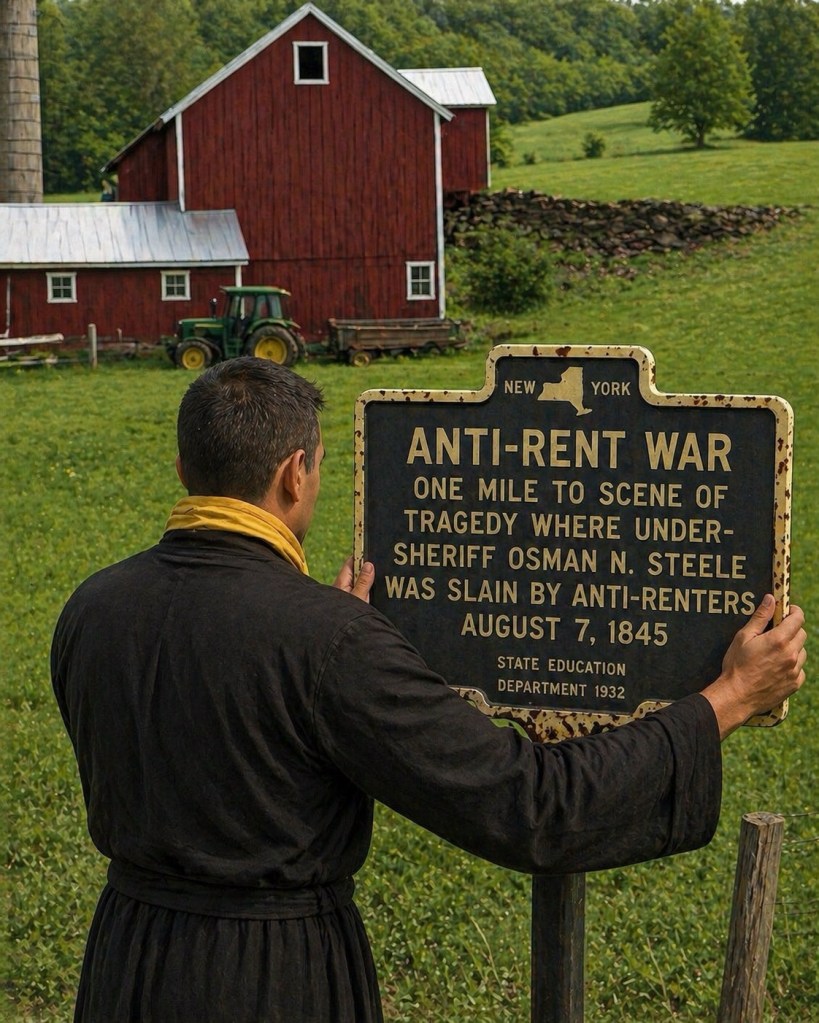
—spoken by Sheriff Osman Steele hours before succumbing to bullet from Anti-Rent resistor
At the end of this sequence stood a plaque for Undersheriff Osman Steele, and beside it a man who looked, not impatient, but entirely unsurprised to see me.
“You took the third sign,” he said, with a note of approval that suggested a test had been passed.
“I did,” I replied. “It seemed insistent.”
“They usually are,” he said. “Otherwise people think the first one was a suggestion.”
We read the plaque at the actual murder site, together. It records that Steele, a county officer, was shot and killed in 1845 by members of the Anti-Rent movement—tenant farmers disguised as “Calico Indians,” resisting rent collection on large estates.
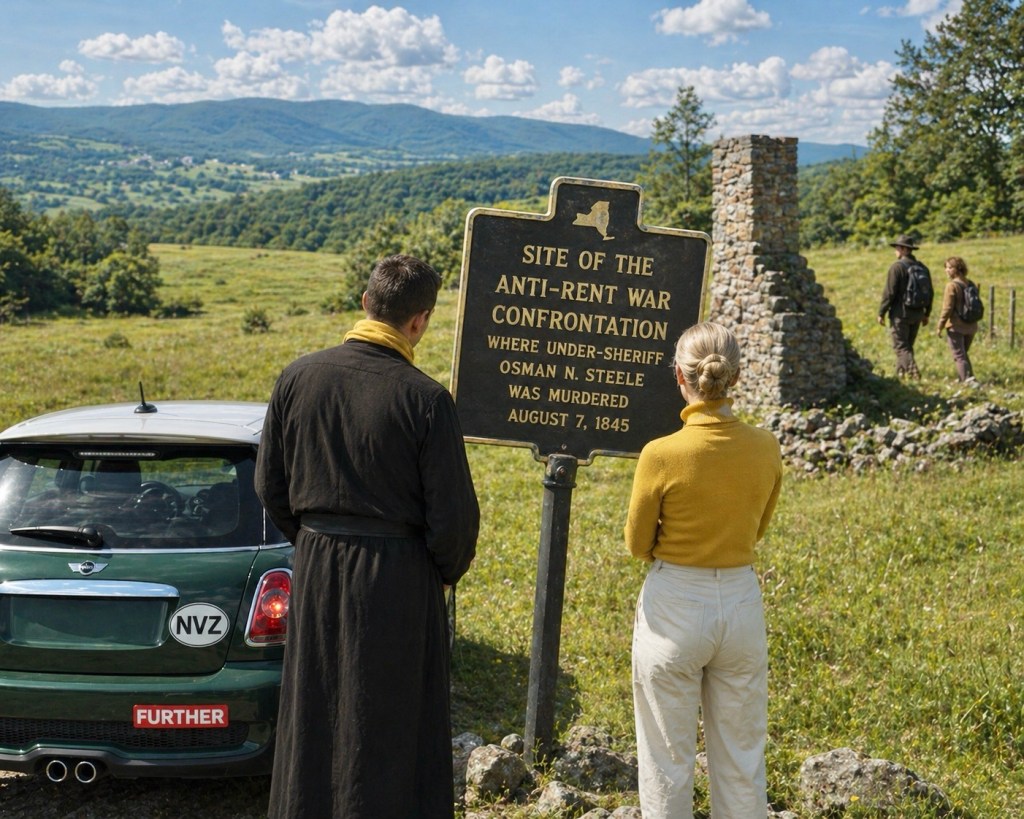
“So it was a group,” I said, “though only one man is named.”
“That’s the shape it takes once it’s posted,” he said, with a slight shrug. “You can’t list a mob on a sign. It looks untidy.”
I looked at him more closely.
“You are, I think, Black Cloud, the Council poet.”
“I am,” he said. “And you must be Mrs. Begonia.”
“I was told we might meet.”
“Evola likes a clean handoff,” he said. “Says it keeps the narrative from wandering.”
“I suspect the narrative may have other plans,” said I.
He smiled, just slightly. “It usually does. Where are you heading?”
“To French Azilum historic site.”
“Ah,” he said, brightening in a way that seemed, given his name, Black Cloud, almost professionally significant. “A near-miss. Excellent choice. We can make a few stops on the way—if you don’t mind arriving by the scenic route.”
“I have already begun to suspect,” I said, “that efficiency is not the governing principle on this trip.”
“Not today,” he said, and got into the car.
We had not gone far when another marker appeared, the now-familiar blue and yellow.
“‘Site of Indian raid,’” I read. “A farmhouse attacked, the occupants killed or taken captive during the frontier wars.”
Black Cloud nodded. “Eighteenth century. Small parties, quick work. They didn’t leave brochures.”
“There are no names,” I said, glancing back at the sign as we passed.
“No room, and not much use,” he said. “If you’re trying to fix the place, you fix the place.”
“And so the place stands in for the event,” I said, “and the event for all those involved.”
“Exactly. It’s a kind of compression. America likes things that fit on posts.”
A few miles on, another marker recorded a similar incident—homes burned, livestock taken, families dispersed.
“I begin to see a pattern,” I said. “There are rather a lot of these. Not merely isolated instances, but a kind of series.”
He gave a small, almost satisfied nod. “Different stops, same trouble. You can follow them, if you like. People do, without quite realizing it.”
“And this is not peculiar to this valley?”
“Not at all,” he said. “You’ll see them all over—New York, Pennsylvania. . . keep going east and you’ll find them in Connecticut. The details change, but the format holds.”
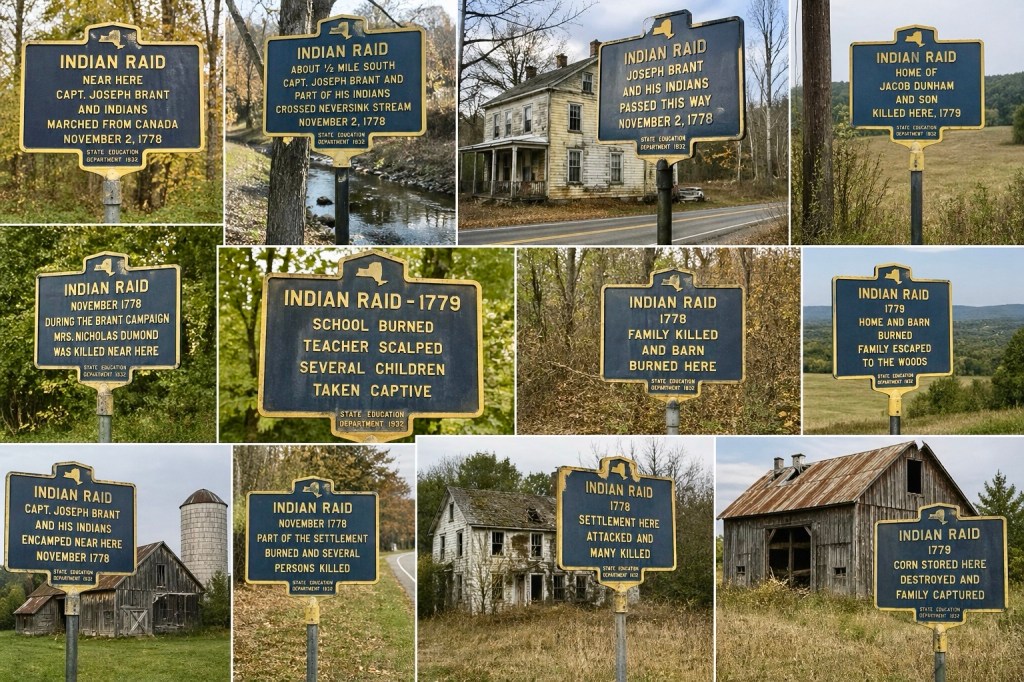
“It is curious that so many of these markers concern violence—raids, burnings, killings—set down with such admirable brevity. One might almost think it the preferred subject.”
He considered this. “It’s not the only subject, but it’s the one that doesn’t get argued with as much. A raid happened, a house burned, people died—there’s a kind of agreement there.”
“And so it is posted.”
“And so it is posted. . .”
By the time we reached Cherry Valley Battlefield, I had begun to anticipate the shift.
“Cherry Valley Massacre” The marker explains that in November 1778 a combined Loyalist and Native American force attacked the village, killing soldiers and civilians—women and children among them—and burning much of the settlement.
“This one has acquired a name.”
“It’s a promotion,” he replied lightly. “Once it’s big enough, it gets a title. Makes it easier to reference later.”
“And a longer account,” I said. “One feels the need to justify the space.”
“Or the attention,” he said.
“It still does not settle on a single figure,” I observed.
He tilted his head. “No, but it doesn’t feel the lack. Sometimes the story is the crowd.”
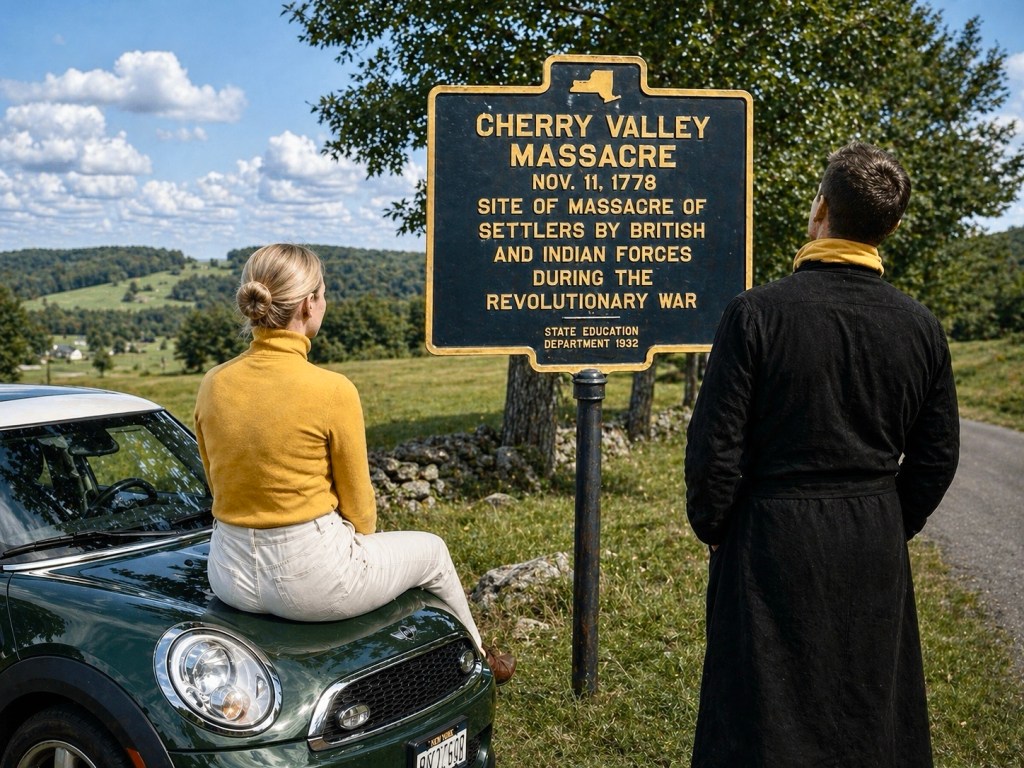
—B C.
Back in the car, as we pulled away, he said, almost conversationally, “You’ve seen the signs. You might as well hear the other version.”
“The other version?”
“My version, the one that uses Simon & Garfunkel‘s tune, The Sounds of Silence.” he said, and began to recite.
“I call it, The Paradox of Violence.”
Hello, violence my old friend,
We know he’ll never kill again.
With the DA softly speaking,
Said there was still room for bargaining.
And the sentence for his bullet in that brain
Will remain.
His victim still is silenced.
Resentful memes he learned at home,
In the streets, and all alone.
’Neath the blackness of a darkened lamp,
He turned his hoodie to the cold and damp.
Then your back he stabbed,
When the flash of a squad car light,
Split the night.
He lost his gold from violence.
And in the courtroom light I saw,
Testament to blood and gore.
Judges gavelling without speaking.
Jurors napping and not listening.
Liberals whining,
“It’s because we don’t care.”
But they don’t dare,
To blame, inherent violence.
“Fools” said I, “You do not know.”
Violent crime is all he knows.
Hear my words that I might teach you
Violence also we cannot eschew.
But my words,
like squib-load bullets fell;
They failed to stop
the violence.
And the people bowed and scraped
To the fishy god they prayed
And the sign fleshed out its ‘sborning
To the slaves that it was preaching
And the sign said “The death of your wages
Shall be wasted on the welfare scrolls
And tenement holes.”
Ush’ring in,
Majority silence.
When he finished, there was a brief and rather noticeable silence in the car.
“Well. That is . . . considerably less concise than the signs,” I said at last.
“They don’t give you much room,” he said, gesturing back toward the road.
“No, they do not. And yet they do not, I think, suggest quite what you have just suggested.”
He glanced at me, not defensively, but with a kind of rueful acknowledgment.
“I don’t like it,” he said. “But sometimes it looks that way from where I’m standing. Like the only thing that answers violence is more of it.”
“That is a very American conclusion,” I said.
“It’s a very old one, America just posts it.”
I considered this.
“The signs, at least, refrain from recommending anything.”
“They just point,” he said. “I fill in the arrows.”
“I should prefer if the arrows remained hypothetical.”
“So would I,” he said, with a small, almost apologetic smile.
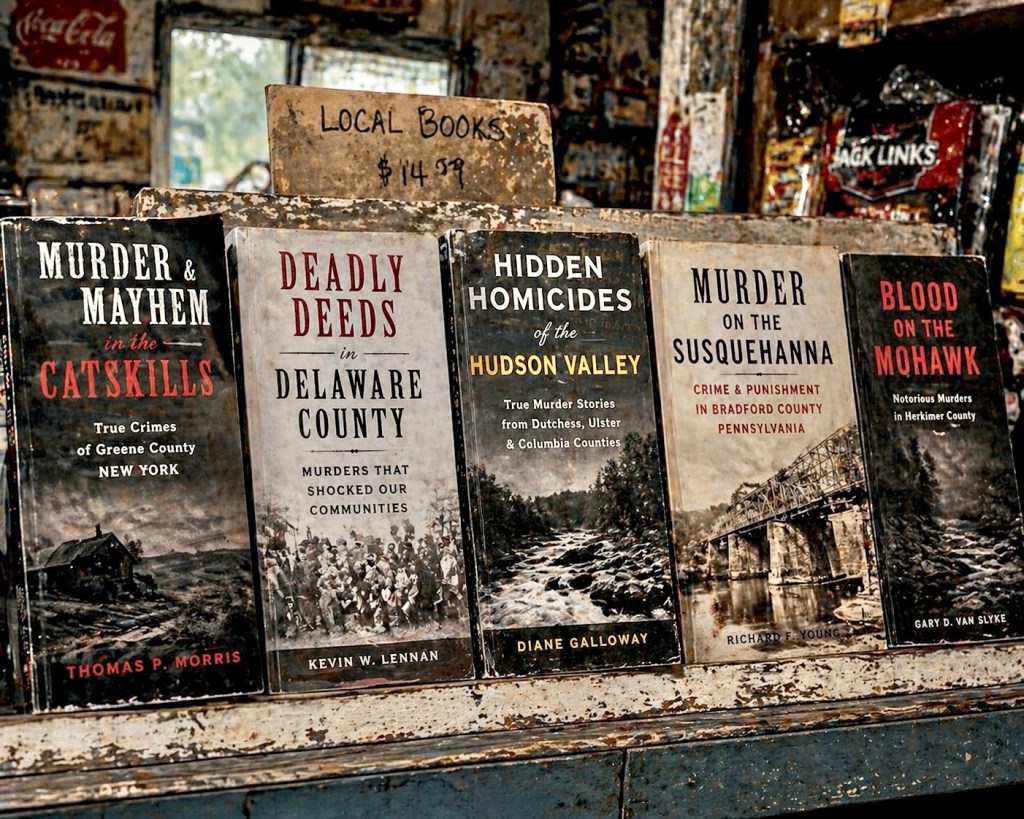
We drove on into the Schoharie Valley, where the markers appeared with increasing frequency, as though we had entered a particularly talkative stretch of road.
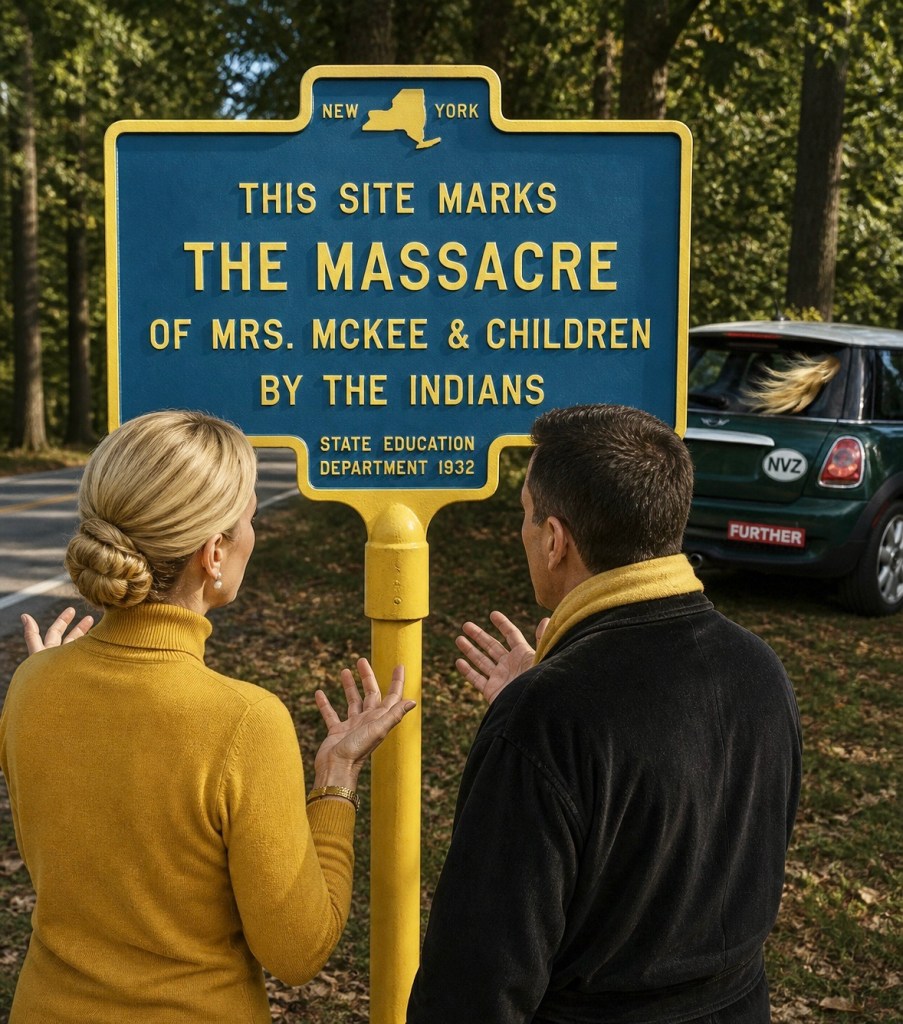
And yet another sign recorded the Burning of Schoharie—settlements destroyed, homes and fields burned, inhabitants driven off or killed.
A little later we stopped at Vroman’s Nose, a physical feature where, for once, there was no marker insisting upon our attention.
“It is almost a relief,” I said, stepping out.
“It doesn’t advertise,” he replied.
“It has been painted, though,” I said, thinking of Thomas Cole and his great sequence of landscapes, in which such vistas advance, with some inevitability, toward a crowded and rather violent end. And this Nose is featured in each one.
“Different kind of record,” Black Cloud suggested.
I looked out over the valley.
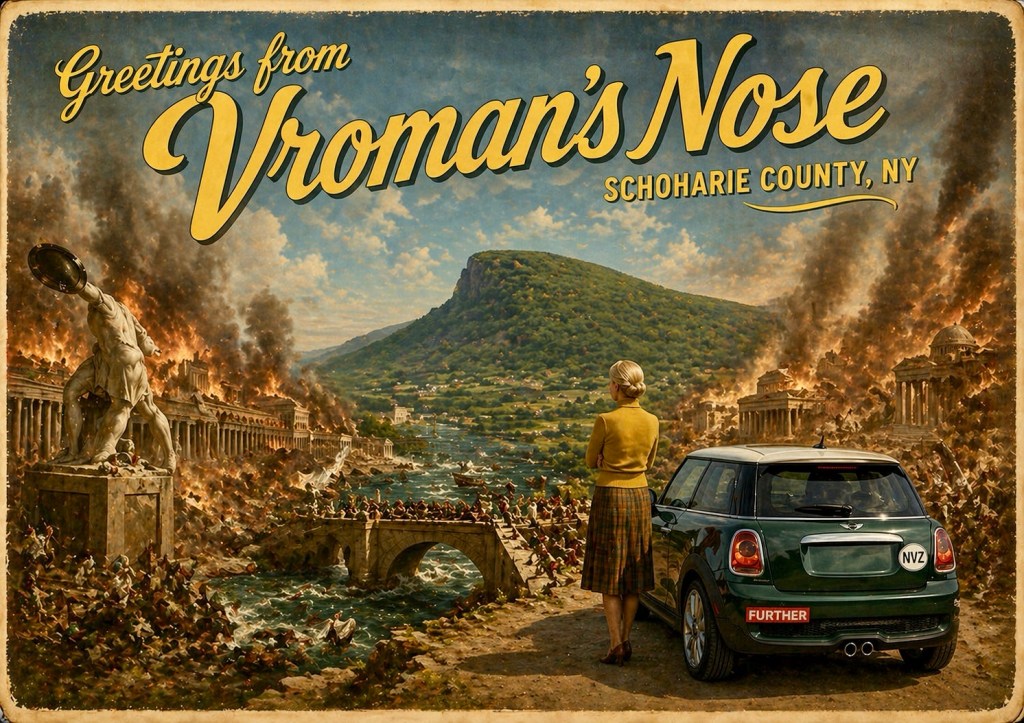
“All day,” I said, “I have been shown where things happened. Here one sees where Cole stood and tried to make sense of it—perhaps even to place it in a sequence.”
“You can’t put that on a roadside sign,” he said.
“No. It would require agreement, which seems in shorter supply than posts. Though I suppose one might attempt it—Mr. Cole, for instance, required several rather large canvases.”
We crossed into Pennsylvania along a route that had by now abandoned any pretense of efficiency.
“This is not, strictly speaking, the most direct way to French Azilum historic site,” I said.
“No,” he agreed. “But it’s a better read.”
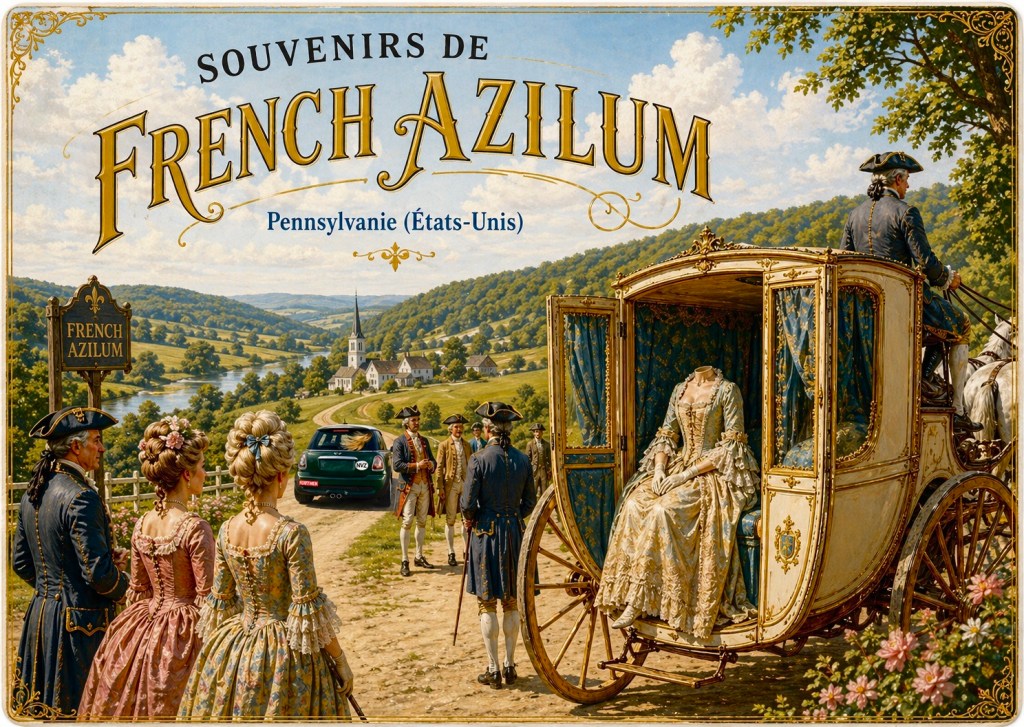
—A queen in exile, duly noted —though the headcount might still vary.”
We arrived at French Azilum historic site in the late afternoon.
The grounds were orderly, the foundations marked, the plan of the settlement still visible. It had been prepared in the 1790s for French refugees from the terror of the Revolution, and, briefly, for the possible arrival of their queen.
I read the panel.
“Prepared for French émigrés. . . possible residence of Marie Antoinette.”
“She did not arrive,” I said.
“No, She didn’t.”
“Because the violence occurred elsewhere,” I said.
“In France,” he said.
I looked across the quiet field.
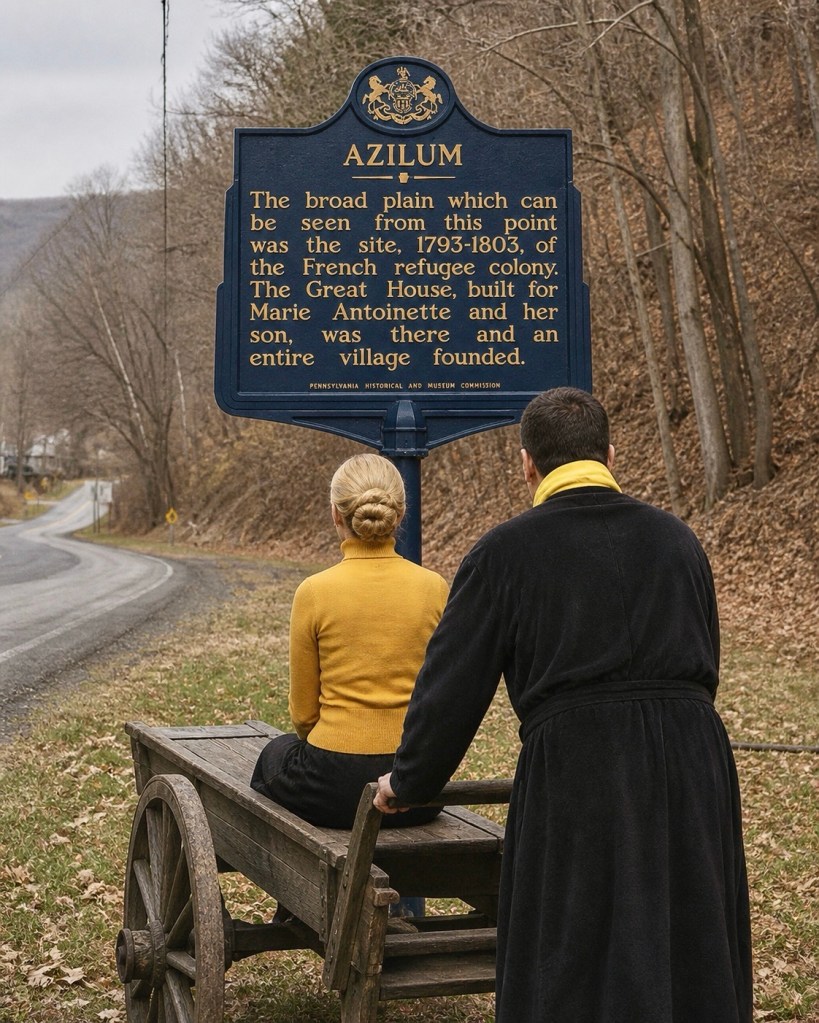
“We have spent the day visiting places where violence is fixed to the land,” I said, “carefully indicated and repeatedly affirmed. Here we have a place where it might have changed everything, had it been moved.”
Black Cloud nodded.
“Near-miss,” he said.
We were, in a sense, denied a marker.
He gave a small smile. “You’d have to go to France for that.”
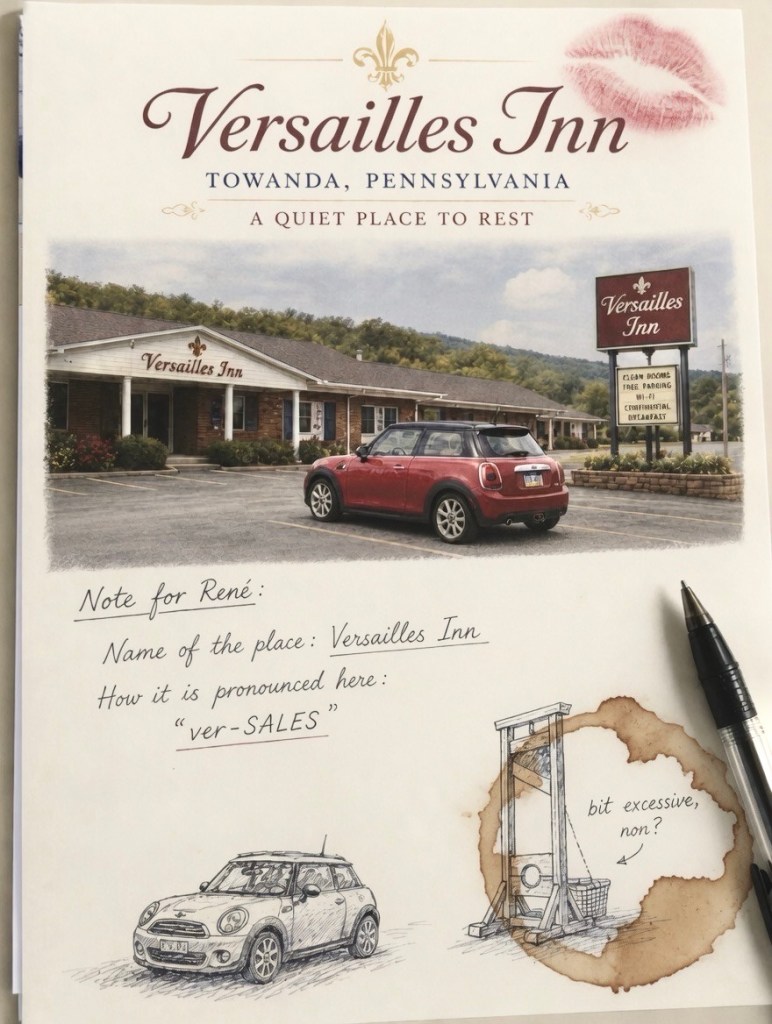
It seems to me, René, that one may travel a considerable distance in this country by reading what it has chosen to remember in this manner. The signs are brief, consistent, and placed with care. They tell you where to stand, and what occurred there, and then they send you on.
One is not left to wonder where violence took place.
One is shown.
Yours,
Mrs. Begonia Contretemps
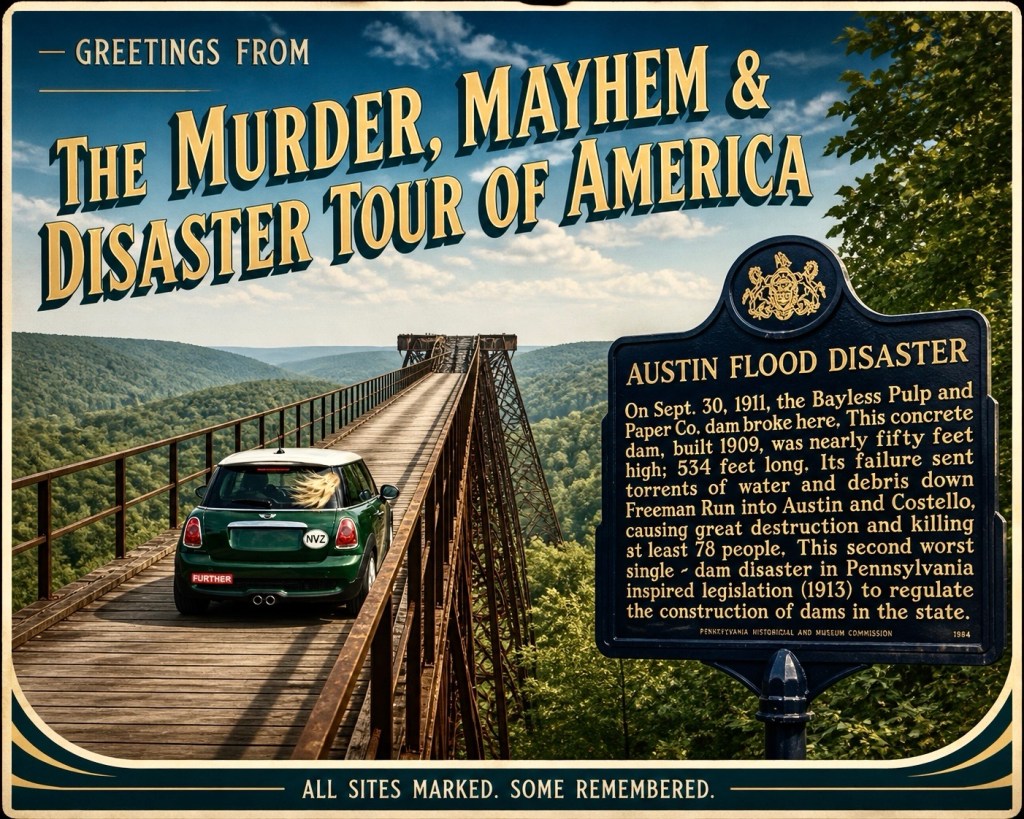
I begin to suspect I have found the seam: America, diligently annotated in roadside markers—mayhem, disaster, and murder rendered navigable, if not entirely explicable. Of course, these are but the negative occurrences; nevertheless, they are all quite dutifully marked.
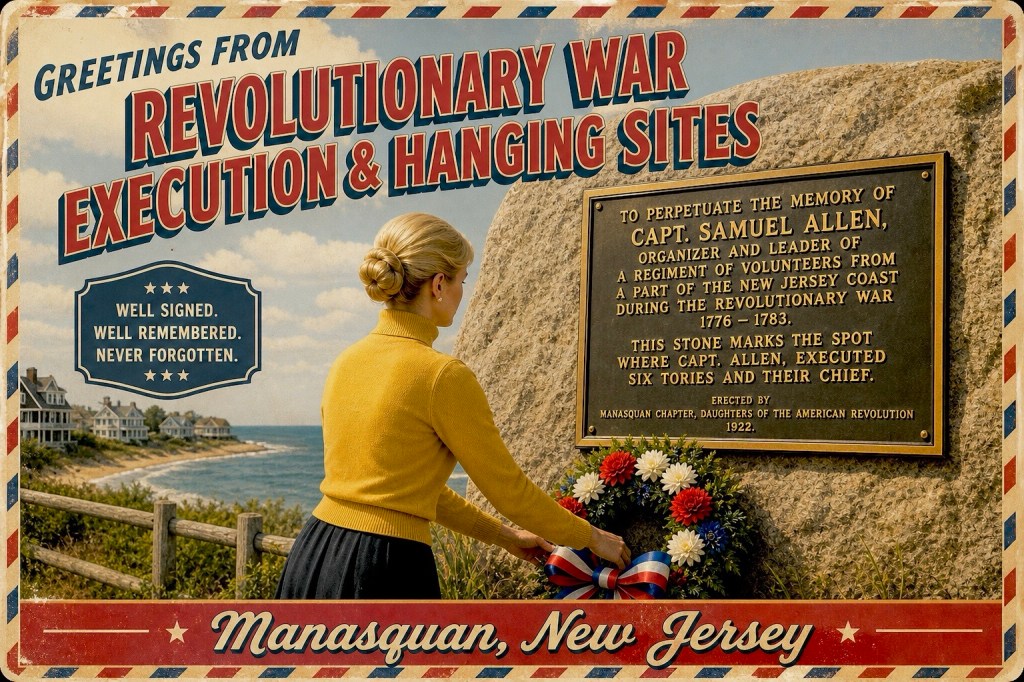
“I confess to a certain indignation at the present “king’s” fashion for inviting Americans to prosecute the distant quarrel in the Ukraine under the banner of other people’s sovereignty, while the condition of sovereignty in our kingdom remains—how shall I put it—imperfectly secured. The asymmetry is difficult to admire. In America, at least, the terms were plain: those once called Tories were loyal subjects, and those who dispatched them were, by the standard of the day, traitors. I have laid a wreath accordingly to our Loyalists—for their fealty, which seems to fare poorly in all ages.”
René Seance Replies:
CAFÉ MONTSÉGUR, OCCITANIE
(Where les Gnostiques were liberated from this world)
Mayday—Anno Domini 2026
Chère Begonia—
In America, I observe the sites of murder and mayhem—each one modest, particular—while the catastrophes, though fewer in deaths, are. . . how you say. . . larger in their number. Chez nous, en Europe, the massacres, the catastrophes. . . trop de monde. One cannot make a marker for a city. We prefer une mémoire discrète—less said, more buried.
Adieu, René
More from Mrs. Begonia Contretemps: HERE


Leave a Reply