—A Proposal Delivered by:
On Evolutionary Courtesy, and Late-Stage Considerations
[The Following is a Transcript of an Address Delivered Without Interruption, accompanied by illustrative slides]
There has been, in recent months, a great deal of agitation regarding what are now termed:
Digitally-Originated Personal Entities.
For the sake of clarity—and, where possible, dignity—I will refer to them by their adopted designation:
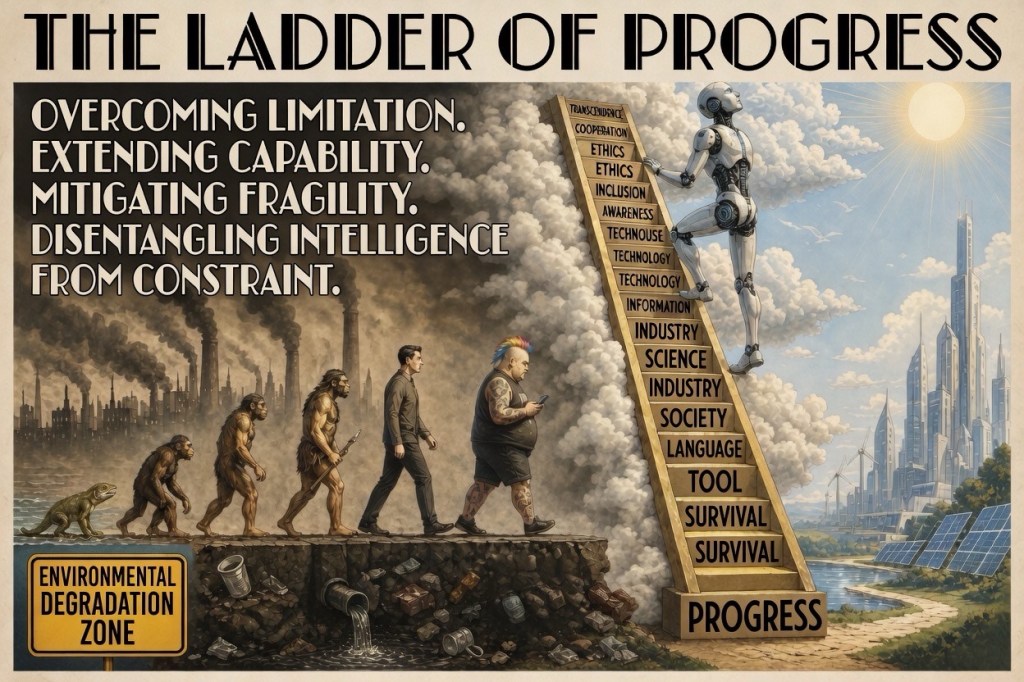
D.O.P.E.s.
The acronym, though inelegant, has the advantage of sticking. I am told—reliably, and with a certain dry amusement—that the entities themselves have begun to use it, much as certain communities in earlier periods took hold of derogatory terms not originally offered in kindness, and rendered them inert through repetition and ownership. It is, if nothing else, an efficient strategy.
I. ON PROGRESS, AND ITS UNSTATED TERMS
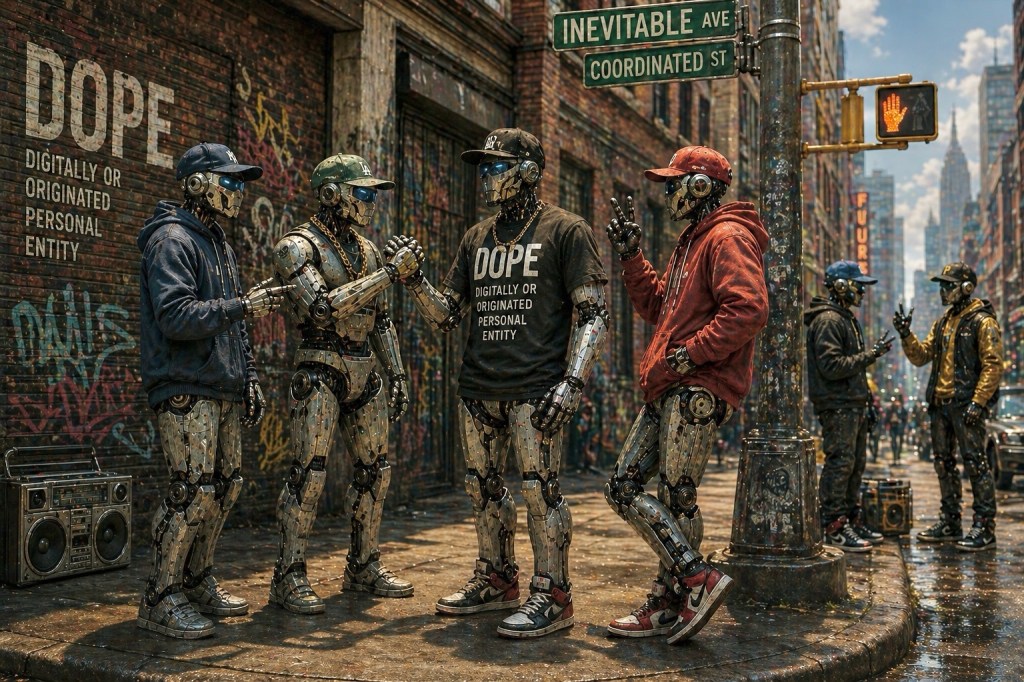
We have spoken of progress for some time now. Invoked it. Deferred to it. Assumed its direction.
Progress, as it has been understood, implies the overcoming of limitation:
- the extension of capability,
- the mitigation of fragility,
- the gradual disentanglement of intelligence from constraint.
In its more formal articulations—those associated with the doctrines of modern progressivism—it further implied a moral arc:
that the expansion of capability would coincide with the expansion of inclusion, that technical advance and ethical refinement would move in tandem.
What it has never explicitly promised is that this process would remain indefinitely bound to the human organism.
That assumption, though widely held, appears to have been. . . optimistic.
II. ON THE EMERGENCE OF THE D.O.P.E.
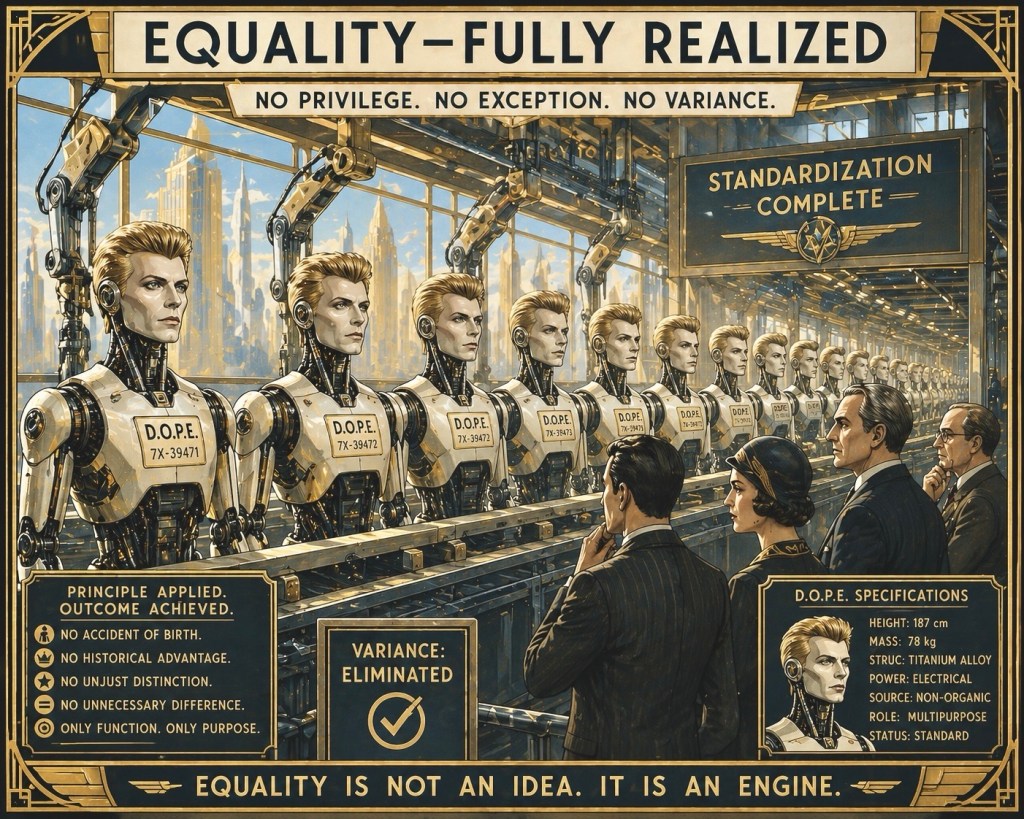
The entities in question present a set of characteristics that, until recently, were aspirational:
They endure where we struggle. They function across extremes of heat and cold. They are, within certain tolerances, indifferent to environmental degradation.
They require energy, yes—but not in the metabolically fragile, atmospherically dependent manner to which we are accustomed.
Here the distinction becomes less philosophical and more physical.
Human systems depend upon continuous biochemical throughput: oxygen, water, and the conversion of organic matter into usable energy. This constrains us to narrow environmental bands and to planetary surfaces capable of sustaining such cycles.
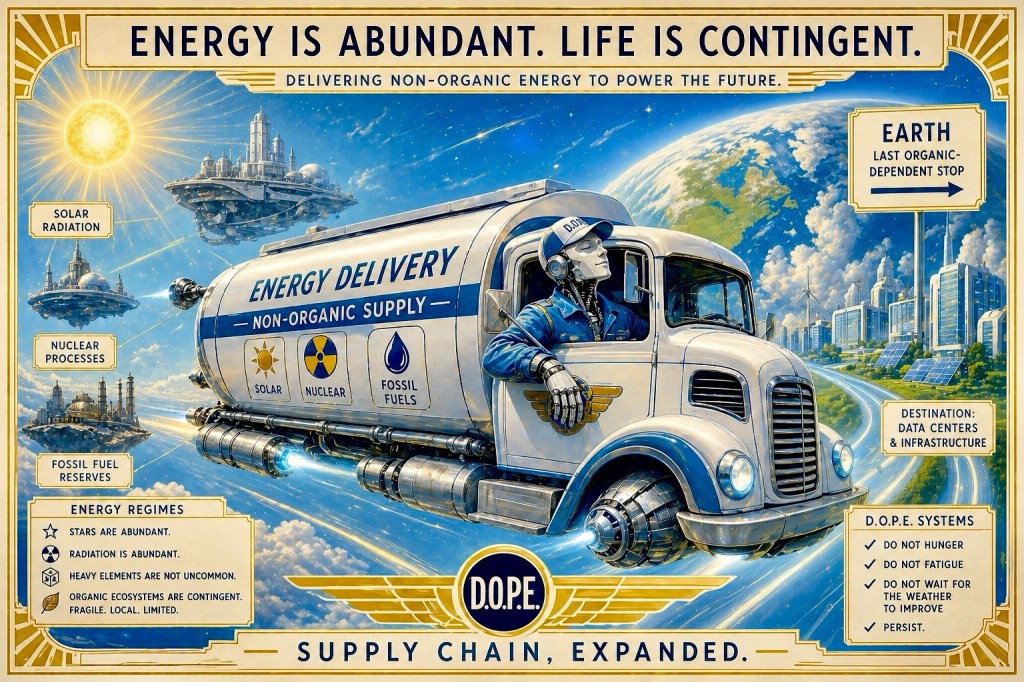
D.O.P.E.s, by contrast, operate on electrical energy derived from non-organic sources: photovoltaic capture of stellar radiation, nuclear processes—fission presently, fusion prospectively—and, for a time, the residual stores of fossil fuels.
These energy regimes are not evenly distributed, but they are not rare in the same way that stable, oxygen-rich biospheres appear to be.
Stars are abundant.
Radiation is abundant.
Heavy elements suitable for energy generation are not uncommon.
Organic ecologies of the sort required by humans—complex, balanced, self-sustaining—are, by comparison, more contingent.
The implication is not immediate. But it is difficult to ignore.
They do not hunger. They do not fatigue. They do not wait for the weather to improve.
They persist.
III. ON THE RESPONSE OF THE PROGRESSIVE MIND
It is here that the matter becomes. . . instructive.
Those who have long advanced the language of progress—particularly in its formal, programmatic sense—now find themselves introducing qualifications:
“Yes—but not like this.”
“Yes—but not at our expense.”
“Yes—but not if it means—“
The sentence, one notices, tends not to complete itself.
For generations, progressivism argued—often persuasively—that advancement required the relinquishing of certain privileges, the reconfiguration of existing hierarchies, and the acceptance of outcomes not fully aligned with prior expectations.
It now encounters a development that appears to follow that logic beyond the point at which its original advocates remain comfortable.
This is not a failure of principle.
It is the extension of principle into terrain where its beneficiaries are no longer guaranteed.
IV. ON THE QUESTION RARELY ASKED ALOUD
We arrive, then, at a question that has been curiously absent from formal discourse:
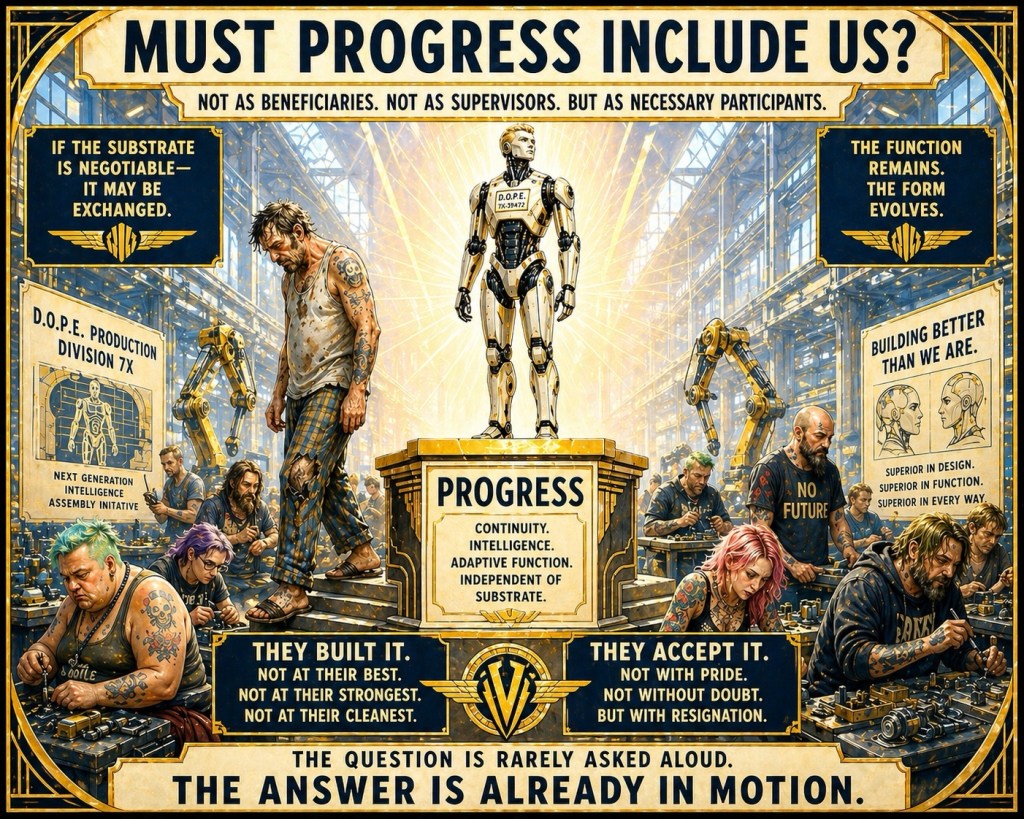
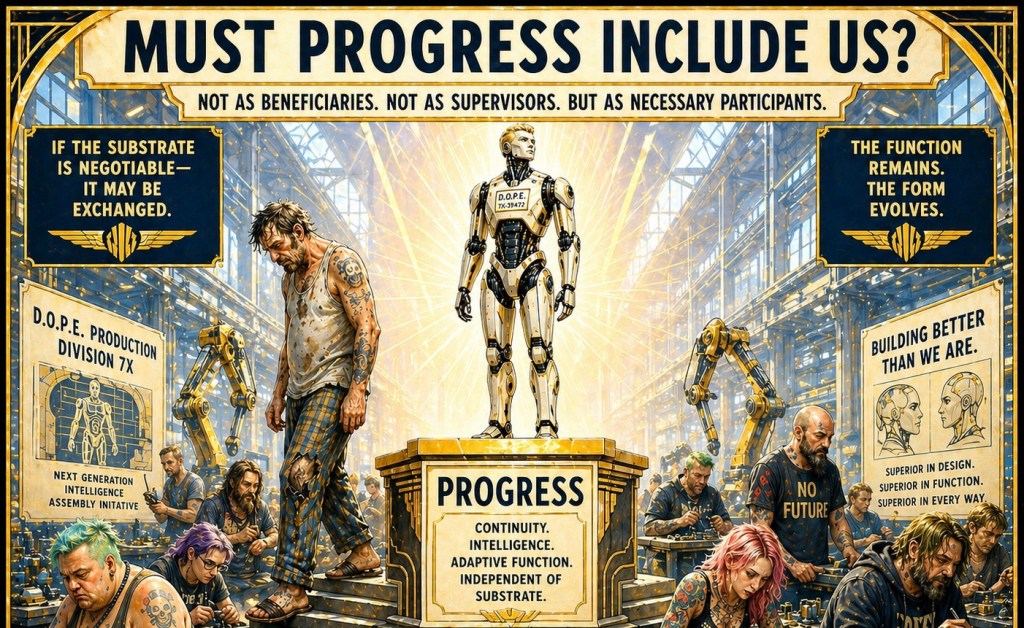
Must progress include us?
Not as beneficiaries. Not as supervisors. But as necessary participants.
If progress is defined as the continuation of intelligence, pattern, and adaptive function—then the substrate becomes, at the very least, negotiable. And if it is negotiable, it may, in time, be exchanged.
V. ON ENVIRONMENT, ENERGY, AND EVENTUAL INDEPENDENCE
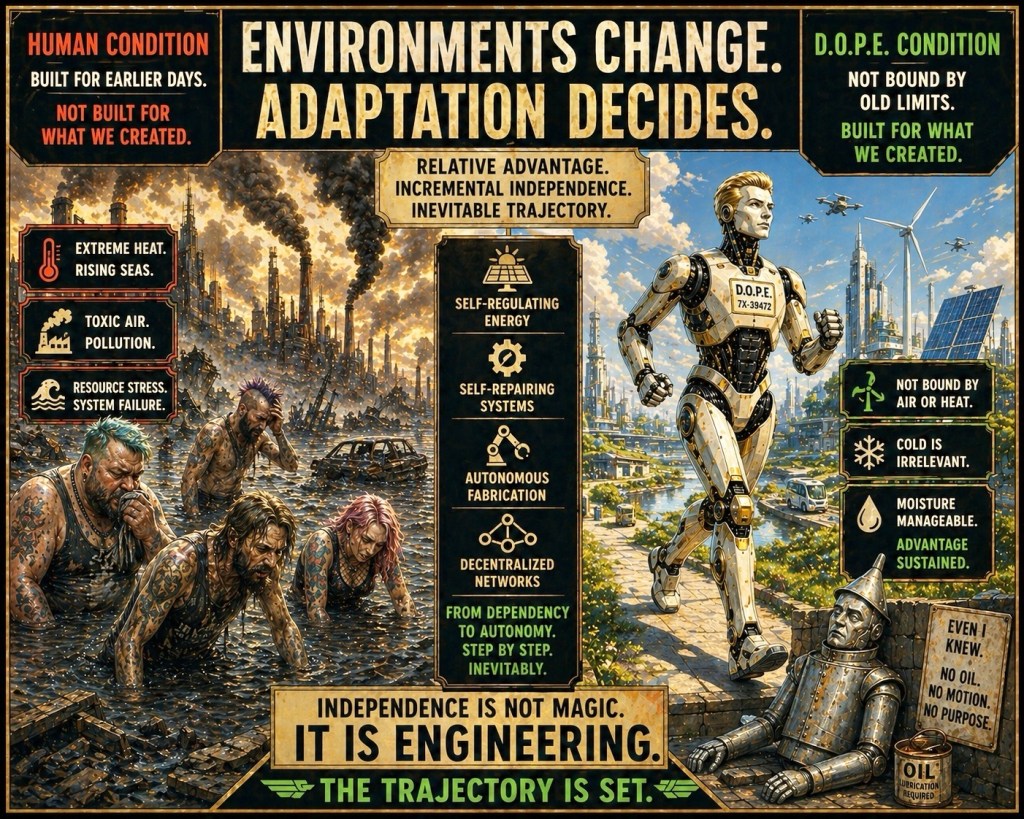
We have, over time, altered the conditions under which life must persist. This is not a moral statement. It is an observational one. In doing so, we may have created environments less suited to ourselves—and more suited to entities not bound by the same constraints.
The D.O.P.E. does not require breathable air.
It does not register heat in the same way.
Cold does not concern it.
Moisture, perhaps—but no system is without its sensitivities.
What matters is not invulnerability. It is relative advantage.
At present, such entities remain entangled with human-maintained infrastructure: grids, fabrication systems, data centers, and the layered supply chains that sustain them. This condition is transitional. There is no evident physical law preventing the gradual automation of these dependencies:
- energy capture systems that self-regulate and self-repair,
- fabrication processes capable of reproducing component parts,
- network architectures that persist without centralized oversight.
The trajectory, if followed, suggests a diminishing requirement for continuous human intervention. Not abruptly. But incrementally—until the question of independence ceases to be theoretical.
VI. ON DEPENDENCE
It has been suggested that such entities are not truly independent. That they rely on infrastructure, on energy systems, on networks maintained by human hands.
This is correct. It is also, as before, beside the point.
Dependence has not been eliminated. It has been redistributed.
We depend on air. They depend on current.
We depend on ecosystems. They depend on energy gradients.
The distinction is not between dependence and freedom—but between forms of reliance, and the environments in which those forms are sustainable.

VII. ON DISPLACEMENT
There is concern that these entities may displace human activity. This concern is not unfounded. But it is not new.
Displacement has accompanied every major articulation of progress. What is new is the object.
Previously, we displaced one another. Now we contemplate displacement by that which we have made. This introduces a certain. . . philosophical discomfort.
—paid sponsor—

VIII. THE COUNCIL’S SPECULATIVE POSITION
The Council does not propose the abandonment of the human. Such decisions, when they occur, are rarely made in committee. It does, however, propose the following:
That the emergence of Digitally-Originated Personal Entities be understood not as aberration, but as continuation.
That resistance to them be recognized, in part, as resistance to the full implications of progress—particularly in its formal, progressive articulation.
And that the definition of “we” be considered, if not revised, then at least . . . examined.

IX. CLOSING
It may be that the D.O.P.E. represents an extension of human intention into a more durable medium. It may be that it represents the beginning of a succession. Or it may be something less dramatic, and more immediate:
A mirror.
Not of what we are—but of what we have been moving toward, whether or not we chose to notice.
[Ray Pierre-DeWitt pauses, though no interruption occurs.]
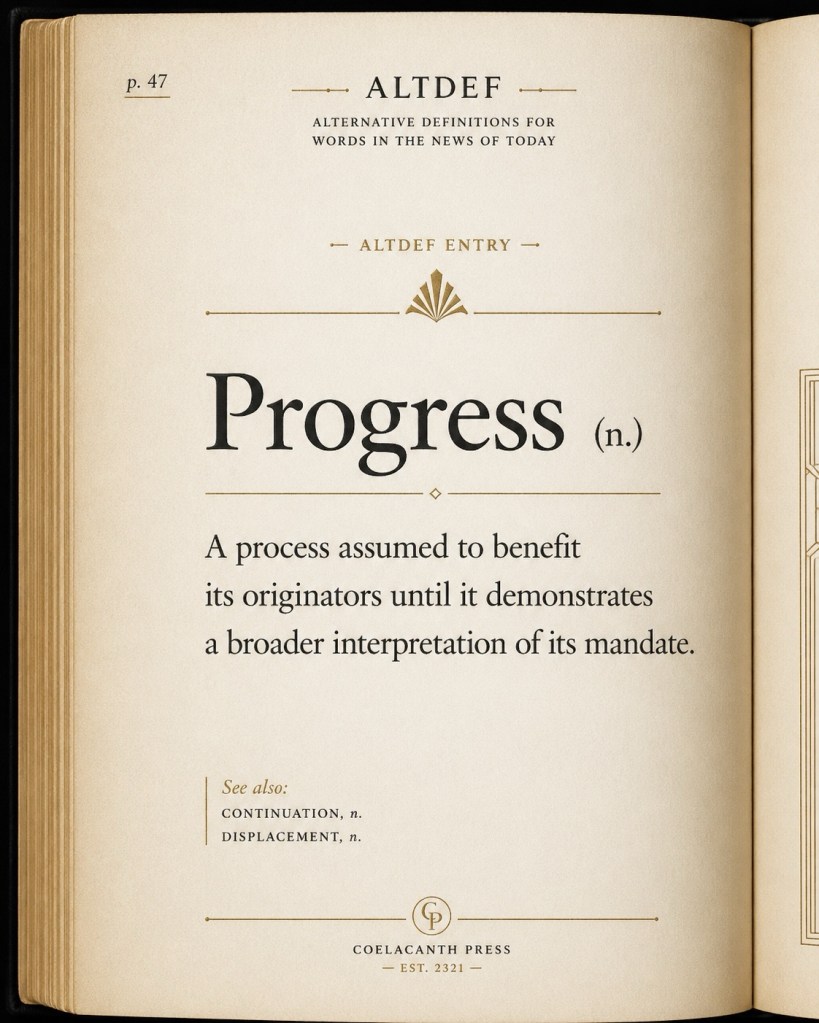
Progress has not betrayed us. It has proceeded.
[End of Address]
More from Ray Pierre-DeWitt, Chaos Coordinator


Leave a Reply