
Further along the road, Mrs. Begonia finds that America continues to present itself—often without introduction; her task, as assigned by the Nouvelle Vague Zwischenschaft (NVZ), being to observe what appears, and to determine—where possible—what, precisely, America believes itself to be.
—A Visit to an Earlier Arrangement— Socialism, Spirituality, and Cutlery
April, 2026
Somewhere in the Burned Over District, New York
René,
At the suggestion of one of your more elusive correspondents—he styles himself The Accidental Initiate, and with some justification—I made a brief detour to a former site of communal living in this western region of the State, where I was told an experiment had taken place, and, in some sense, continued.
The place in question is known as the Oneida Community, though it now presents itself with a degree of polish that suggests a later refinement of purpose.
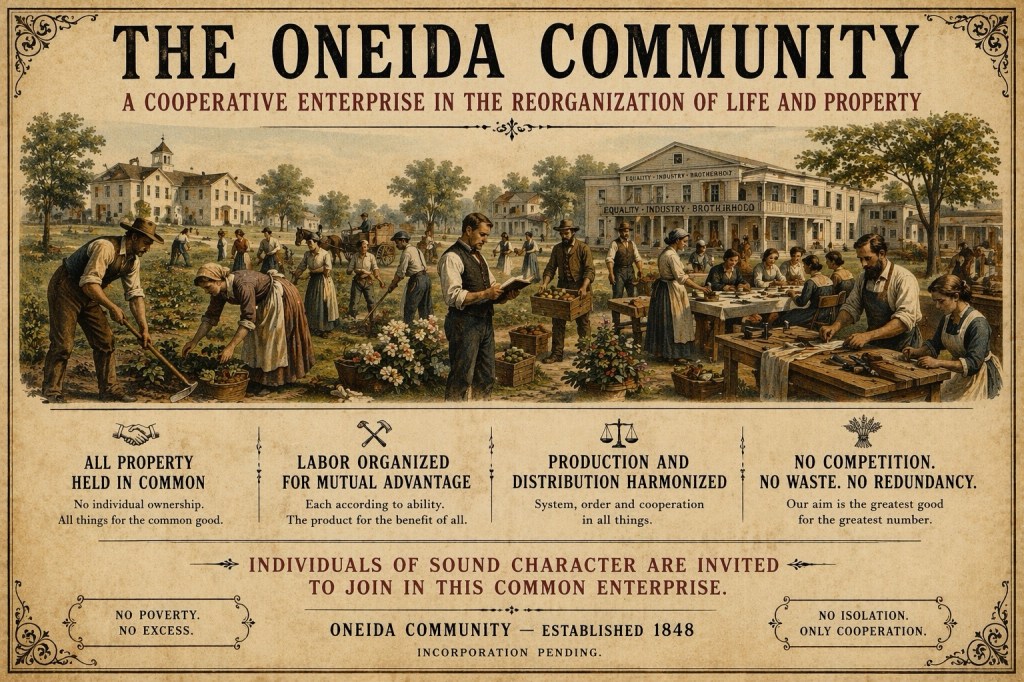
I was informed, as we walked the grounds, that the original inhabitants—under the direction of one John Humphrey Noyes—a name which, to the foreign ear, presents itself as a kind of hesitation, no and yes held together—had attempted a form of communal life in which property was held in common, labor organized collectively, and individual ownership, as such, was set aside in favor of what they considered a perfected social arrangement. It was, if not socialism in the later doctrinal sense, then certainly a close American cousin—practical, moral, and confidently arranged.
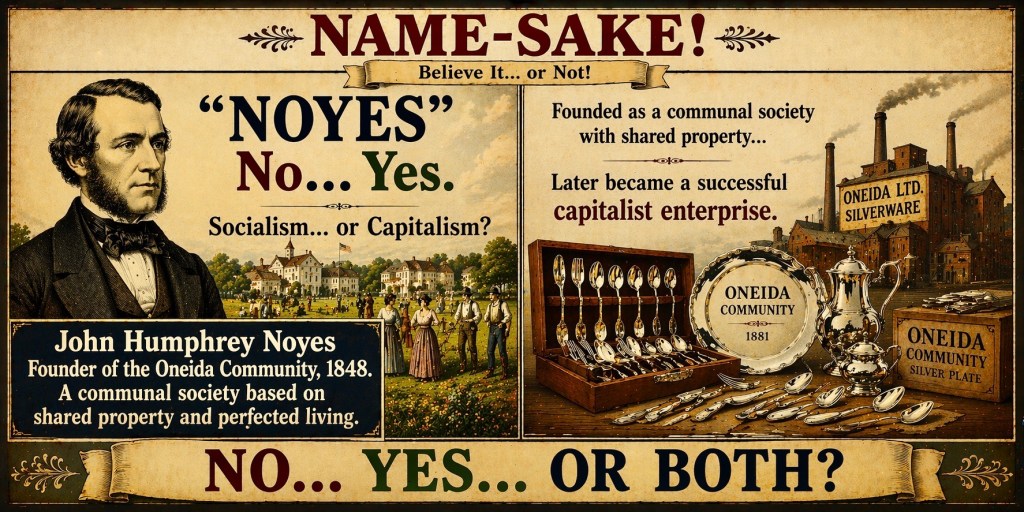
What interested my companion was not the founding idea of the Oneida community, but the outcome.
The Accidental Initiate:
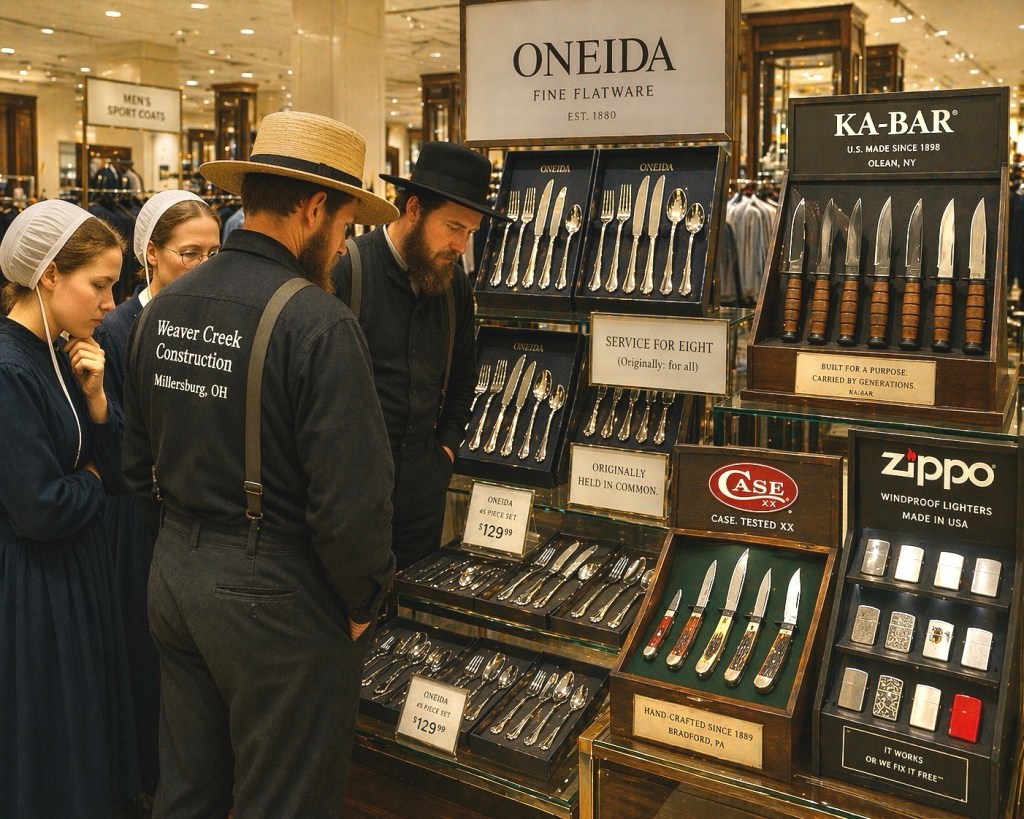
“It didn’t end the way they thought,” he said, indicating a display of finely arranged utensils in a nearby case. “Or maybe it did. I’m not sure anymore.”
I am given to understand that the community, having once abolished ownership among its members, later found itself in possession of a most successful enterprise in the production of silverware. This struck me not as a contradiction, but as a sequence.
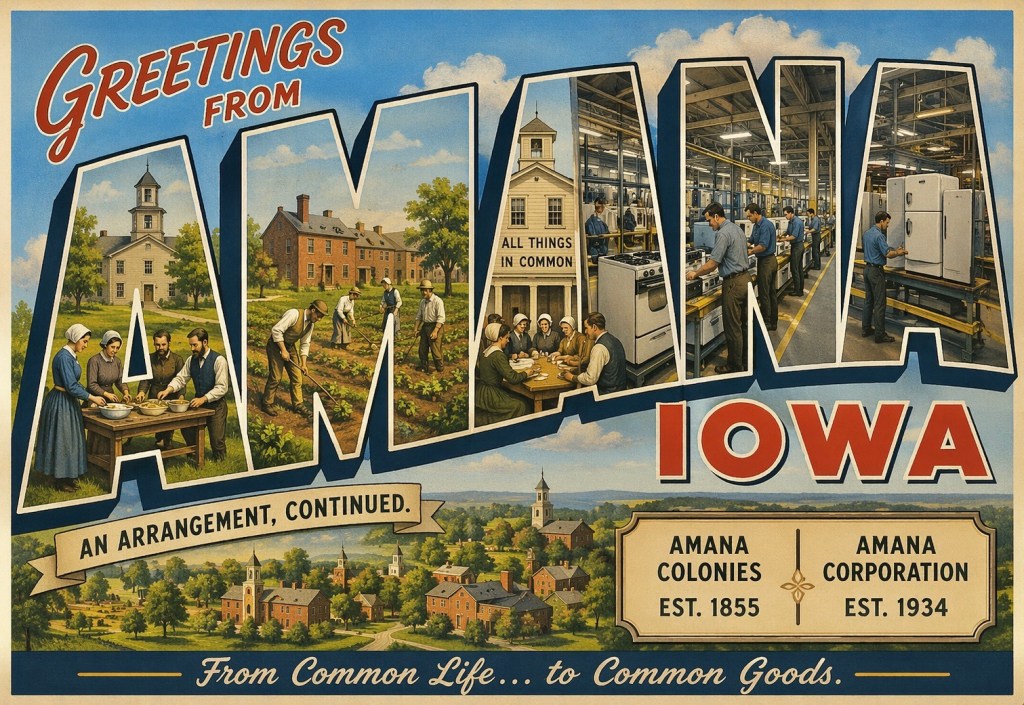
One is reminded, in passing, of the Amana Colonies—another religious and communal experiment, where property was likewise shared and life arranged in common, and which in time gave rise to the commercial enterprise now associated with Amana Corporation. The pattern, it seems, is not entirely unique.
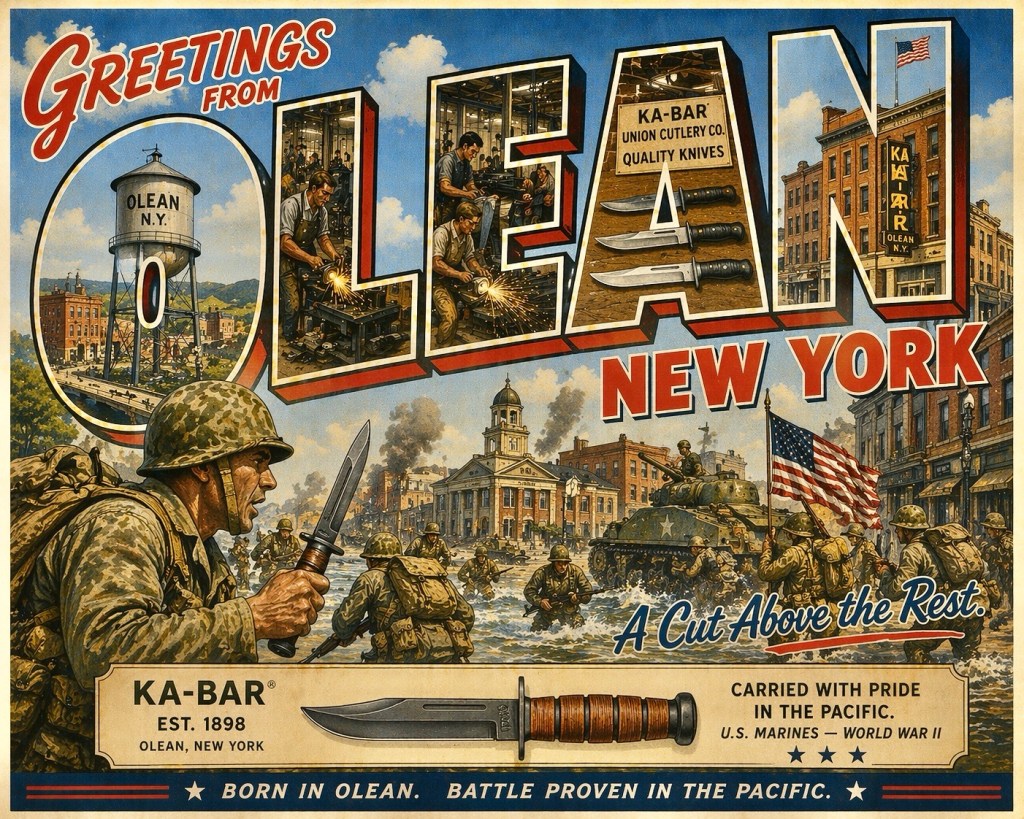
We continued on, passing through what I was told had once been the principal building of the Oneida community—now arranged as a sequence of rooms, the air pleasantly undecided between museum and showroom. Outside, the grounds opened into a region curiously dense with manufacturers of knives and cutlery—an industry which appears, for reasons both practical and historical, to have gathered here with some persistence.
One notes, too, that similar patterns of gathering—though of a more abstract kind—have been observable for some time in other sectors, particularly in media, where firms increasingly acquire not only competitors but entire chains of production and distribution, until what once appeared as exchange begins to resemble arrangement.
The Accidental Initiate:
“One begins to notice a pattern,” he said. “Things collect. First people. Then ideas. Then. . . production.”
Mrs. Begonia:
“And afterward?” I asked.
The Accidental Initiate:
“I used to think it was just about keeping things balanced,” he said. “Budgets, spending, all that. Back then I leaned more toward a kind of free-market conservatism—nothing too formal, but I had absorbed the idea that government spending, welfare programs, all of it, were distortions. Things to be reduced, if not eliminated.”
He paused, as if revisiting the position with some distance.
The Accidental Initiate:
“I had a friend then—Portuguese, older than me. His family had emigrated to France before the war, and he grew up, at least in part, under occupation in Bordeaux. He was, to put it mildly, a communist. I assumed that meant he saw the world in a way I didn’t—or perhaps more accurately, that he had seen things I hadn’t.”
Mrs. Begonia:
“And you disagreed?”
The Accidental Initiate:
“We used to argue about it. I’d say we needed to cut spending, balance the budget, let the market sort things out. And he’d just shake his head.”
Mrs. Begonia:
“And what did he say?”
The Accidental Initiate:
“He said: if nobody has money, how do you expect them to buy anything? And if they can’t buy anything, how do you keep the system going? So you need wages, you need social programs—not because they’re morally satisfying, necessarily, but because otherwise the whole thing stalls.”
He gave a small, almost reluctant smile.
The Accidental Initiate:
“At the time, I thought it was backwards. A socialist defending the conditions that keep capitalism alive. It felt like a contradiction.”
We paused before a small placard describing the community’s transition into a corporate entity. The language was careful, almost courteous.
The Accidental Initiate:
“I think he might have been right,” he added. “Or at least—right about something I wasn’t seeing.”
He gestured, not to the display, but outward—toward the towns beyond.
The Accidental Initiate:
“And now it seems to be going the other way. Fewer owners. Larger systems. Everything integrated. And the middle—what used to sit between—seems to thin out. The middle class, I suppose you’d call it. Which is another way of saying: fewer people with anything substantial to their name.”
Mrs. Begonia:
“I am told,” I offered, “that one concern — HBO, which carried a certain prestige — was recently the subject of a bidding arrangement between two larger entities, each of which was itself the result of a previous arrangement. The concern in question changed hands, in effect, without ever quite arriving. An American journalist noted some years ago that fifty corporations then controlled the majority of what his countrymen read and watched. He kept revising the figure downward. By the time he stopped, the number had reached six. He had been called alarmist for the first edition.”
He nodded.
The Accidental Initiate:
“Yes. It’s not sudden. That’s the strange part. It’s been happening for a while. You just don’t notice it until you step back.”
Mrs. Begonia:
“And stepping back—what does one see?”
The Accidental Initiate:
He smiled, though without much confidence.
“It may sound wrong,” he said, “but I began to think—if you carry it far enough—it starts to look like a kind of communism. Not the planned kind. Just. . . nobody owning anything.”
He paused, as if aware he had overreached.
The Accidental Initiate:
“Though I admit I may be using the term incorrectly.”
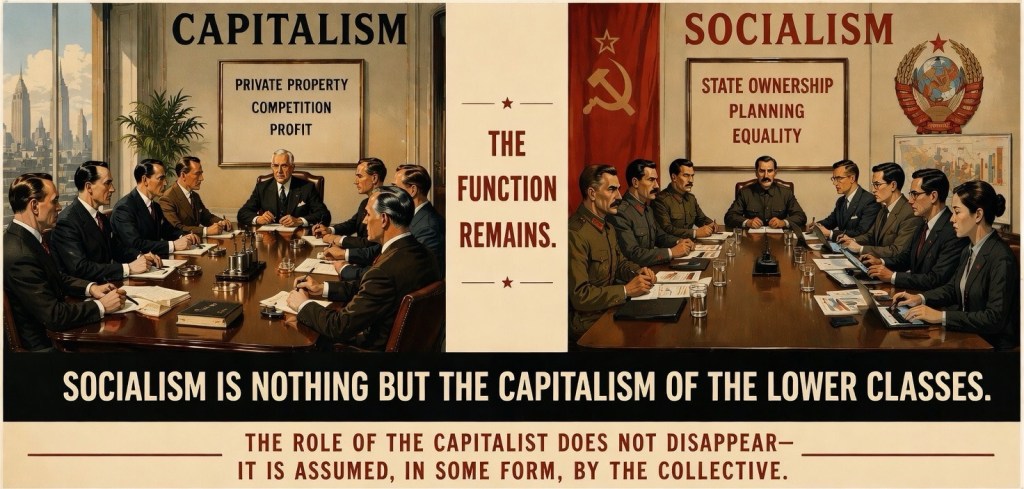
At this point, I recalled a remark by Oswald Spengler to the effect that socialism is, in some sense, the capitalism of the lower classes. Standing there, among the relics of a communal experiment that had matured into a commercial success, I found the distinction increasingly difficult to maintain.
The Accidental Initiate:
“It’s not just ownership,” he continued, more quietly now. “It’s work. If the work goes—if it’s all handled elsewhere, or by something else—then the question becomes. . . who is the system for?”
Mrs. Begonia:
“An unfashionable question,” I said.
The Accidental Initiate:
“Yes,” he replied. “But it keeps coming up.”
We stood for a moment in what I can only describe as a well-appointed room devoted to the display of implements designed to divide, portion, and refine.
The Accidental Initiate:
“It occurred to me,” he said at last, “that they tried to abolish ownership here on purpose. And now we may be doing something similar by accident. Only instead of sharing it, we’ve just. . . gathered it.”
He did not appear alarmed—only thoughtful, as one who has misplaced a premise and is not yet certain where it fell.
For my own part, I was struck less by the argument than by the setting in which it had been made. It is not often that one encounters a conversation of this kind conducted, quite literally, under the knife—though I assure you the exchange remained cordial throughout.
One observes, even now, a tendency toward gathering—of firms, of functions, of decisions. Whether this represents a temporary phase or a final arrangement is, I am told, still under discussion.
The system itself, however, appears to be proceeding.
René,
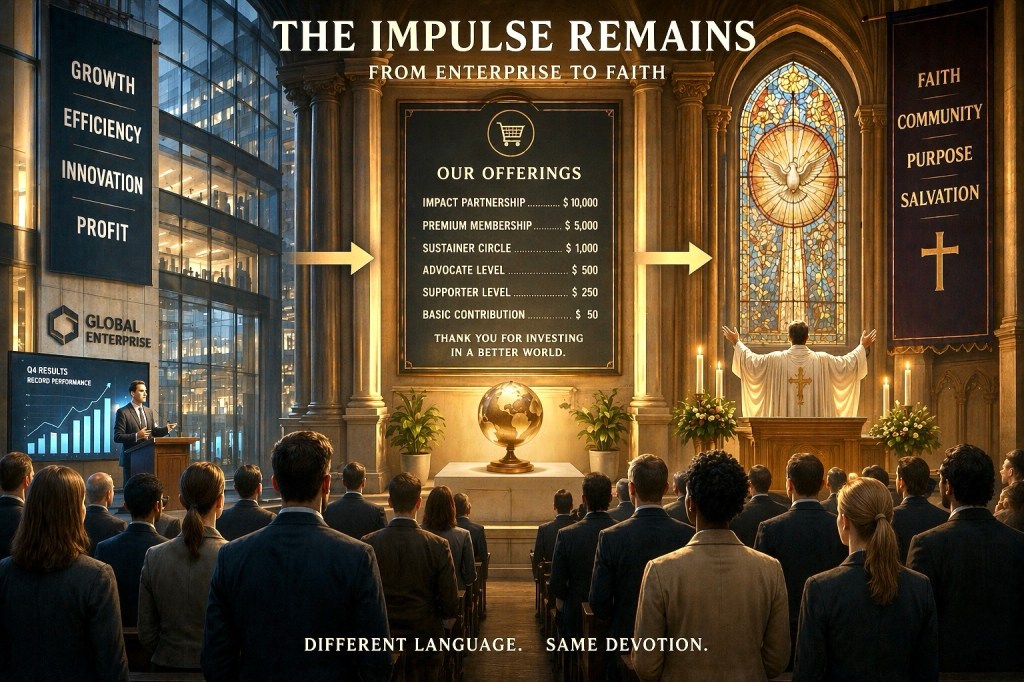
One is reminded—if only in passing—of that oft-repeated American observation that the business of America is business. It presents itself here in a slightly altered form. For one finds, upon examination, that even those arrangements which begin in the spirit of renunciation—property set aside, labor shared, life held in common—tend, over time, to reorganize themselves along lines not entirely dissimilar to enterprise. The instance at Oneida, and likewise at the Amana Colonies—whose communal life matured, with a certain inevitability, into the Amana Corporation—suggest that the impulse to organize, to produce, and to distribute does not so much disappear as change its language.
Whether this is to be regarded as a failure of the original intention, or its unintended fulfillment, I leave—provisionally—to your judgment.
Yours,
Begonia
Restaurant Le Carrefour Café
Hautes-Pyrénées
Madame,
You continue to describe these developments as if they were decisions. They are not. They are formations. What you call markets, others call systems, but both are arrangements that tend, over time, toward coherence.
Concentration is not an error. It is a tendency.
The tree does not consult before growing toward the light.
That one form should come to resemble another is not a contradiction, but a phase.
Whether it endures is another matter.
—René Sèance

More correspondence from Mrs. Begonia Contretemps HERE


Leave a Reply