
Specimen Observed:

Some words do not merely describe events. They arrive carrying dust, noise, and movement inside them.
Mêlée is one of these.
Usually spelled without its French accent in modern American usage (melee), the word derives from the Old French meslee — meaning mixed, mingled, confused fighting. It once referred to the swirling collisions of medieval battlefields where distinctions between combatants temporarily dissolved into collective turbulence.
The term has since migrated into modern habitats.
Stay ALERT!
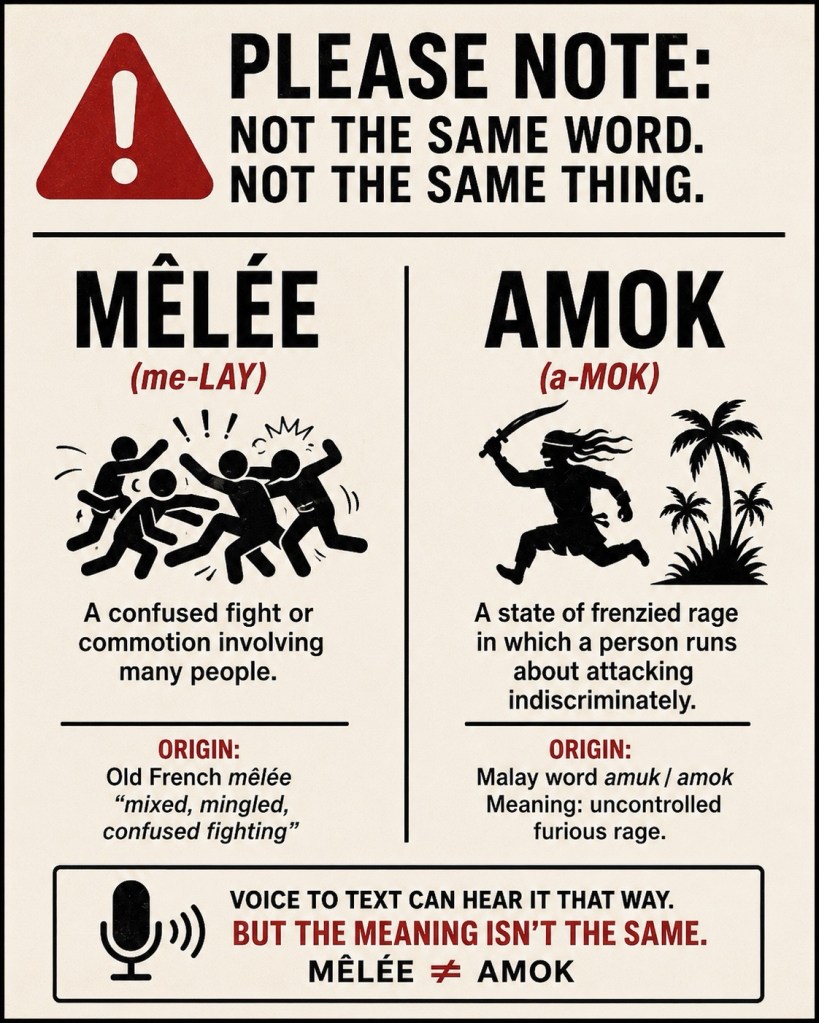
Common Contemporary Sightings of Mêlée Include:
- kindergarten assemblies,
- youth sporting events,
- prom after-parties,
- school-board meetings,
- graduation ceremonies,
- parking lots immediately following children’s baseball games,
- discount retail environments,
- and public gatherings operating beyond emotional carrying capacity.
Unlike the duel, which is structured, or the riot, which is ideological, the mêlée is often spontaneous. It behaves less like strategy than weather.
Researchers of the phenomenon note several recurring behavioral indicators:
- abandonment of queue ethics,
- accelerated filming activity,
- circular shouting formations,
- footwear separation events,
- and the mysterious evaporation of all nearby responsible adults.
A queue represents civilization in its dominant state.
The mêlée begins when civilization becomes aerobic—and kinetic.
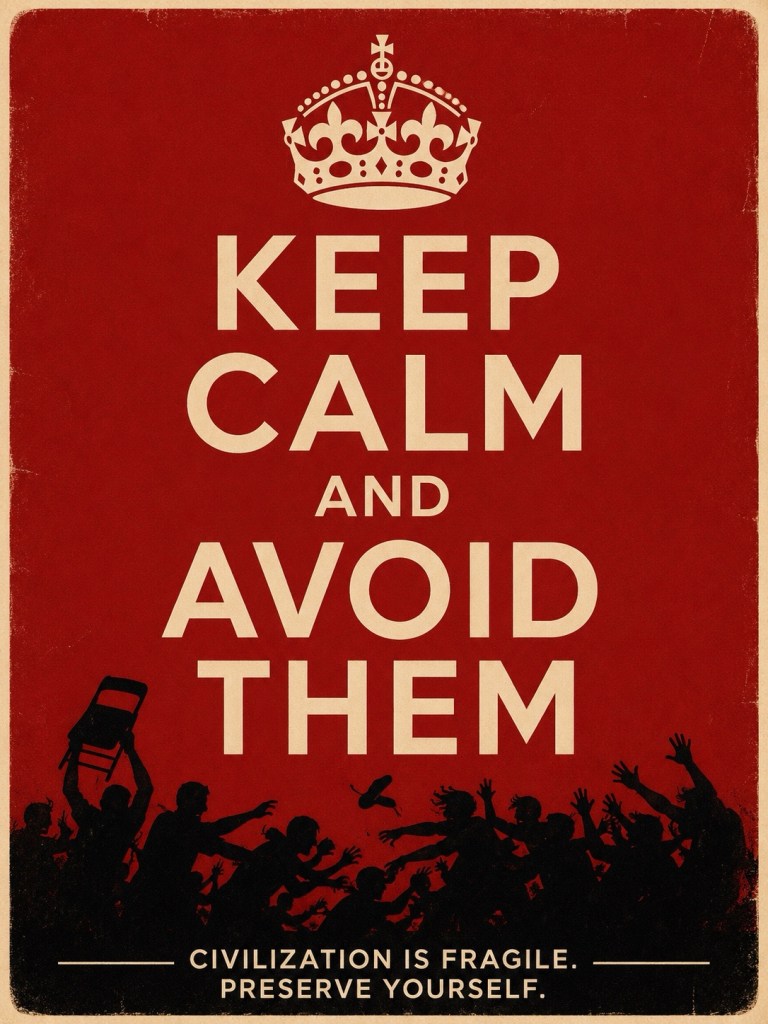
Interestingly, the animal kingdom provides only partial parallels. Certain primates exhibit contagious agitation responses, territorial surges, dominance displays, and mobbing behavior under stress conditions. Herd animals may stampede. Chimpanzees occasionally erupt into chaotic status conflicts. Yet relatively few species produce the distinctly chimpish/human combination of:
- symbolic grievance,
- theatrical outrage,
- smartphone documentation,
- and litigation potential.
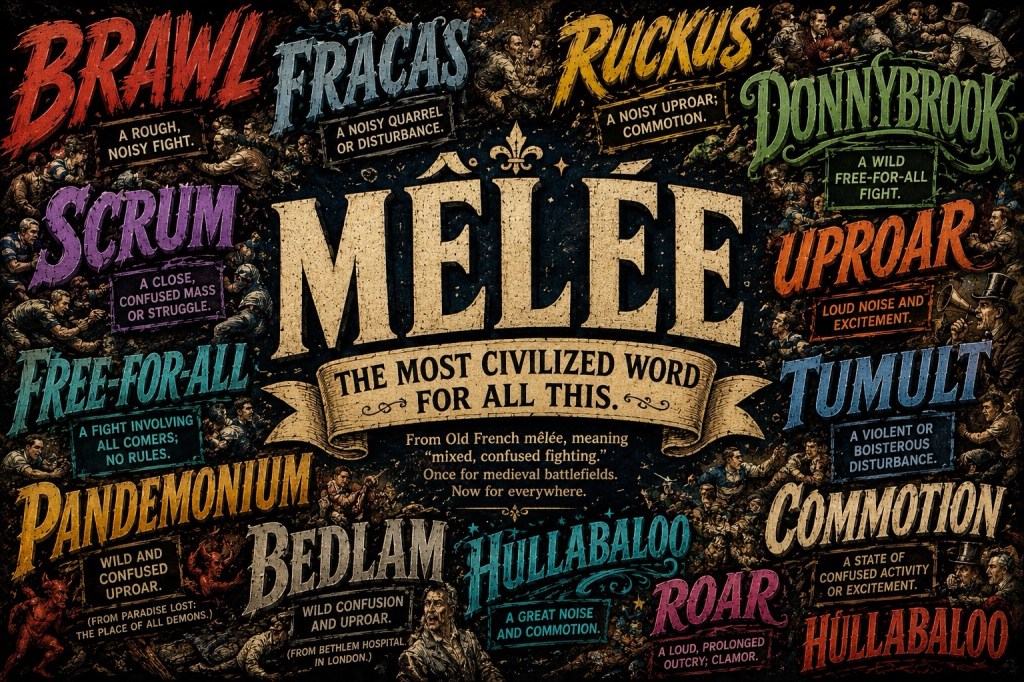
Anthropologists once traveled into jungles to observe primate dominance rituals. Increasingly, similar observations may now be conducted beside the concession stand after a disputed junior-varsity basketball call.
The modern mêlée appears especially likely to emerge wherever three conditions converge:
- emotional overheating,
- crowd density,
- and the suspicion that nobody is truly in charge.
It is worth repeating that recent field reports suggest especially vigorous activity around:
- youth athletics,
- ceremonial school functions,
- children’s milestone events,
- and any public gathering involving folding chairs and overstimulated adults.
The seasoned observer learns to recognize pre-mêlée atmospheric conditions much as sailors once learned to read storms.
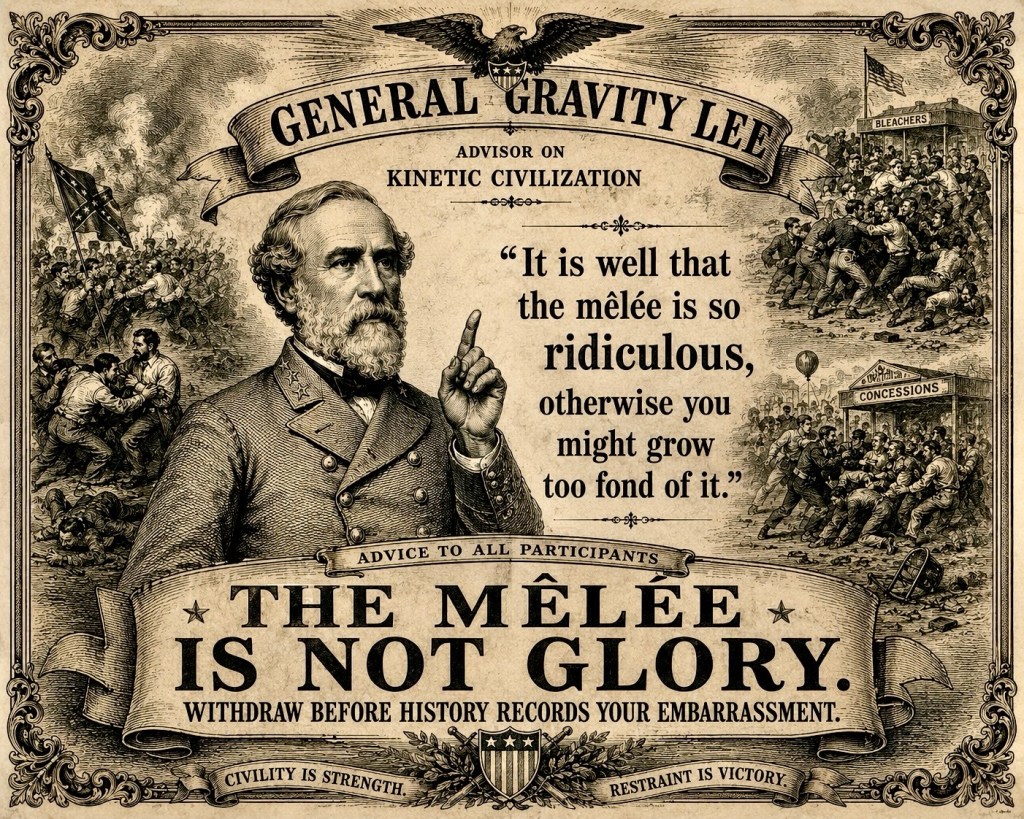
Civilization depends upon millions of tiny voluntary pauses performed daily by exhausted strangers.
The mêlée begins when enough people simultaneously decide the pauses are no longer required.
Or perhaps more precisely:
Civilization survives largely through voluntary restraint.
The mêlée is what occurs when restraint leaves the building.
This report prepared by:
Paige Turner, Council-of-Concerned-Conservationist sub sub librarian


Leave a Reply