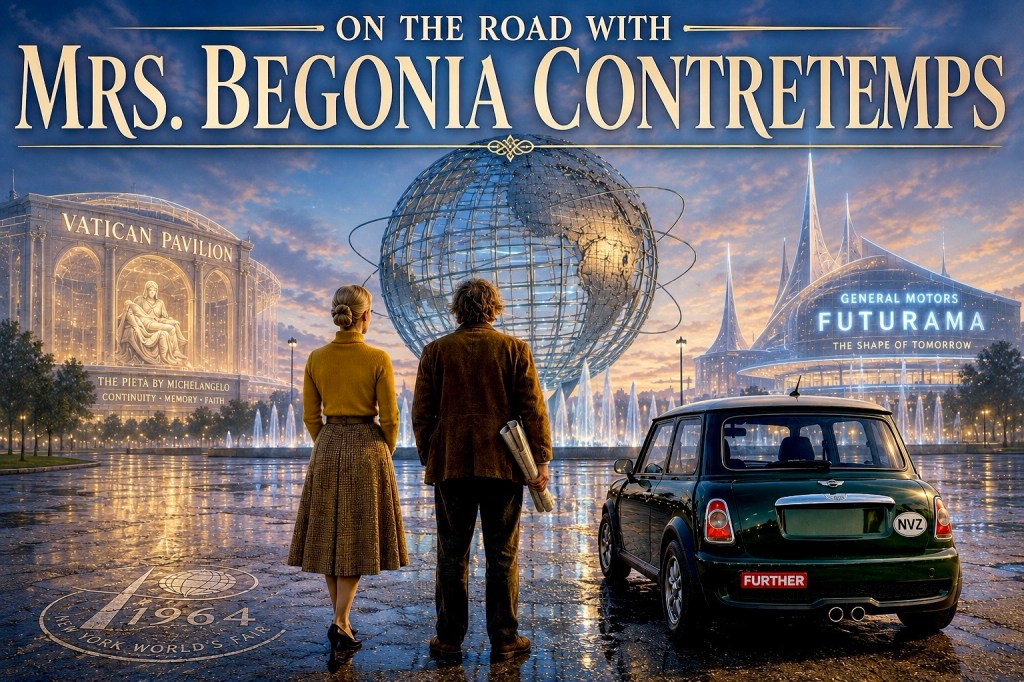
Mrs. Begonia Contretemps has been dispatched by the European Nouvelle Vague Zwischenshaft (NVZ) to investigate peculiar survivals of continuity, symbolism, and craft civilization within the modern American landscape—particularly those strange moments where the future appears unable to fully escape the past. Filed as a letter to René Séance, Chief Theoretician of the NVZ
From the Grounds of the Former 1964 New York World’s Fair, Queens
May MMXXVI // After the Future
My Dear René,
The fairgrounds look less like the future than an archaeological site dedicated to a civilization that once believed very strongly in monorails.
I met Eugene Bodeswell, the Council ethnographer, beneath the rusting remains of the New York State Pavilion where he unfolded a yellowing site map from a cardboard tube with the solemnity of a man preparing artillery coordinates. Nearby rose the Unisphere, still proclaiming planetary confidence from another century while joggers circled beneath it wearing devices capable of tracking their heartbeat in real time while apparently doing little to improve their posture.
I had insisted we meet here after learning that the Vatican Pavilion had been among the most popular attractions at the 1964 World’s Fair, second only to General Motors.
I found this deeply moving.
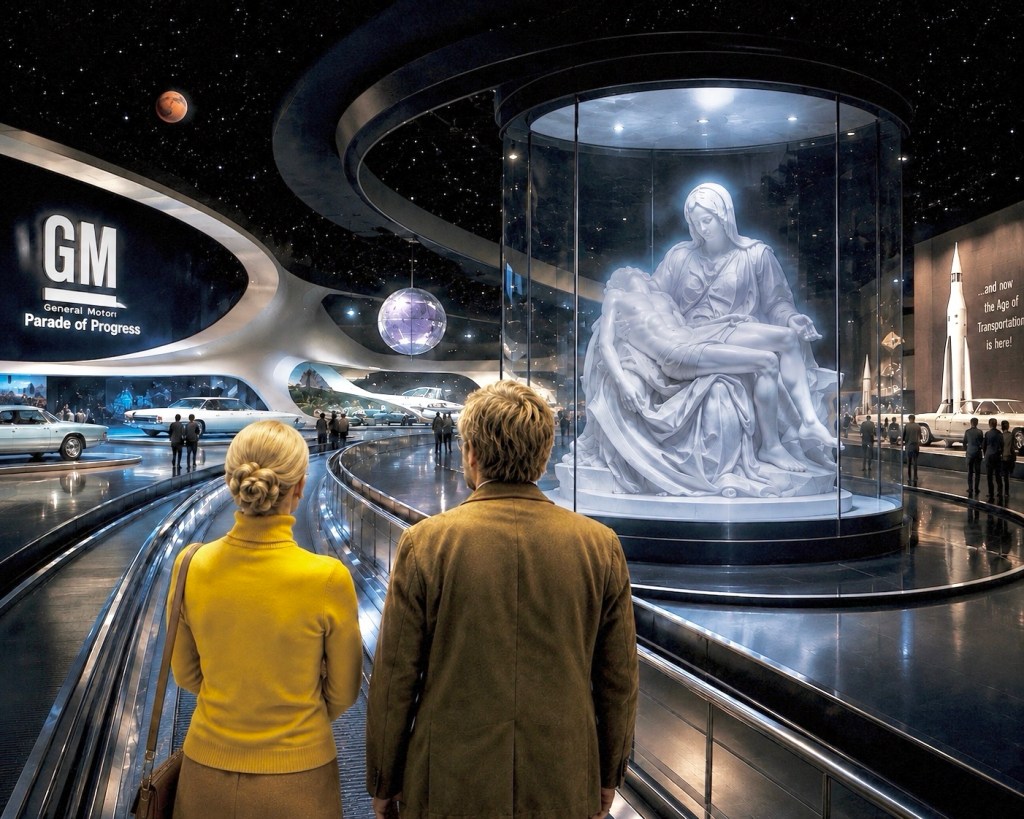
At the height of American technological optimism—amid rockets, automation, highways, and visions of mechanized abundance—millions nevertheless queued patiently to see Pietà.
Not a machine.
Not a prototype.
Not tomorrow.
Marble.
“The General Motors pavilion still drew larger attendance,” Eugene reminded me.
“Yes,” I replied, “but General Motors promised transportation. Michelangelo promised continuity.”
I believe he secretly wrote this sentence down in his notebook while pretending merely to adjust his papers.
The site of the 1964 World’s Fair possesses the melancholy peculiar to abandoned futures. Everything once pointed forward here with such confidence that its present decay now feels almost tender. One senses that the twentieth century truly believed history itself would become streamlined, hygienic, and illuminated by corporate sponsorship.
Yet somehow the old instincts remain.
This realization became even stranger after we traveled westward to visit the Forestiere Underground Gardens and later the Watts Towers.
Until recently I had assumed such constructions emerged from monasteries, guilds, or villages.
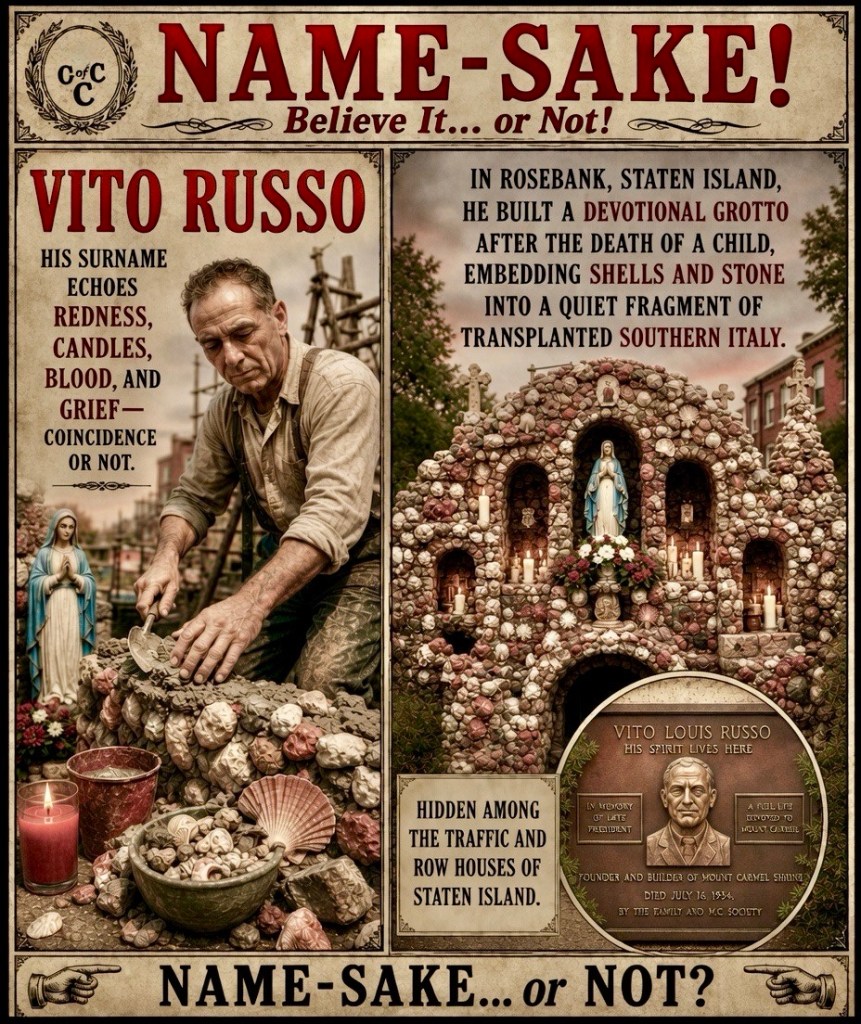
Instead I discovered they were principally the work of singular Italian immigrants: Baldassare Forestiere, Simon Rodia, and Vito Russo of Rosebank whose devotional grotto on Staten Island transformed grief, stone, shells, and neighborhood memory into a fragment of transplanted Southern Italy.
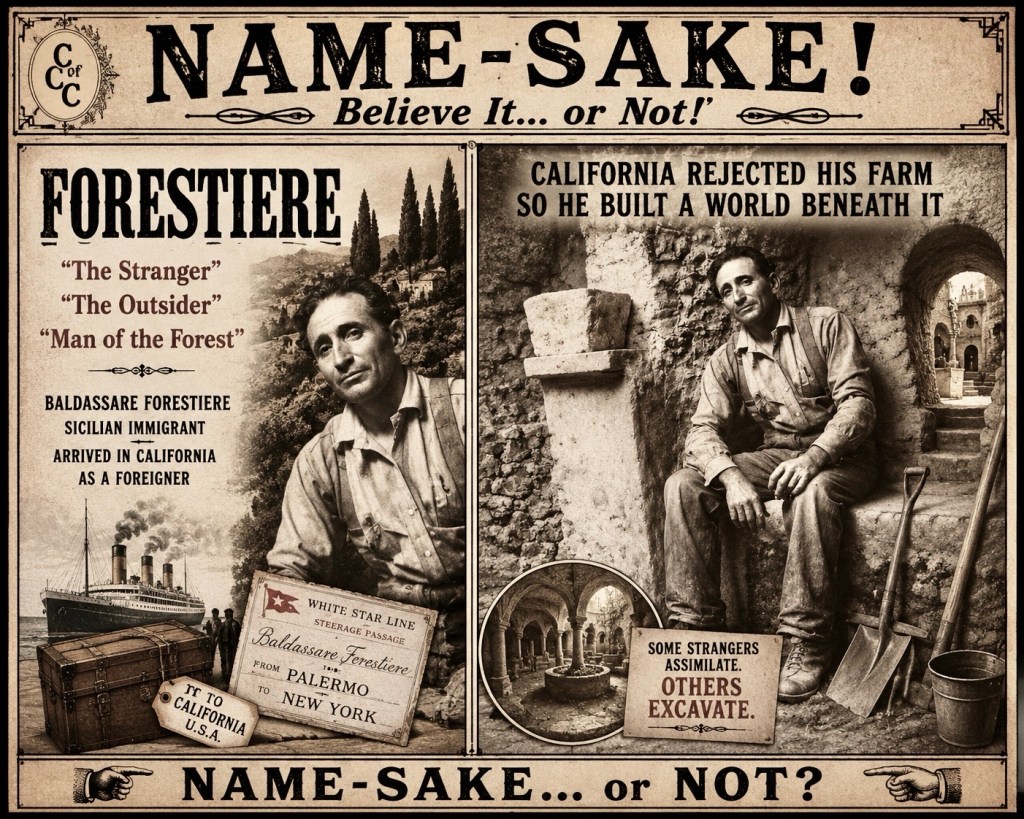
Forestiere, whose surname wonderfully suggests “the stranger” or “the outsider,” discovered upon arriving in California that his land consisted largely of hardpan unsuitable for ordinary farming. Rather than abandon it, the Sicilian spent decades excavating downward by hand, constructing underground chambers, arches, courtyards, and fruit-bearing gardens beneath the brutal California heat like some Mediterranean badger-monk of the frontier.
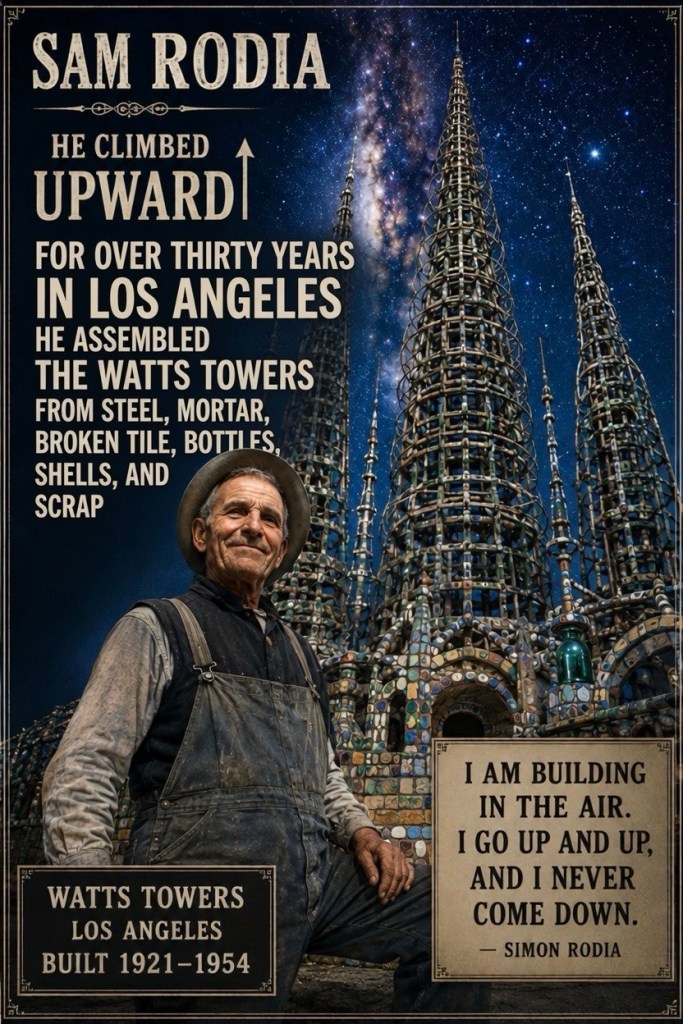
Rodia, meanwhile, climbed upward. For over thirty years in Los Angeles he assembled the Watts Towers from steel, mortar, broken tile, bottles, shells, and scrap, producing structures that resemble at once campaniles, radio antennas, and the dream of a cathedral remembered imperfectly after immigration and several decades of sun exposure.
And in Rosebank, Vito Russo—his surname echoing redness, candles, blood, and grief whether coincidence or not—helped create a devotional grotto after the death of a child, embedding shells and stone into a quiet fragment of transplanted Southern Italy hidden among the traffic and row houses of Staten Island.
One went below the earth.
One reached toward the heavens.
And one extended memory horizontally into neighborhood life itself.
You would have adored Forestiere, René. America continually astonishes me in this regard.
In Europe, a monastery builds a cloister.
In America, the villager becomes the monastery.
Mr. Bodeswell, naturally, resisted my attempts to romanticize the matter. He preferred phrases such as “persistent symbolic enclosure behaviors” and “Mediterranean architectural continuity,” though I noticed he spent an increasingly suspicious amount of time touching masonry for a man committed to scientific detachment.
For someone so outwardly Protestant in temperament, he possesses an unexpectedly Catholic relationship with stone.
During one particularly long drive through California he explained, with great caution, that Europe itself emerged from multiple ancestral layers over immense spans of time:
hunter-gatherers, early farming populations, later migratory peoples.
“One hesitates to draw uninterrupted lines across millennia,” he said carefully, “yet certain populations do appear unusually persistent in their tendency to transform settlement into symbolic landscape.”
I looked out at the towers rising against the California sky and replied:
“So Europe survived not only in blood, Mr. Bodeswell. . . but also in masonry.”
He pretended not to hear this because he strongly suspected I was correct.
Our final stop before returning east brought us again to the grotto in Rosebank where we were met by Vito Haeckeler carrying coffee and immediate opinions.
“You two are late,” he announced. “The saints noticed.”
The grotto stands quietly among ordinary streets and passing traffic with the uncanny sensation that Southern Italy has survived by disguising itself as Staten Island.
Eugene began discussing immigrant devotional carryovers before abruptly trailing off while examining embedded shells in the masonry like a man experiencing an anthropological crisis.
Vito observed this silently for a moment before remarking:
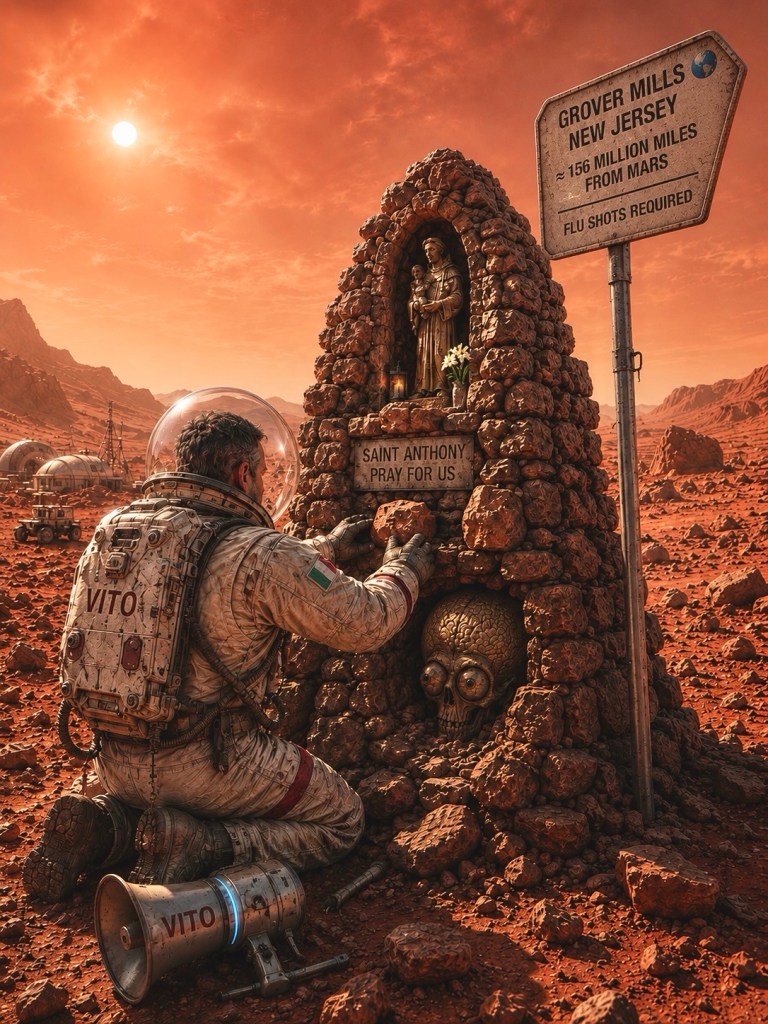
“You know someday some paisan’s gonna get to Mars and stack up a bunch’a rocks for Saint Anthony. Watch.”
I laughed.
Eugene did not.
Instead he stared thoughtfully at the shrine before replying:
“Curiously, if extraterrestrial settlement occurs under conditions of material scarcity, locally available stone may again become the dominant symbolic medium.”
Vito blinked twice.
“See? That’s exactly what I just said except with tuition debt.”
And there, René, standing beneath a handmade grotto beside the harbor infrastructure of modern America, I suddenly understood something.
The future may arrive wrapped in algorithms, rockets, and machine intelligence.
But somewhere, on some barren frontier beneath unfamiliar stars, human beings will almost certainly begin stacking stones again—some upward toward the heavens, some downward into the earth, and some outward in little acts of grief, memory, and devotion against the surrounding emptiness.
Yours in continuity, masonry, and occasional archeo-futurist bewilderment,
Mrs. Begonia Contretemps
The Further Writings of Mrs. Begonia Contretemps can be found: HERE


Leave a Reply