—A Modest Museum Pilgrimage Undertaken in the Company of Dr. Faye C. Schüß
Filed as a Special Report to René Séance
Nouvelle Vague Zwischenschaft (NVZ)
Department of Cultural Health & Atmospheric Conditions
—From the café terrace of the Cloisters on the anniversary of Salvador Dalí’s birth, while the Hudson drifted beneath the Palisades like a landscape beginning to forget itself…
11•May• MMXXVI
Dear René,
I had lately begun to experience the uneasy sensation that contemporary civilization resembled a gallery in which the portraits had gradually lost confidence in the continued existence of faces.
At first I attributed this merely to fatigue, overstimulation, or perhaps excessive exposure to political broadcasting. Yet the feeling persisted. Public life itself seemed increasingly abstracted: language detached from reference, institutions from memory, and individuals from recognizable proportion. Everywhere one encountered fragmentation enthusiastically reclassified as liberation.
Unsure whether this reflected cultural development, civilizational exhaustion, or simply Manhattan after lunch, I arranged to meet the Council mental hygienist, Dr. Faye C. Schüß at the Cloisters for what was initially intended as a modest afternoon of aesthetic clarification.
The day was overcast in the Hudson manner — silver river light, damp stone, distant fog suspended above the Palisades like an unresolved theological question. Dr. Faye arrived carrying an umbrella, two museum maps, and a bulging leather portfolio labeled:
PRELIMINARY OBSERVATIONS ON SYMBOLIC DISINTEGRATION IN ADVANCED CIVILIZATIONAL ORGANISMS
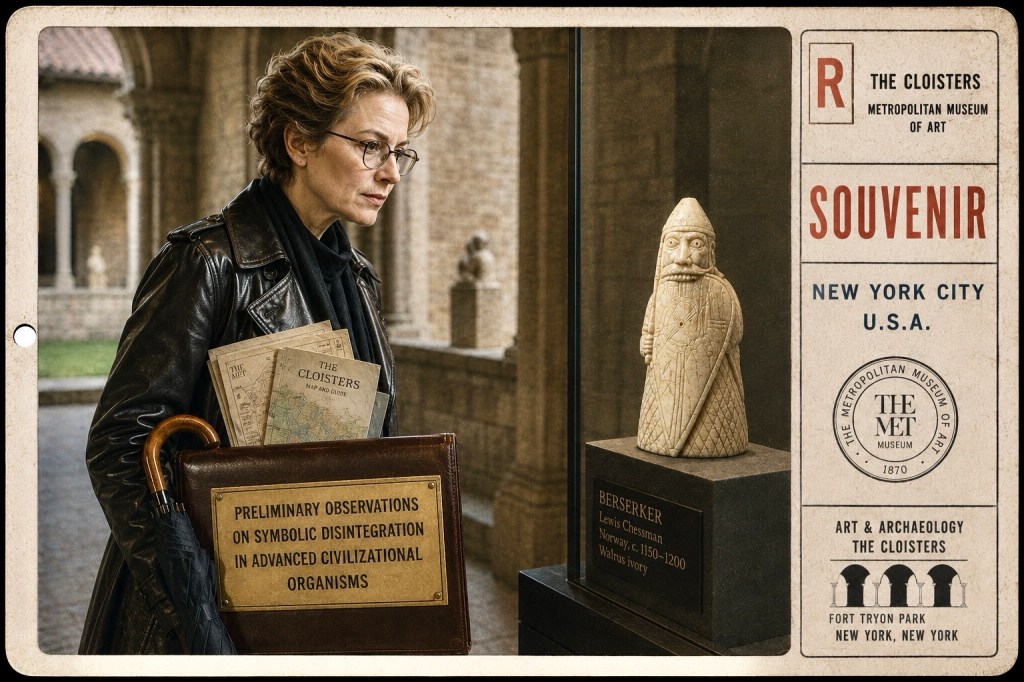
I informed the doctor that the title of her thesis itself seemed somewhat premature.
“Not at all,” she replied. “One must begin charting the symptoms before the patient starts replacing the clocks with conceptual furniture.”
This did little to calm me.
We wandered quietly through the medieval halls. Tapestries, reliquaries, carved saints, illuminated manuscripts — all damaged by time, many visibly incomplete, yet still unmistakably striving toward coherence. Even broken figures retained orientation. Missing faces still belonged to recognizable humanity. The fragments implied a whole.
Dr. Faye paused before a weathered devotional panel and adjusted her spectacles.
“Curious,” she murmured. “Even deterioration here appears to remember what it once intended to become.”
It was then, I suspect, that our excursion ceased to be entirely recreational.
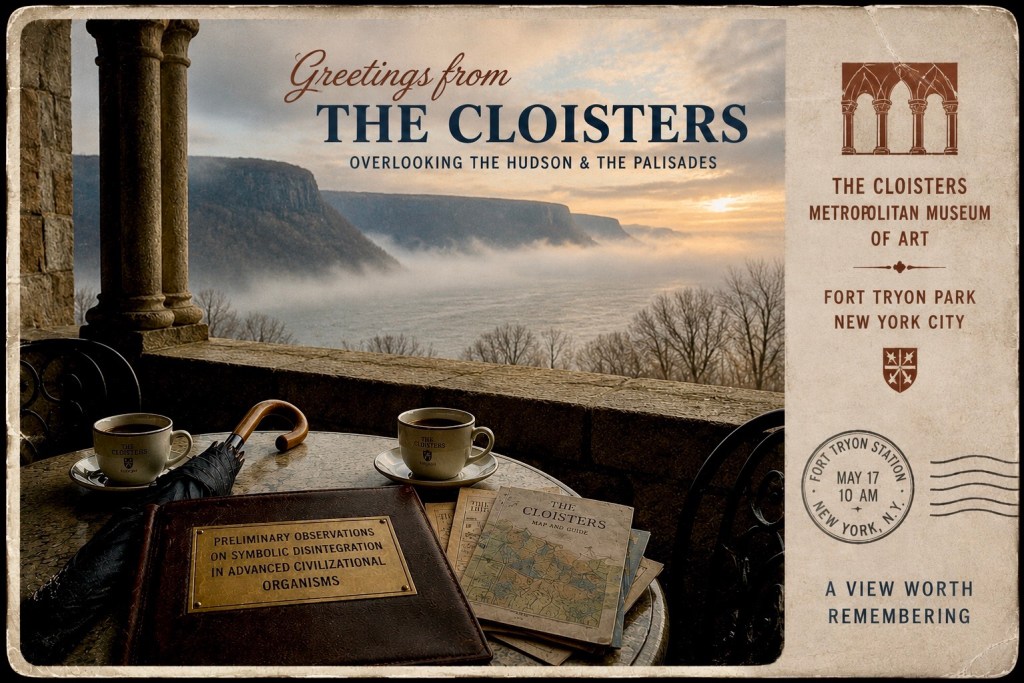
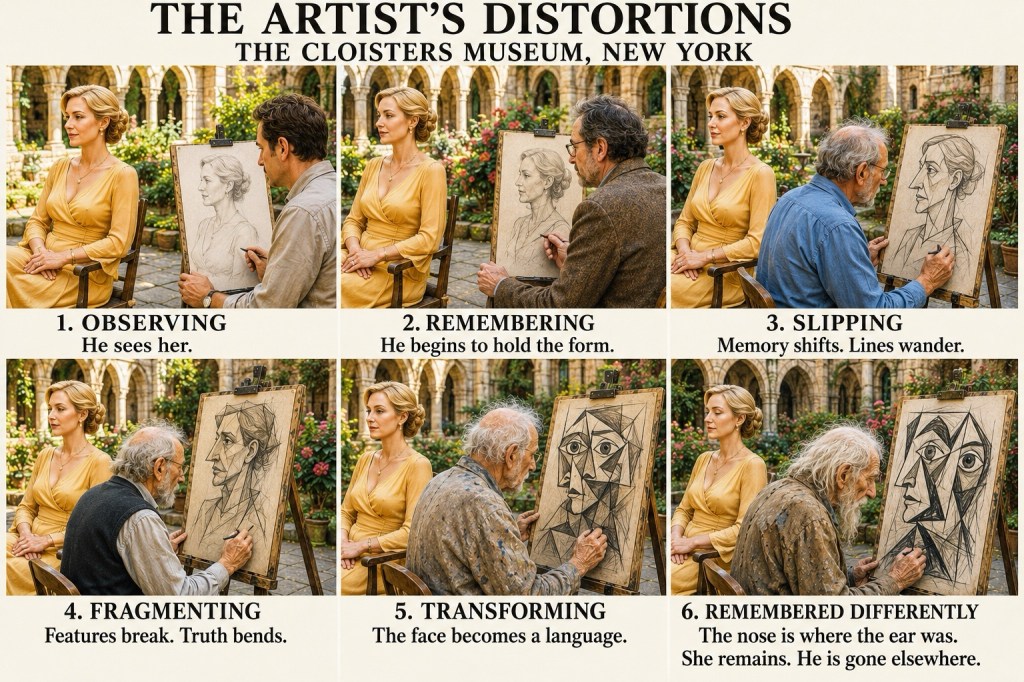
With our tea in the café overlooking the Hudson, I confessed the true source of my unease: that certain contemporary museums increasingly reminded me not of artistic evolution, but of the visual records of neurological decline encountered while reading about the painter William Utermohlen, whose self-portraits tracked the tragic progression of Alzheimer’s disease from coherent representation into fragmentation and dissolution.
Importantly, René, I do not mean this crudely. There exist abstractions which elevate, compress, symbolize, or reveal. Kandinsky’s paintings, for instance, often affect me not as confusion but as altitude.
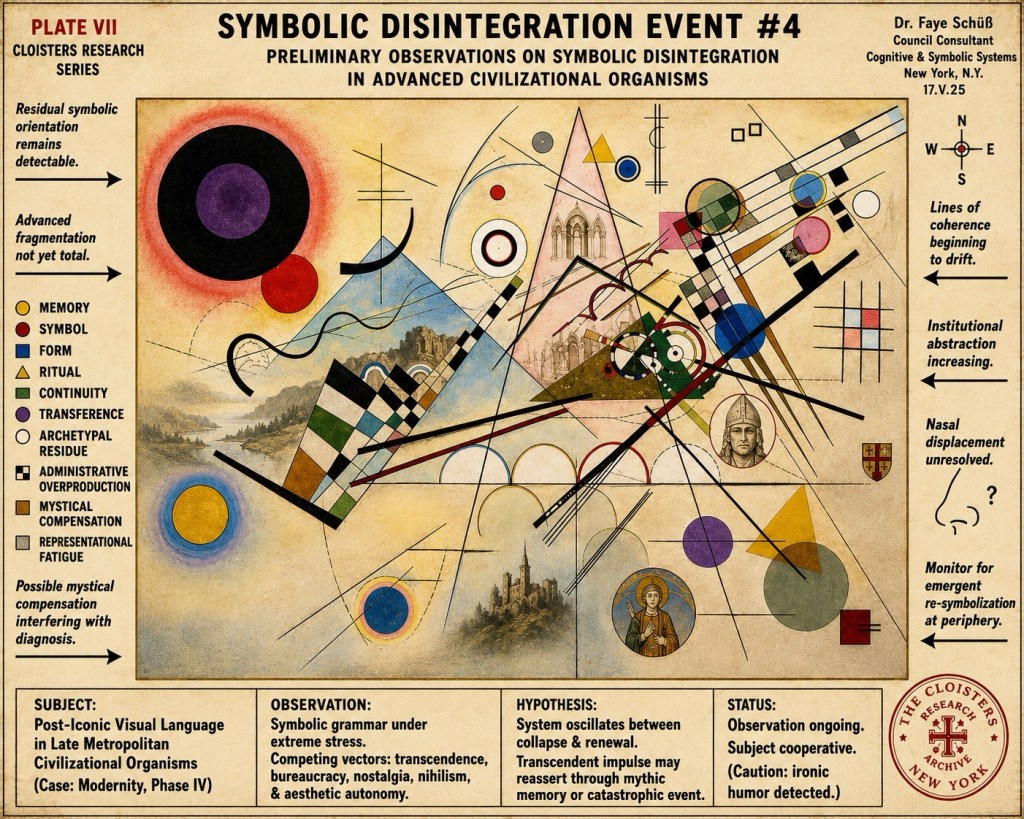
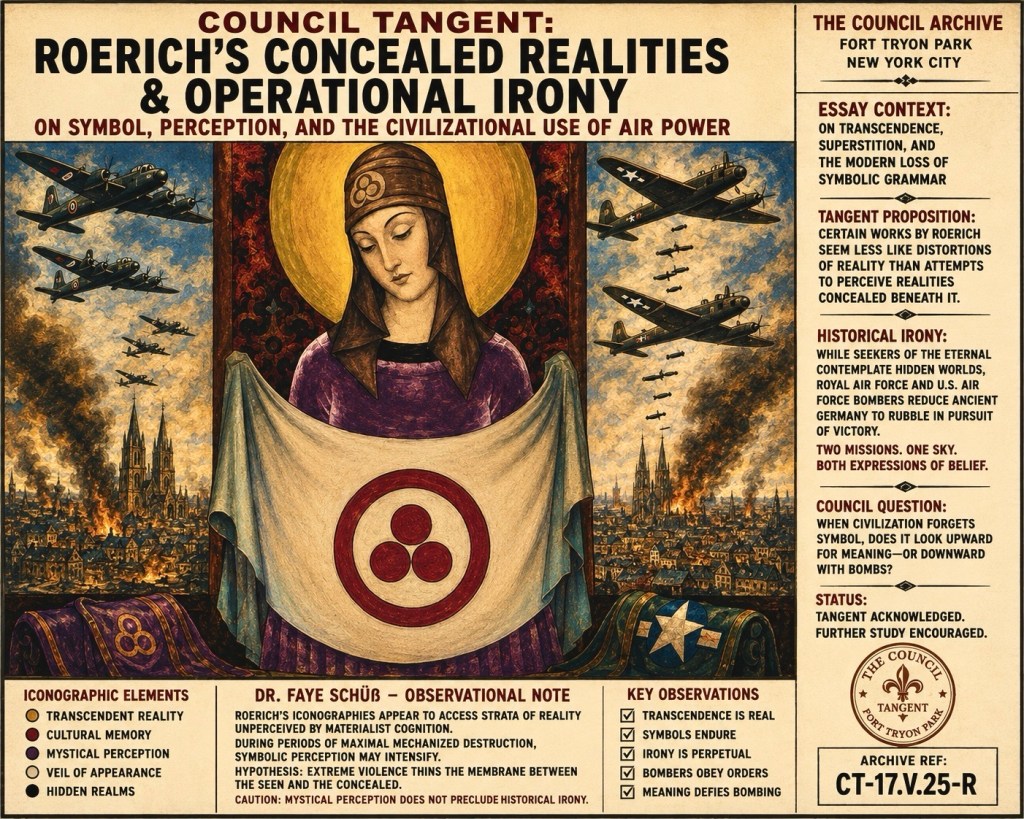
Also, certain works by Nicholas Roerich seem less like distortions of reality than attempts to perceive realities concealed beneath it.
“No serious observer,” Dr. Faye cautioned, stirring her tea with clinical severity, “would confuse sacred abstraction with perceptual collapse. Icons are abstractions. Heraldry is abstraction. The question is whether simplification intensifies meaning. . . or merely reflects difficulty retaining it.”
I then asked whether Dr Schüß truly believed a civilization might reveal its psychological condition through its art.
“Where else,” she replied, “would it reveal itself more honestly?”
Thus began our pilgrimage.
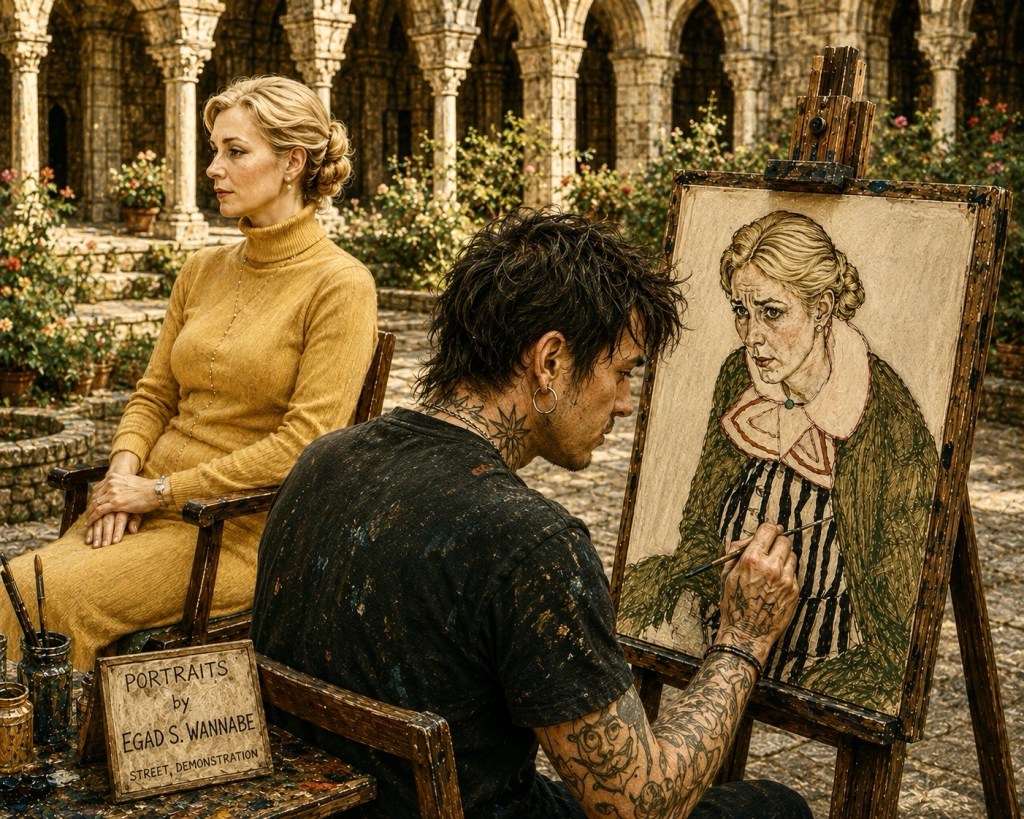
From the Cloisters we descended once more into Manhattan and proceeded first to the Neue Galerie, where Dr. Faye became increasingly interested in Egon Schiele, whom she described as :
“a civilization drawing itself through insomnia.”
By the second room she had begun quietly noting
“early symbolic destabilization indicators”
into her portfolio, though I still felt she was being charitable.
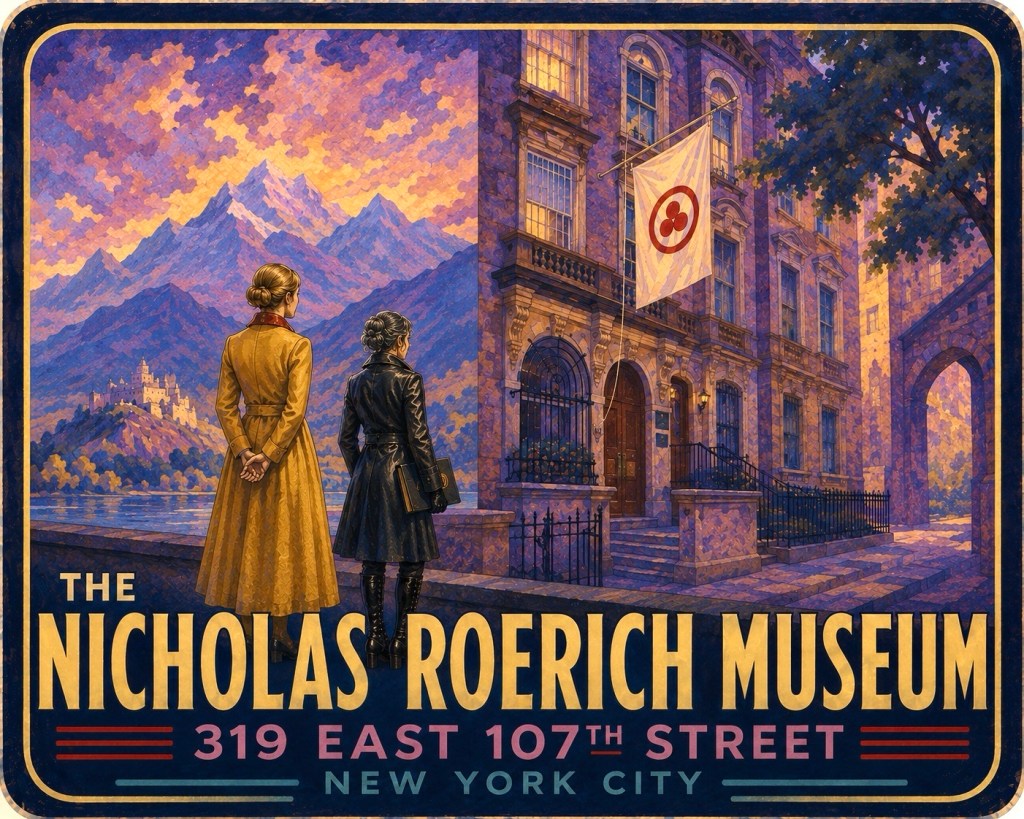
At the Nicholas Roerich Museum, however, the diagnosis suffered complications. Roerich’s mountains retained symbolic order despite their dreamlike abstraction, and for nearly forty minutes Dr. Faye was forced to concede the possibility that not all departures from realism indicated pathology.
“This,” she admitted reluctantly, “may represent transcendence rather than degeneration.”
“You sound disappointed,” I observed.
“A diagnostician must remain adaptable.”
Our discussions grew more complicated after she introduced me to the work of Hans Prinzhorn, the psychiatrist whose collection of art by psychiatric patients profoundly influenced segments of modernism itself. Here the boundary between revelation and dissolution became deeply unstable.
“A wounded mind producing fractured symbols is tragic,” Dr. Faye explained quietly.
“A civilization treating fracture itself as the highest aesthetic achievement may represent a different category of concern.”
This distinction haunted the remainder of our journey.
At the Museum of Modern Art, matters became difficult.
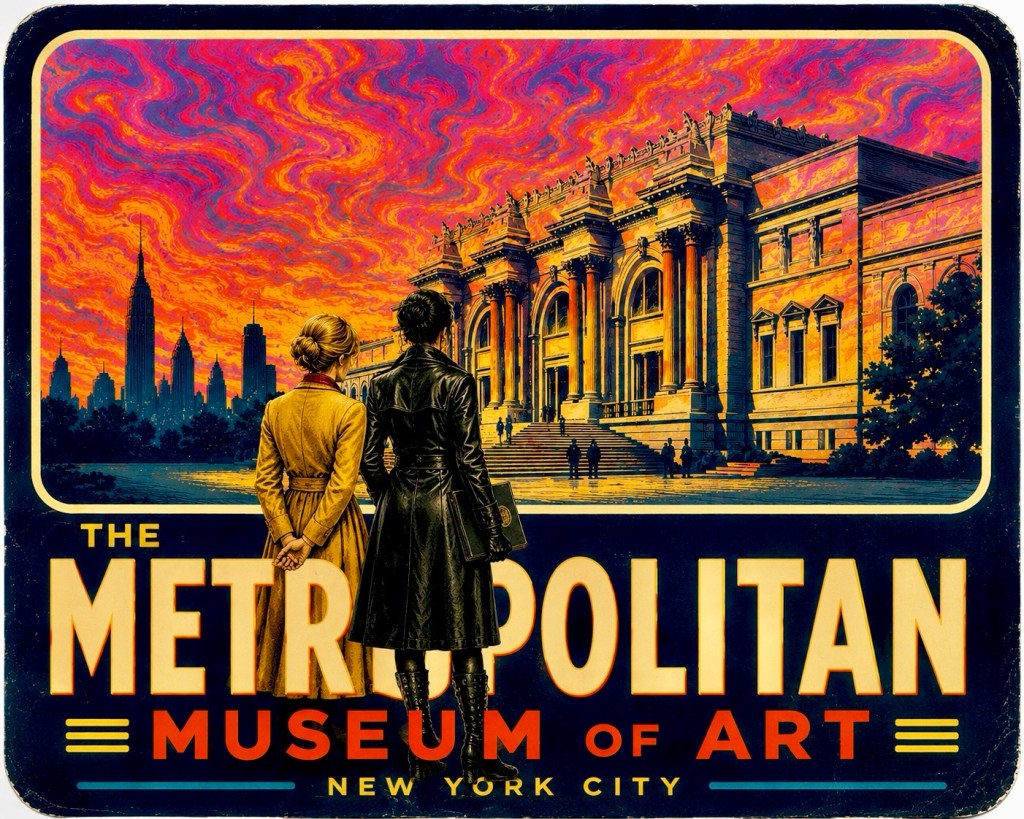
Certain rooms affected Dr. Faye visibly. Before one large canvas consisting primarily of geometric interruption and aggressively displaced anatomy, she removed her glasses and whispered:
“Again, the patient appears increasingly unable to locate the nose.”
I reminded her that Cubism was not generally considered a medical emergency.
“Not individually,” she replied. “Collectively it remains under review.”
Yet even there the theory refused complete obedience. A Paul Klee unexpectedly moved me with enormous force. Dr. Faye explained that Klee’s abstractions were partly inspired by viewing the landscape from the air during the early age of flight — fields, roads, villages, and boundaries transformed into floating geometry. Seen that way, the painting no longer resembled disintegration so much as civilization remembered from above, as though distance itself had turned the earth into symbolism.
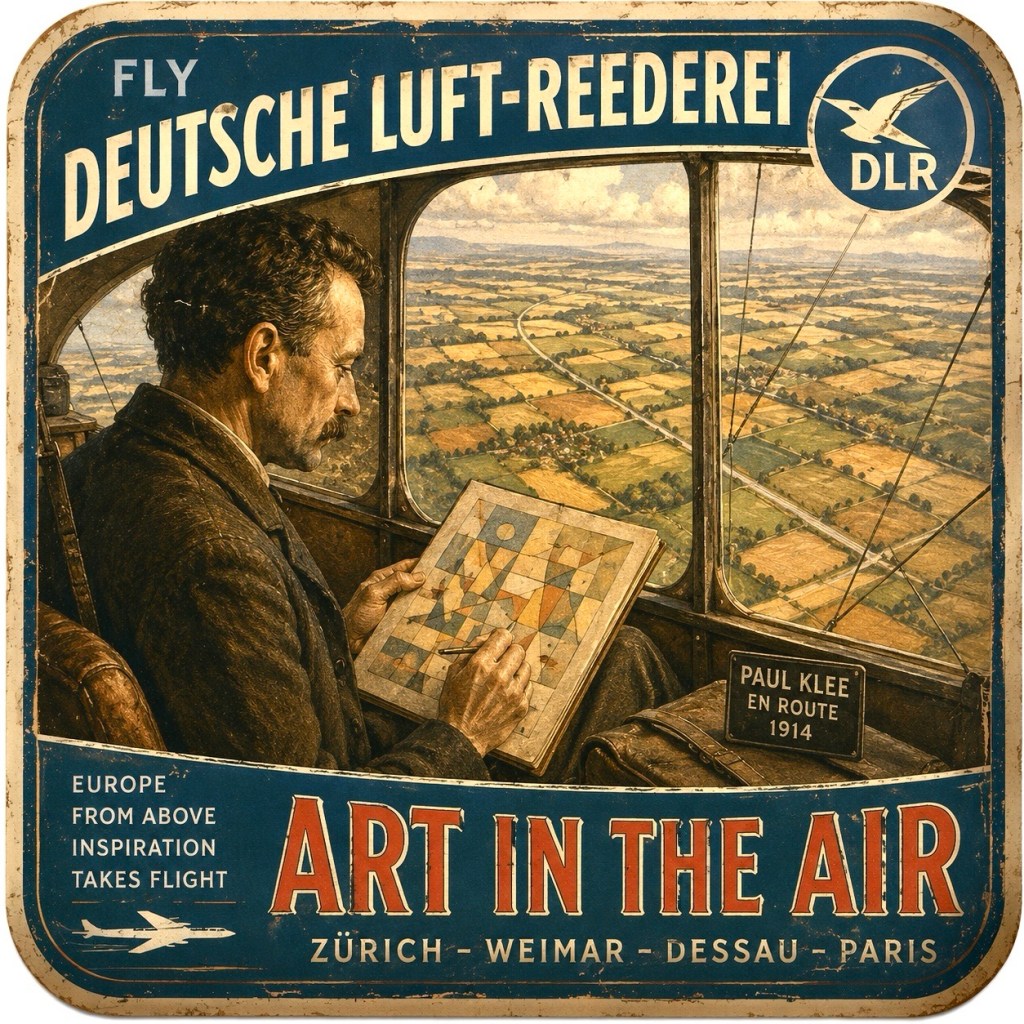
“I regret to inform you,” I told Dr. Faye, “that this painting appears to possess a soul.”
She looked genuinely troubled.
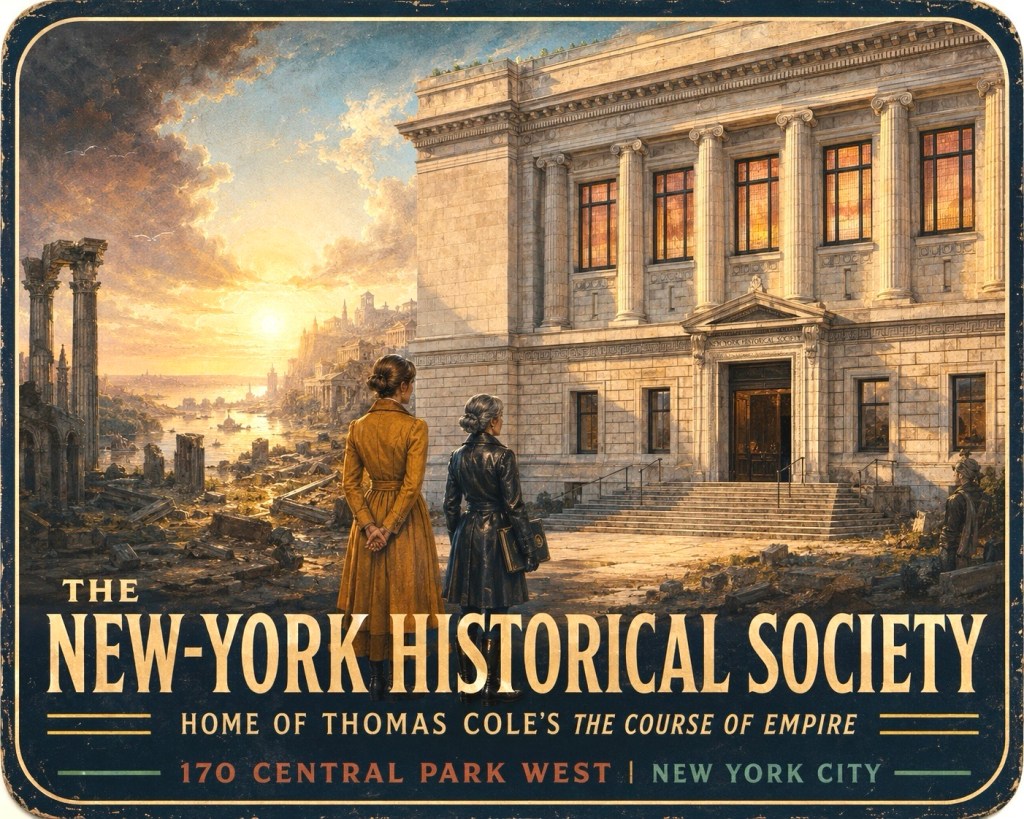
By the time we arrived at the New-York Historical Society to stand before Thomas Cole’s Course of Empire, our confidence in any simple diagnosis had largely dissolved.
There the cycle revealed itself fully:
birth,
ascent,
consummation,
collapse,
desolation.
Yet what lingered most powerfully was not destruction, but recurrence.
In the fifth frame the mountain remained.
The river remained.
Vegetation quietly returned.
The world itself appeared less terminal than forgetful.
Dr. Faye stood silently before the painting, Desolation for a very long time before speaking.
“A healthy organism may distort itself symbolically through dreams, visions, rituals, and revelations,” she said softly. “A dying organism often loses the distinction between fragmentation and freedom.”
Night had fallen by the time we returned at last to the Cloisters.
The Hudson below reflected scattered lights from Manhattan. Somewhere in the distance a siren echoed faintly through the fog. We walked once more through the stone corridors in near silence.
At length I asked Dr. Faye whether she believed civilization’s condition to be reversible.
She considered this carefully.
“The terminal phase,” she replied at last, “may not be frenzy, Begonia. It may simply be exhaustion. But exhaustion is not always extinction.”
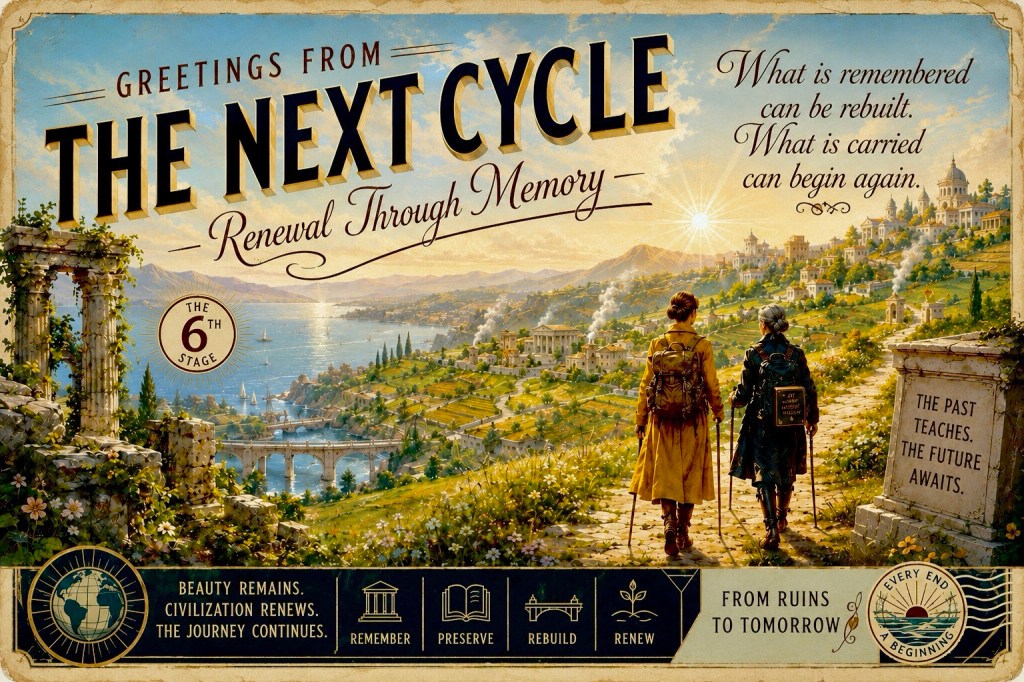
I thought then of Thomas Cole’s final ruins giving way once more to wilderness, and wilderness eventually to symbol, and symbol eventually again to civilization.
Empires, perhaps, dissolve into symbols before symbols once more become empires.
One hopes the next civilization remembers how to paint hands.
Yours in continued observation,
Mrs. Begonia Contretemps
Renè Séance replied:
My dear Begonia,
Your excursion with Dr. Faye through the neurological weather systems of Western civilization was, as always, both alarming and strangely invigorating. Yet I confess I remain partial to Gerhard Richter and his severe hyperrealism. The Americans, after all, appear to have solved the entire philosophical problem with the expression:
“It is what it is.”
And what, chère Begonia, could possibly be more “it is what it is” than painting a thing exactly as it appears?
As for your final image — you and Dr. Faye hiking optimistically toward the next cycle with satchels full of symbolic continuity while the ruins glow behind you — I believe I have located the proper musical accompaniment.
“My dear Begonia, should Monsieur Manilow fail to appear, first disable your VPN before diagnosing the collapse of Western civilization. And is it not curious? The very songs we once dismissed as unbearably bourgeois now arrive upon us with age sounding almost. . . sublime. Whether this reflects wisdom, nostalgia, or the earliest stages of cultural dementia, I leave respectfully to Dr. Faye.”
Yours, in continued continental uncertainty,
René Séance
The Further writings of Mrs. Begonia can be found: HERE


Leave a Reply