JABRONI
—Now Observed Outside Its Native Range

Submitted for observation by Vito Haeckeler, who reports increasing sightings of the term in urban, digital, and media environments once thought outside its natural habitat
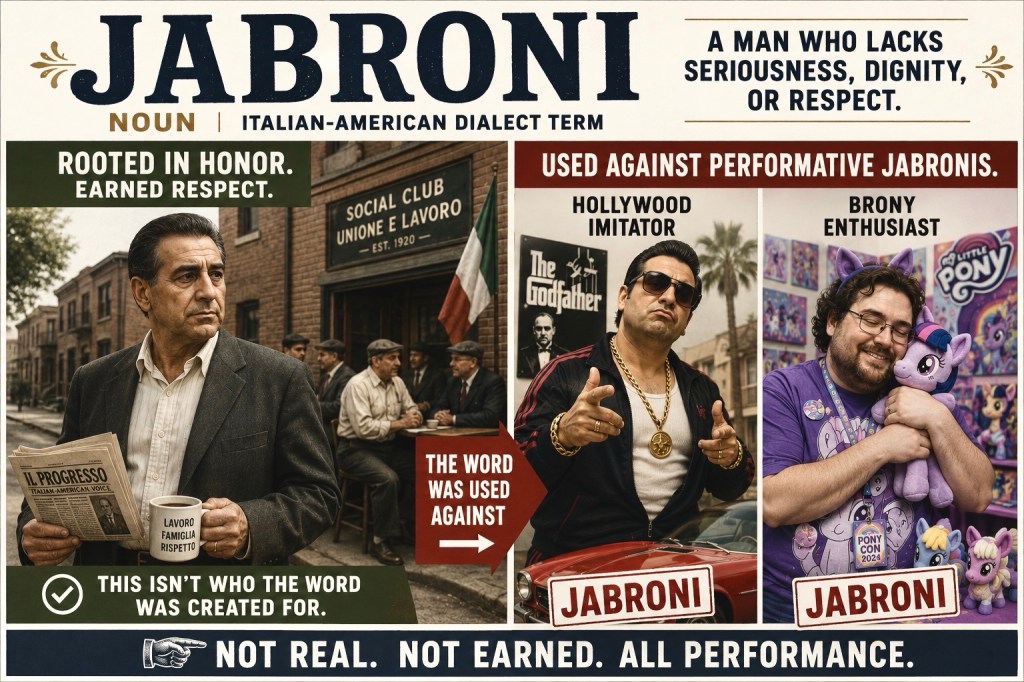
The word jabroni is generally believed to have emerged from Italian-American dialect ecosystems, particularly in working-class Northeastern neighborhoods, where it referred to a man lacking seriousness, discipline, dignity, or self-awareness. Though its exact linguistic ancestry remains debated, researchers commonly trace it to Southern Italian dialect mutation, street usage, and overlapping immigrant slang formations.
Though often used critically, the term could also function affectionately — a corrective aimed at friends, cousins, coworkers, or neighborhood characters whose behavior drifted into foolishness, theatricality, or unnecessary display.
In this sense, a jabroni was not always a villain. Sometimes he was simply “one of the guys” acting like a horse’s ass.
For decades the term remained largely local — a spoken corrective, usually delivered with disappointment, amusement, or weary familiarity rather than theatrical outrage.
Its great migration appears to have occurred through exhibition wrestling culture, where the word was amplified, exaggerated, and broadcast into mass entertainment ecosystems. From there, jabroni escaped containment entirely.
It now appears in:
- online fandom habitats,
- performative masculinity displays,
- influencer ecosystems,
- meme culture,
- and various theatrical identity performances.
Mr. Haeckeler insists the word no longer merely describes a type of person.
“It describes a condition of performance,” he observed while standing in the office of his family’s mechanical contracting business, founded by an uncle after the Second War.
*Bonus Footnote
(The uncle, born in 1900, possessed the rare misfortune of being young enough to be drafted into the First World War and still young enough to be called again during the Second. Like many older soldiers of that later conflict, he reportedly spent much of his service attached to coastal artillery and harbor defense units — guarding the homeland while younger men were shipped toward the front.
Written documentation from the Brooklyn Eagle newspaper is pending.)


Leave a Reply