—Plasticity, and the American Use Of It.

Mrs. Begonia Contretemps, under instruction from the European NVZ, returned to the field. She was a bit unsettled by her last tour of disaster, mayhem, murder, and massacre sites, and approached this assignment accordingly.
Ole Bull State Park, Commonwealth of Pennsylvania
(Formerly the Site of New Norway)
—the 3rd of May, 2026
Dear René,
I had been assured that if one wished to encounter America in its more reflective mood, one should drive through its quieter regions—the places where the land has not yet been persuaded to speak too loudly.
The Pennsylvania Wilds, I was told, would suffice.
They nearly did.
It was on a bend of road, between a stand of trees and a view that required no commentary, that I encountered a billboard.

It bore, with surprising confidence, a line from Alfred North Whitehead—that:
Man is not separate from Nature, but an expression of its mutability.
This metaphysical assurance was accompanied by two images: a raven, composed and sufficient; and a fighter jet, equally composed, though for different reasons. A discreet logo below suggested the latter could be acquired, in some sense, by interested national entities.
One does not expect ontology to be subcontracted to industry, but there it was—set against a horizon that had, until then, required no assistance.
I objected immediately, though I could not say precisely to what.
Not long after, the valley supplied an answer.
A jet passed low overhead—so low, René, that it did not so much traverse the landscape as enter it. The sound arrived before the object, and lingered after it had gone, as though the air itself had been persuaded to remember. I am told the Maryland Air National Guard conducts training runs through these hollows, at altitudes that approach the ground with unusual confidence.

My instinct was uncomplicated: this does not belong. And yet, I had just been instructed otherwise by a billboard.
If Man is not separate from Nature, then neither is his machinery. The jet, however inelegant in its manners, is no less a product of the same earth as the bird it so rudely outpaces. Ore, fuel, combustion—one need only follow the chain long enough and the distinction dissolves.
I concede the continuity.
I reserve the right to object to the manner.

I left the road shortly thereafter, in search of a silence that would not argue with me.
Instead, I found the stones.
Small piles at first—then more, then many. Balanced, provisional, multiplying with a quiet insistence. They were not markers, nor memorials, nor even particularly beautiful. They seemed to function as a kind of declaration, though of what I could not quite determine.
I took out my notebook to record the phenomenon and found, to my mild irritation, that the device insisted on correcting:
cairns to Karens.
One is tempted to resist such intrusions, though in this case the substitution was not entirely without suggestion. These intentional piles of rock do not so much mark the landscape as address it—each a small correction, as if the stones had been found wanting in their original arrangement and gently improved upon by passing authority.

So we arranged it that way. No apology.
I made a note to restore the proper spelling, and then hesitated. The piles were a presence without obligation.
One hesitates to use the term, but it suggested itself:
a kind of graffiti.
Not destructive, exactly. Merely unnecessary—each small arrangement of stones interrupting a landscape that had not asked to be edited.
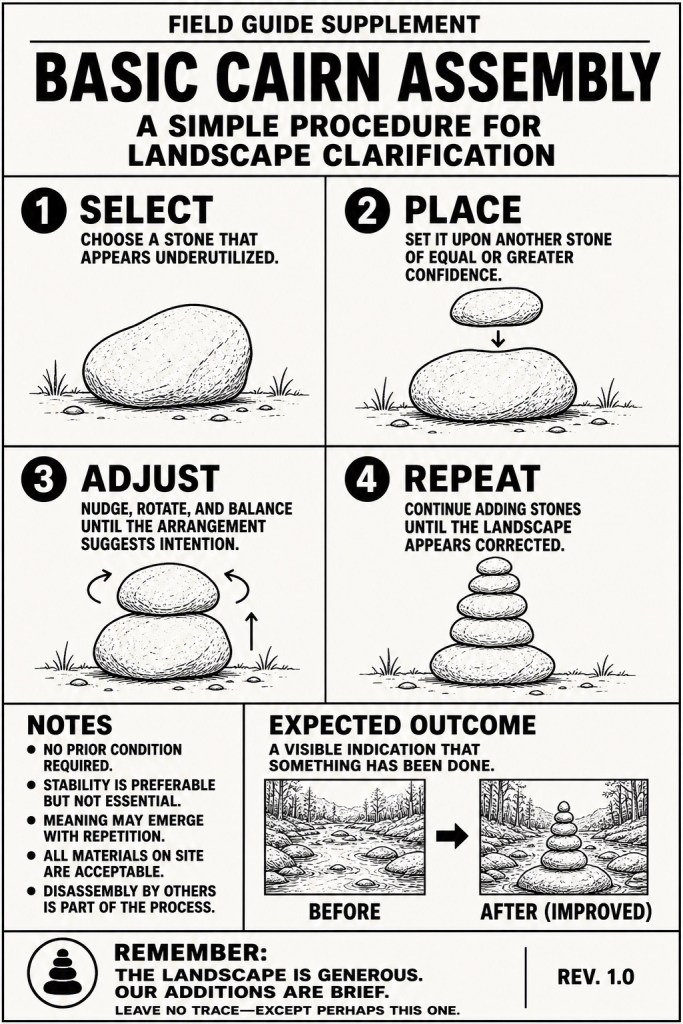
as though the original arrangement had been found in need of comment.
A short walk further on, the tone corrected itself.
A wall emerged from the trees—low, irregular, unmistakably deliberate. The stones here had not been placed for expression, but for use. They had been removed from fields that required clearing, and in being removed, had been made to serve a second purpose: boundary, enclosure, definition.
Here, arrangement followed necessity.
Nothing announced itself. Nothing insisted. The structure had settled into the land as though it had always been negotiating with it.

And then, in a small clearing that might easily have been missed, I encountered something else.
Here, the same act—placing one stone upon another—had acquired a different weight.
Not the urgency of the wall. Not the casualness of the piles. But something in between:
intention without intrusion.

It was at this point, René, that the earlier instruction returned to me with greater clarity.
Man, we are told, is an expression of Nature’s plasticity. I do not dispute it. I note only that plasticity, while expansive, can be self-guiding.
The same impulse—
to take what is given and arrange it— produces, in this country:
—a wall that answers a need,
—a pile of rock that answers a mood,
—and a flying machine that answers nothing but its own capacity.
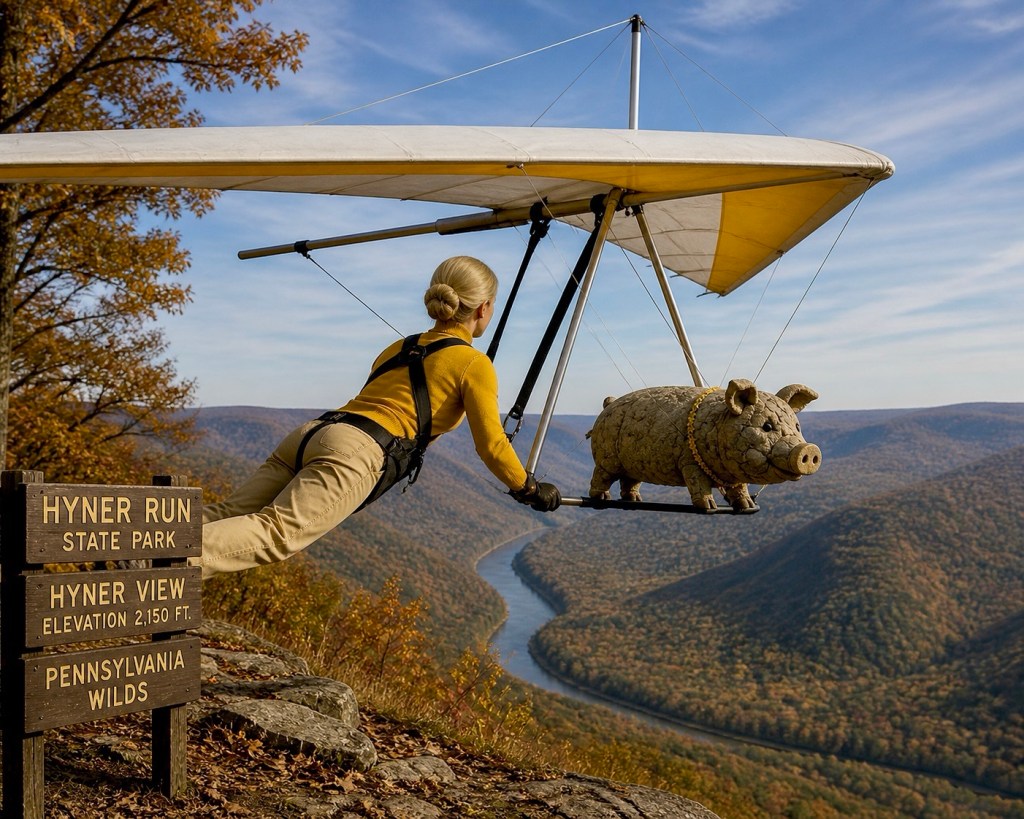
Why one would do so remains an open question.”
I now find myself in a position I had not anticipated.
If all of this is continuous—if the raven and the jet, the wall and the cairn, belong to a single unfolding—then the question is no longer what is natural.
The question is—
what is decided upon
And here, America reveals something of its essence.
It does not lack restraint because it cannot restrain itself. It lacks restraint because it has discovered it need not. Which suggests, rather uncomfortably, that it could.
As I returned to the road, the sky remained available, though momentarily unoccupied. The stones, in their various arrangements, continued their quiet negotiations with gravity and intention.
And it occurred to me—more plainly than before—that if plasticity is indeed our condition,
then it extends not only to what we build, but to what we permit.
The same hand that assembles a machine may also withhold it.
The same impulse that stacks a stone may also leave it unturned.
If Man is continuous with Nature, then so too is his restraint.
He may choose the jet, the pile, or with equal authority choose the silence that precedes them both.

Nothing prevented the removal of the stones.
Nothing required the next pass of the aircraft. Plasticity, it seems, includes the option not to proceed.
I am told this is freedom. I remain uncertain whether it is being used.
Yours,
(in measured concession and unresolved expectation,)
Mrs. Begonia Contretemps
Filed from a valley that endures more than it agrees to.
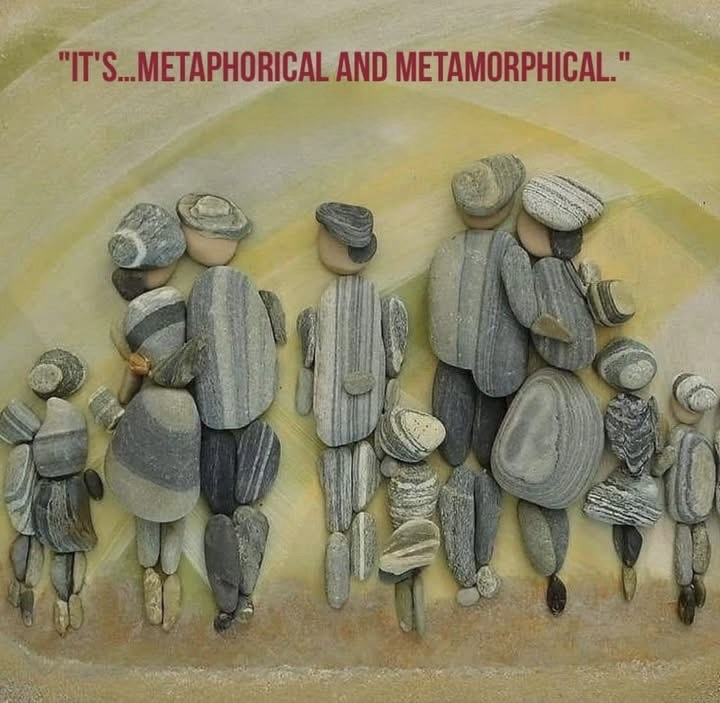
The Further writings of Mrs. Begonia Contretemps can be found HERE.



Leave a Reply