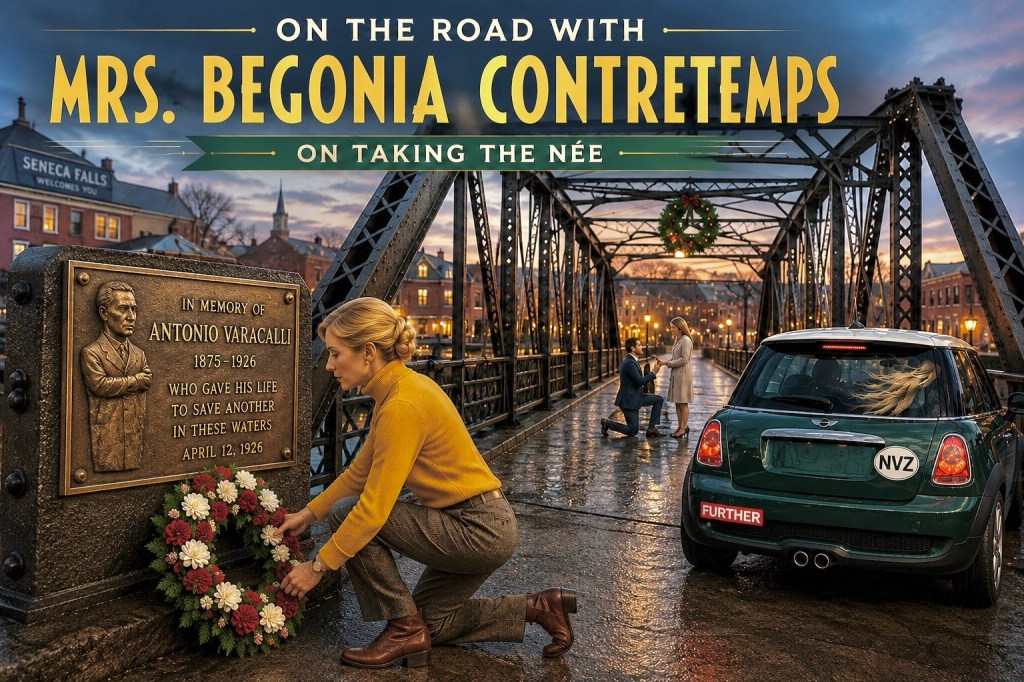
A Special Commission from the Nouvelle Vague Zwischenschaft to Discover What, Precisely, America Means
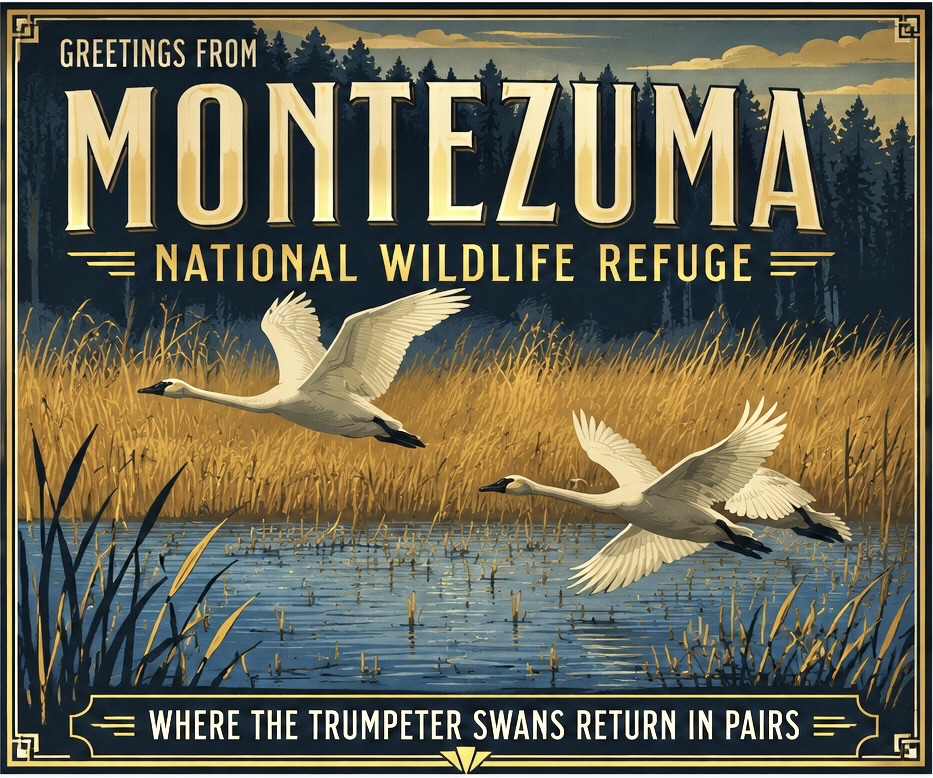
From the Montezuma Marshes of the Cayuga–Seneca Corridor
2026-05-08
Dear René,
I traveled to Seneca Falls, in the Finger Lakes region of western New York, for no ideological purpose whatsoever.
I had merely arranged to meet Lefoto ‘Lee’ Sfocato, who had gone north to photograph spring migrations at Montezuma National Wildlife Refuge. Lee informed me by postcard that the northern harriers were
“doin’ the interestin’ a thing over the marsh,”
which, in his peculiar system of priorities, justified several hundred miles of driving and at least one thermos of espresso of suspicious composition.
Thus does one accidentally discover America.
While waiting for Lee to emerge from the reeds and cattails, I wandered through town and soon encountered the local It’s a Wonderful Life Museum, where residents maintain the longstanding belief that Frank Capra drew inspiration here for Bedford Falls in the movie, It’s a Wonderful Life.
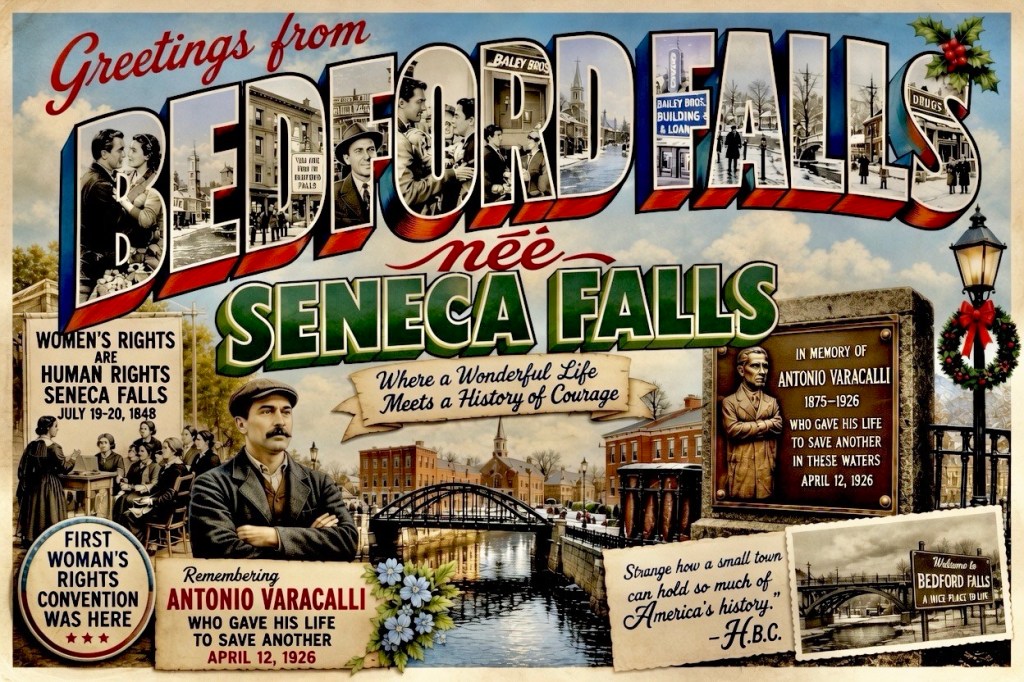
Spending an afternoon in the town, one understands the theory immediately.
The canal.
The bridges.
The compact streets.
The old storefronts carrying equal measures of optimism and fatigue.
Most striking of all was the story of Antonio Varacalli—the laborer from the province of Potenza in the Basilicata region of Italy—who successfully rescued a woman from the canal before drowning himself decades before Clarence, the angel from the film, earned his wings beside a fictional bridge in the American cinema imagination.
Seneca Falls possesses the unnerving ability to make coincidence feel authored.
Now to the point. . . At the museum guestbook I encountered a surname of such heroic-hyphenation that it crossed the page diagonally like a railway merger negotiated under international supervision. To wit:
Dr. Eleanor Whitmore-Castellani-Pembroke-Ramírez.
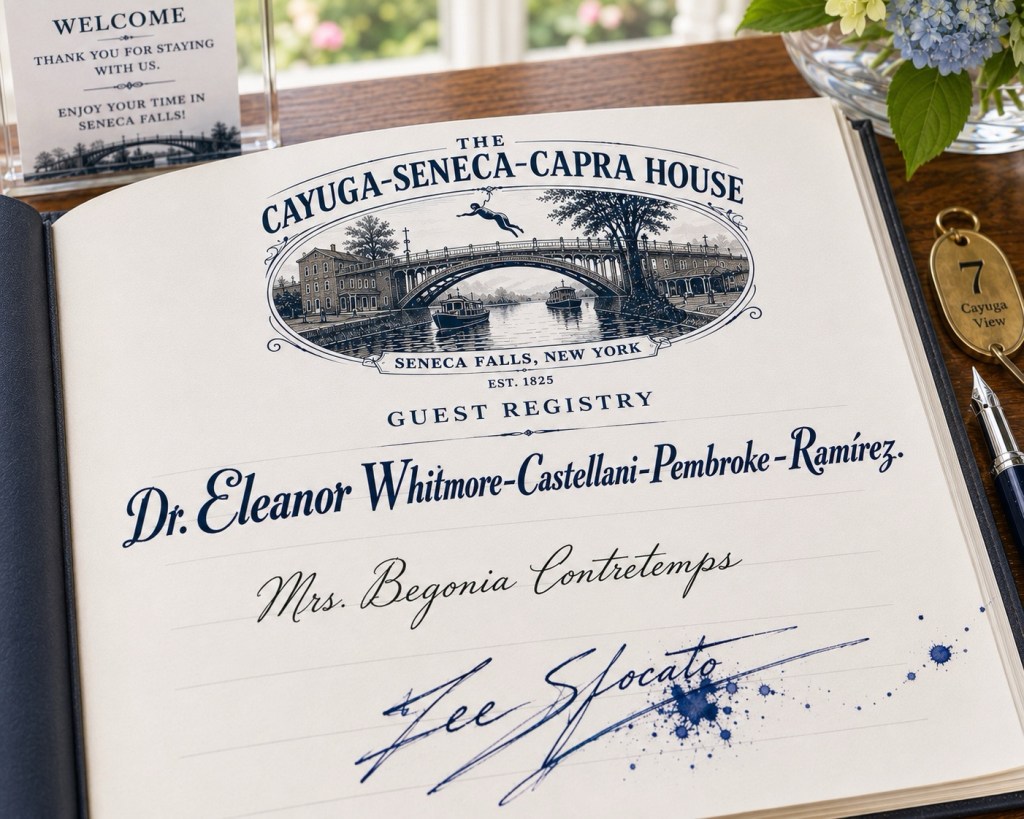
It did not appear signed so much as ratified.
Later that afternoon I found Lee standing knee-deep in marsh grass at Montezuma National Wildlife Refuge with a camera lens resembling anti-aircraft equipment. Geese moved overhead against the gray sky in orderly formation while he waited for a kestrel to return above the reeds.
I mentioned the guestbook name.
Lee shrugged.
“Easy fix.”
“Oh?”
“Take a the née.”
“I beg your pardon?”
“You know, now everybody talk about taking-a the knee. Maybe bring back taking-a the née instead, eh? Solve the whole thing.”
He returned immediately to photographing birds, apparently satisfied he had resolved Western civilization.
The more I considered it, however, the less absurd it became.
The old notation:
NÉE
possessed a strange elegance.
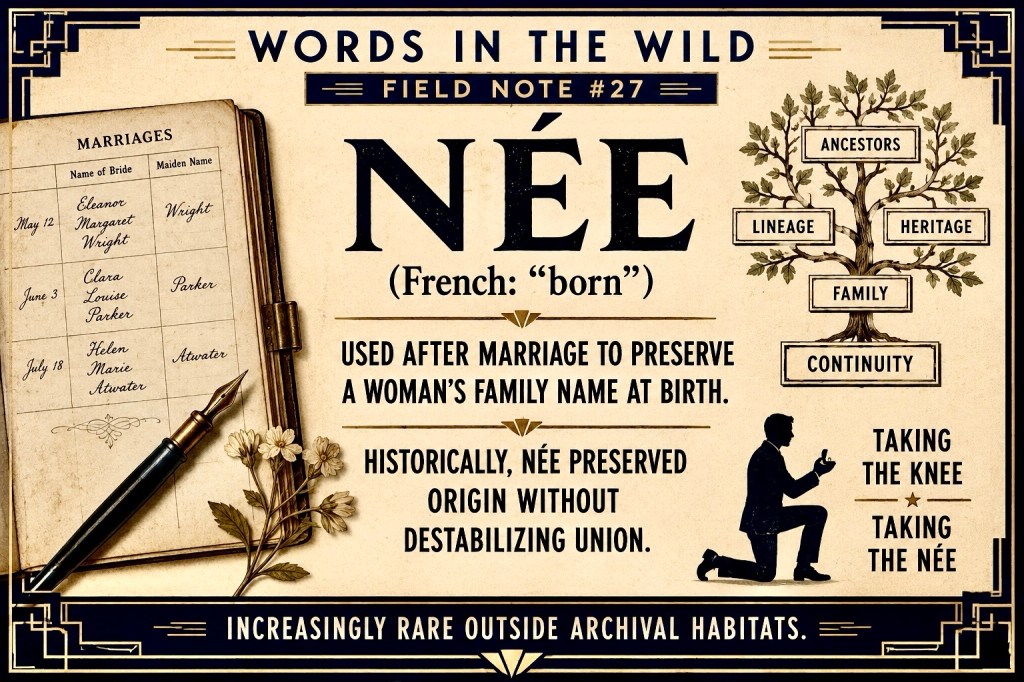
A woman preserved the memory of her family name without transforming matrimony into a diplomatic conference between competing jurisdictions. Origin remained visible. Continuity survived. Yet the household itself retained a unified symbolic identity.
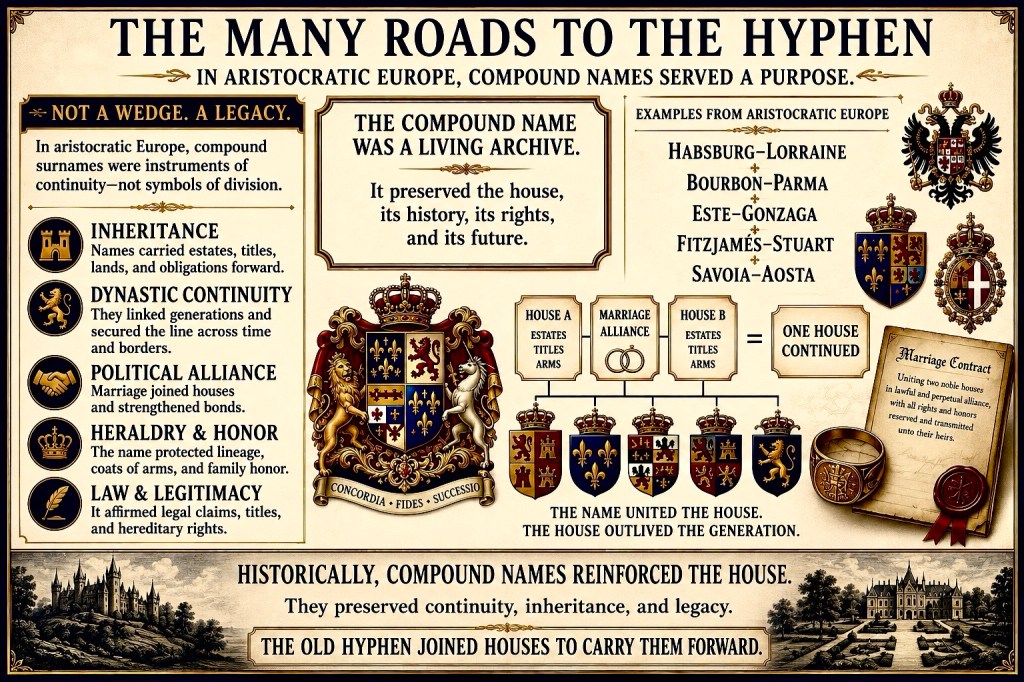
One notices now that surnames increasingly resemble coalition governments held together by punctuation.
Modern society appears deeply uncomfortable with symbolic incorporation into anything larger than the autonomous self:
marriage,
nation,
religion,
family,
even permanence itself.
Everything must remain negotiable, reversible, independently branded.
And yet above the marshes at Montezuma the migratory birds continue ancient inherited routes without visible concern regarding self-expression.
They pair off.
They build.
They return.
They depart.
Then they come back again.
No symposiums are convened.
One suspects relations between the sexes were never governed quite as fully by legislation as reformers on either side imagined. Women possessed immense influence long before bureaucracies attempted to convert human realities into administrative diagrams.
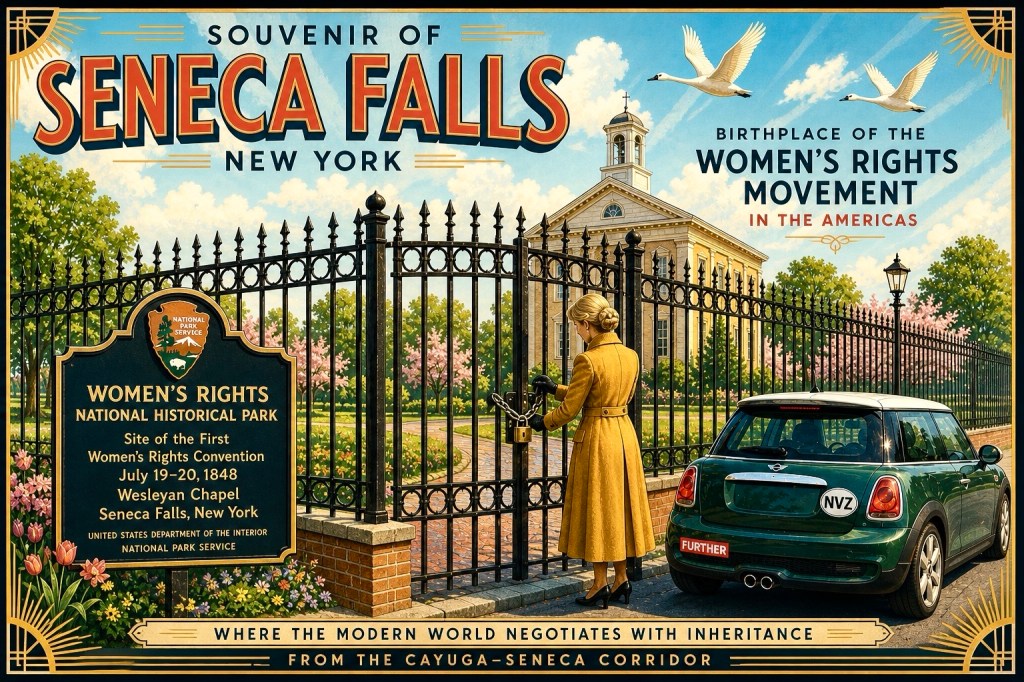
For all its monuments to rights and reforms, Seneca Falls remains haunted by older things:
courtship,
memory,
sacrifice,
belonging,—and the peculiar American longing embodied by Bedford Falls itself — the idea that a meaningful, wonderful life is one bound to others rather than endlessly negotiated apart from them.
At Montezuma the birds still navigate by invisible inheritance.
Meanwhile the surnames grow longer in hyphenation, even as the households grow smaller.
One suspects the matter involves more than a separating punctuation mark.
Yours,
from the marshlands of symbolic America,
Mrs. Begonia Contretemps
René, a Post Script, if I may—
This excursion was also suggested by our editor, John St. Evola, who had previously stumbled upon the peculiar conjunction here in Seneca Falls between the mythology of Bedford Falls and the birthplace of first-wave feminism. He suspected there existed some deep American contradiction between the sentimental household ideal preserved in It’s a Wonderful Life and the simultaneous negotiation against inherited domestic roles occurring beside the very same canal and bridge.
Having now visited the place myself, I regret to inform you that he may not have been entirely wrong.
—René Séance replied several days later by airmail from the Nouvelle Vague Zwischenschaft headquarters:
***
From the Left Bank annex of the Nouvelle Vague Zwischenschaft, overlooking the Canal Saint-Martin
“My dear Begonia,
Your observations regarding Seneca Falls are most troubling. One begins to suspect that America simultaneously invented both the sentimental household and the permanent negotiation against it, often on opposite sides of the same canal.
Here in Europe, naturally, we prefer catastrophe with greater architectural coherence.
I will confess, however, that your account of Signor Varacalli affected me deeply. A man who leaps into freezing water to save another person belongs to an older civilization entirely.
One cannot help wondering whether the wrong person fell into the canal.
Had Sartre’s companion, Mademoiselle de Beauvoir entered the water instead of Signor Varacalli, the modern West might today possess both intact households and tolerable cafés.
Yours in civilizational exhaustion,
René Séance
The Further writings of Mrs. Begonia can be found: HERE


Leave a Reply