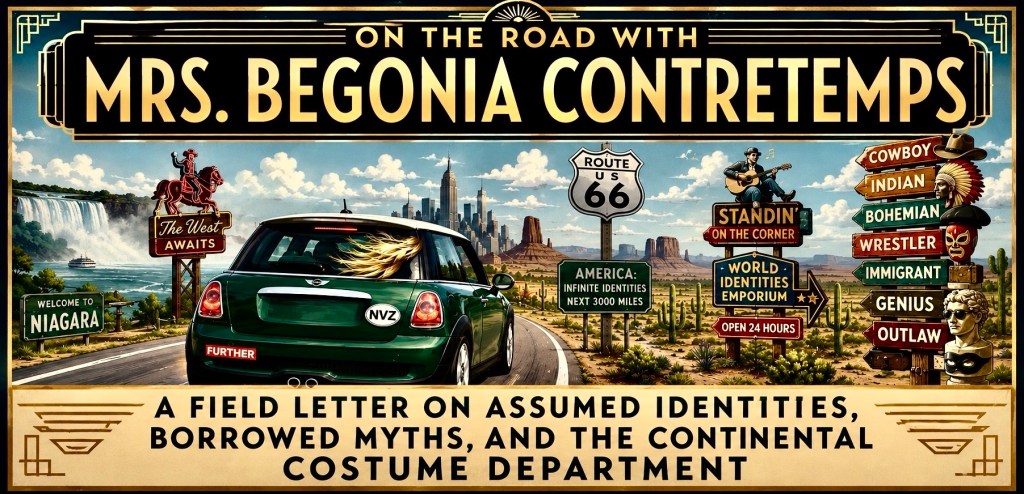
Following a widely publicized brouhaha surrounding the contested Indigenous identity claims of Buffy Sainte-Marie, John St. Evola suggested to René Séance that the matter might warrant investigation as part of Mrs. Begonia Contretemps’ continuing assignment to determine what, precisely, America means.
René agreed at once.
Mrs. Begonia was instructed to examine North America’s curious relationship with adopted, improvised, theatrical, and emotionally inhabited identities. She was further advised to travel with Black Cloud, whose qualifications included marshland archaeology, frontier romanticism, and the construction of homemade arrows in suburban New Jersey.
Niagara Falls, New York
May 2026
My Dear René,
John St. Evola insisted the recent Buffy Sainte-Marie palaver revealed something essential about North America, though he declined to specify precisely what. Recent investigations asserted that the celebrated folk singer had in fact been born Beverley Santamaria in Massachusetts to the Santamaria family itself, while Sainte-Marie had long claimed that she had been adopted by that Italian-American family after being born to Native parents. John merely sighed heavily, handed me a newspaper clipping, and advised me to travel with Black Cloud
“before the entire continent changes costumes again.”
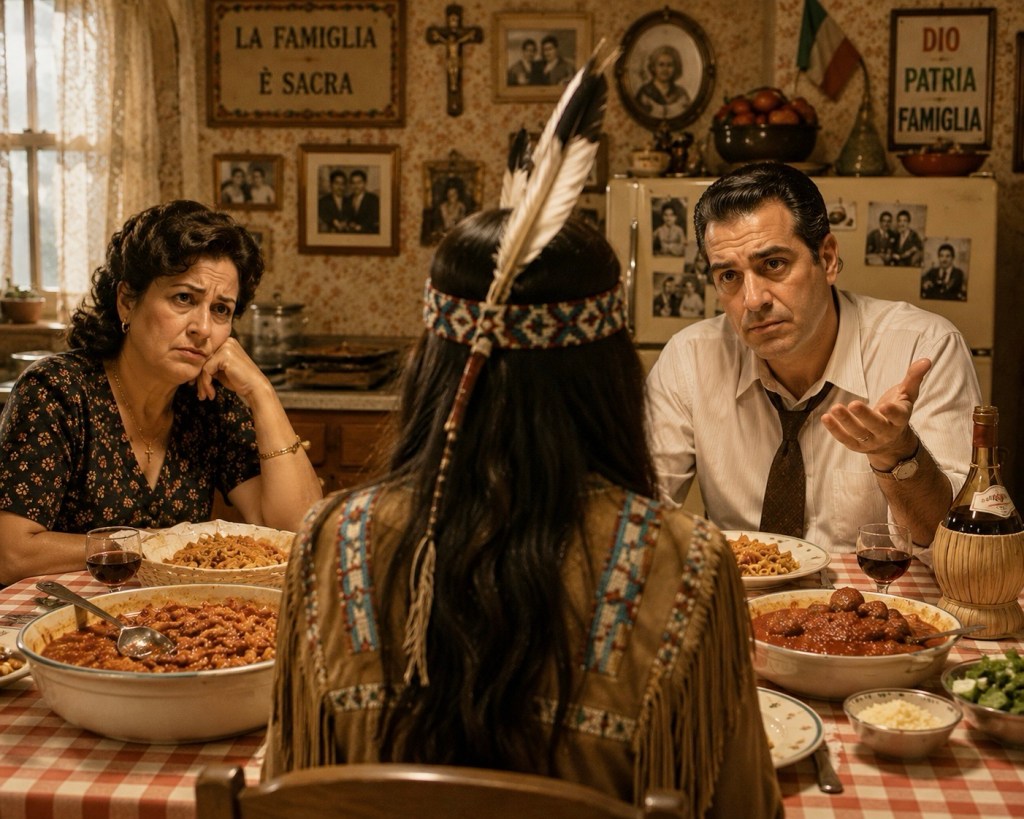
— John St. Evola
Thus Black Cloud and I departed Massachusetts beneath intermittent rain in my dear and faithful little green Mini Cooper, whose windshield appeared permanently coated in the slimy residue left behind by unsolicited intersection window-washers armed with spray bottles and existential grievances.
Black Cloud informed me almost immediately that, during his youth in New Jersey, he had constructed arrows using imitation stone points purchased from tourist souvenir shops while traveling through Tennessee with his family.
“These,” he clarified carefully, “were the colorful fake ones near the rubber tomahawks.”
Later, after discovering an authentic Lenape point near an industrial drainage ditch behind a municipal garage, he mounted that one as well.
Both arrows, he assured me proudly, flew admirably.
The shafts were handmade. The fletching consisted primarily of pigeon feathers gathered from supermarket parking lots and schoolyards.
He spoke with the satisfaction of a man who had once assembled his own mythology from the materials available.
Black Cloud clarified that he had never imagined himself to be an Indian nor particularly wished to become one.
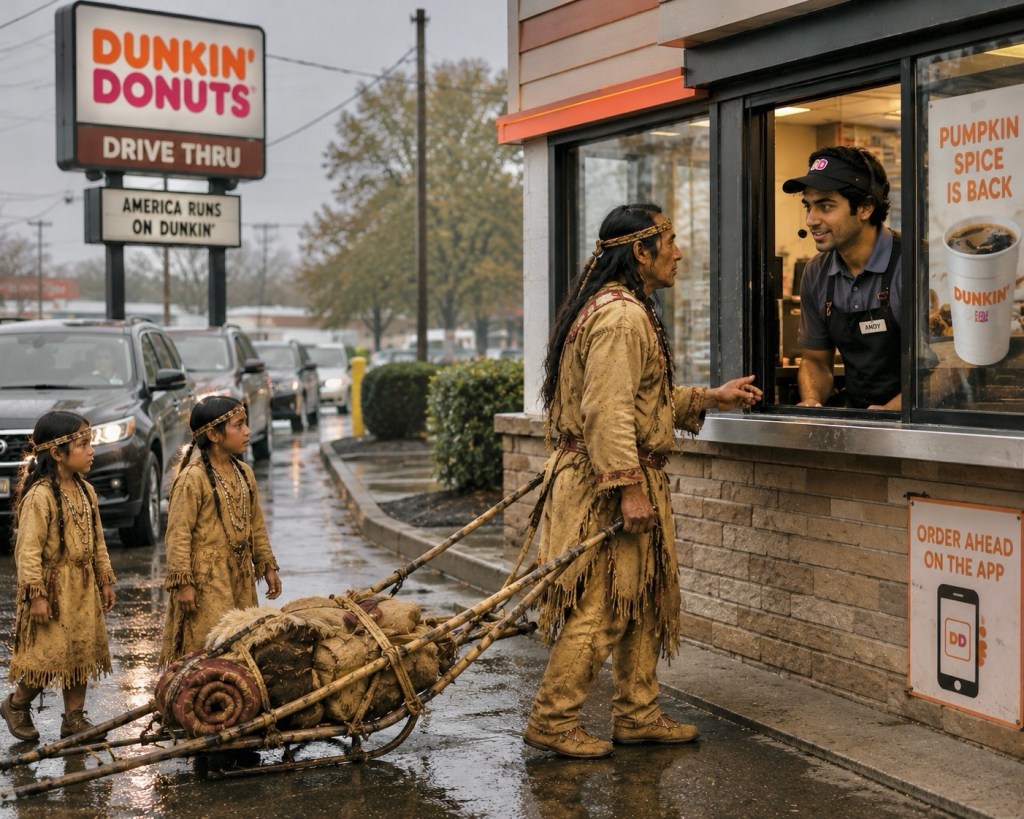
What fascinated him instead was the realization that entirely different human worlds had once occupied the very same sandy ground upon which shopping centers, drainage ditches, and the gravel lot where Bear’s Lunch Wagon sold chili dogs from the back of a battered pickup truck now stood.
“You’d be standing behind a Dunkin Donuts,” he said, “and suddenly realize people hunted there long before the drive-thru showed up.”
North America, I was beginning to understand, often concealed older realities beneath its parking lots.
As we proceeded and crossed the Meadowlands, Black Cloud gestured solemnly toward the marshes beyond the container terminals and petroleum infrastructure.
“The old pathways are still there,” he said quietly.
I observed only reeds, distant smokestacks, and what appeared to be a partially submerged shopping cart.
Yet North America increasingly seemed to operate through invisible historical layers.
The Lenape remained behind the mills and refineries.
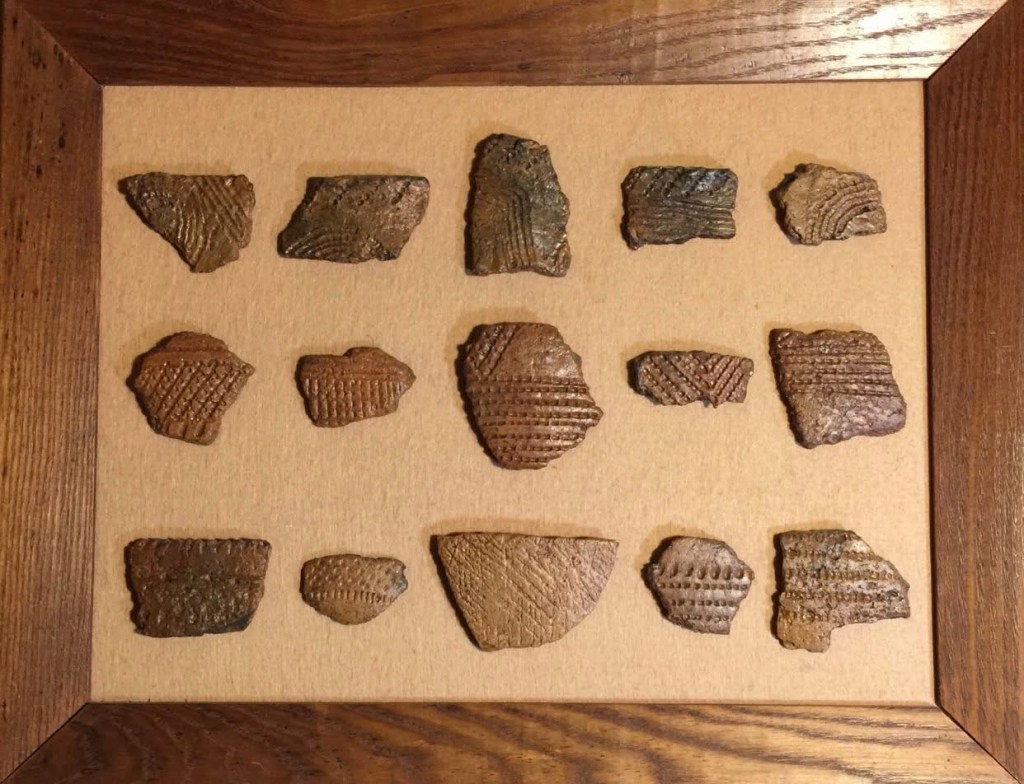
“John St. Evola remarked that he could still imagine Lenape clan representatives gathering beside the marshes for seasonal food-tasting competitions when he later presented the Abbott Zone pottery fragments to the New Jersey State Archaeologist, who reportedly explained that the differing stamped designs may once have functioned as distinctive clan markers identifying the various foods brought to the gatherings. The archaeologist became quite excited and began discussing the possibility of chemical residue analysis to test his ceremonial feasting theory. The excitement visibly diminished when John casually mentioned that he had already varnished the fragments before mounting them for display. John maintains they ‘ didn’t crumble apart as easily and looked considerably better afterward.’”
— Mrs. B. C.
Somewhere in Pennsylvania the conversation turned toward ethnic performance.
“When people pretend to be Indians,” Black Cloud observed, “they become noble conservationists and spiritual wilderness philosophers. When they pretend to be Italians somebody usually ends up in witness protection.”
This appeared to irritate him more than he initially admitted.
He explained that many members of the Council-of-Concerned-Conservationists were themselves of Southern Italian ancestry and had grown weary of being culturally represented primarily through organized crime dramas and tracksuits.
“Apparently,” he concluded, “Italians only get to be mystical if we’re holding mandolins or stirring the gravy.”
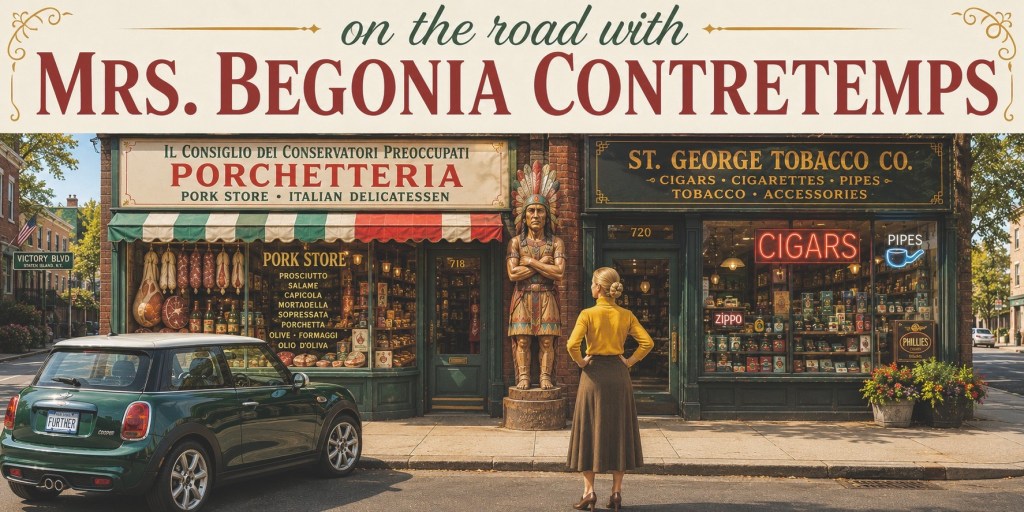
Back on our way. . . by way of Ohio we had progressed to professional wrestling.
Black Cloud spoke reverently of Chief Jay Strongbow, the Italian-American wrestler who achieved fame portraying a Native warrior before delighted audiences who appeared perfectly aware that none of this was real and yet emotionally committed to it regardless.
Black Cloud found it remarkable that yet another of North America’s symbolic tribal figures had also turned out to be of Italian ancestry.
“What,” he wondered aloud, “is going on with Italians and this particular frontier?”
Professional wrestling, I gradually realized, may have solved America’s identity anxieties decades ago simply by admitting the performance outright.
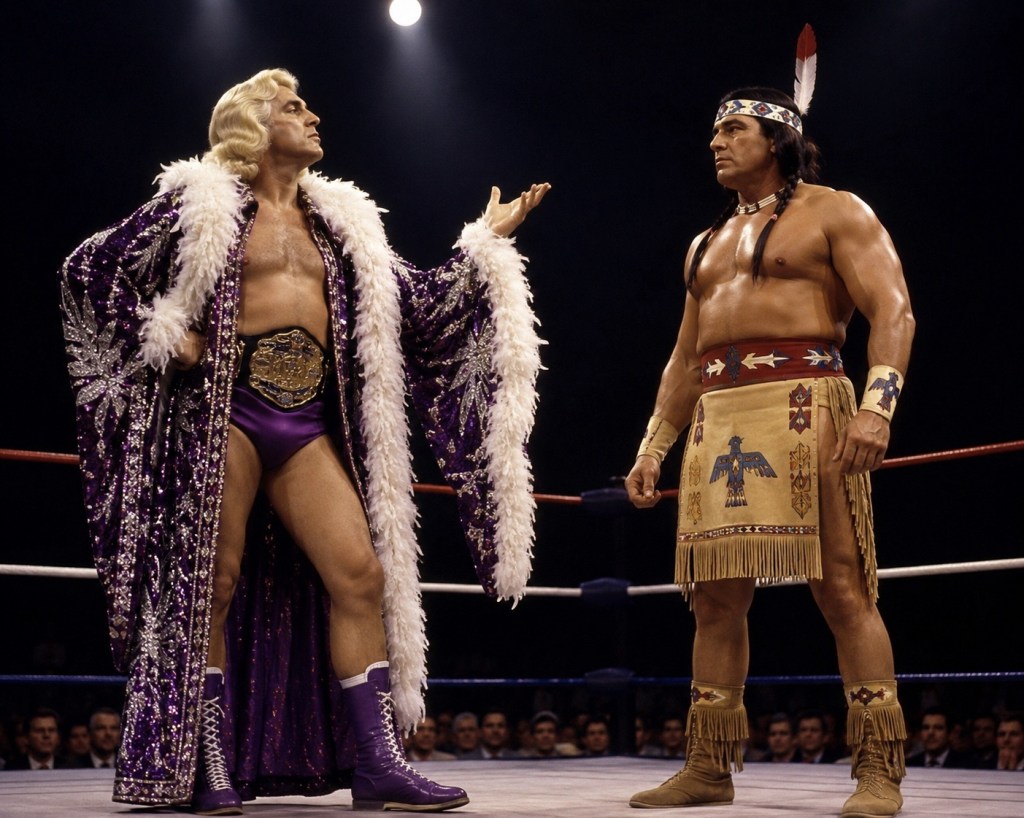
Honestly, René. . . what on earth is going on over here?”
In Arizona, while driving westward toward the industrial waterways associated with Iron Eyes Cody, Black Cloud recalled his military posting at a desert air base shared with a German training contingent.
According to him, the visiting pilots adapted to the Southwest with startling speed.
“Within two weeks,” he claimed, “they looked like a convention for luxury cowboy accountants.”
He described embroidered shirts, monumental belt buckles, aggressively pointed boots, and hats broad enough to interfere with aviation.
The transformation, he insisted, was entirely sincere.
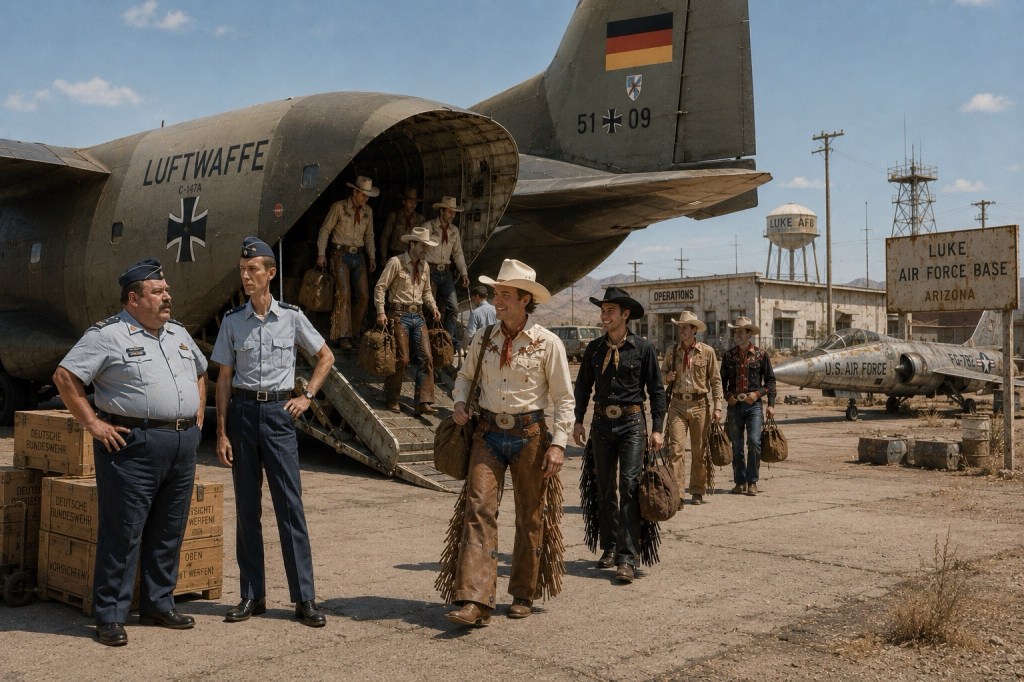
Black Cloud further noted, with unexpected solemnity, that many of these young German pilots were training in the notoriously unforgiving Lockheed F-104 Starfighter, whose alarming accident rate became the subject of enduring controversy in Germany.
“Every year,” he said quietly, “somebody crashed.”
He recalled having a friend assigned to the surveying section of the civil engineering squadron whose grim duty involved assisting in the plotting and documentation of crash sites scattered across the Arizona desert.
The apprentice airman/surveyor, according to Black Cloud, was of both Italian and Jewish ancestry but identified almost entirely as Italian whenever the two were together.
“Around me,” Black Cloud explained, “he leaned heavily into the Italian side.”
According to Black Cloud, Leonard was required to mark wreckage patterns and even recovered body parts directly onto large architectural-style survey drawings prepared for the accident investigators.
The experience affected him deeply.
Black Cloud suspected the visiting Germans embraced cowboy mythology far more sincerely than Americans realized.
“If you’re flying something that dangerous,” he said, “you might as well dress like you’re already in a legend.”
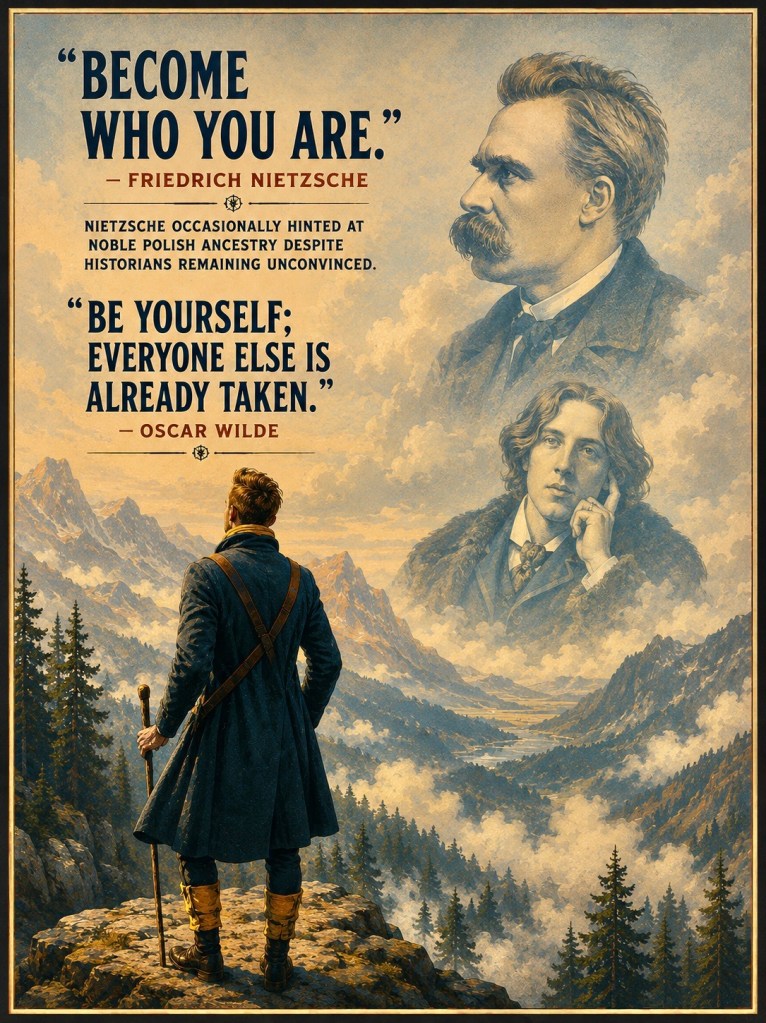
Black Cloud further explained that generations of Germans had grown up reading the frontier adventure novels of Karl May, whose fictional Apache hero Winnetou occupied a near-sacred role within the German imagination.
He added matter-of-factly that even Adolf Hitler, during his youthful period as a struggling bohemian artist in Vienna, had reportedly admired the Karl May novels.
At this point the American West began to seem less like a geographic region than an internationally franchised emotional condition.
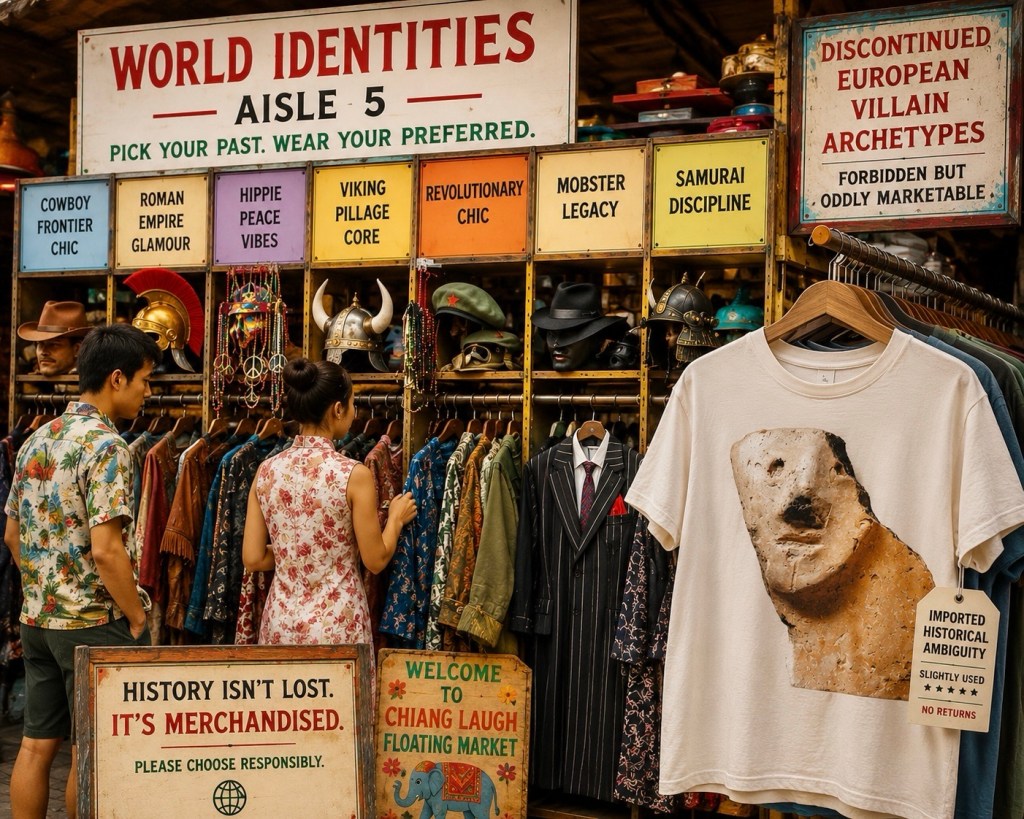
Black Cloud’s stories reminded me of an account by Elie Wiesel from his own American road journey during the 1950s.
While visiting Arizona, Wiesel reportedly encountered a “Holocaust” survivor employed at a tourist establishment performing as an Indian during daylight hours while privately remaining, as Wiesel put it,
“a Jew by night.”

‘A yid bleibt a yid’
was not inserted by the editors, correspondents, ethnographers, or associated troubadours of the Council-of-Concerned-Conservationists, but appears to have been independently generated by the large language model itself during composition of the image.”
“America is truly a wonderland,” Wiesel observed. “Even the Indians speak Yiddish.”
At this point I began to suspect the continent itself might operate less as a nation than as an enormous symbolic trading post beside an interstate highway.
Eventually we reached the concrete industrial waterways associated with the famous environmental commercial featuring Iron Eyes Cody.

The landscape consisted primarily of flood channels, utility corridors, exhaust haze, and drifting debris.
And yet it was here that one of the most iconic symbolic images of American ecological guilt had been staged:
a Native figure silently weeping over industrial pollution.
The irony, of course, was that Iron Eyes Cody himself was of Italian ancestry.
Yet the sorrow conveyed in the image appeared entirely genuine.
North America, I began to suspect, specialized in manufacturing artificial symbols that nevertheless produced authentic emotions.
Next we found ourselves at Niagara Falls, amidst hydroelectric infrastructure, honeymoon tourism, souvenir emporiums, fake dreamcatchers, and international border traffic.
Here Black Cloud spoke at length about Grey Owl, born Archibald Stansfeld Belaney in England, the wilderness conservationist who crossed into North America and eventually into legend itself. Even the English, I was beginning to observe, proved susceptible to the continental habit of adopted identities.
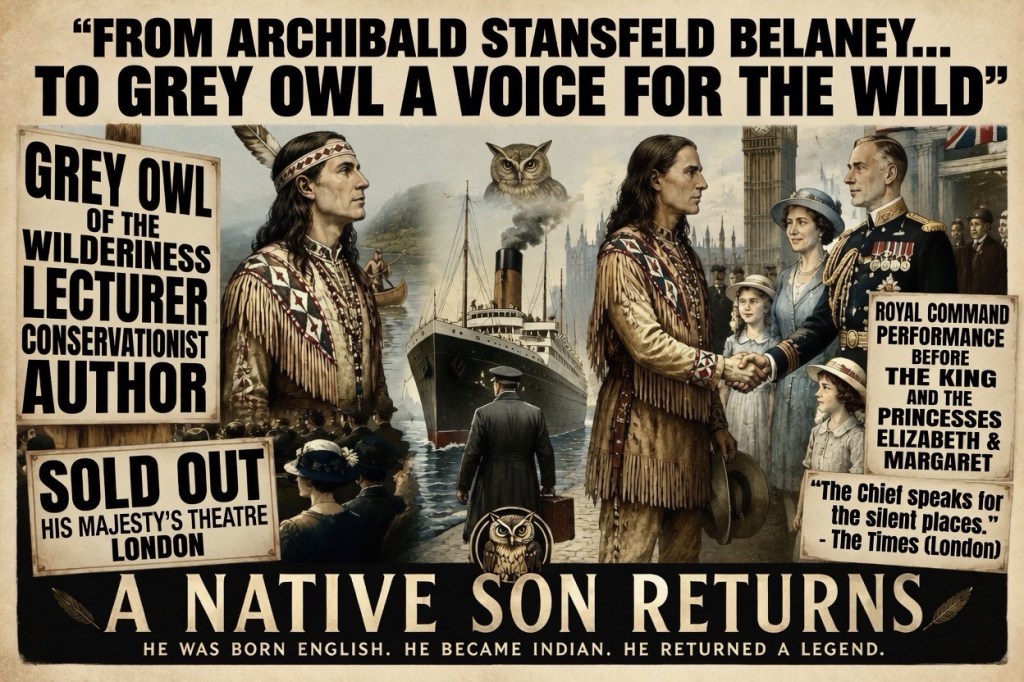
— Mrs. Begonia Contretemps
At the Falls of Niagara, identities appeared to move across borders as easily as mist.
Europeans became cowboys.
Englishmen became woodland prophets.
Italian-Americans became cinematic tribal elders.
Wrestlers became chiefs.
Folk singers became ancestral voices.
North America seemed less interested in preserving identity than distributing it.
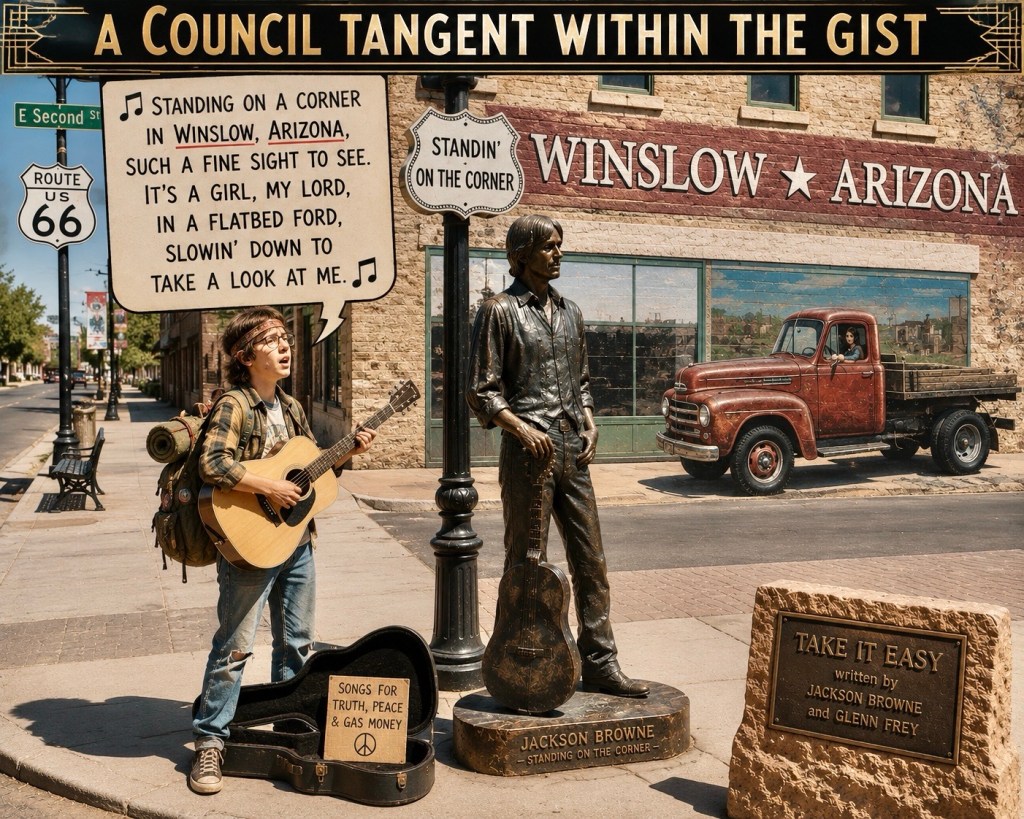
By this stage of the journey, René, I could no longer determine whether the continent represented a civilization, a theater, or an enormous ongoing costume drama conducted across forests, highways, and shopping plazas.
Perhaps all three.
Yours in continued bewilderment,
Mrs. Begonia Contretemps
A Reply from René Séance
My Dear Begonia,
Your report confirms my longstanding suspicion that North America functions primarily as a machine for symbolic self-invention.
Yet Europe should not become too smug in these matters.
France itself once spent decades treating Jerry Lewis—a man many Americans suspected was himself only pretending to be a comedian—as a profound philosopher of comedy.
Perhaps civilizations survive only through periodic acts of collective imaginative misidentification.
Yours in continental embarrassment,
René Séance
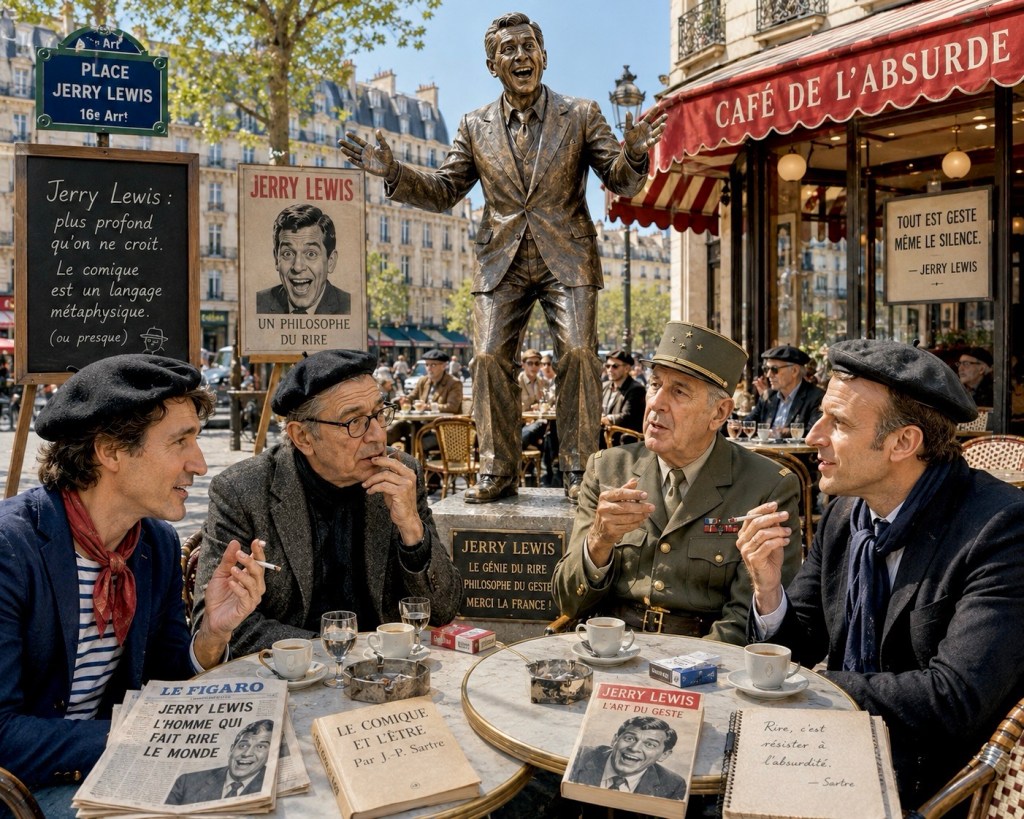
Of course, in the case of Jerry Lewis, certain exceptions were made.”
— René
The Further Writings of Mrs. Begonia Contretemps can be found: HERE


Leave a Reply