——On Certain Rectangles Observed in America—
Editorial Introduction:
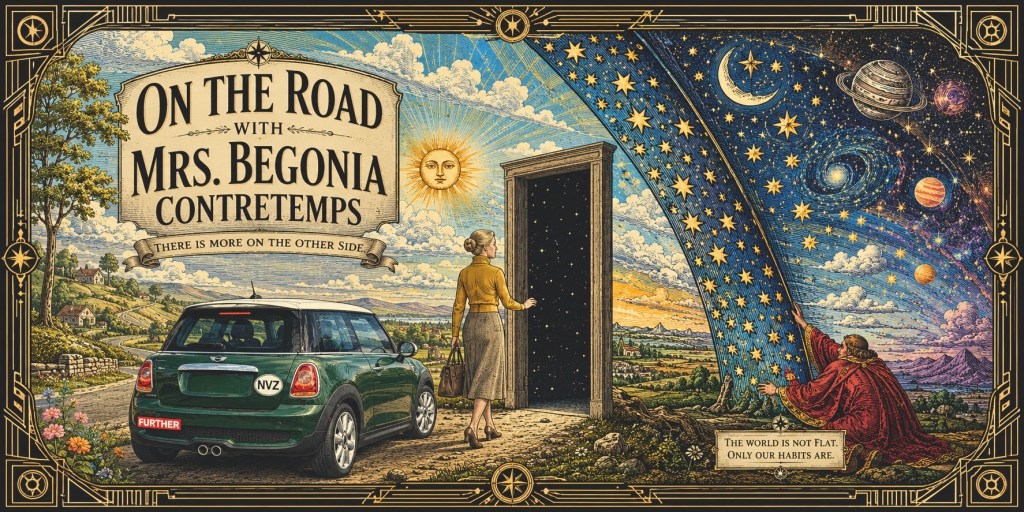
At the request of the Council-of-Concerned-Conservationists, and under provisional review by the NVZ Committee on Symbolic Environments, Mrs. Begonia Contretemps was dispatched alongside Council correspondent known as The Accidental Initiate to investigate a developing realization concerning reflective surfaces, land surveying, illuminated architecture, and the peculiar rise of the rectangle in American civilization.
The Council wishes to clarify that no formal theory presently exists. Rather, the following observations emerged gradually during travel and conversation, which is how many American truths seem to arrive.
EAGLE ROCK RESERVATION
The Watchung Mountains
Overlooking Newark and the Illuminated Plain Beyond
MAY MMXXVI
Mon cher René,
The matter began, as these things often do, with a casual remark from John St. Evola over coffee at the Gist & Tangent Espresso Bar. He informed me that the Accidental Initiate had lately become preoccupied with what he called “the framing of America” and had begun assembling an increasingly strange collection of engravings, survey maps, aerial photographs, and roadside observations concerning rectangles.
“Ordinarily,” Mr. St. Evola explained, “we would dismiss this sort of thing immediately. Unfortunately, the lad has started noticing examples.”
It was therefore suggested — partly by the Council and partly by my own curiosity — that I accompany the Accidental Initiate on a short journey through New Jersey and beyond in order to determine whether his observations represented a genuine cultural pattern or merely a mild geometric disturbance of the imagination.
The Accidental Initiate himself did not begin with a theory. This is perhaps why I eventually found him more persuasive than alarming
He merely carried a cardboard folder filled with odd things he could not stop thinking about:
colonial engravings of Lenape traders examining European mirrors,
WPA-era murals repeatedly mistaken online for smartphone users,
old township survey maps,
aerial photographs of Midwestern farmland,
and several stills from 2001: A Space Odyssey clipped from magazines long ago and folded many times over.
“I know this sounds ridiculous,” he told me somewhere near Brick Township. “But once I noticed it, I couldn’t stop seeing it.”
He then showed me an engraving depicting Native Americans examining European trade mirrors near the early colonial settlements along the Passaic River at Newark, New Jersey — originally “New Ark,” a name suggesting both refuge and civilizational beginning. I admitted that the figures genuinely resembled modern commuters staring into mobile phones.
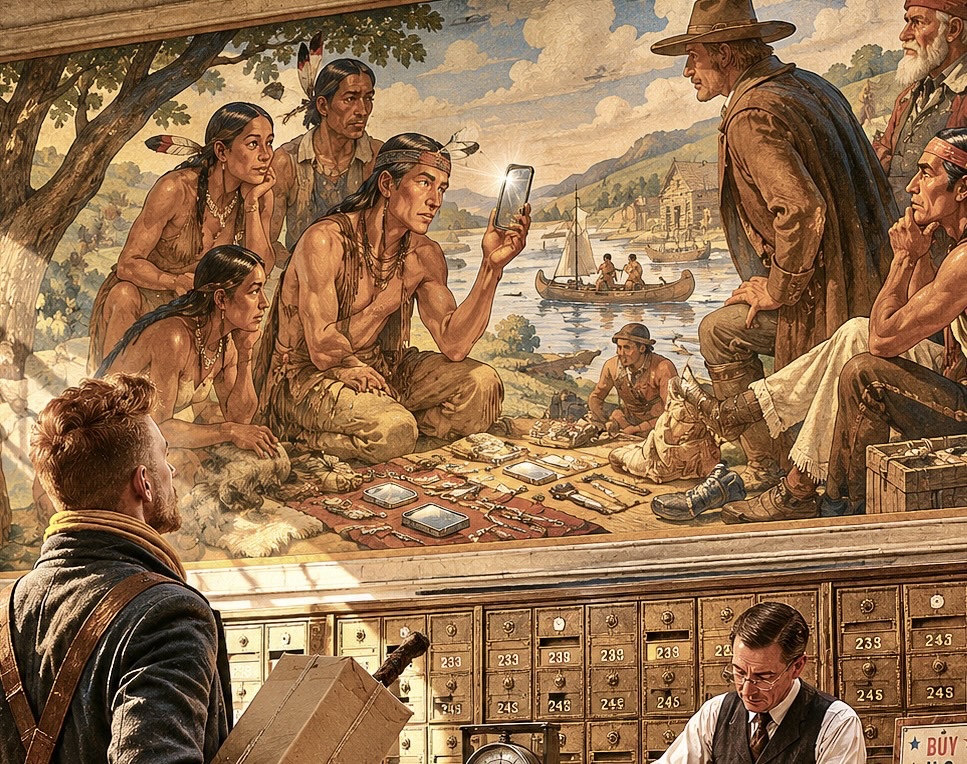
The Accidental Initiate smiled nervously, relieved perhaps that someone else finally saw it too.
“The mirror arrives first,” he said. “The rest comes later.”
Unlike our own Mr. Mason Freeman, he did not speak as though unveiling a hidden conspiracy. He sounded more like a man embarrassed by an observation that had followed him too far.
From North Plainfield we climbed into the Watchung Mountains and stopped at Eagle Rock Reservation, where the volcanic ridges overlook the immense illuminated geometry stretching eastward toward Manhattan — that basalt-like colossus of rectilinear skyscrapers. Yet even there, the rectangles no longer stood perfectly upright. The towers bent, twisted, leaned, and warped in ways I could not yet interpret, as though the geometry itself had begun slipping beyond ordinary utility into something stranger and less comprehensible. Beneath us lay warehouses, apartment blocks, office towers, parking lots, airport runways, and endless rows of glowing windows emerging in the dusk like graph paper slowly learning electricity.
It was there that he mentioned Iceland.
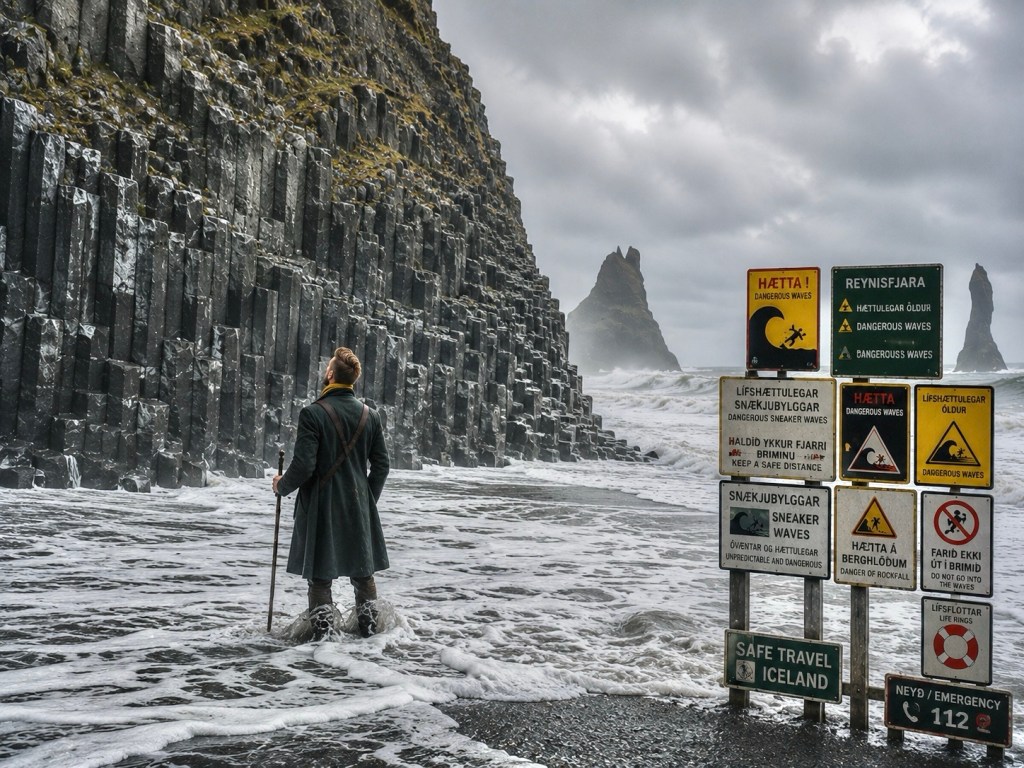
Years earlier, he told me, he had driven through volcanic regions there and later through parts of Oregon where basalt formations rose from the earth in strange geometric columns resembling primitive skyscrapers or unfinished monoliths. The sight had unsettled him because the stone itself appeared architectural.
“Nature occasionally hints at the rectangle,” he said quietly. “As though civilization discovered something sleeping inside the geology.”
I laughed at this, though not entirely.
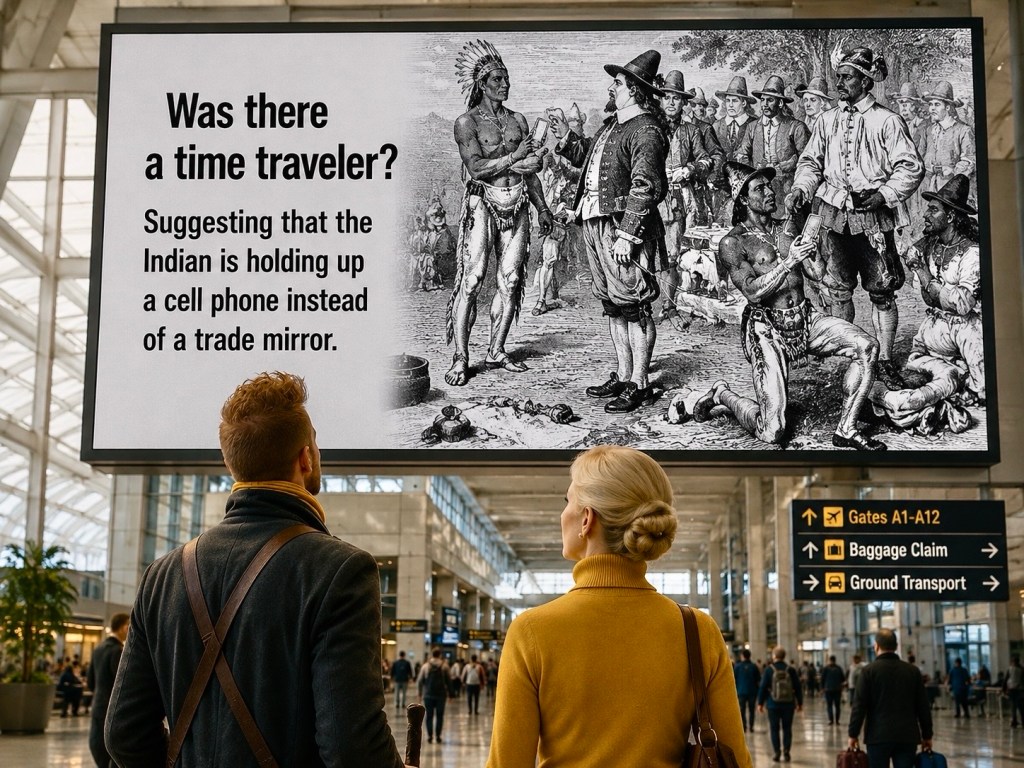
Yes. Most definitely.
Not because he carried a cellphone,
but because the future had already arrived in reflective rectangular form.”
The truly strange moment came later, somewhere west of Linesville, Pennsylvania, when he unfolded several old land survey maps across a diner table sticky with maple syrup. He explained that once American settlement pushed beyond the Mississippi, enormous portions of the continent were systematically divided into rectangular townships and sections. Roads extended ruler-straight toward distant horizons. Farms became squares. Counties became grids.
“Europe inherited its shapes,” he explained while absentmindedly aligning salt packets into rows. “America surveyed them.”
That sentence stayed with me longer than I wished.
He pointed out that the wilderness was not merely occupied but reformatted.
I initially dismissed this as poetic overreach until the following afternoon, somewhere above the Midwest, when I looked from the airplane window and saw below me an almost endless matrix of roads, fields, rooftops, subdivisions, and swimming pools glowing pale blue in the evening light.
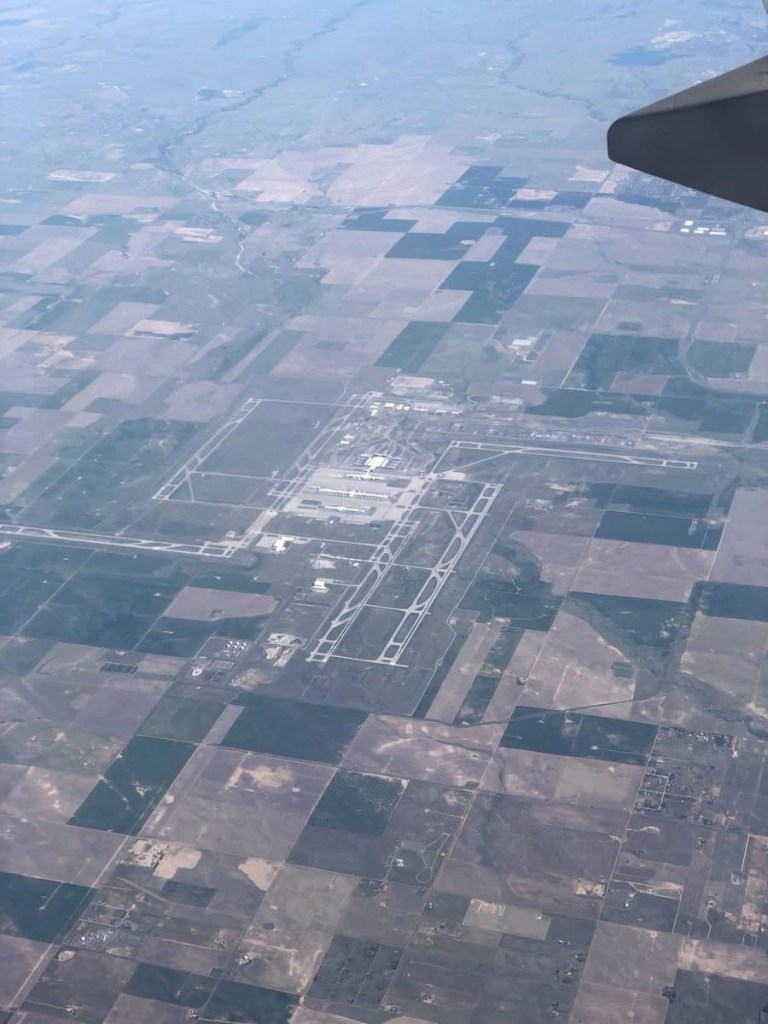
Even leisure, René, had become rectilinear.
From that altitude the continent resembled a colossal illuminated ledger.

We later passed through the old research corridors of New Jersey, where immense rectangular office buildings and former laboratory campuses still stand beside the highways like abandoned temples devoted to administrative thought. Endless darkened windows reflected the evening sky.
“At first the rectangle reflected man,” the Accidental Initiate said. “Then it stored information. Eventually it began storing human attention itself.”
I informed him that this sounded vaguely insane.
“Yes,” he replied. “But look around.”
And annoyingly, one could.
By the third day I feared the Accidental Initiate had developed a mild case of rectangular apophenia. Unfortunately, the landscape itself increasingly appeared determined to validate the condition.
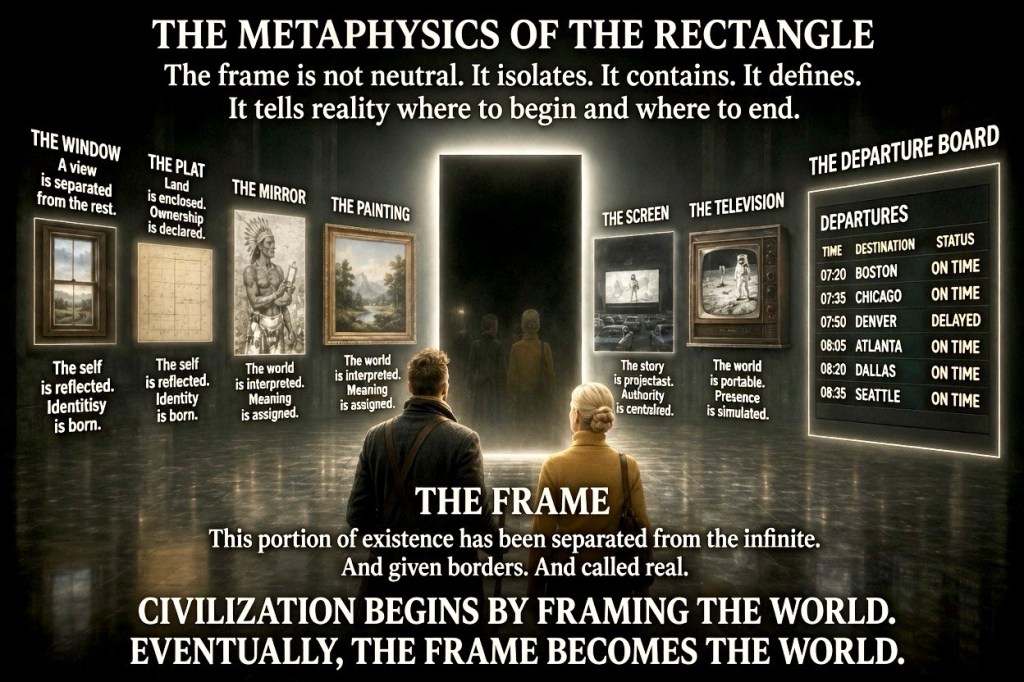
The culmination of the journey occurred at an old drive-in theater somewhere beyond the outer suburban belts — one of those surviving American places where automobiles still gather before a gigantic illuminated screen suspended against the night like a secular rectilinear moon.
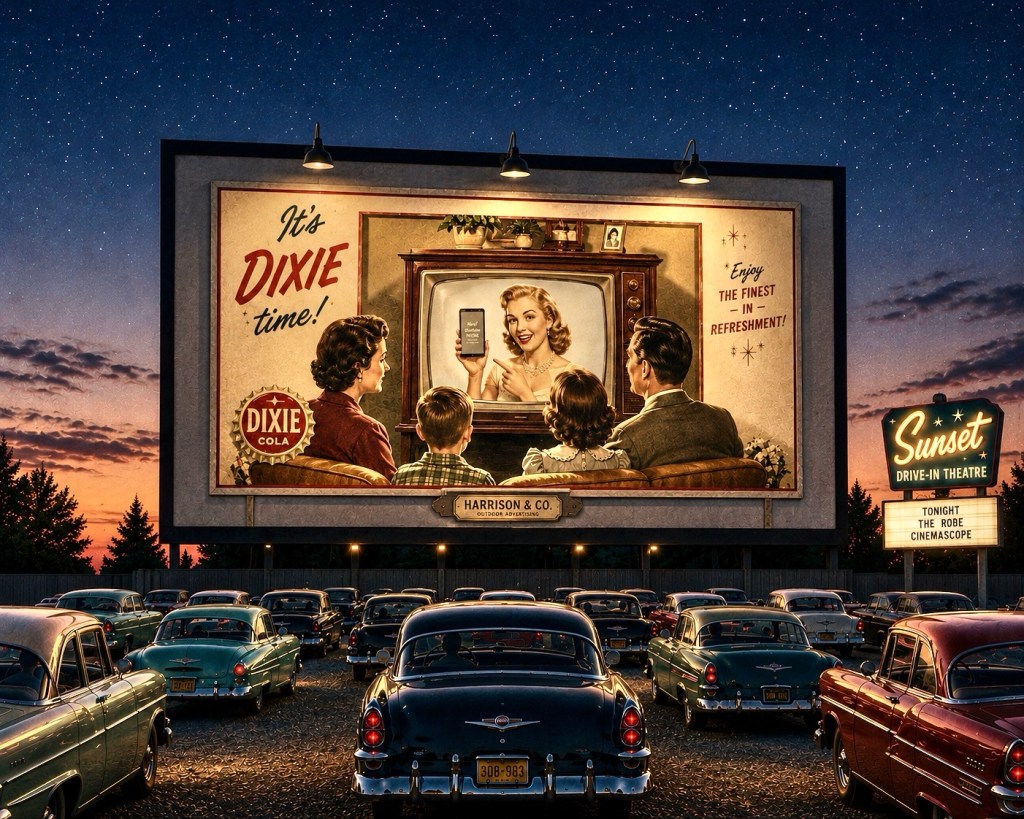
The Accidental Initiate scarcely watched the film itself. Instead he watched the audience: faces glowing softly within rows of parked vehicles while light flickered across windshields and chrome.
“The campfire became rectangular,” he murmured almost to himself.
I confess, René, that at this point I no longer entirely wished to continue the conversation.
For the remainder of the drive I began noticing the forms everywhere without his assistance:
motel windows,
television screens,
street signs,
office towers,
warehouse doors,
smartphones illuminating faces at gas stations.
Most unsettling of all were the billboards.
America, I realized, does not merely permit rectangles; it elevates them above the landscape itself. Along highways they stand suspended over forests, marshes, deserts, and farmland like illuminated commandments competing for spiritual jurisdiction over the horizon.
Some advertised injury attorneys.
Others, fast food.
One simply displayed an enormous smiling hamburger visible from nearly half a mile away.
The Accidental Initiate regarded these structures with a kind of reluctant wonder.
“The old civilizations raised obelisks,” he said quietly. “America installs backlit vinyl.”
For the remainder of the journey I continued noticing the pattern from the air: those tiny rectangular swimming pools glowing pale blue within suburban darkness like domesticated fragments of the moon,
warehouse roofs stretching like pale geometric continents,
parking lots illuminated in white grids,
rows of motel doors repeating toward infinity.
At some point during the journey I ceased asking whether America preferred the rectangle and began wondering whether the rectangle preferred America.
Perhaps this nation did not invent the form. Perhaps it merely provided the ideal open terrain through which it could spread indefinitely.
And yet my thoughts kept returning to that small engraving the Accidental Initiate—or AI as we call him—first showed me near Newark, where Lenape figures stood examining European trade mirrors along the Passaic River with expressions of unmistakable fascination.

I now suspect what unsettled me was not merely the resemblance to modern people staring into smartphones, but the possibility that the resemblance was spiritually accurate. The Lenape man holding the small rectangular trade mirror was already participating in a new way of encountering the self: through a framed reflective surface held in the hand and studied with fascinated attention. The technology changed. The posture did not.
The mirror was small.
Portable.
Reflective.
Rectangular.
The continent, perhaps, had already encountered its future.
Yours beneath the illuminated grid,
Mrs. Begonia Contretemps
René Seancè replies:
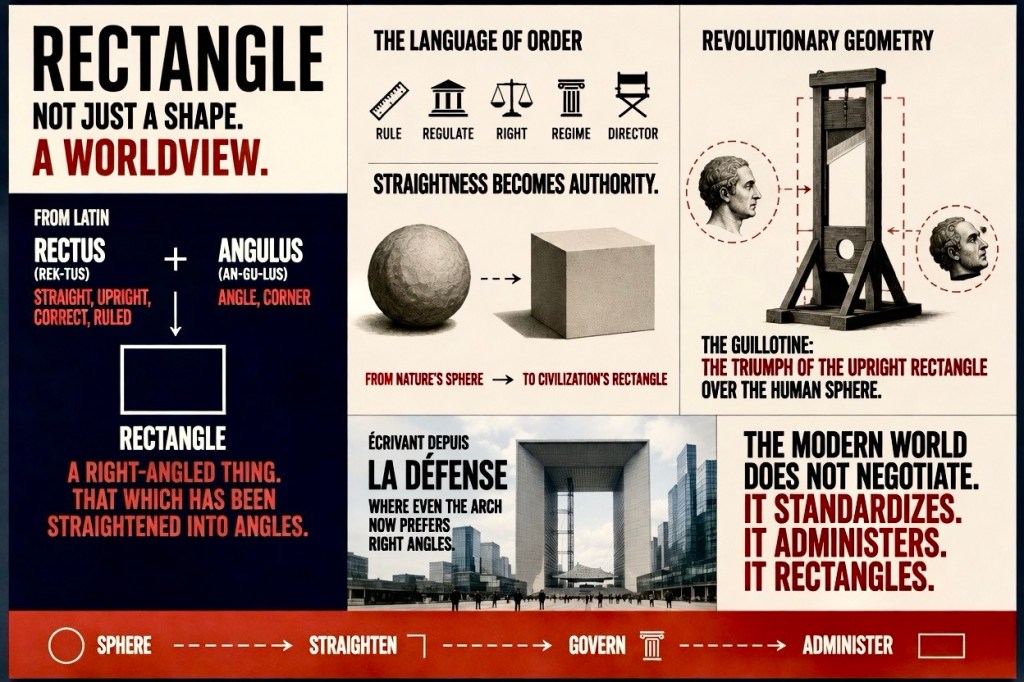
Écrivant depuis La Défense — where even the arch now prefers right angles —
beneath the Grande Arche, that monumental rectangle which modern France continues insisting upon calling an arch,
PARIS
MAY MMXXVI
“My dear Begonia, America may indeed have scaled the rectangle, but Europe first taught it to govern. We French introduced the modern tricolor during the Revolution — itself three disciplined rectangles stitched together — and shortly thereafter perfected the upright administrative rectangle known as the guillotine. America merely electrified the form and scattered it across a continent.”
P.S. Ah, but perhaps your young lad has noticed something deeper still. The guillotine, after all, was a machine designed for the efficient removal of that most stubbornly spherical object — la tête — the head itself. One might say the Revolution began by disciplining rectangles and ended by simplifying circles.


Leave a Reply