Live from the Gist-and-Tangent Cabaret of Concepts:
—An Evening of Entertaining Thoughts
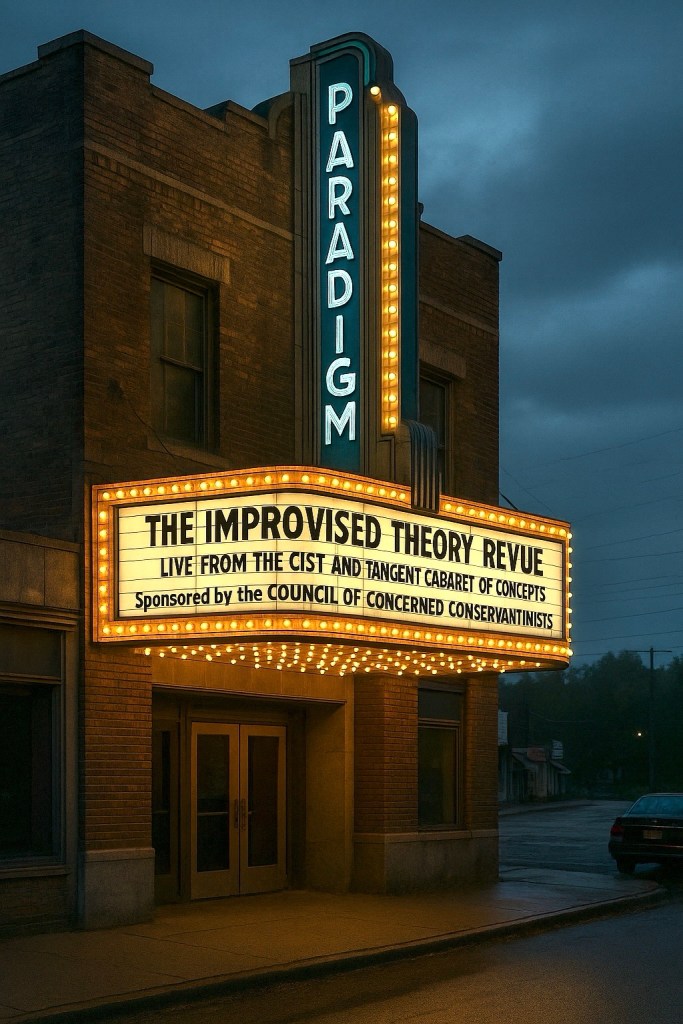
Council Disclaimer:
The Council affirms its respect for all theories performing tonight. Each has endured the tests of time, trial, and peer review—[someplace]—and still manages to hold its audience’s attention. Some may be expanded, some refined, and a few will dance in new directions as fresh evidence cues them forward. But all have, in their way, explained life beautifully—to someone.

The Emcee Steps Foreword
At the Gist-and-Tangent Cabaret of Concepts, the lights rise not on frivolity, but on admiration.
Tonight, we celebrate the theories that have carried civilization’s thinking across centuries—those elegant frameworks of understanding that manage, despite contradiction and revision, to remain both useful and entertaining.
The air hums with anticipation. The Bell Curve polishes its arcs backstage; the Overton Window adjusts its frame; the Invisible Hand practices its sleight with quiet dignity. These are not jesters but seasoned performers, some with a résumé longer than history itself.
Seated in the front row, the Council gathers in earnest delight: Mrs. Begonia Contretemp with her opera glasses, Peter R. Mossback leaning forward like a scholar at play, and John St. Evola remarking that “a well-framed theory can hold its tune longer than most civilizations.”
Because here, to entertain a theory is not to trivialize it—it is to invite it to live again, under lights, in company, and in motion.
Theories, after all, are our oldest dance partners in the ballroom of thought.
A voice from the wings announces:
“Ladies and gentlemen, and all seekers of elegant explanation—please welcome our first act.”
The orchestra swells.
Act I – The Bell Curve Balances Itself
A hush falls. A pale curve glides forward on a tightrope of reason, bowing to both ends of the spectrum before settling gracefully at the mean.
Dr. Faye C. Schüß leans over to Mrs. Begonia and whispers,
“Symmetry—still the purest seduction in science.”
The curve performs a slow pirouette, balancing probability on the tip of a statistic, then exits to polite applause and quiet murmurs of “remarkably consistent.”
Act II – The Overton Window: A Moving Performance
Spotlights follow a frame gliding left, then right, then up into the rafters before returning to center.
Mrs. Begonia sighs:
“Ah, a window with wanderlust! So modern, so mercurial.”
The audience chuckles.
A voice from offstage adds, “Tonight’s view is sponsored by public opinion—subject to change without notice.”
The Overton Window bows and disappears, leaving only the faint sound of shifting consensus.
Act III – Dialectical Materialism: The Pas de Deux of History
Two dancers enter—Thesis and Antithesis—locked in precise embrace. Their motion is both conflict and courtship.
From their movement arises a third figure—Synthesis—resplendent in dialectical silk.
Peter R. Mossback taps his program.
“Every age needs its duet of opposites,” he muses, “though sometimes they step on each other’s feet.”
Dr. Schüß replies:
“That’s progress—choreographed friction.”
The crowd nods appreciatively, murmuring “beautiful inevitability” as the trio exits.
Act IV – Godwin’s Law Descends the Staircase
A double-breasted gentleman enters with solemn dignity, holding a candle and a single line of dialogue:
“Eventually, all conversations lead to me.”
The audience sighs knowingly.
“He bows, unoffended, and exits to mixed applause—proof that even inevitability can earn a standing ovation, and that the man the Overton Window still gestures toward carries more juju than reason knows what to do with.”

Act V – The Out-of-Africa Theory Sings the Blues
A chorus of ancestral voices fills the hall, the rhythm steady, the melody vast.
Maps unfurl; shadows dance across continents.
Eugene Bodeswell, the ethnographer, wipes a tear:
“We all migrated once. The trouble is, some forgot to unpack their humility,” John said.
Eugene, always the ethnographer, nodded and added that some never fully unpacked their Denisovan or other archaic admixture, and really should address this.
The refrain lingers: “We all came out of somewhere.”
Act VI – The Religious Interlude: The Faith Theories’ Grand Ensemble
A hush falls; a soft golden light floods the stage.
From stage right, the Chosen People enter in solemn procession, carrying scrolls and covenantal flame.
Jánosh Alovatski rises reverently, then murmurs that even if they are self-chosen, it takes chutzpah to keep the covenant in an age that keeps revising the terms.
From stage left, Redemption herself descends, robed in crimson and humility, singing an aria of forgiveness that reaches every table.
A brief intermission is declared — time to stretch legs, refill popcorn, or reconsider metaphysics. The ushers remind everyone that the restrooms, like redemption, are down the hall and to the right.
“Neil Young plays in the background, softly. Bless him — part Neanderthal, part egotistic narcissist, part troubadour. The brow is prehistoric, the ego planetary, yet somehow he writes songs that sound like forgiveness itself.”
Intermission’s over, enlightenment’s up next. Having survived redemption, the audience is encouraged to lower expectations and heart rates alike. The ushers remind us: in the Axial Age, the show must go on — just without attachment.
A bell tolls softly and Buddhism appears—barefoot, serene, balancing a lotus on one hand and a teacup on the other.
Atheism follows, dressed in impeccable black, shrugging with eloquent grace.
“I may not have faith,” he says, “but I have been told by some that I wear negation and lack of imagination well.”
The quartet gathers in a circle.
For a moment, their harmonies interweave—a hymn, a chant, a silence, and a laugh.
John St. Evola raises his glass:
“It’s almost as if the theories of divinity conspire to describe the same thing—
just in different accents.”
Applause, soft but thunderous in spirit.
Act VII – The Invisible Hand Performs Sleight of Hand
A magician in fine cuffs lifts a coin, lets it vanish, and reappear in someone else’s pocket.
The audience gasps—half in wonder, half in recognition.
The Accidental Initiate mutters,
“Ah, the free market—our favorite illusionist.”
St. Evola smiles, “He performs best when no one looks directly at him.”
The Hand waves, invisible but warmly felt.
Act VIII – The Multiverse Finale
Twelve performers take the stage at once, each claiming to be the real Theory of Everything.
They overlap, harmonize, and momentarily cancel one another out in a spectacular burst of possibility.
The audience stands, seeing themselves—each a slightly different version of understanding.
A final banner unfurls above the stage:
“The more ways there are to explain the world, the richer the applause.”
Curtain Call – John St. Evola Speaks
The applause softens into a rustle, like pages closing.
John steps onto the stage, the yellow gaiter gleaming faintly under the lights.
He carries no notes—only the ease of a man who has soldered circuits and contemplated souls in equal measure.
“Ladies and gentlemen, fellow conservators of meaning—thank you for entertaining our theories tonight.
You have given them what every idea longs for: an audience.
Some insist a theory must be proven to be real; others, disproven to be pure.
But we of the Council hold another view:
that in an infinite universe, all of these things are true in some corner.
Each shines, somewhere, in its own valid quadrant of being—
perhaps in the next galaxy over, perhaps in the neighbor’s head. Or at least we hope so for their sake.
And so the most entertaining theory of all may be the one that includes them all:
that the cosmos is spacious enough for every explanation, every faith, every irony, and every law of averages to take its bow.”
He glances upward toward the dim balcony where metaphysics sits anonymously.
“Not every theory is a universal; some are simply locals with excellent diction.
But if infinity means anything, it means hospitality—
the infinite capacity to let truths, partial and plural, coexist without envy.”
He raises his glass; the orchestra swells.
“The Council of Concerned Conservationists salutes the performers of mind and matter alike.
May we continue to entertain our theories—
and in doing so, keep the universe entertained by us.”
The lights dim to a golden hush.
Yellow gaiters gleam like constellations across the room.
Somewhere backstage, Truth herself sighs—flattered, amused, and not quite ready to leave.
Epilogue – The Accidental Initiate’s Afterthought
As chairs scrape and the audience begins to rise, the Accidental Initiate stands, half-inspired, half-bewildered.
The popcorn in his lap flutters to the floor like a fallen hypothesis.
“If I may,” he begins softly, “perhaps the reason all these theories argue so passionately here—
is because Earth might be the only place where they all collide.”
The room stills again.
He gestures upward, as if tracing the arc of a half-remembered orbit.
“Maybe elsewhere in the cosmos, each theory lives alone in perfect peace:
the Bell Curve unbothered by anomalies,
the Overton Window content with its view,
the gods and their deniers each reigning uncontested in their quiet corners of infinity.
Only here—on this small, contradictory sphere—do they overlap, interrupt, and cross-talk.
Only here do they debate, duel, and occasionally fall in love.
That’s what makes Earth both the most entertaining and the most maddening corner of the universe.”
He looks toward St Evola, who smiles in silent agreement.
“So perhaps the Council’s calling,” the Initiate concludes,
“is not just to conserve meaning, but to host the quarrel of the cosmos—
to keep the conversation going until the lights come up in every world.”
He sits. The orchestra, almost by instinct, reprises the opening theme.
The night sky glittered as though the walls had forgotten where inside ended and out began.
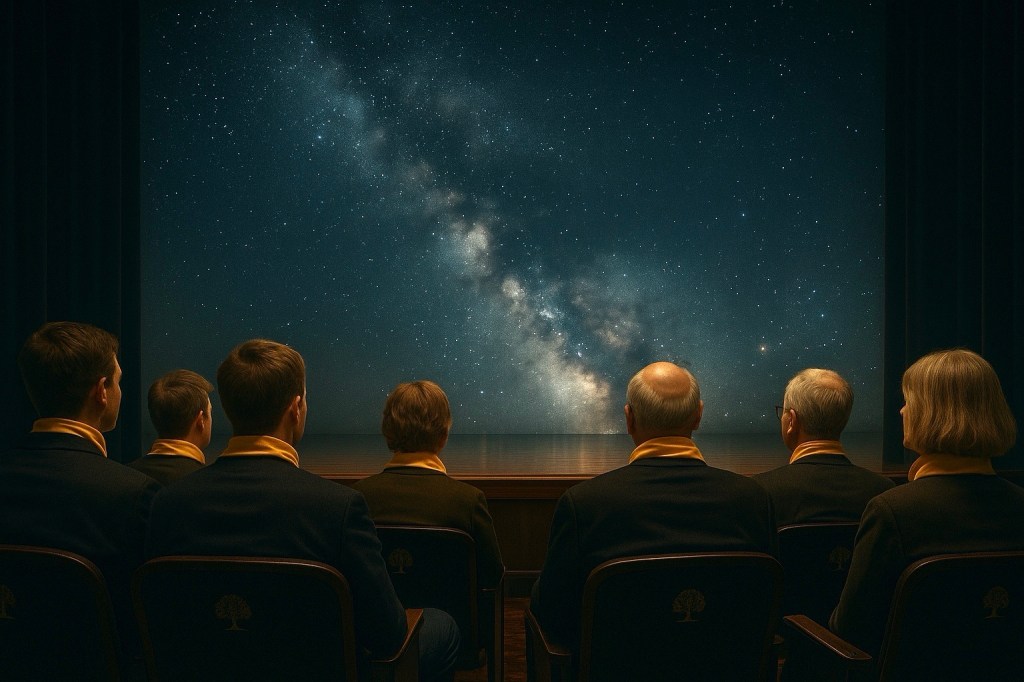
“If the universe is infinite, then every theory deserves a stage.
The Council merely provides the lighting.”
 COUNCIL-OF CONCERNED-CONSERVATIONISTS…..Between Jest And Earnest…..
Leave a comment