—WORDS ON THE LOOSE
—A Linguistic Field Guide
—Field Report #001
— by Paige Turner,
Sub-Sub Librarian—
The word VAGUS has left its shelf.
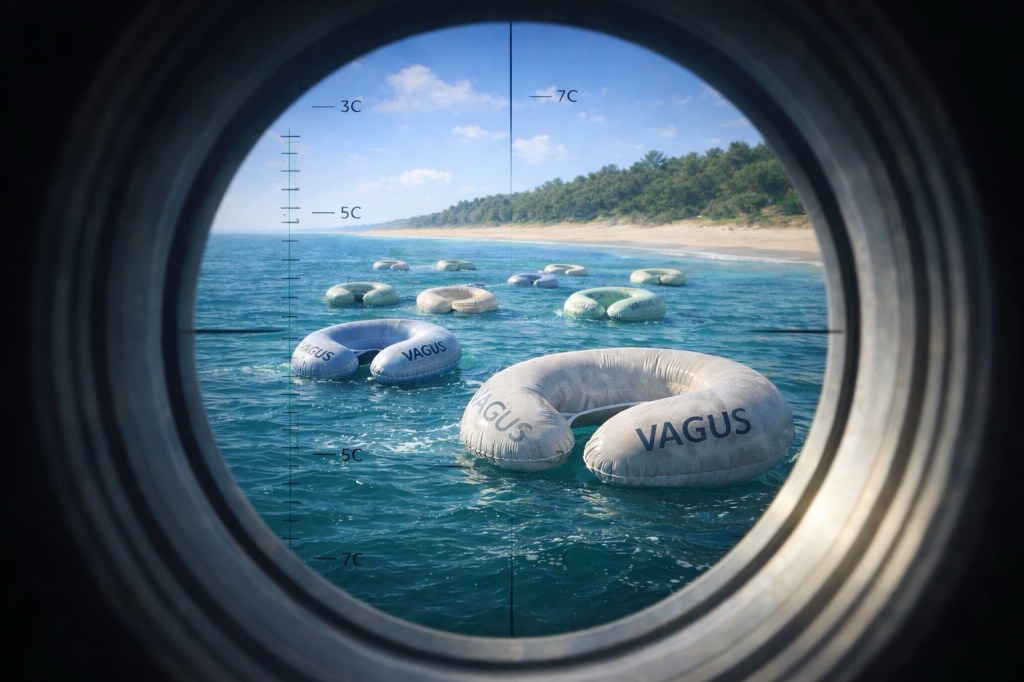
Formerly native to anatomy—Cranial Nerve X, Latin for “wanderer”—it has recently been observed in wellness podcasts, ice-bath testimonials, guided humming sessions, corporate resilience workshops, and chalkboard menus advertising something called “vagal cacao.” This range expansion has been rapid and unusually confident.
For baseline identification: the vagus nerve exists. It is not symbolic. It is a long, unassuming nerve running from the brainstem into the chest and abdomen, contacting the heart, lungs, gut, and voice. Its primary function is regulation. It slows systems down. It prevents unnecessary alarm. For most of its recorded history, it did this without attracting observers.
The word, however, has migrated.
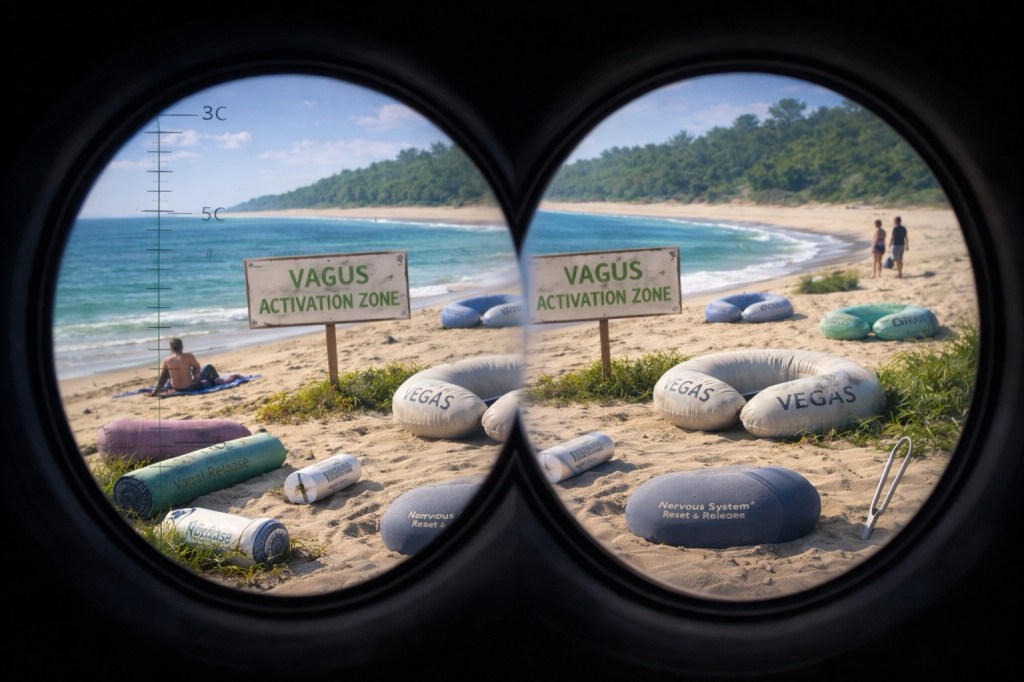
In its current environment, vagus is used to explain a wide variety of conditions: anxiety, burnout, trauma, digestive trouble, vocal tone, posture, emotional sensitivity, and the persistent sensation that something is wrong even when nothing in particular is occurring. This suggests a species under unusual adaptive pressure.
Mid-range observations indicate heightened activity.

Calls synchronized within hours.
Vagus is now described as “activated,” “stimulated,” “reset,” “toned,” “trained,” and, in some regions, “unlocked.” It responds to breathwork, cold exposure, chanting, humming, gargling, eye movements, and standing barefoot on stones while someone nearby says “good.” Entire weekends are devoted to coaxing this word—and the nerve it names—into compliance, often at measurable expense.
At this stage of the survey, a phonetic resemblance becomes difficult to ignore. Vagus now circulates in environments resembling Vegas: high stimulation, continuous promises of payoff, and the suggestion that the next technique will finally deliver calm. The lever is pulled repeatedly. Calm remains imminent. Ka-ching is not part of the Latin root, but it is audible.
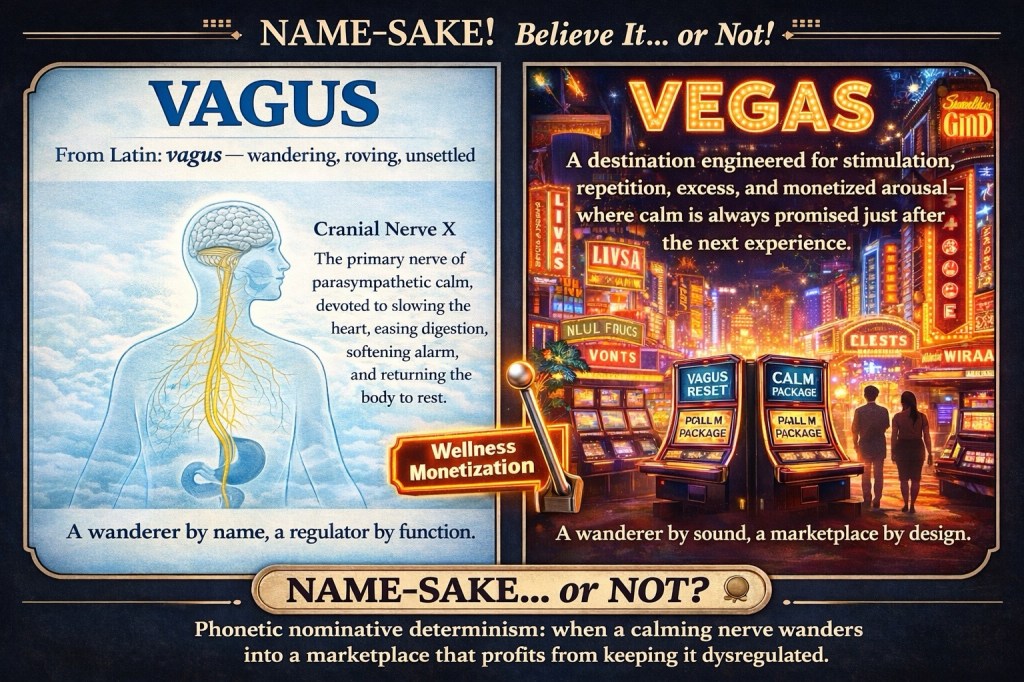
This enthusiasm should not be attributed to the nerve itself.
In biological terms, the vagus nerve functions as a brake. It dampens excess. It signals enough. Its cultural life, by contrast, has been loud, urgent, and highly optimized. The present moment is characterized by individuals aggressively attempting to relax, which may explain some of the erratic behavior observed.
———

(pause; binoculars lowered)
——
This report notes a momentary loss of field neutrality.
Returning to cause analysis: the sudden proliferation of vagus appears to result from several converging conditions. Neuroscientific language now confers legitimacy. Trauma-informed frameworks locate distress in the body rather than the will. Market systems favor named mechanisms over unnamed cultural strain. A portable nerve provides explanation without requiring structural adjustment.
Words, like animals, expand territory when their original habitat can no longer support the load placed upon them. Vagus has been pressed into service as a general-purpose mediator between a hyper-stimulating world and nervous systems built for slower weather.
The nerve remains real.
The word remains useful.
Their current population density is unsustainable.
Status: Still at large
Current habitat: Wellness media, therapeutic language, lifestyle optimization zones
Behavior: Highly reactive to attention
Recommendation: Observe at a distance. Avoid excessive handling.
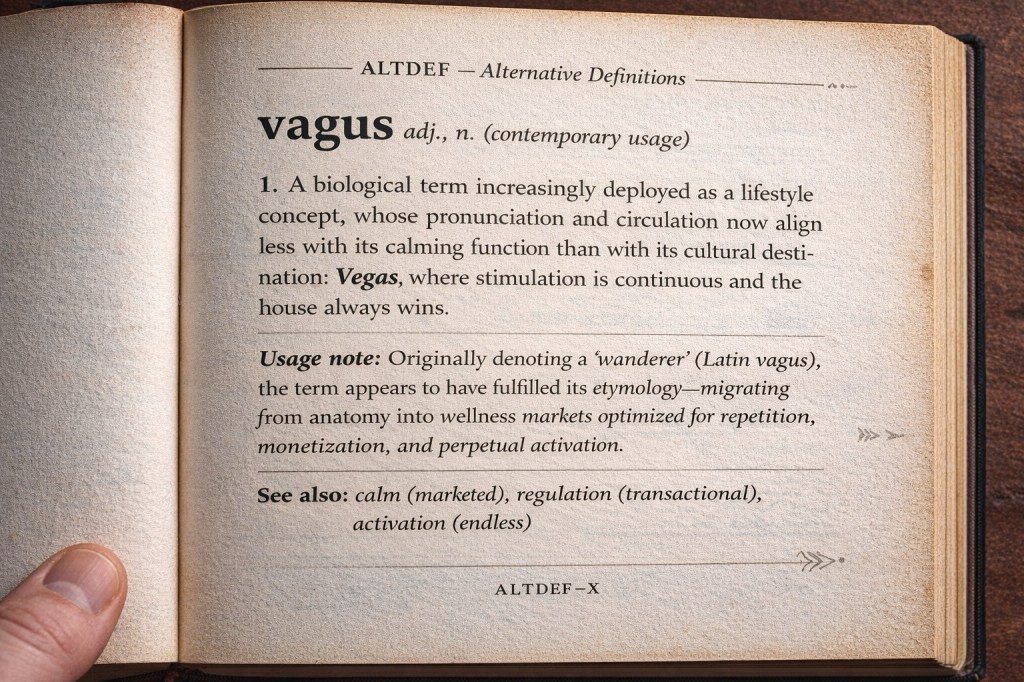
—Report filed by Paige Turner in AltDef
***

 COUNCIL-OF CONCERNED-CONSERVATIONISTS…..Between Jest And Earnest…..
Leave a comment