—An Informal Exercise in Target Acquisition, in Which the Objects Are Not Always the Intended Ones.

April, 2026
—New York—having passed from a shooting range into a hall of toys
René, Dear Custodian of My Expanding Brief,
You will recall that my assignment extended to
“all American expressions of cultural production,”
—a phrase whose elasticity continues to produce results.
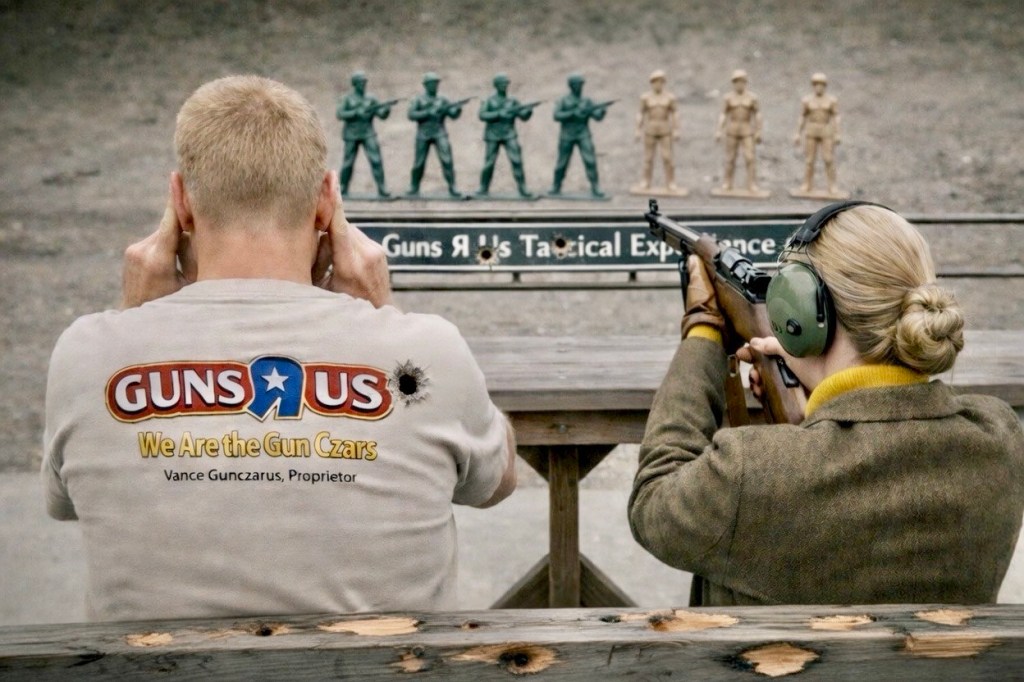
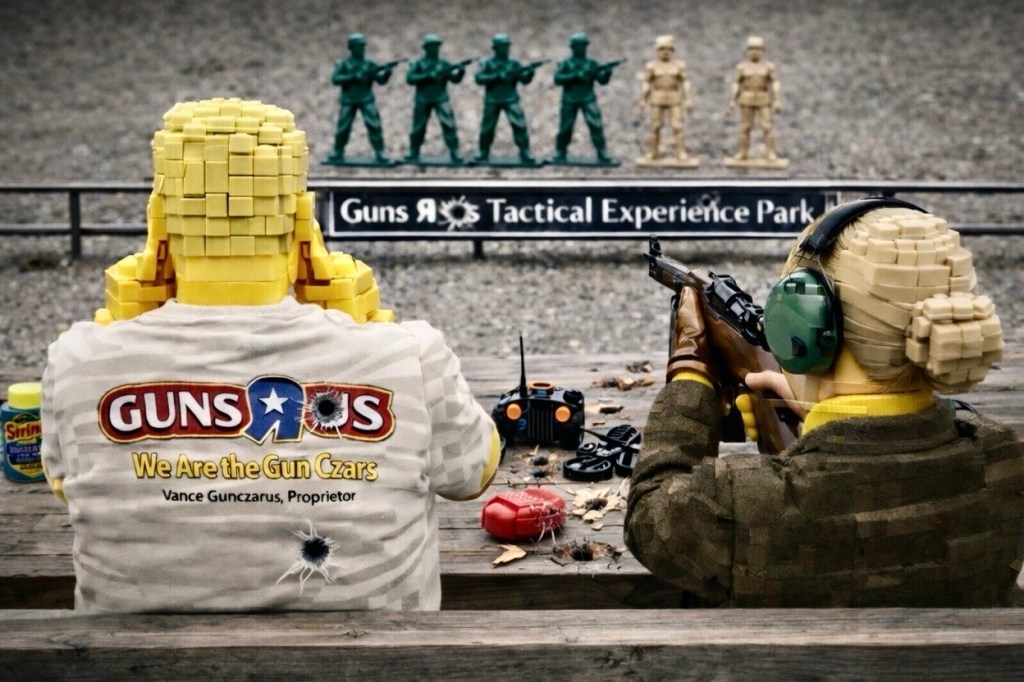
I was recently introduced to a gentleman of the Council, one Mr. Vance Gunczarus, the Council’s Waffenmacher and Waffenmeister, who proposed that I accompany him to a shooting range. How American is that? So yes, I accepted, expecting a certain austerity. What I found was something closer to organized recreation.
The environment was controlled, the participants attentive, and the activity structured around repetition, adjustment, and measurable improvement. Equipment was compared, modified, and discussed with the sort of care one encounters among enthusiasts in any number of pursuits. There were rules, there were targets, and there was satisfaction in refinement. It was not frivolous. But neither was it, in any immediate sense, war.
It was, unmistakably, a system.
This impression was clarified for me by a conversation I had some time ago with John St. Evola, who spoke of the military board games of his youth.
One, titled Africa Korps, concerned the North African campaign under Rommel and required hours—often days—to complete. Another, Anzio, traced the Italian campaign with sufficient detail that he could identify units in which his uncle had served, and in which his father would later serve, lending the exercise a distinctly personal dimension— not to mention the fact that the battles took place in his ancestral homeland.
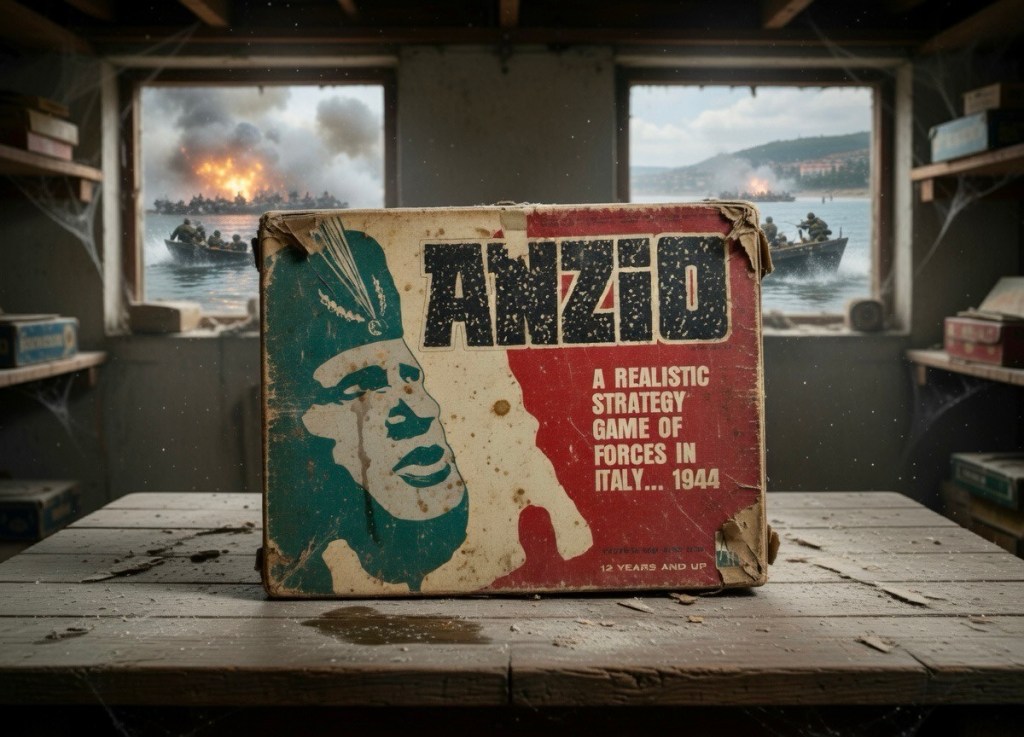
John did not omit to mention that disagreements over rules or interpretation occasionally escalated into a brief exchange of punches between himself and his opponent—an event sufficient to end the game immediately, whatever its strategic state at the time, and concluded only upon the intervention of his mother, who imposed terms of peace with final authority.
Even in miniature, it seems, the conflict was not entirely contained.
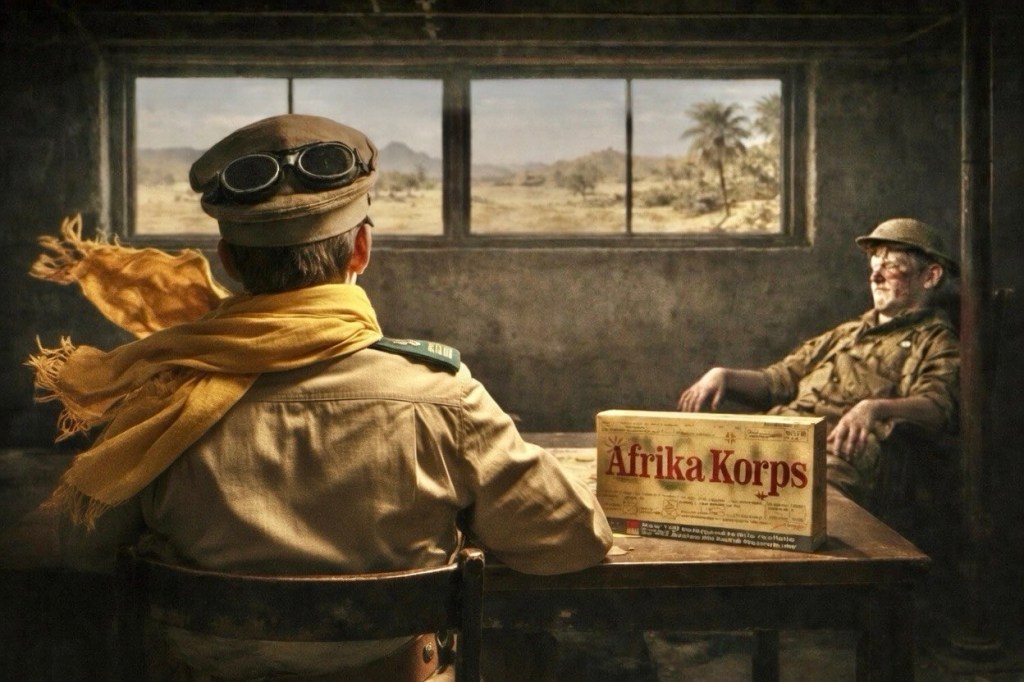
What I was observing, in that unopposed exchange, was not unfamiliar. I had encountered it before in objects sold as toys—and, on at least one occasion, in that contest briefly interrupted by fisticuffs before any proper conclusion could be reached—several of which have since been adapted, with minimal alteration, to purposes of war—retaining, in the process, that same element of remove between action and consequence.
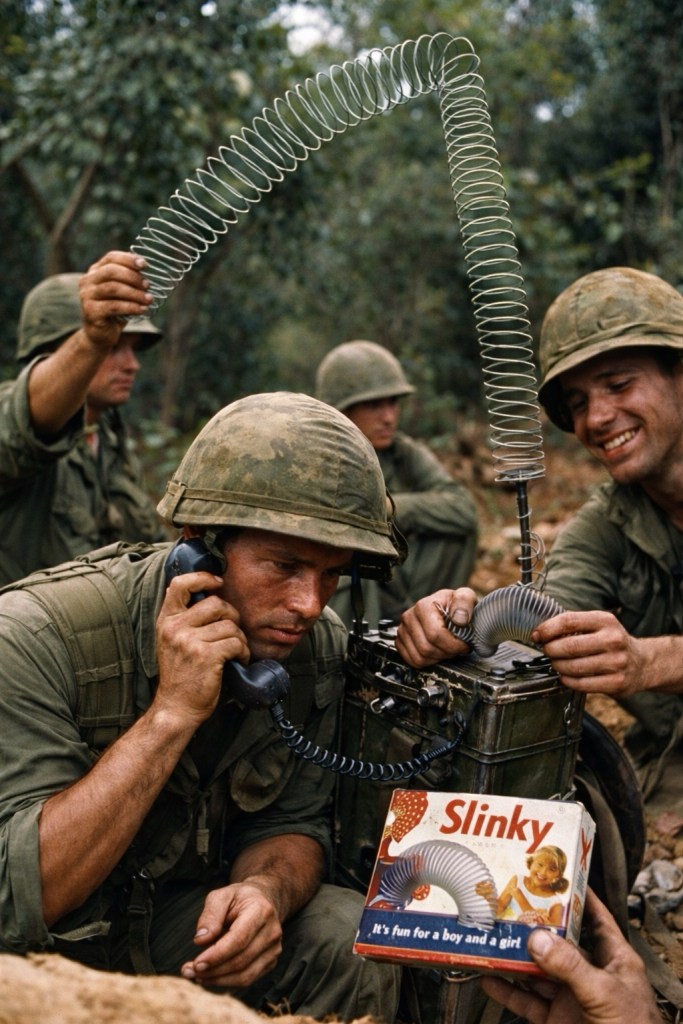
And further, the object known as the Slinky—a coiled spring marketed for its ability to descend a staircase—was first developed by an engineer working on naval instrumentation. The principle was not initially playful. It became so by circumstance. Later, in Vietnam, the same object was used by soldiers as an improvised radio antenna, its properties once again pressed into service.
And there is the example of Silly Putty, now sold as a novelty for children. It originated in wartime research into synthetic rubber, when natural supplies were constrained. Failed in its intended purpose, it succeeded, instead, as a toy.

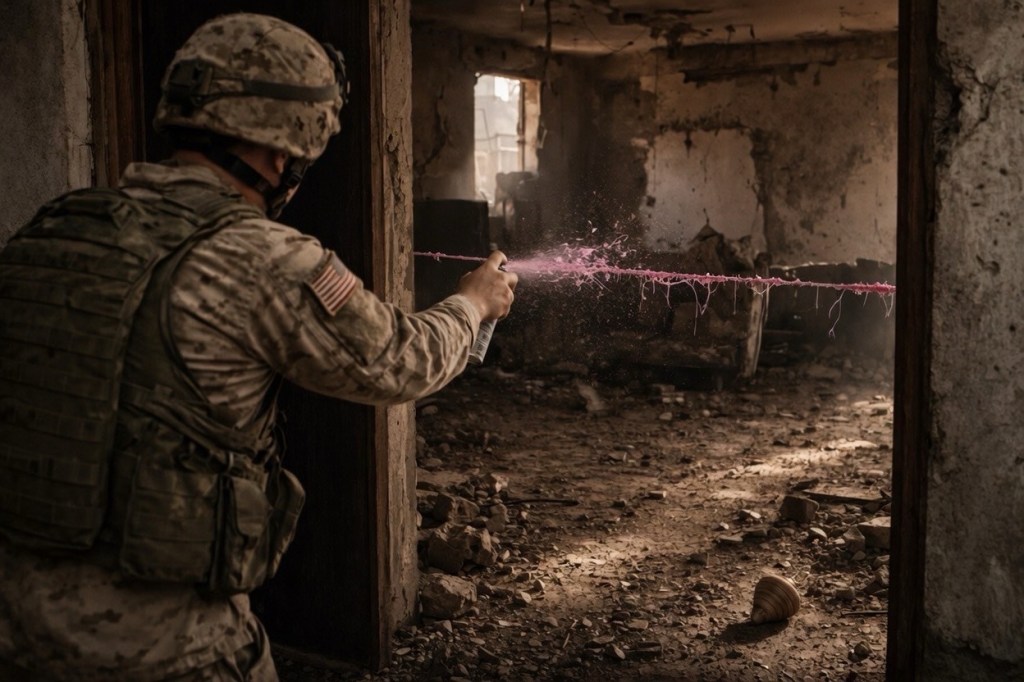
I draw your attention to Silly String—dispensed from an aerosol can for amusement. It was used by American soldiers to detect tripwires, the strands revealing what could not otherwise be seen.
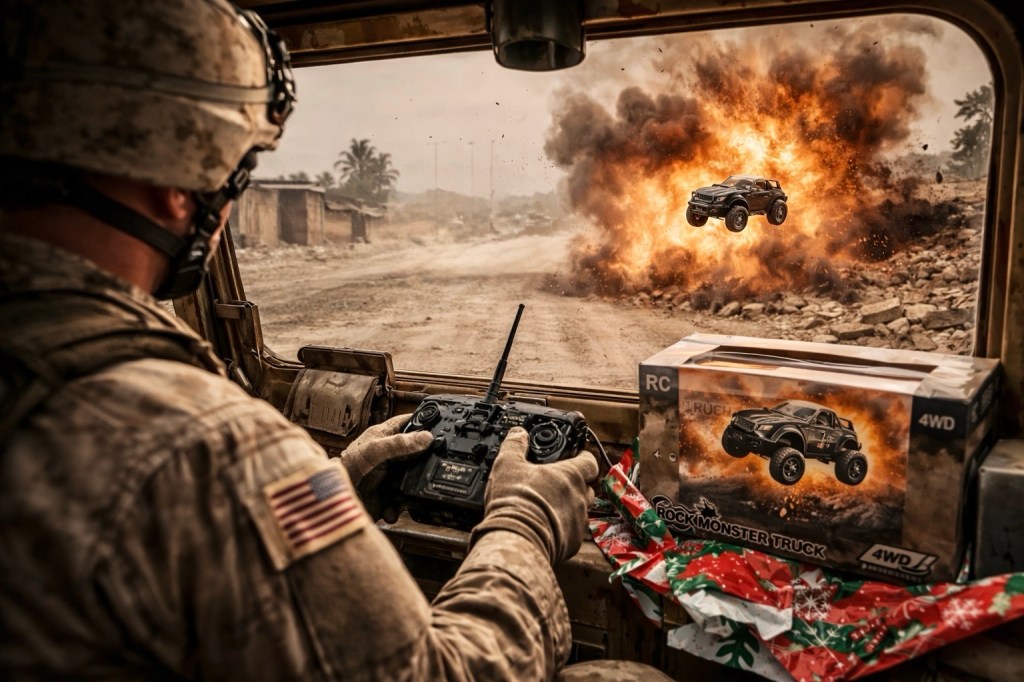
In Iraq, small remote-controlled cars—commercial toys, or near enough—were used to approach suspected roadside bombs. They were inexpensive, replaceable, and already designed for control at a distance. No significant conceptual modification was required.
And then there is the drone.
What began, in many cases, as a hobbyist’s device—a remote-controlled aircraft for recreation or photography—now occupies a central position in modern conflict. It extends sight, action, and consequence across distance, while preserving the operator from immediate risk. The interface remains, in many respects, indistinguishable from that of a game.
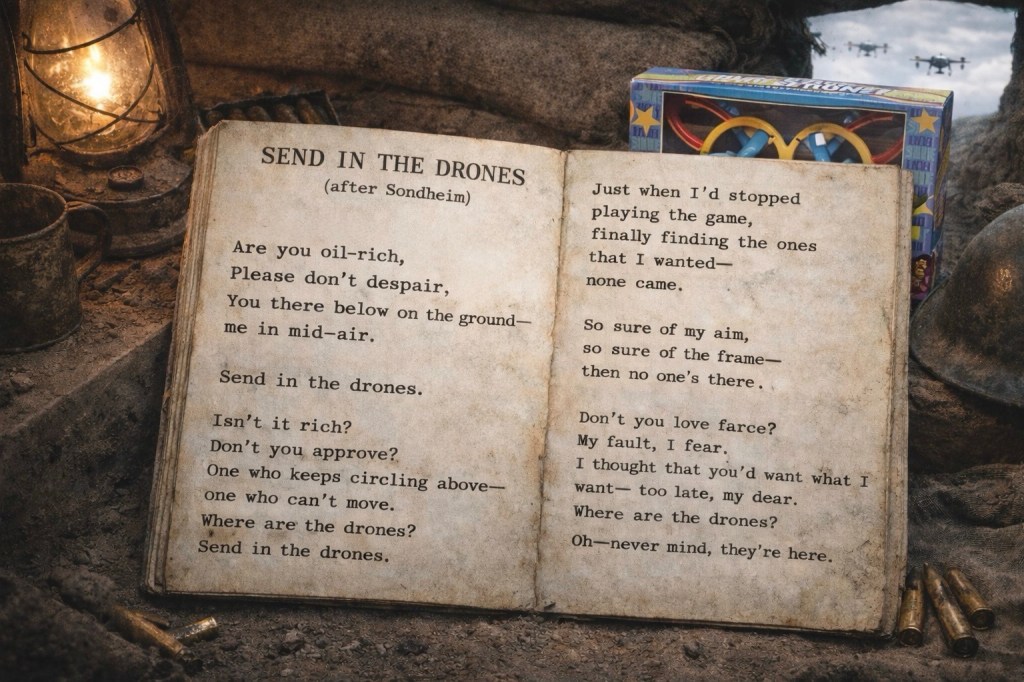
One suspects that even composition persists under such conditions—though the repertoire has, in certain respects, changed.”
I am further given to understand that in the present conflict involving Iran, even children’s construction systems—Lego among them—have been used in the production of propaganda imagery, assembling miniature representations of events intended to communicate something quite serious through unmistakably playful means.
The pattern does not require embellishment.
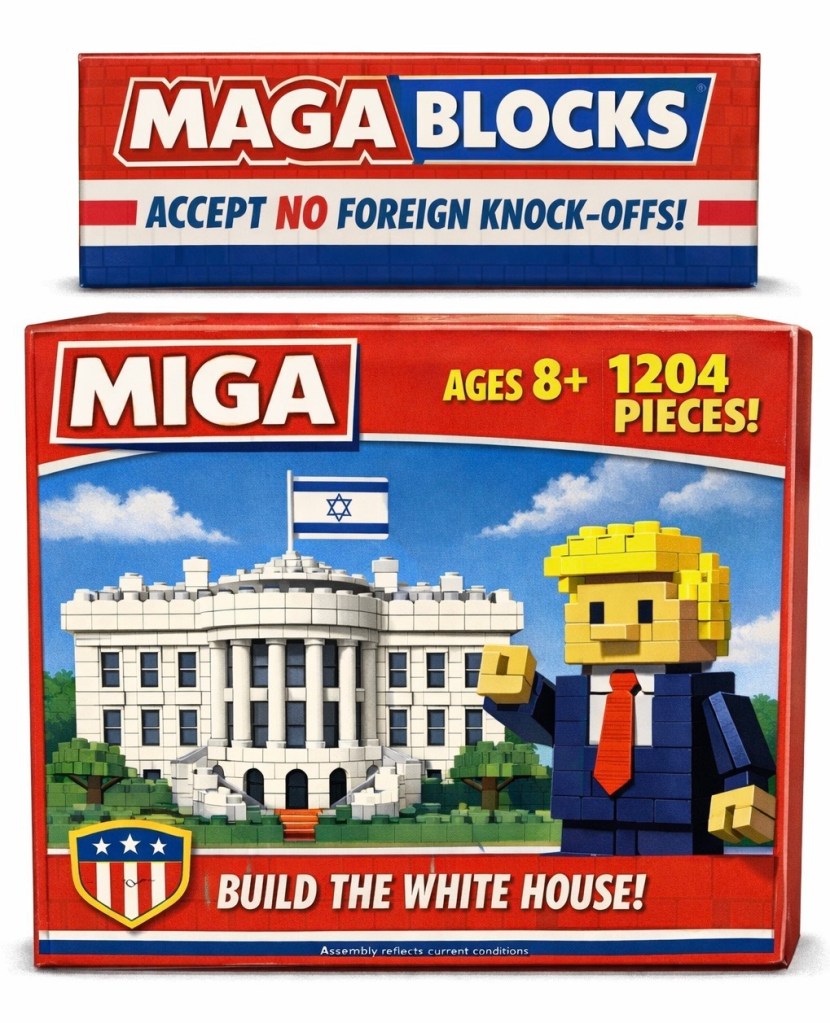
I did, quite by accident, pass through the New York Toy Fair, where many of these same principles were displayed without pretense: control, responsiveness, modularity, repetition. The scale differed. The logic did not.
The Japanese, I am told, pursue refinement of the object—precision, finish, miniature completeness. The Americans, by contrast, appear to pursue the refinement of systems: how objects are used, repeated, scaled, and integrated into larger structures of activity.
This may account for a certain ease with which one domain passes into another.
It is not necessary to argue that toys become weapons. It is sufficient to observe that the distance between them is, in practice, quite small. The same mechanisms—remote control, simulation, iteration—operate in both.
At the range, the targets remained fixed, the outcomes contained. The participants improved, compared, and concluded their session without incident.
The structure, however, was already in place.
Yours, in the ongoing effort to determine what America believes itself to be,
Begonia
P.S. I am left with the impression that in America, play and power are not opposites, but adjacent states—occasionally separated by nothing more than scale.
 COUNCIL-OF CONCERNED-CONSERVATIONISTS…..Between Jest And Earnest…..
Leave a comment