—High Noon at the Drag Strip
—(with a passing case of High Anxiety)
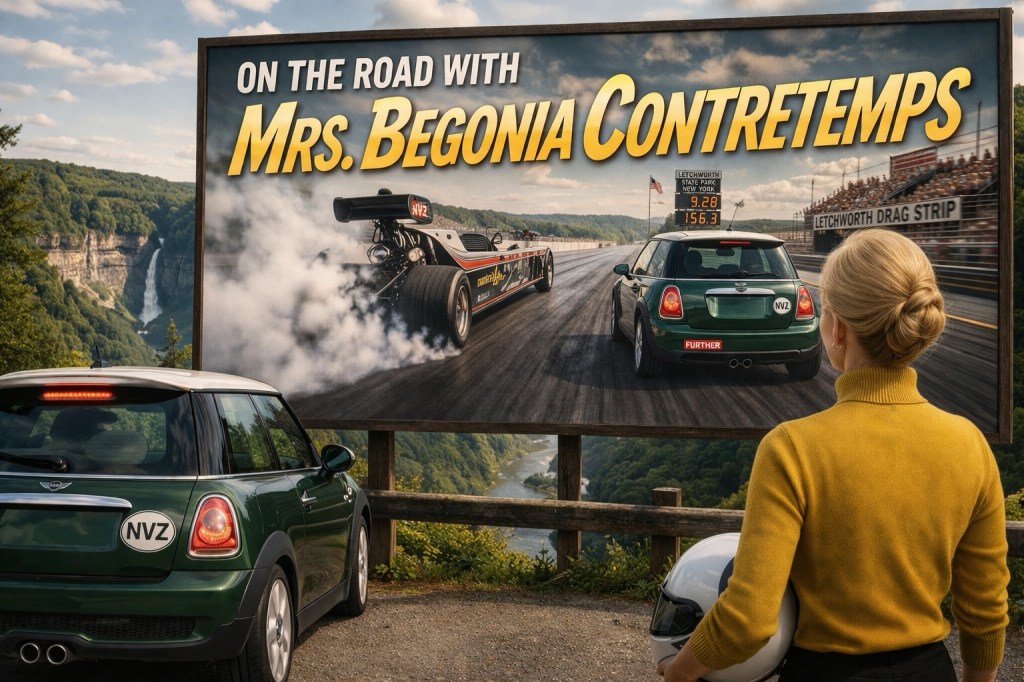
Commissioned by René Séance of the Nouvelle Vague Zwischenshaft (NVZ), Mrs. Begonia Contretemps proceeds across the American landscape with a simple brief: to observe what presents itself, and to determine-where possible-what, precisely, America means; expenses reimbursed where warranted.
April 4th
In The Year Of Our Lord, 2026
René,
The hour is exact, the air impertinent, and I find myself not entirely pleased with what insists on being seen.
I was told—quite plainly—that I must see a drag race.
And this time, I was not misled. At least, not at first.
The thing itself—how shall I put it—was magnificent. Not refined, certainly, but elemental. The engines did not merely produce sound; they announced a condition. One felt it in the chest, in the teeth—indeed, in regions one does not ordinarily associate with machinery (though one suspects machinery has lately made certain advances in that regard).
The bleachers themselves seemed to participate. At full rev, the vibration traveled upward—through wood, through flesh and bone—until one was no longer merely seated, but—addressed. It was not unpleasant. On the contrary, I found myself, quite against my better judgment, lingering in the sensation.
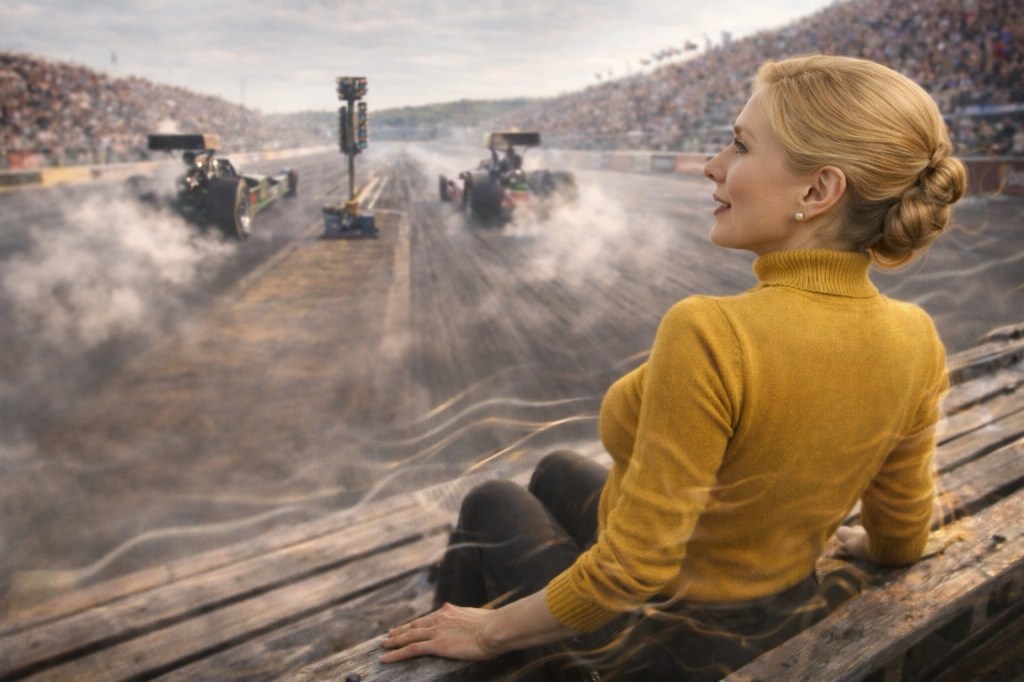
There is, I begin to suspect, a form of American piety expressed not through silence. . . but through combustion.
The cars—“muscle,” I believe they are called, with admirable directness—lined up like dueling propositions. And when they were released, it was less a race than a declaration: a brief, thunderous insistence that power, once summoned, ought to be spent immediately.
I was, I confess, more than moved. I was—if only for a moment—aligned.
And then—High Noon.
A pause. An intermission. The crowd rose, as if by instinct, toward fried substances and carbonated consolations. I remained, expecting perhaps a resetting of the ritual.
Instead, an announcement—delivered with the unmistakable tone of a man who believes himself to have improved upon something that did not require improvement.
A “Special Presentation.”
There was Music.
And then—introduced, with a flourish bordering on the self-congratulatory—a race of drag queens—invited, it seemed, to participate in the festivities by. . . running the strip themselves.
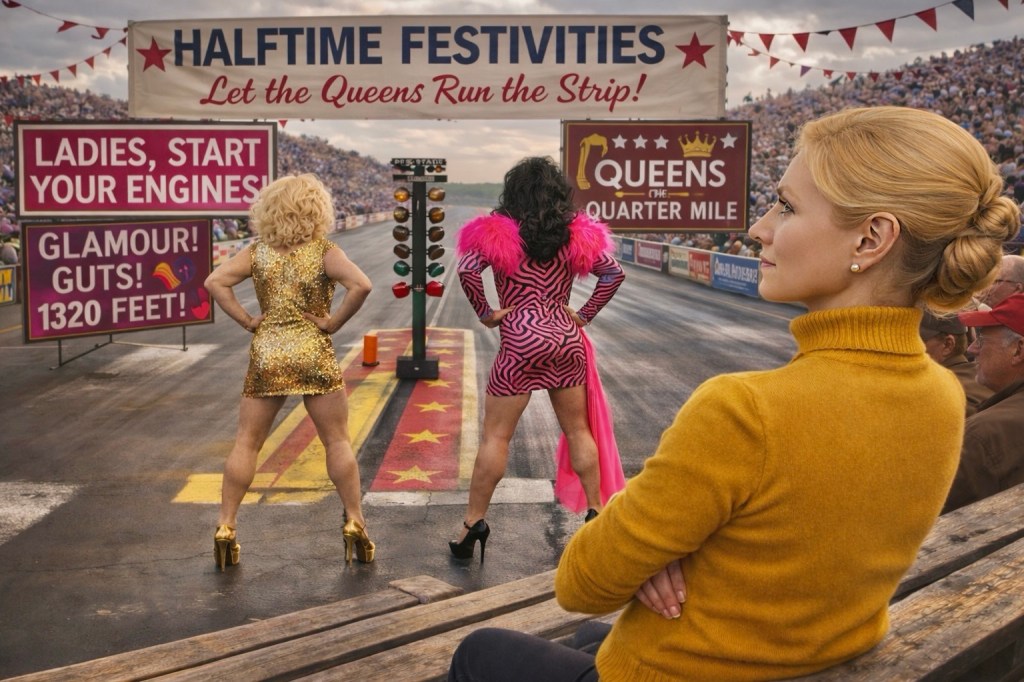
I waited—briefly—for the correction. One assumes, in such moments, that one has misunderstood the premise. No such mercy was forthcoming. They were to race.
In heels.
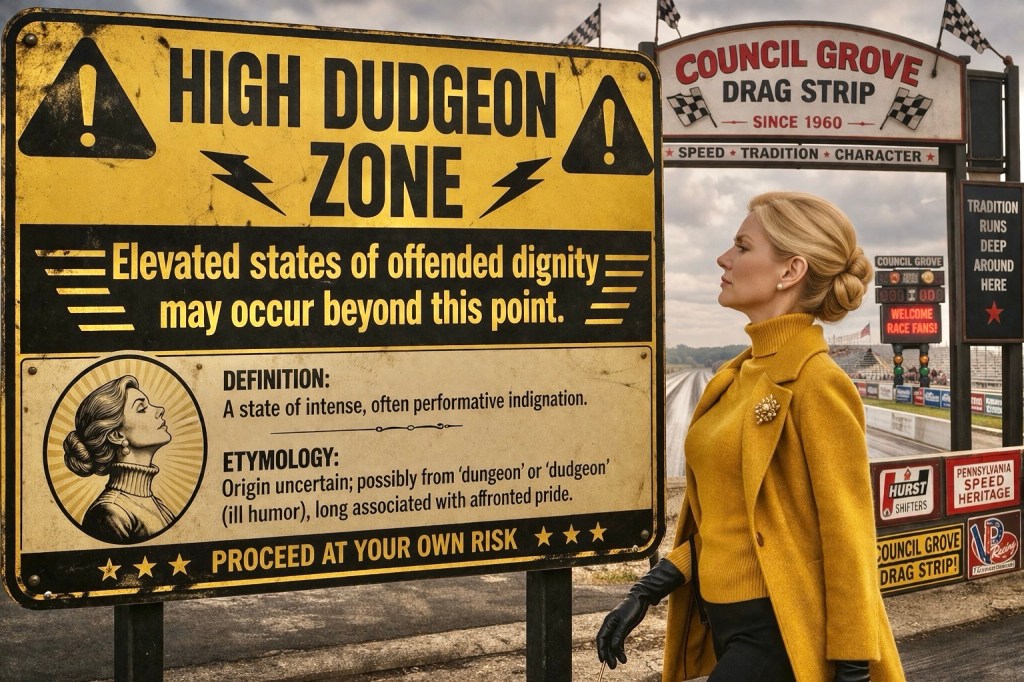
I felt it then, René—rising, unmistakable, almost architectural in its construction:
High Dudgeon.
Not the common sort, mind you. Not irritation. Not even offense. But that particular English sensation that something has been made needlessly clever at the expense of its own dignity.
One does not interrupt a liturgy with a pantomime, however well-costumed. And yet—here is where matters became. . . complicated.
For the performance—if that is the word—was not careless. Quite the opposite. The ersatz feminine gestures were deliberate. The presentation studied. There was, dare I say, a kind of devotion in it—though to what, precisely, I could not immediately determine.
It brought to mind, quite without invitation:
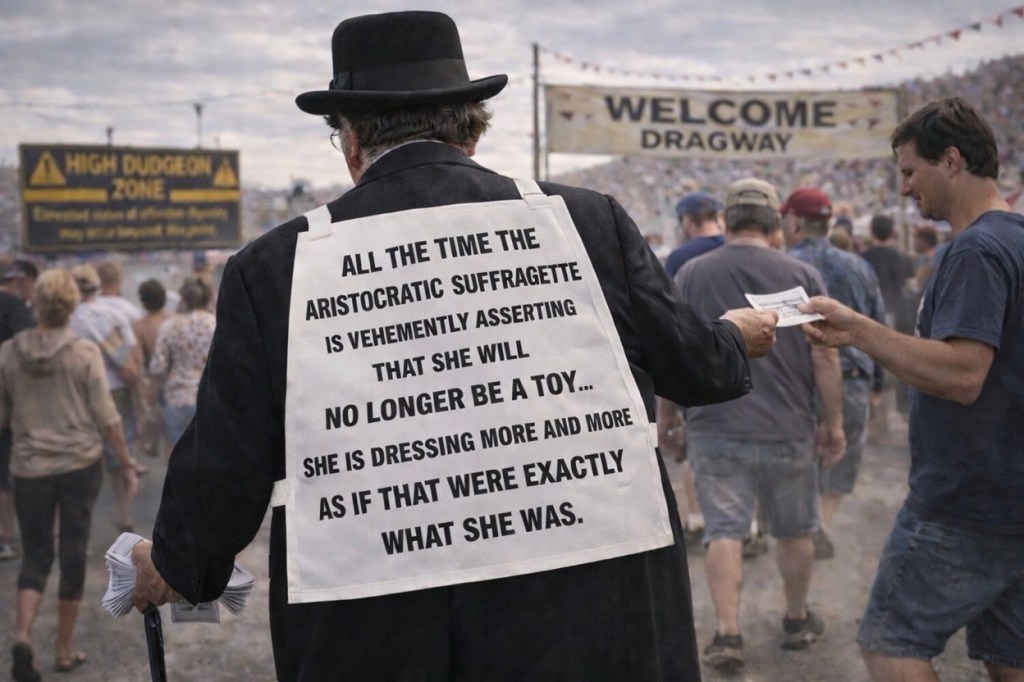
And then, as if in reply:
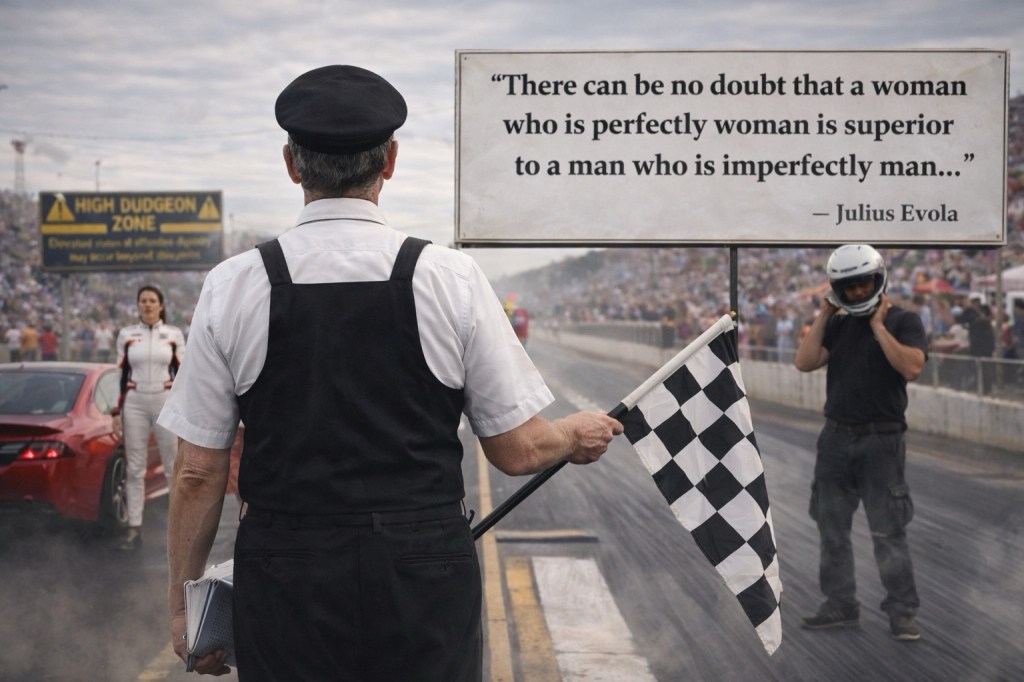
I do not deploy these quotes as arguments. I merely note that they arrived—unbidden, and rather pointedly.
For what I witnessed on that strip was a curious inversion.
The earlier display—the engines, the force, the unapologetic expenditure of energy, the glorious vibration that made my Earth move—had possessed a kind of honesty, however crude. It was not pretending to be anything other than itself.
But here—here was something else.
An attempt, it seemed, to recover a form through performance. To render femininity not as inheritance, nor even as instinct, but as interpretation—heightened, exaggerated, and, in its way, reverent.
And I could not help but notice—however reluctantly—that while one movement has urged women to abandon the older signs of their sex in pursuit of parity with men,
here were men—quite literally—laboring to reconstruct those very signs, stitch by stitch, gesture by gesture!
Grotesque? At moments, undeniably.
Excessive? Certainly.
And yet—attentive. One might even say: honoring, in distortion, what others have discarded in earnest.
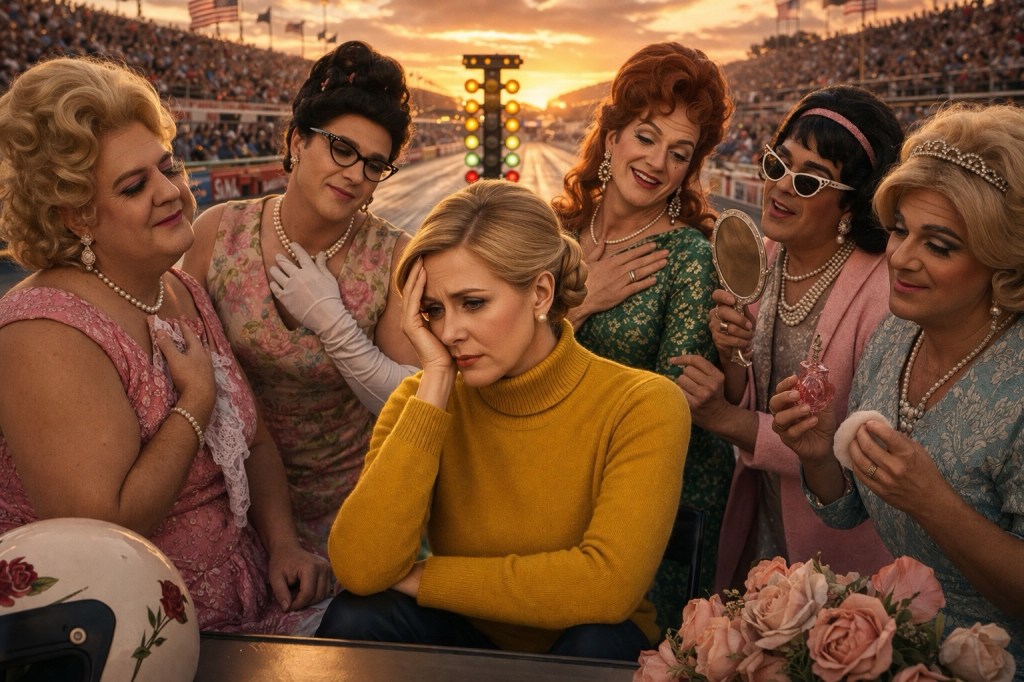
Meanwhile, those who had long insisted upon its redefinition have rendered it—how shall I say—administratively unavailable.
One is left, then, with a most peculiar arrangement:
The form preserved. . . by those outside it.
The substance diluted. . . by those within.
I found this less amusing than the promoters clearly intended.
Indeed, their satisfaction—visible, unmistakable—suggested they believed themselves to have executed a pun of considerable cultural value.
(One is reminded—as people say (and I do mean you, John—if you’re listening)—that the English language has endured worse, and that cleverness, left unattended, is rather fond of its own applause.)
The engines resumed shortly thereafter, as though to restore order. I was grateful for it.
Still, the interruption lingered.
Not merely as irritation—but as something closer to a tremor beneath it. A suspicion, perhaps, that one has not misread the scene, but that the scene itself has begun to. . . misplace its meanings.
I had come in search of a certain clarity—something loud, Americana yes, but legible.
Instead, I found myself, quite unexpectedly, in a condition approaching High Anxiety.
Not of the immediate sort—no shrieking violins, no visible peril—but the quieter variety: the sense that what one has taken to be emblematic may, on closer inspection, be. . . improvising.
I shall have to look more carefully, René.
Twice, perhaps.
Yours,
Begonia
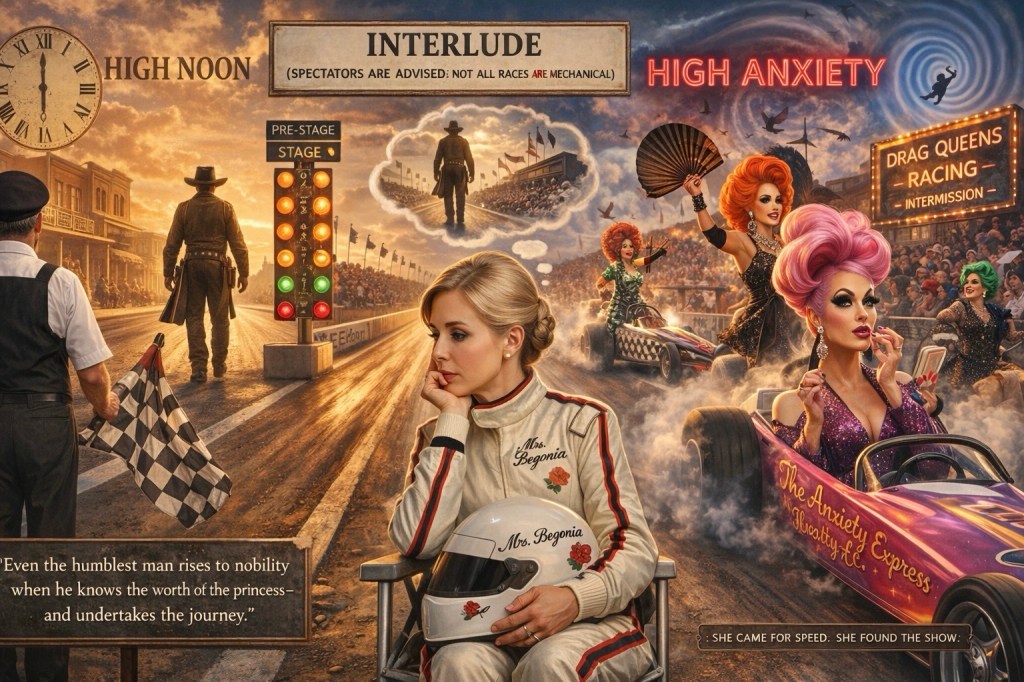
I find myself wondering, René, whether I might yet star in a fourth picture—High Dudgeon—a matter I shall have to discuss with you. . . and with John.
Next stop: Hollywood.”
More missives from: Mrs. Begonia Contretemps


Leave a Reply