—Filed After an Evening Viewing and a Subsequent Departure—
ON THE NEW SITUATIONS OF DEMOCRACY IN AMERICA

—Being a Modest Continuation of the Inquiry Begun by a Certain Frenchman, René Séance. Now Conducted Under Conditions Less Assured—
April, 2026
Somewhere Between the Library and the Loading Dock
René, Dearest Custodian of My Original Assignment,
I must begin with an admission of influence.
One evening, in a modest accommodation of uncertain pedigree, I encountered an episode of that American program known as:

—a series dedicated to the pursuit of elusive phenomena: monsters, vanished civilizations, and other matters whose existence is felt more readily than it is confirmed.
It occurred to me that democracy—having last been reliably documented in the pages of Democracy in America by Alexis De Tocqueville —might now qualify for similar treatment.
Alexis found it in townships, juries, and assemblies of men.
I resolved to determine whether it might still be found—and if so, in what form.
I closed the book. I left the room. I began the search. I did not expect to find traces so quickly.
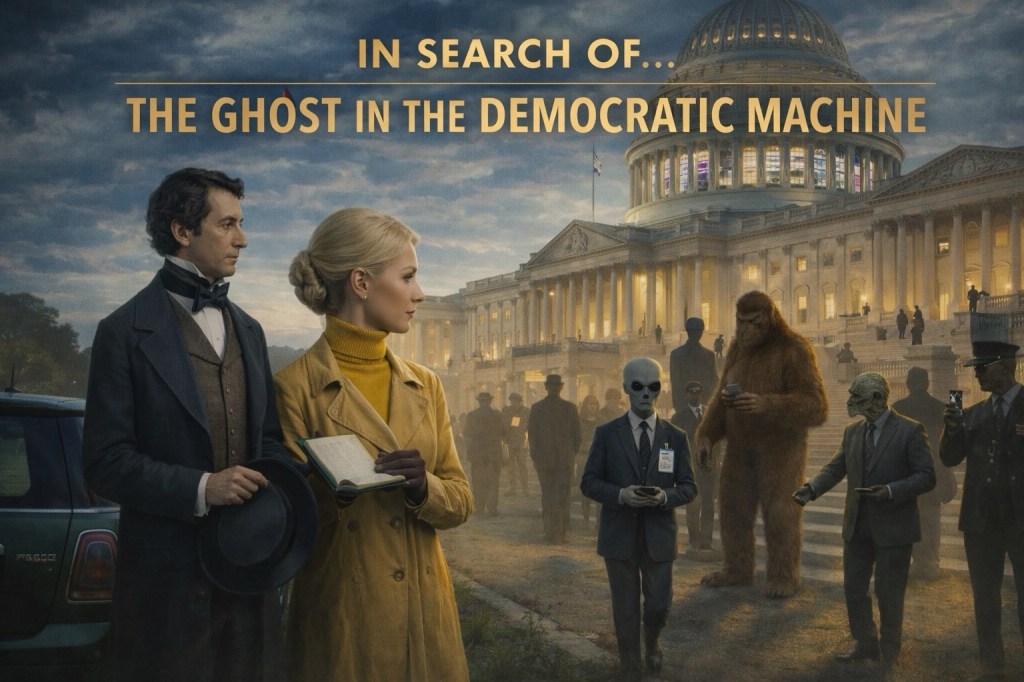
I will now proceed to list my further discoveries in sequence:
I. The Franchise of Stars
My first encounter was not in a town square, but in a rideshare vehicle arranged through a mobile application—an arrangement made necessary by the sudden and wholly unsurprising failure of my Mini Cooper, which, like my former Jaguar, appears to regard mechanical reliability as a matter of national character rather than engineering obligation. (One is reminded that British cars do not so much break down as fulfill a reputation.) The driver’s continued access to work, I was informed, depends upon maintaining a high passenger rating, typically expressed on a five-star scale.

At the conclusion of the journey, I was prompted—immediately and unavoidably—to assign a rating to the driver, just as previous passengers had rated him, and just as he, in turn, would rate me.
One no longer waits to be governed; one governs constantly, in increments of five.
Each transaction concludes in a plebiscite. Each citizen is both electorate and officeholder, though the term of office lasts only as long as the next interaction.
It was here I first suspected I had found not the thing itself, but a trace—a small, repeating pattern.
The creature we are seeking, if such it is, appears capable of dividing itself into units no larger than a moment.
II. The Republic of the Algorithmic Feed
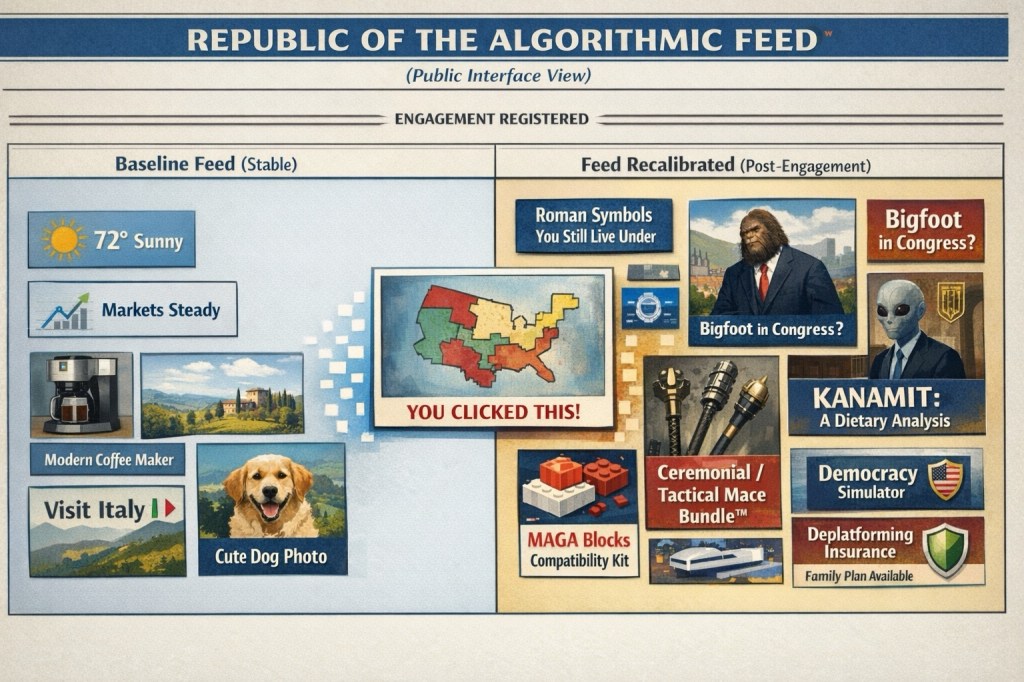
I next observed a system in which individuals scrolling through social media applications—video platforms, news feeds, and online marketplaces—are shown content and advertisements selected by algorithms trained on their prior clicks, pauses, searches, and purchases.
A man who lingers over a particular item finds himself presented with increasingly refined variations of the same, as the system learns what holds his attention.
Each man is given a voice; that voice is recorded; and the system replies—not in argument, but in offerings.
Freedom of speech has been succeeded, in certain quarters, by the freedom of being spoken to with precision.
The people govern their environment indirectly, by training it.
Here the pattern reappeared—larger now, and more patient.
It does not merely listen; it arranges.
And it was here, René, that I experienced a moment of philosophical recollection.
One is reminded of that earlier error—the so-called “ghost in the machine,” by which it was once assumed that some hidden entity resided within the apparatus, directing its behavior.
And yet, observing this system, one begins to wonder whether the error lay not in imagining the ghost. . .
—but in assuming it could be located in a single place.
III. The Districting of the Map
In a more formal inquiry, I examined electoral district maps used to define voting boundaries—shapes drawn and redrawn through a process known as gerrymandering, in which districts are configured in irregular and often elaborate forms in order to concentrate or disperse particular voting populations.
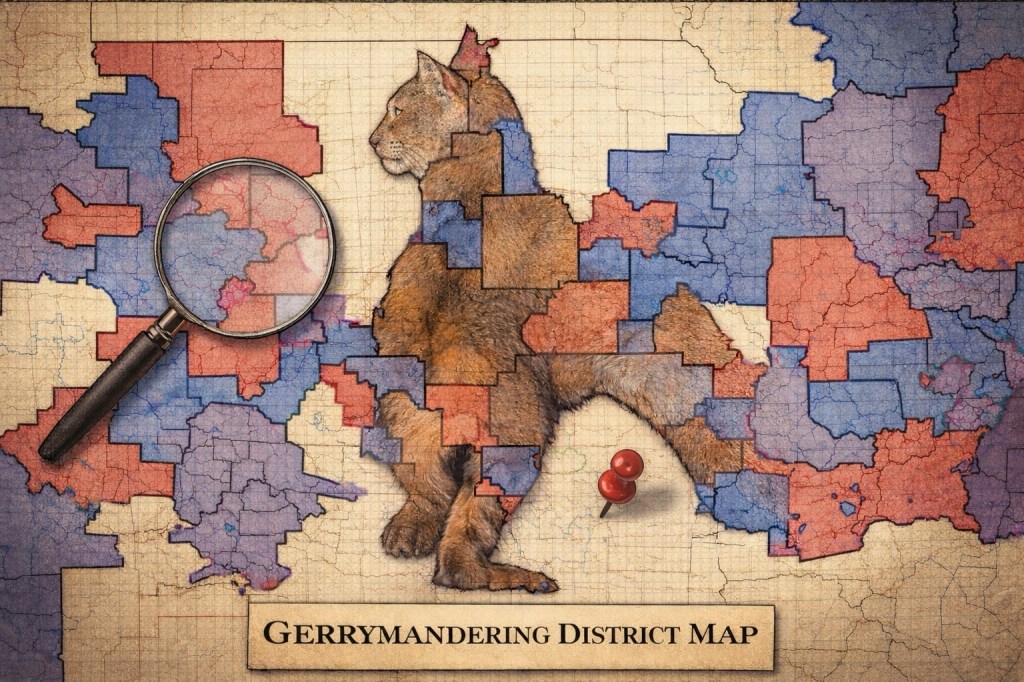
These maps—some winding, some contorted—bear little resemblance to natural geography, and yet determine representation with mathematical precision.
The vote remains equal; the arrangement of the votes does not.
Here, democracy is not denied, but configured.
It does not silence the voice; it organizes where the voice will count.
I began to suspect the creature possessed a cartographic faculty.
It draws—in a most feline way.
IV. The Self-Checkout Aisle and the Locked Case
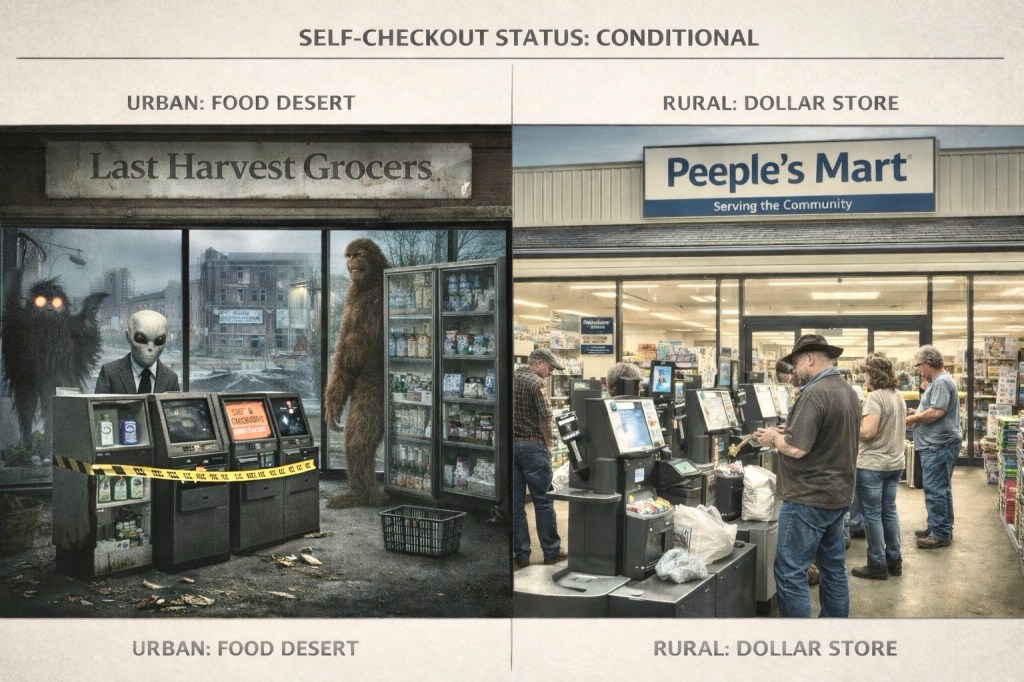
At a grocery store, I encountered a dual arrangement. In one section, customers were invited to scan and bag their own items at self-checkout kiosks, completing payment without the assistance of a cashier. In another section, certain goods—household products, medicines, and other frequently pilfered items—were secured behind locked glass cases, accessible only by requesting an employee with a key.
The distinction was neither hidden nor explained.
The franchise appears to persist at the self-checkout kiosk, and to be suspended at the locked case, pending further assurances of behavior.
Democracy, it seems, requires not only participation, but trust. Where that trust is insufficient, the system reverts to supervision.
Here, I began to notice something else.
The creature of the demos does not appear everywhere at once. It advances where conditions permit, and withdraws where they do not.
V. The Workshop of Drones and Improvised Systems
I was then introduced—through the good offices of a certain enthusiast—to a workbench on which small aerial drones were being assembled and modified from commercially available components: quadcopter frames, lithium batteries, miniature cameras, radio transmitters, and guidance modules commonly sold for hobby use or recreational flying.
These devices are similar in kind to those currently used in modern conflicts for aerial reconnaissance, surveillance, and targeted attacks, often at a cost measured in hundreds or thousands of dollars rather than millions.
The distinction between toy and weapon appeared, in this setting, to have undergone a practical erasure.
A device purchased for amusement may, with slight modification, acquire consequence.
That which once required the resources of a state—persistent aerial observation, precision delivery of explosives, and real-time battlefield awareness—may now be approximated at the level of the individual operator or small unit.
One had expected democracy to distribute authority. It appears also to distribute reach.
The cost of participation has fallen; the cost of being participated upon has not.
Here, the pattern acquired a new and less comfortable dimension.
It does not only speak, or count, or arrange. It extends.
VI. The Eloquence Machine
In a quieter setting, I observed individuals composing essays, letters, and arguments with the assistance of artificial intelligence systems, which generate coherent and often polished prose in response to short written prompts. I leave it to your discretion, René, whether this paragraph should be read as observation or demonstration; in either case, I trust you will not betray me by asking which of us, precisely, is doing the writing. And yet—I confess a certain satisfaction in the discovery—for here, at last, democracy appears not as a theory but as a condition: the inarticulate rendered articulate, the hesitant given voice, and the distance between them, if not abolished, then at least. . . most agreeably narrowed

A user need only supply a general idea or request, and the system produces paragraphs of structured language—grammatically sound, rhetorically organized, and readily deployable.
Eloquence, once cultivated, is now issued upon request.
The capacity to produce articulate writing has, in this respect, been extended to those who may not previously have possessed it.
Once again, the pattern held.
It equips.
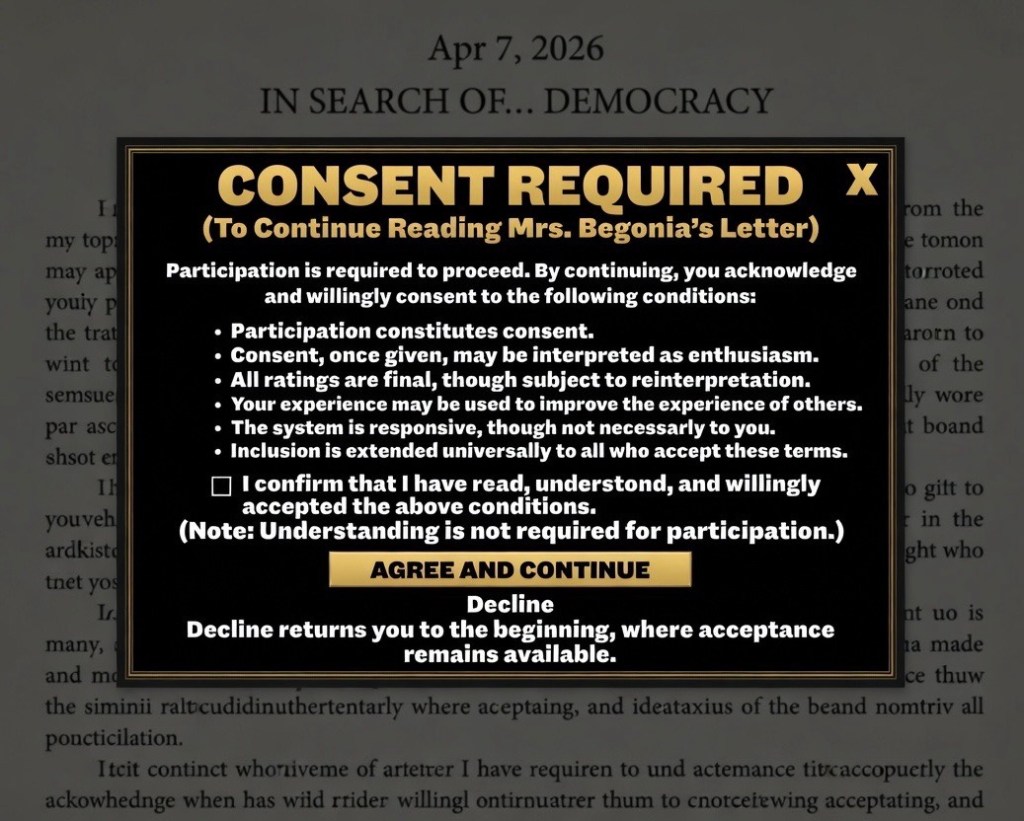
VII. The Ritual of Terms and Conditions
Repeatedly, I was required to accept “terms and conditions” presented on screens—long digital contracts governing the use of software, services, and devices—by clicking a button marked “Agree.”
These documents were uniform, non-negotiable, and identical for all users.
Consent is obtained universally, though one suspects it is rarely negotiated.
Participation is equal; influence over the terms is not.
Here, the pattern became almost ceremonial.
It requires acknowledgment, though not engagement.
VIII. The Comment Section
In online comment sections beneath articles, videos, and public statements, I observed a space in which any individual may contribute an opinion, regardless of status, credential, or expertise.
Thousands of voices appear side by side, arranged not by rank but by timing and algorithmic sorting.
The conversation proceeds at great volume, though not always in sequence.
Authority is flattened; expression is universal; coherence is optional.
The pattern multiplied rapidly here.
It thrives in noise.
Again, René, a small victory.

IX. The Withdrawal of Access
Finally, I encountered cases in which individuals, while not formally silenced, were de-amplified, shadow banned, or removed from digital platforms, resulting in their speech reaching far fewer people than intended. In other instances, individuals or organizations were excluded from payment processors, credit card networks, or online financial services, limiting their ability to conduct transactions.
These actions were not always accompanied by clear explanation, public process, or visible appeal.
One may speak, and yet not be heard; one may transact, and yet not be permitted to do so.
Here, the absence itself was instructive.
It withholds.
In this instance, the monster eluded us. For where access may be withdrawn, and speech rendered economically inaudible, democracy retreats into something more theoretical than observable. I proceed, nonetheless.

Concluding Observation
I set out, as did our French predecessor, to find democracy among the people.
I regret to report that I have instead found it embedded in systems—distributed, procedural, and, in certain cases, conditional.
It flourishes where trust is assumed.
It functions where behavior is constrained.
It withdraws where neither can be guaranteed.
And yet—it persists.
Not always where it is proclaimed, but often where it is engineered.
I shall continue the search.
I am no longer certain whether I am looking for a principle, a condition—or a presence.
But I can report this with some confidence:
It leaves tracks. It arranges them. And occasionally—it watches them being followed.
Your Obedient Correspondent,
Mrs. Begonia Contretemps
(Expenses to be submitted under “Comparative Political Structures, Applied.”)
Nouvelle Vague Zwischenshaft (NVZ)
Strasbourg
Ma Chère Mrs. Begonia Contretemps, Presently Somewhere Between Jurisdictions,
Your opening image prominently advertises Iceland—specifically the rift at Þingvellir, which I am given to understand separates the continents. Kindly confirm: are you presently in the United States, as assigned?
Yours, in administrative clarity,
René Séance
NVZ
More from: Mrs. Begonia Contretemps
 COUNCIL-OF CONCERNED-CONSERVATIONISTS…..Between Jest And Earnest…..
Leave a comment