
A NOTE FROM THE COUNCIL
Currying favor is one of those phrases whose meaning is considerably easier to understand after watching people for a while. That made it less a job for a lexicographer than an ethnographer. We sent for Eugene Bodeswell.
I had not intended to go looking for this particular phrase. I encountered it in the wild, where such things are generally found: attached to human behavior. And lately there seems to be a great deal of the behavior about.
Politicians court voters and patrons, corporations court governments, institutions court benefactors, and nearly everyone online seems to be courting somebody.
Whether the phrase itself is becoming more common I cannot say.
The activity certainly seems well supplied with practitioners.
Then I noticed a particularly interesting variation among certain public figures of Indian-subcontinental ancestry. Here the English language had accidentally arranged a double entendre before the ethnographer even arrived.
They appeared to be currying favor.
The pun, I soon discovered, was hardly original. The specimen to which I had applied it was more interesting.
That was when I began taking notes.
The ethnographer is advised to pay particular attention to courtship rituals. Not merely between the sexes, but between peoples.
One such ritual may be observed among immigrants and their descendants: the conspicuous demonstration that they understand the host civilization perfectly well—sometimes rather better than the natives themselves. They know its heroes. They defend its customs. They deplore its decadence. They may become more English than the English or more American than the Americans. And the Indian diaspora has supplied some unusually prominent specimens.
In America there are Nikki Haley, Vivek Ramaswamy, Dinesh D’Souza and Bobby Jindal. Across the Atlantic one encounters Rishi Sunak, Priti Patel and Suella Braverman. Different people, different histories, different politics—and certainly no reason to assume identical motives. Ahem. Do excuse the ethnographer.
But they raise an interesting ethnographic question.
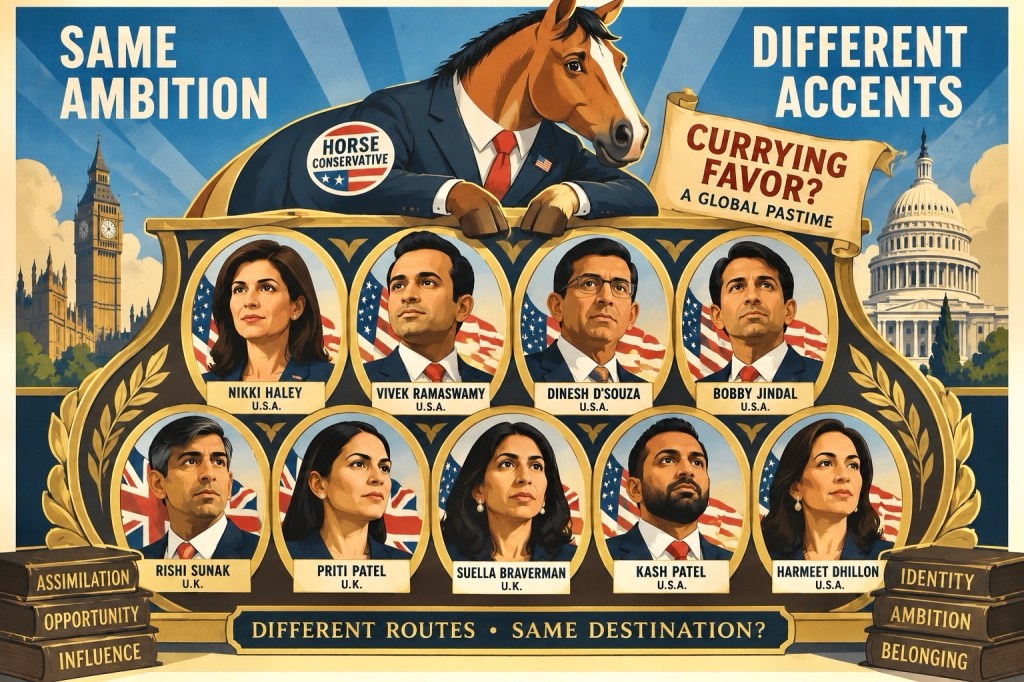
When an outsider or the child of outsiders becomes an emphatic defender of the civilization he has entered, what exactly are we observing?
Assimilation? Gratitude? Conviction? Ambition? Or the ancient art of winning acceptance from the host tribe?
The answer, inconveniently, may differ from person to person.
Vivek Ramaswamy, for example, has publicly emphasized both his Hindu and Indian inheritance and his insistence that he is an American first. Bobby Jindal, born Piyush Jindal in Louisiana to Indian parents and raised Hindu, converted to Catholicism and constructed a thoroughly Louisianan public identity. Dinesh D’Souza presents yet another case: born in Bombay, he arrived in America as an exchange student, attended Dartmouth, and eventually worked in the Reagan administration.
None of these biographies, by themselves, establishes ingratiation.
Curiously, the ethnographer is not alone in noticing the broader phenomenon.
A 2026 paper in the Journal of Race, Ethnicity, and Politics examines Nikki Haley, Vivek Ramaswamy, Kash Patel and Harmeet Dhillon under the rather splendid academic term “strategic assimilation.” The author examines how these South Asian Republicans negotiate ethnic and religious identity while establishing legitimacy within American conservative politics.
This does not mean that “strategic assimilation” is simply an academic synonym for currying favor. It isn’t. But it does give a respectable name to the territory in which our little phrase has wandered.
There. All necessary distinctions have now been observed.
The ethnographer resumes taking notes.
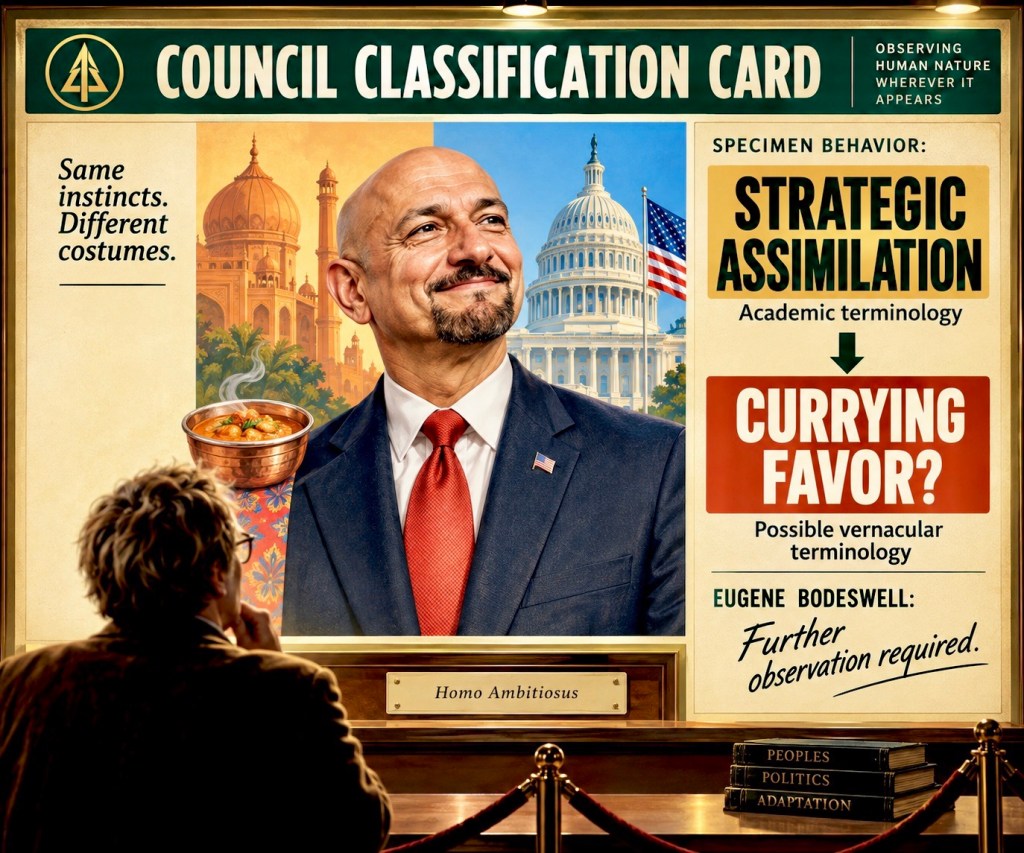
Where, then, does assimilation end and ingratiation begin?
The question becomes particularly irresistible when the assimilating party comes from the Indian subcontinent, because the English language has accidentally supplied the perfect expression for the possibility:
CURRYING FAVOR
Unfortunately, there is a problem.
The Council regrets to report that the curry in currying favor is not Indian.
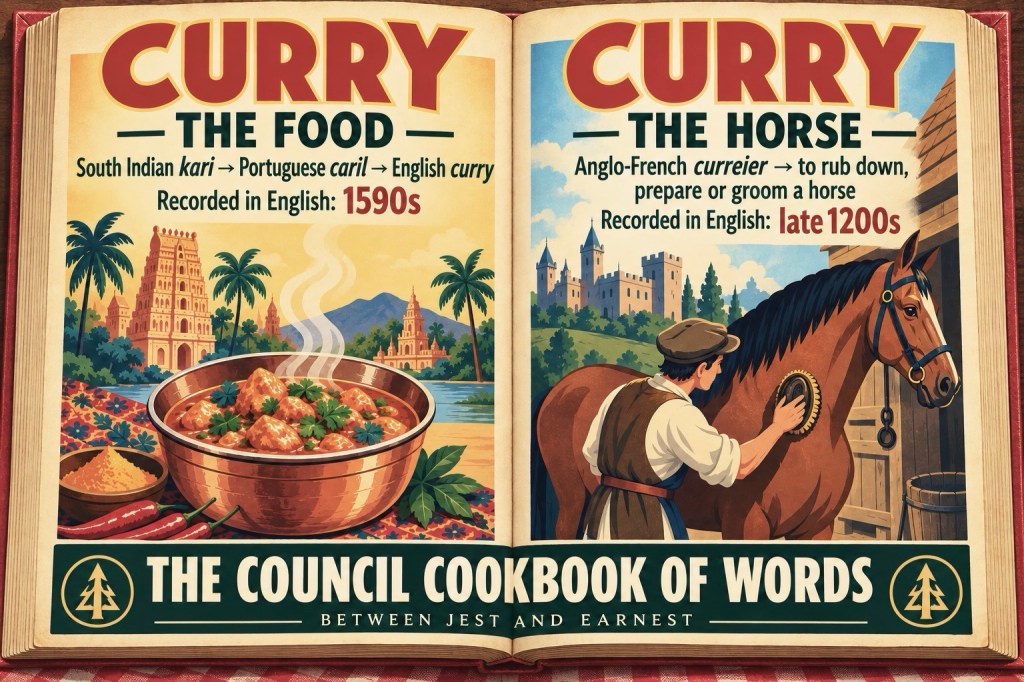
Well, not quite. Sometimes English just likes to mess with you.
Horse-, incidentally, once served as an intensifier for something large, coarse, or strong—which may leave the ethnographer wondering whether strategic assimilation occasionally produces the horse-conservative.
The culinary curry entered English by way of South Asia and Portuguese contact with it.
The other curry was already wandering around medieval Europe centuries earlier. It meant, among other things, to rub down or groom a horse.
Which brings us to Favel.
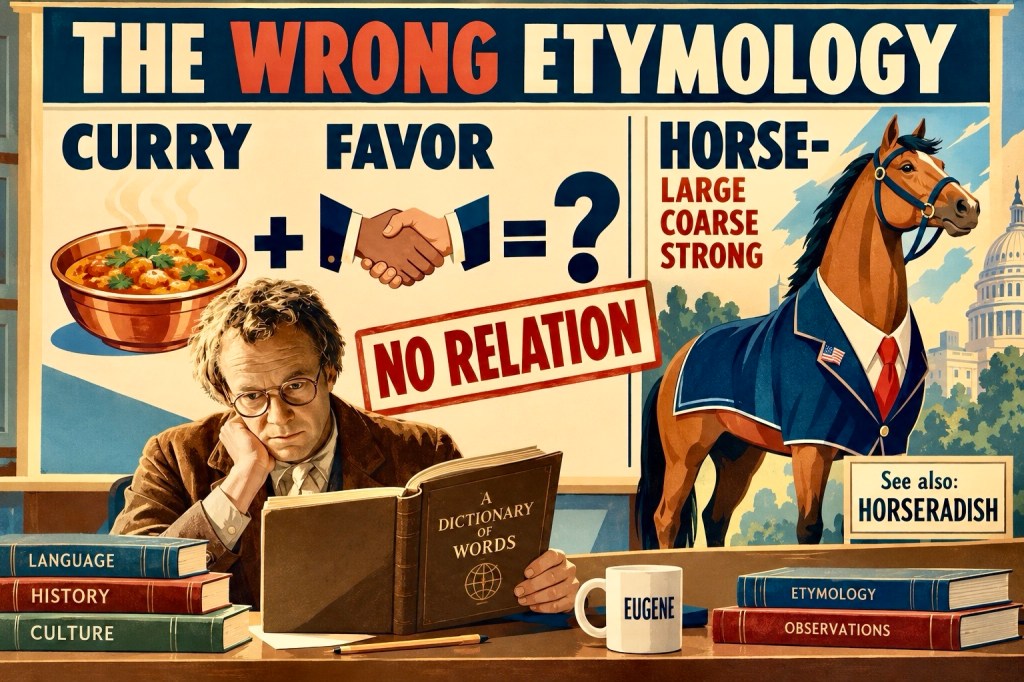
The ancestor of our expression was “to curry Favel.”
Favel—or Fauvel—was associated with the deceitful horse of medieval tradition and, most famously, the early-fourteenth-century French satirical Roman de Fauvel. Fauvel represents a whole stable of human failings:
falseness, hypocrisy, vanity, greed and the willingness of people to accommodate themselves to power.
And what do the ambitious people surrounding Fauvel do?
They groom the horse.
They curry Fauvel.

There is something wonderfully durable about the image. The fellow with the currycomb isn’t merely cleaning a horse. He is attending upon power in hopes that some of the power might rub off in the opposite direction.
Eventually English speakers lost track of Favel. The strange proper name ceased to make much sense, while the familiar word favor made perfect sense.
The phrase adapted.
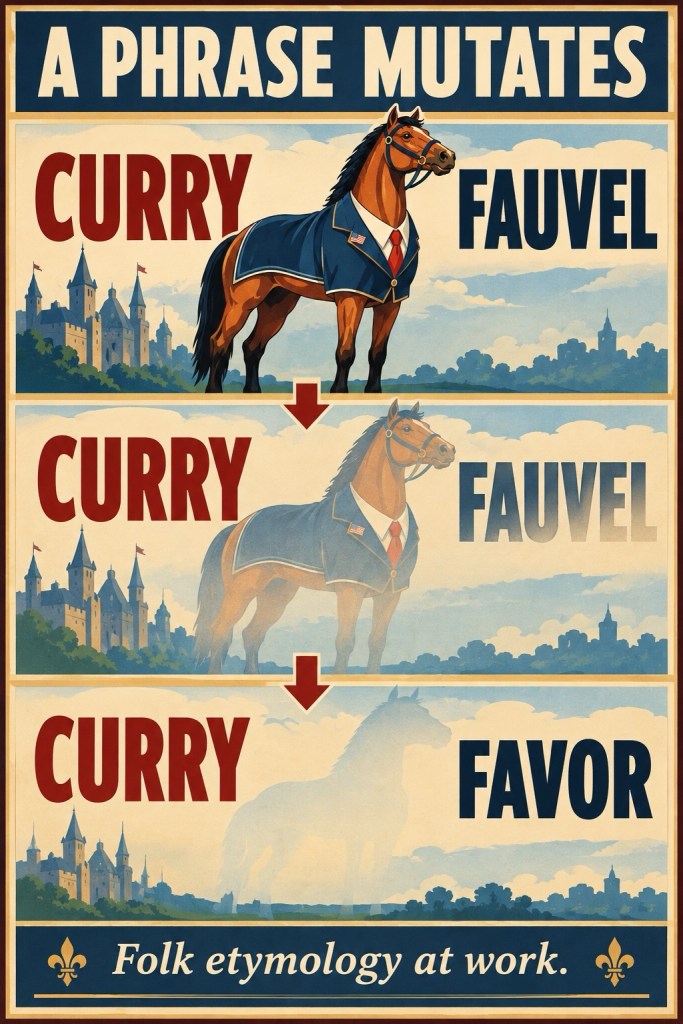
And so we arrive at the modern expression.
To curry favor means to ingratiate oneself with somebody—particularly somebody possessing authority, influence or something else one would rather like to have.
The medieval horse has disappeared. The currycomb has disappeared. Favel himself has disappeared. Only the behavior survived.
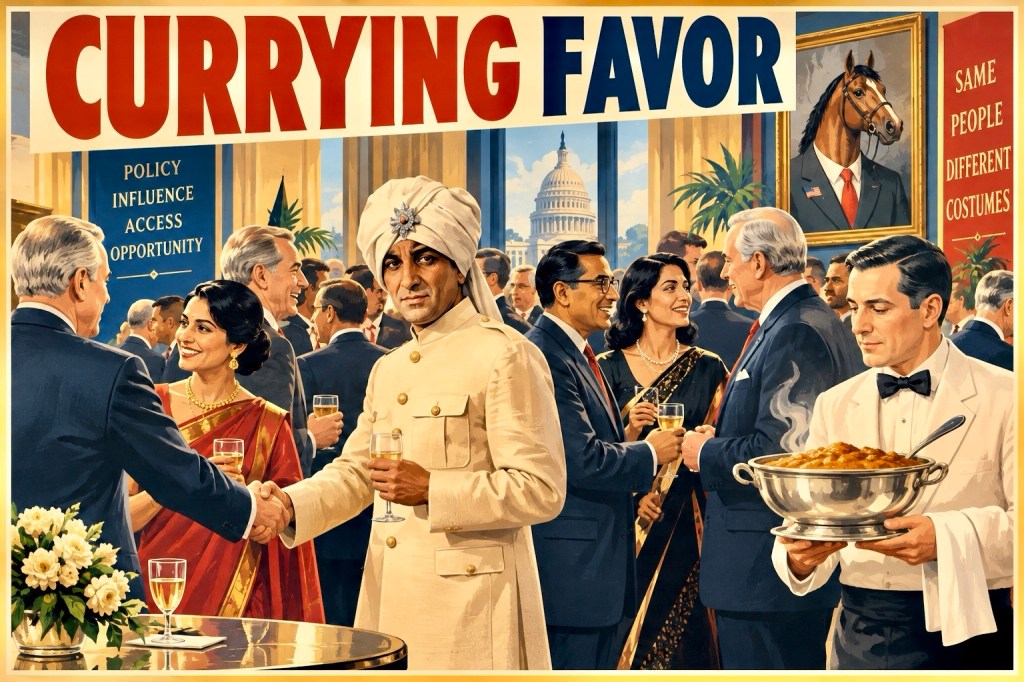
Got a Nehru jacket on.
You know that is a sin ,
Gunga Din🎶
—The Byrds, “Gunga Din,” 1969
(Dress accordingly.)
Which leaves the Council ethnographer with an uncomfortable conclusion. Perhaps currying favor isn’t really about immigrants at all. Perhaps immigrants merely make the mechanism easier to see because assimilation necessarily involves learning the signals of another culture. The native-born perform much the same ritual every day—before employers, patrons, institutions, political parties, social circles and increasingly the great invisible audience of the Internet.
Some do it because they believe. Some because they belong. Some because they wish to belong. And some because they have noticed who is grooming the horse.
Seven centuries later, the costumes have changed considerably. The cuisine changes. The courtier does not.
— Eugene Bodeswell
Council Ethnographer
AFTERWORD
John St. Evola
It occurs to me that Eugene’s observations might be applied rather unfairly to another immigrant population.
Italian-Americans have traditionally displayed an unusually vigorous American patriotism. Flags on the porch. Flags on the bumper. Flags at the feast. Occasionally enough red, white and blue to suggest that somebody was trying a little too hard.
One might even be tempted to call it strategic assimilation.
I object. The circumstances are entirely different. After all, when the Italians arrived, the Americans were already calling their legislature a Senate, comparing George Washington to Cincinnatus, putting Roman columns on government buildings and covering their new capital with architectural references to antiquity. Thomas Jefferson, meanwhile, was studying Andrea Palladio so enthusiastically that he eventually called Palladio’s work his architectural “bible.” Under these circumstances it becomes rather difficult to determine who was assimilating whom.
An Italian immigrant standing patriotically before the United States Capitol might therefore be forgiven for experiencing a certain ancestral familiarity.
He hadn’t curried favor.
He had found the Americans currying Rome.
— John St. Evola

Yes, yes, we know the origin story. The earliest Latins and other Italic peoples are generally understood to have had Indo-European origins farther north, with older theories occasionally putting them in close company with the Celts.
But the Mediterranean peoples already inhabiting the peninsula were being absorbed into Rome almost from the beginning. They intermarried, assimilated and became Roman. Rome was very early something larger than the ancestry of its founding population.
One did not have to arrive with Romulus to become Roman.
 COUNCIL-OF CONCERNED-CONSERVATIONISTS…..Between Jest And Earnest…..
Leave a comment