By The Accidental Initiate
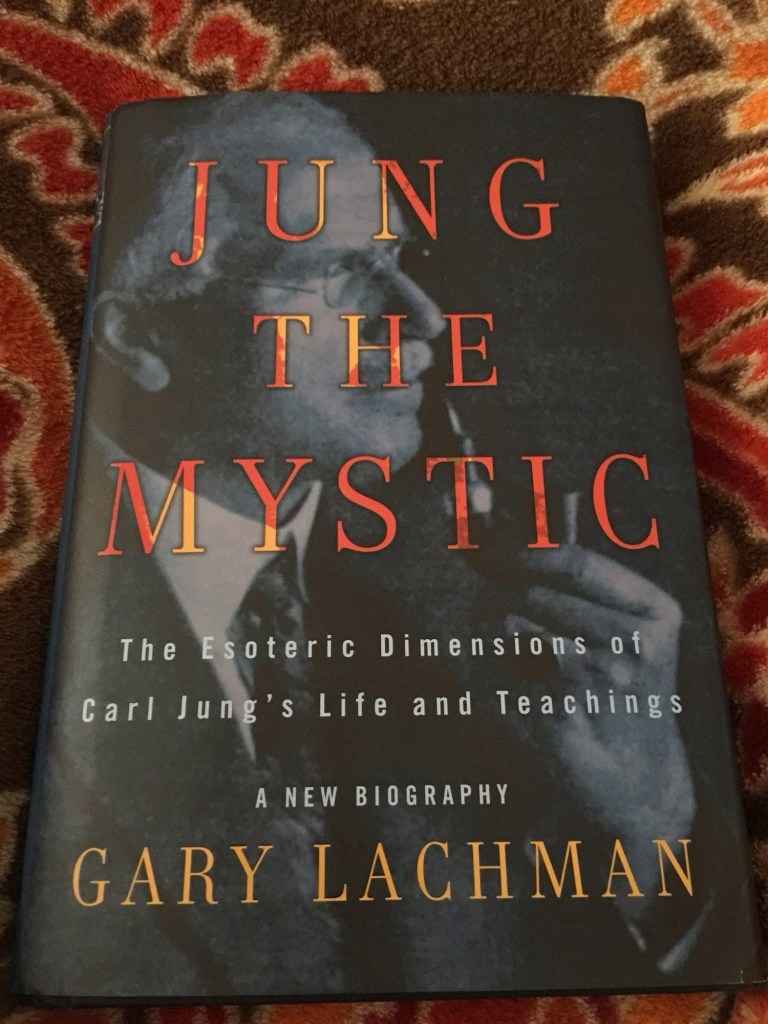
That’s not marketing—that’s synchronicity. Go make your own. Buy it here.
“Synchronicity, as defined by Carl Jung, is an interesting coincidence only if it points to something meaningful.
Turning a page towards the end of this book I read that on this present 6th day of June (2015) that Jung died on June 6th.
Earlier in the day I learned that Europe was made safe for its present day invasion from the South by an invasion from the North which began on the sixth hour—of the sixth day—of the sixth month of 1944.
And my blanket matched the pattern of the lettering on the book” (original noticing date: June 6, 2015)
At this juncture, I’ve stopped trying to figure out whether I’m reading reality or just being read by it. Jung called it synchronicity, but I suspect it’s the universe playing a kind of metaphysical Battleship with my subconscious—and scoring direct hits on my blanket.
Some say synchronicity is just a meaningful coincidence. I say: It’s coincidence that got a good conduct medal.
And when it happens to me, it’s usually accompanied by a faint harmonica in the distance, as if I’ve stumbled into the closing credits of my own life’s mid-budget WWII metaphysical dramedy. Picture black-and-white newsreel footage slowly giving way to Technicolor irony—and there it is: the Landing Craft of Meaning.
I didn’t plan to match my book to my throw blanket on the anniversary of both D-Day and Jung’s death. And yet here I am—floating ashore on a symbolic vessel loaded with unresolved dreams, an unread appendix on archetypes, and a crate of government-surplus irony.
No one plans a revelation. They just… disembark.
THE UNDERAPPRECIATED INVASION: OPERATION DRAGOON
While the world commemorates the Normandy landings of June 6, 1944, it’s worth pausing to recall that a second major Allied invasion occurred two months later: Operation Dragoon, launched on August 15, 1944. Allied troops landed in southern France—on the Riviera, no less—and rapidly took over key ports, cutting off German forces in Italy and enabling the swift Allied advance into Germany.
My father, for instance, was intentionally initiated by uncle Sam, and entered the European Theater not via the famous beaches of Normandy, but through the Riviera, arriving in December 1944 as a conscripted replacement. He was not photographed, commemorated, or mythologized—he just showed up. As most meaning does.
FROM WAR TO FURNITURE DELIVERY
In one of history’s more surreal punchlines, a World War II landing craft—originally used to storm the beaches of southern France—was later repurposed to haul furniture across the Great Lakes.¹ A PBS episode of History Detectives traces this very transformation, documenting the life of a vessel designed for combat as it evolves into a floating showroom of American domesticity. This LCT landing craft was even used by the regiment from within the division my father was assigned to.
It’s either absurdity or prophecy: a nation that once launched boats to liberate Amerikanize Europe and extend the Our Democracy franchise, later sent them to deliver recliners, all while Europe itself becomes the passive recipient of a new kind of invasion—a migrant invasion alà Camp Of The Saints.[2] This one unassimilable, and self-perpetuating. The original cargo was soldiers; the second, sectional sofas. Somewhere in between: the soul of a civilization trying to redecorate itself into meaning.
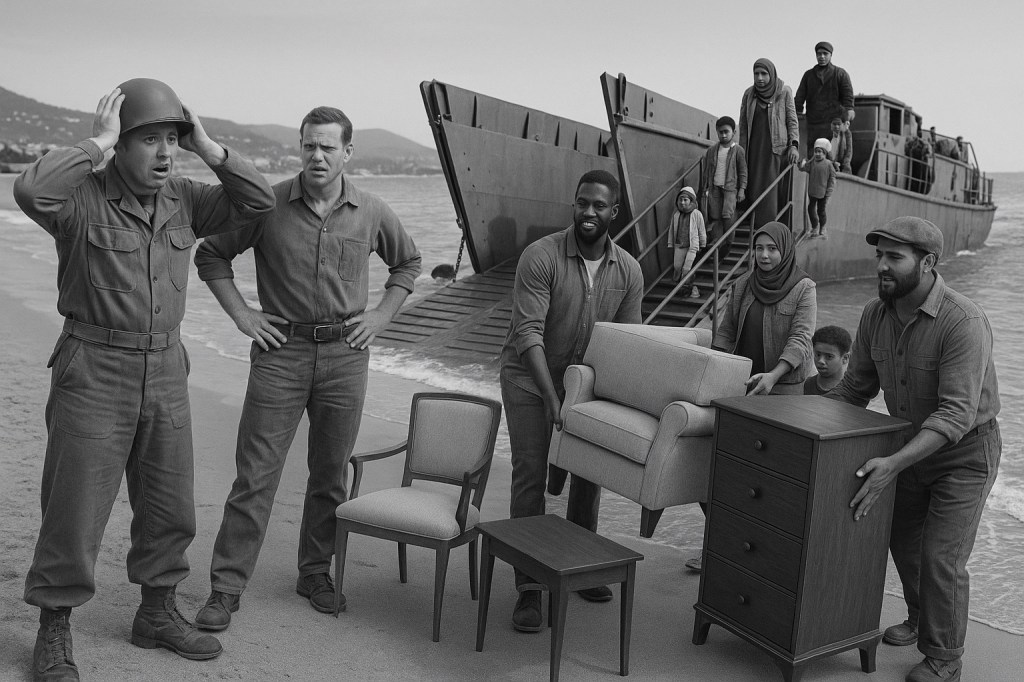
—Pfc. Earl “Socks” DiMarco, 3rd Chairborne Division
So if you’re reading this and thinking, “Wait, I just read about synchronicity somewhere else today,” well—
Welcome to the Circle.
Your landing craft’s outside.
— The Accidental Initiate
FOOTNOTES:
[1] History Detectives, Season 2, Episode 3 investigates a World War II Landing Craft Tank (LCT) believed to have participated in Operation Dragoon before being repurposed to deliver furniture across the Great Lakes. See PBS transcript here: https://www.pbs.org/www-tc.pbs.org/opb/historydetectives/static/media/transcripts/2011-04-20/203_LCT.pdf
[2] The phrase “camp of the saints” originates from Revelation 20:9, which describes the climactic moment when the enemies of God surround “the camp of the saints and the beloved city,” only to be consumed by fire from heaven. This passage symbolizes the faithful overcoming their adversaries through divine intervention.
This imagery inspired Jean Raspail’s 1973 novel The Camp of the Saints, a controversial and prophetic work imagining the collapse of Western civilization under the pressure of mass Third World migration. The novel has been both lauded for its foresight by those with eyes to see and condemned for its racial and political provocations by those in denial. Despite the controversy, it has remained a touchstone in debates over immigration and cultural survival.


Leave a Reply